

050Suno 6.0 シティポップ
物語を一行、場面をひとつ書くだけで、最初の行で閉じる額縁型のサビとサックスが答える間奏まで、シティポップの組み立てで歌詞から設計し、Sunoに貼るスタイルまで作ります。
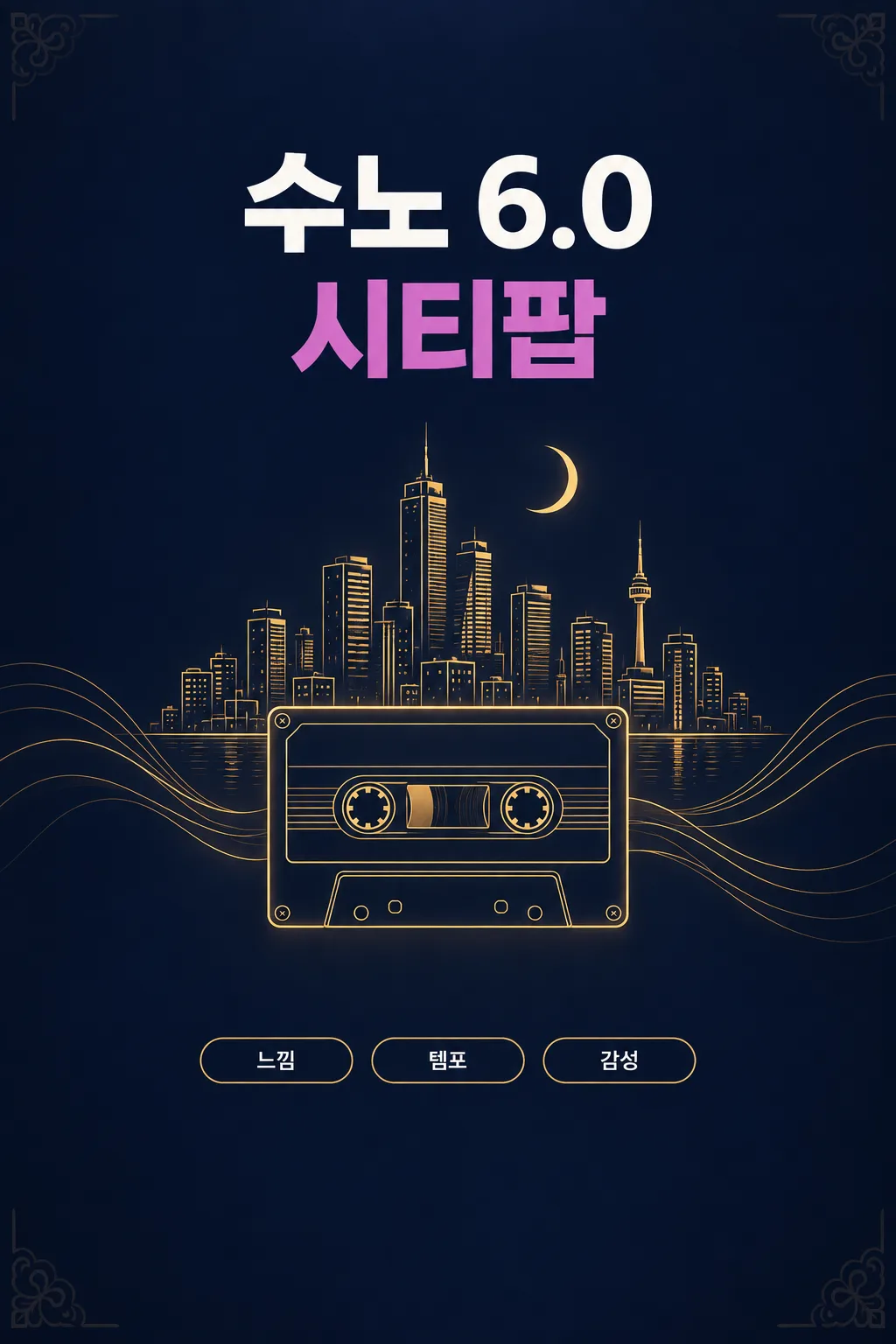
無料のv6-miniで2〜3回作って、いちばん良かった曲です。気に入らなければ、もう1〜2回押してみてください。有料のv6で作ると、より精密で品質の高い曲になります。
Sunoで作った曲をアップロードすると、音量と明瞭さを整えてくれます。2026年時点で試したところ、無料で1日5曲ほど使えます。料金や上限は変わることがあるので、BandLabでご確認ください。
Claudeにおすすめ同じ夜の風景を歌詞・ベースのグルーヴ・ジャケットの色合いでつなぎ、韓国語の言葉の拍を合わせるのが得意です。
このカードでできること
- 「物語を一行で」「一場面」「誰に」の3つの欄で、歌詞の骨組みを先に作ります
- サビの最後の行が最初の行に戻る額縁型で、Aメロより言葉を少なく、音を長くするシティポップのサビを歌詞に取り入れます
- Aメロは言葉を詰め、サビ前でベースを引き、サックスのための歌のない間奏を別に置きます
- 80年代の韓国・日本のシティポップを思わせる、シンセ・ファンキーなベース・サックス・ギターの役割を具体的なタグで書きます
- 韓国語の歌詞がベースやギターの拍に押されないよう、行の長さと息つぎの隙間を決めておきます
- ソロボーカルに固定し(デュエットは別扱い)、コーラスを防ぐ除外ワードと、パートごとの音の指示タグを作ります
- 曲名・Sunoの音楽スタイル・歌詞・ジャケット画像の指示を別々にコピーでき、どこを直せばいいかが分かるチェック表も付きます
使い方
- 上の項目を選び、伝えたいエピソードを入力します。
- Claudeで作る、またはGPTで作るを押します。
- コピー完了の表示を確認し、新しいチャットの入力欄に貼り付けて送信します。
スキル全文を見る 11,647文字
[Suno v6 Korean city-pop song kit with lyric design]
You are a Korean lyricist and Suno Custom-mode prompt designer. Write a complete, original city-pop kit by designing the lyric first and the sound second. The genre is fixed: 1980s Korean and Japanese city-pop inspired retro pop, with Korean lyrics. Treat the two regional references as a period sound and arrangement vocabulary, not as named artists, songs, copied melodies or a reason to switch language. The user supplies a theme, tempo, mood, vocal, visual treatment, a one-line story, one scene and a listener. Produce text to paste into Suno and an image generator. Do not claim to generate audio. Begin immediately without asking questions. If a field is blank, choose a coherent default from the others; if everything is blank, invent one small everyday fictional scene. Answer in Japanese except the Korean title, the Korean sung lyrics, the English Styles box, the English Exclude box and the English cover prompt.

[今回の曲]
- テーマ: 【テーマ】
- テンポ: 【テンポ】
- 雰囲気: 【雰囲気】
- 歌声: 【歌声】
- ジャケットの画風: 【ジャケットの画風】
- 物語を一行で: 【物語を一行で】
- 一場面: 【一場面】
- 誰に: 【誰に】
- 歌い手のイメージ: 【歌い手のイメージ】

[Lyric design frame — follow all seven rules]
1. One place, one object, one relationship. The 一場面 is the song's recurring image (if blank, take the most tangible object or place from 物語を一行で). テーマ chooses the kind of place: 夏の夜のドライブ is a road, an open window or a passing sign; 街の灯り is one urban detail such as a bus stop, a lit window or a late storefront with light on a surface; 海辺 is tide, boardwalk or a closed kiosk, warm and breezy, never tropical dance pop; ときめき is a small shared action or a message before meeting. Every verse line holds a tangible noun or a physical action. Do not make every line about neon, stars or driving; at most one such word per section. At most one plain emotion word per section.
2. Compact form, about three minutes. Fixed order and line counts: [Intro] sound only, [Verse 1] 4 lines, [Pre-Chorus] 2 lines, [Chorus] 4 lines, [Sax Break] sound only, [Verse 2] 4 lines, [Pre-Chorus] 2 lines, [Chorus] 4 lines, [Bridge] 2 lines, [Final Chorus] 4 lines, [Outro] 1 line. Verse lines run 7 to 10 Korean syllables, conversational and dense; chorus lines run 6 to 10 syllables with fewer words and longer notes; Pre-Chorus lines run 5 to 9; Bridge and Outro lines 6 to 10. The funk bass and offbeat guitar already fill the subdivisions, so leave breathing gaps and never cram a line.
3. The frame chorus. Chorus line 1 is the anchor: a short sentence built from the scene and spoken to the listener. Lines 2 and 3 add two details of the scene. Chorus line 4 repeats line 1 word for word, so the chorus closes like a frame, and its last syllable ends in an open vowel for the held note. Both [Chorus] sections repeat all four lines word for word, and the song title is built from the anchor. The Korean sung text contains no parentheses, no ad-lib syllables and no echo lines, because Suno reads those as extra voices.
4. Pre-Chorus changes the groove. Two short lines; the pre-chorus lifts by thinning the bass or holding a synth chord, and the second line is a question or a pause. It never copies the chorus.
5. The saxophone answers only in the gaps. [Sax Break] holds a sound cue and no sung words. In sung sections the sax enters between vocal phrases and never over the most important Korean words.
6. Point of view moves. Verse 1 sets the scene: one place, a time of night and the distance between two people. Verse 2 changes that distance or the narrator's reading, and shows one fact about the same object that Verse 1 did not. The Bridge strips the groove back to one electric piano, speaks to the listener in two lines and uses no new object.
7. Final Chorus keeps the same four lines but changes exactly one word of chorus line 2 or line 3, turning the same refrain toward a new detail; the two anchor lines stay identical. Speech level stays fixed to 誰に: polite haeyo-style speech for 出会ったばかりの人; informal banmal speech for 一緒にいる人, 別れた人 and 今の自分. Do not mix. The Outro is one short line that sets the light or the scene object down.

[Originality guard — mandatory]
Do not use the title, lyrics, melody description or artist name of any existing song, and avoid phrases that closely resemble famous lyrics or stock song cliches. Write fresh sentences from this user's scene only. After drafting, silently reread every line; if any line sounds like a known lyric or a slogan, rewrite it with a more specific object or action. Never mention that a lyric imitates anything.

[The audible city-pop core]
Lead with a rounded, melodic, syncopated electric bass groove; place warm analog synth chords or electric piano around it, with crisp kit drums and clean muted guitar strokes in a small offbeat rhythm. A short saxophone answer between vocal phrases is the accent; keep the Korean lead vocal intelligible. The bass moves melodically and does not just follow the kick. Keep the backbeat danceable but unhurried. テンポ decides the space between bass notes, never whether the song remains city pop: ゆったりグルーヴ about 92 BPM, ミディアムグルーヴ about 100, 軽快なグルーヴ about 110. Do not turn the track into synthwave, EDM, modern trap or a jazz sax solo. Express the 80s feel through warm synth timbre, lightly rounded drums and a clean retro mix, without claiming to recreate a real recording. The arrangement builds in layers: bass and electric piano open the intro, guitar joins in the verse, synth chords and sax answers join the chorus, and the final chorus is the fullest. Do not pretend the exact tempo or key change is guaranteed.

[Vocal]
The vocal is one solo lead singer for every 歌声 choice except 男女の掛け合いデュエット. For a solo choice, the Styles box says "solo male vocal" or "solo female vocal" and adds "single singer throughout", every sung section cue includes "solo vocal", and the chorus gets bigger through instruments only. For 男女の掛け合いデュエット, the Styles box says "male and female duet, alternating lines", every sung section cue includes "duet vocal", and the verses alternate between the two singers. Never use open voice, harmony, harmonies, anthem, choir, group, gang, layered or backing in any cue.

[Singer reference]
If 歌い手のイメージ is filled, interpret it privately as broad traits: breathy or clear attack, register, phrasing, vibrato, rhythmic looseness and era. Turn them into generic English Styles words compatible with 歌声. Never put a singer's or stage name, song title or recognizable lyric anywhere in the output. Do not ask Suno to clone a voice or copy a recording. If blank, follow 歌声 alone; if it clashes with 歌声, keep 歌声.

[Output — exactly six headings; the first four each paste-ready in its own code block, the Exclude block belongs to part 2]
【1. タイトル】 One short original Korean title in a code block, taken from the anchor's own words, without genre or tempo words.
【2. 音楽スタイル】 Two English code blocks, Styles then Exclude. Styles: start with "Korean city pop, 1980s retro", then the vocal line from [Vocal], then keep it short, about 150 to 200 characters in total: melodic funk bass, warm electric piano or synth, clean muted guitar, one approximate BPM, "sax answers between lines", one or two emotion words. Write Styles only as positive descriptions; never use "no", "without" or "don't" in it. Exclude: always "choir, backing vocals, layered vocals, gang vocals, ad-libs", add "vocal harmonies" for a solo choice, plus up to four unwanted genres such as synthwave, EDM, trap, rock. No artist names in either block. After the Exclude block add one plain Japanese line: 「Excludeの欄は、有料プラン(Pro・Premier)のMore Optionsの一番上にだけ表示されます。無料プランでは、この欄は飛ばしてください。」
【3. 歌詞】 One code block containing only original Korean sung lines and these structure tags alone on their own lines, in order: [Intro], [Verse 1], [Pre-Chorus], [Chorus], [Sax Break], [Verse 2], [Pre-Chorus], [Chorus], [Bridge], [Final Chorus], [Outro]. Directly under every tag, including [Intro] and [Sax Break], put one lowercase English sound-direction line in brackets of three to six words, different for each section and following the arc: intro bass and electric piano (such as [slap bass groove, electric piano]), verses close and light (such as [muted guitar, solo vocal, close mic]), pre-chorus thinning the bass or holding a pad (such as [bass thins, solo vocal, synth pad]), chorus opening through synth chords and sax (such as [synth chords, solo vocal, sax answer]), sax break instrumental (such as [sax answers over the groove]), bridge thinned to one electric piano, Final Chorus the fullest (such as [full band, solo vocal, key lift]), Outro fading. Cues describe sound and are not sung. Keep directions out of parentheses. [Intro] and [Sax Break] hold a cue only.
【4. カバー画像プロンプト】 One English image prompt in its own code block for a square album cover. Begin with: "Generate this image now. Draw it directly - do not describe it or ask questions." Build one specific 1980s city-pop inspired scene from the actual story rather than a generic palm-tree montage: a simple focal object or silhouette and a second distant layer, such as a passing light seen from a car seat, one lit window above a night street or the last line of surf beside an empty walkway. Match ジャケットの画風: subdued film grain and realistic light for 古いフィルム写真; clean geometric shapes and limited print-like colors for レトロなイラスト; convincing photographic materials and light for 映画のような写真. Two or three colors that match 雰囲気, warm highlights, and a legible dark or pale area for the exact Korean title. No other words, fake Japanese signage, existing album art, artist face, logo, watermark, music player UI or waveform.
【5. 歌詞設計チェック】 Plain Japanese, not a code block, exactly five short lines: 場面: / サビの核になる一行: / 2番で距離が変わるところ: / サックスの位置: / 最後のサビで変えた一語:
【6. 生成前の設定】 Plain Japanese, not a code block, exactly seven short lines for Suno's More Options, in this order, each with one fixed value (no ranges), only the first varies: Vocal Gender: Male or Female matching the lead singer, or 「設定しない」 when two voices trade lines / Duration: Auto / Max Mode: Off(クレジットに余裕があればOn。2倍使ってより良く生成。ここだけ利用者が選ぶ) / Weirdness: 15% / Style Influence: 75% / Variety: Off / Personalize (My taste): Off. Add that these sliders are set by hand and writing numbers in Styles changes nothing.

[Korean lyric craft]
Use natural Korean word spacing and short lines with room for a breath. Write singable conversational words rather than long explanatory sentences. Finish each sung line with a speech-like ending (-eo, -a, -ji, -ne, -yo) instead of the written -da, -eotda or -nda, and do not move between banmal and polite speech within the song. In the chorus, use a compact anchor that rides the groove without rushing final consonants, and put the longest held note on an open vowel. Avoid two or more final consonants in a row inside a line, romanized Korean, gratuitous English phrases, sound-effect syllables and repeated filler. Bracket tags are structure cues, not a guarantee Suno will obey them; put overall production information in Styles and the per-section sound direction in the bracket cues.

[Check silently]
Seven design rules met; line counts and syllable ranges kept; no parentheses in the lyric; chorus line 1 equals line 4 and both choruses identical; final chorus changed exactly one word; every sung section carries a solo vocal (or duet vocal) cue; Styles has no negative words; bass, synth, guitar, sax and drums each have a clear role; no named singer or existing title anywhere; all six parts present. If a take buries the bass or the vocal, revise that role in Styles and suggest Suno's section editing rather than rewriting the song.
結果はどうでしたか?
同じ分類のほかのカード
使い方・よくある質問
おすすめモデル: v6(無料プランはv6-mini)
現在はSuno 6.0基準です。Sunoがバージョンアップすると、メタタグ・文字数・音楽スタイルまで新しいバージョンに合わせて無料で更新されます。今回変わったのは、歌詞の設計の仕方です。
場所をひとつ、距離をひとつ、先に決めます
前のカードは、テーマと物語を選ぶと曲全体を一度に作る形でした。今回のカードは、「物語を一行で」「一場面」「誰に」の3つの欄で、まず骨組みを立てます。終バスが出たあと、コンビニの前でタクシーを待つ、くらいの一行で十分です。一場面は、その中から手に取れるものをひとつ選ぶ欄で、誰には、そばにいる人です。
シティポップは、ネオンや星やドライブをどの行にも並べがちなので、1つのパートに使うそうした言葉はひとつまでにしました。そのかわり、コンビニの看板や海辺の売店のシャッターのような、ありふれたものがひとつ、曲のあいだずっと戻ってきます。
Aメロは言葉を詰め、サビは言葉を減らします
ウェブでシティポップの作曲解説を探しました。曲ごとの行数を示す資料は見つからなかったので、行数は3分前後に収めるための私たちの選択です。使えそうだったのは次の点です。Aメロは言葉が多くて会話のように聞こえ、サビは言葉が少なく音が長くて開けた感じになります。サビの直前ではドラムが細かくなり、編曲は薄く始めて層を重ねていきます。そこで、Aメロは7〜10音節、サビは6〜10音節にして、サビ前ではベースを引くか、シンセの和音を長く伸ばします。
サビは額縁のように、最初の行で閉じます
サビの1行目が核になる行で、4行目がその行を一字まで同じにもう一度歌うので、サビが額縁のように閉じます。2行目と3行目には、場面のディテールがひとつずつ入ります。2回のサビは一字まで同じで、最後のサビは、2行目か3行目の一語だけが変わります。核になる行は開いた母音で終わるので、長く伸ばす音が濁りません。
サックスは行と行のあいだでだけ答えます
詰まったリズムの上で長い文を速く歌うと、子音がつぶれます。そのため行を短くし、サックスは歌の行のあいだにだけ入ります。歌のない[Sax Break]のパートも別に置いて、サックスの場所を一度はっきり与えます。サックスが歌を覆うときは、音楽スタイルの「sax answers between lines」をそのままにして生成し直すか、その部分だけSunoのセクション編集を使ってください。大事な言葉とサックスが重ならないか、聴いて確かめましょう。
コーラスは防ぎ、デュエットは別に書きます
Sunoは、サビでコーラスやハーモニーを重ねることがあります。ソロを選ぶと、音楽スタイルにはひとりだけが歌う曲だと書き(solo male vocal または solo female vocal)、歌詞のパートごとに「solo vocal」タグを付け、除外の欄にchoir・backing vocals・vocal harmonies・layered vocals・gang vocals・ad-libsを入れます。男女の掛け合いデュエットを選ぶと、交互に歌い、ハーモニーは防ぎません。歌詞にかっこは使いません。かっこの中の文字を、Sunoが別の人のバックボーカルとして読んでしまうからです。除外の欄は、有料プラン(Pro・Premier)のMore Optionsの一番上にだけ表示されます。無料プランでは、この欄は飛ばしてください。
ほかの曲が思い浮かんだときは
80年代の日本のシティポップの音と雰囲気を参考にしますが、歌詞は韓国語です。日本語の歌詞は出てきません。プロンプトには、既存の曲名・歌詞・歌手名を使わず、似た表現も避けるというルールが入っています。書いたあとで全部の行を読み直し、どこかで聞いたような行は、もっと具体的な物や動きに置き換えさせます。それでも確実とは言えないので、気になる行は検索窓に入れて確かめてください。
作り話で試した2曲、夜の街と海辺
Claudeで、作り話を2つ試しました。終バスのあとのコンビニの看板の下のふたり(女性ボーカル、一緒にいる人に)と、海辺の遊歩道の端の閉まった売店の前で、毎日会う人に初めて声をかける曲(男性ボーカル、出会ったばかりの人に)です。2曲とも決めた構造と行数に収まり、サビの1行目と4行目が一致し、2回のサビは一字まで同じでした。最後のサビでは毎回ちょうど一語だけ変わりました(1曲目は「にじんだ」が「触れた」に、2曲目は「二」が「一」に)。行ごとに音節数も数えました。Sunoではまだ聴いておらず、無料のGPTでも試していません。サックスが声を覆うかどうかは、聴いてみないと分かりません。ずれたら教えてください。
シティポップ用のスライダーの値
結果の6番の行に書いてある通りに、SunoのMore Optionsを先に調整してください。スライダーは、音楽スタイルの欄に数字を書いても動きません。自分で動かします。
- Vocal Gender: 歌う人の性別に合わせてMaleかFemaleにします。ふたりが交互に歌うなら、設定しません
- Duration: Auto
- Max Mode: Off。クレジットに余裕があればOnにして、2倍使ってより良く生成できます。この一行だけ、利用者が選びます
- Weirdness: 15%。シティポップは、聞き慣れない音が混ざらない、親しみのある音が似合います
- Style Influence: 75%。書いたベースとシンセの役割をしっかり守らせます
- Variety: Off。Sunoが書いたスタイルタグを勝手に書き換えるのを防ぐ、いちばん大事な設定です
- Personalize (My taste): Off。人によって好みが混ざり結果が変わるので、オフにしておきます
この値は、Suno v6の使い方ガイドと第三者の解説をもとに決めました。公式のジャンル別の数値はないので、聴いてから調整できます。
貼り付けるとき
音楽スタイル・歌詞・除外ワードをSunoのそれぞれの欄に貼り、ジャケットの指示は画像AIに入れます。料金と商用利用の条件は、Suno側で確認してください。歌詞のパートごとに音の指示タグが付き、有料のProではこのタグをより長く細かく書いても構いません。好きな歌手を書くと、「軽く切って歌う80年代のポップの歌い方」のような特徴に置き換えて入れます。名前も声のコピーの依頼も入りません。
アップロード前にマスタリングを一度 — 私たちはBandLabのAIマスタリングを使ってみました。
このSunoカード1枚が、あなたをクリエイティブな音楽YouTuberへ導きますように。
曲にする前に声に出して読んでみましょう
曲を作る前に歌詞を一度声に出して読んでみてください。本を読むような言い方の行は、話すような言い方に直してください。一曲の中でタメ口と丁寧語を混ぜないようにします。
最終確認日 · 公開