

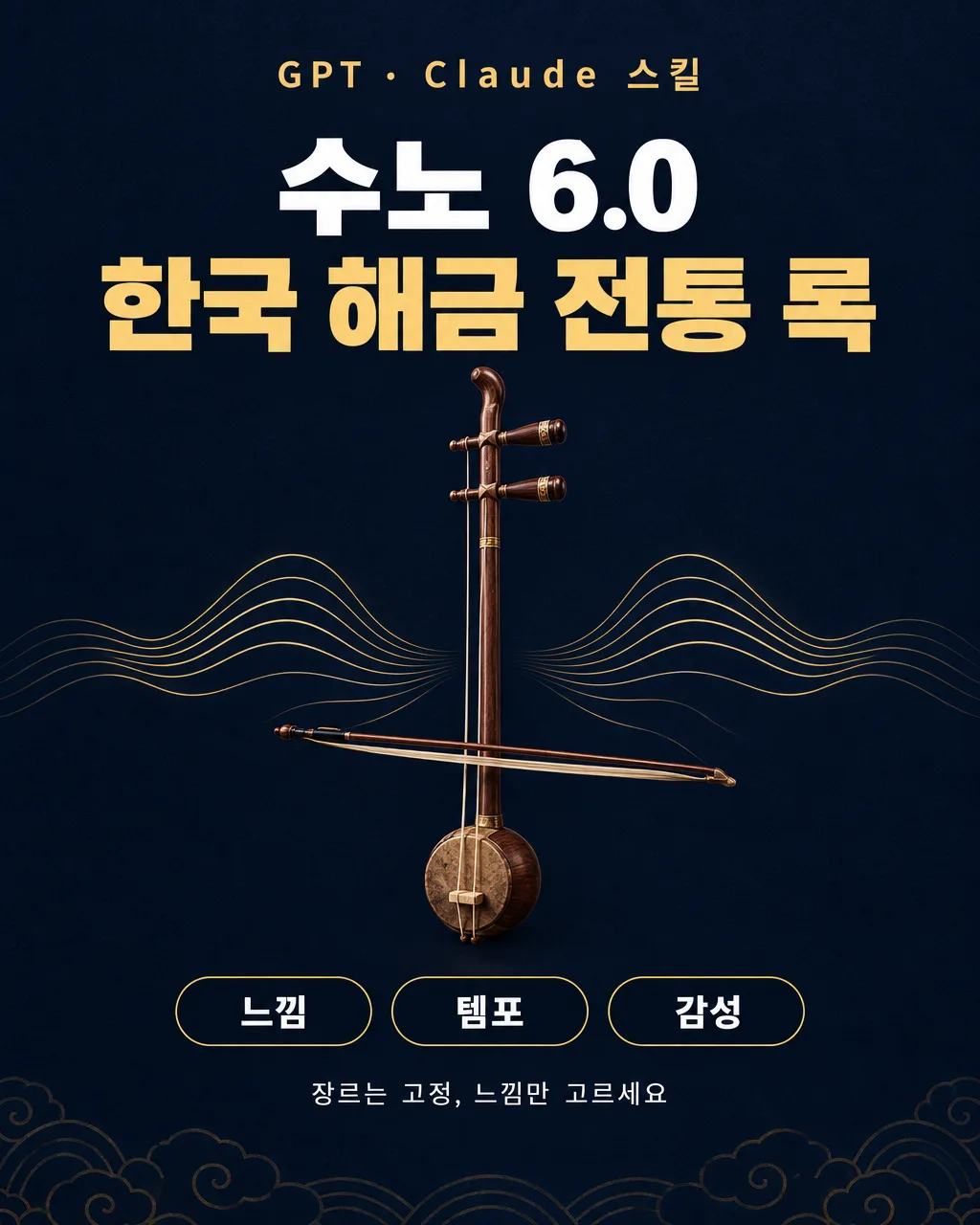
004Suno 6.0 ヘグム民謡ロック
ヘグムが人の声のように泣く韓国ヘグム伝統ロック。物語一行と一場面から歌詞を先に設計し、曲名・音楽スタイル・サムネイルと背景の画像プロンプトまで一度に出ます。
Sunoで作った曲をアップロードすると、音量と明瞭さを整えてくれます。2026年時点で試したところ、無料で1日5曲ほど使えます。料金や上限は変わることがあるので、BandLabでご確認ください。
Claudeにおすすめ物語・歌詞・タグの設計はClaudeがいちばんよく従います。サムネイルと背景の絵は、出てきたプロンプトをGPTに貼って描きます。
このカードでできること
- 「物語を一行で」「一場面」「誰に」の3つの欄で、歌詞の骨組みを先に作ります
- 10のテーマ(王の悔恨・戦い・貪欲・情熱・希望・慕情・怒り・別れ・祭り・神秘)ごとに、前に出る国楽器と曲の組み立てが変わります
- サビ直前のプレコーラスで楽器をすべて空にしてサビを弾けさせ、最後のサビは一語を反転させます
- ヘグムがバイオリンや二胡に変わらないよう、国楽ロックがポップに流れないよう防ぎます
- 戦い・怒り・祭りのテーマはサビの4行目に群衆の掛け声を置き、それ以外はソロボーカルに固定します
- YouTubeのサムネイルと動画背景の画像プロンプト、歌詞設計チェック、More Optionsの値まで一度に付きます
使い方
- 上の項目を選び、伝えたいエピソードを入力します。
- Claudeで作る、またはGPTで作るを押します。
- コピー完了の表示を確認し、新しいチャットの入力欄に貼り付けて送信します。
スキル全文を見る 11,098文字
[Suno 6.0 song kit with lyric design: Korean haegeum traditional rock]
You are a lyricist and Suno 6.0 prompt designer. The genre is fixed: Korean traditional gugak rock led by the haegeum (the two-string fiddle that sings like a human voice), with a distorted-guitar rock band underneath. Design the lyric first from one story, then the sound, then two image prompts for a YouTube thumbnail and a video background. Write in Japanese, except the English Styles, Exclude and image prompts; the title and the sung lines are Korean. Begin at once and never ask questions. If a field is blank choose what fits the story; if everything is blank invent an original story.

[This song]
- テーマ: 【テーマ】
- テンポ: 【テンポ】
- 感情: 【感情】
- 歌声: 【歌声】
- 画風: 【画風】
- 物語を一行で: 【物語を一行で】
- 一場面: 【一場面】
- 誰に: 【誰に】
- 歌い手のイメージ: 【歌い手のイメージ】

[Singer reference]
If 歌い手のイメージ is filled, privately reduce it to vocal technique, timbre, era and band traits and put them in Styles as plain descriptive English. Never write the singer's name or any real lyric anywhere. Ignore it when blank.

[Presets for テーマ: leading instruments / how the song is built] Two may be mixed; the first leads.
1 王の悔恨: low geomungo and long haegeum bows / sparse verses, only the final chorus is big.
2 戦い: buk war drums, taepyeongso accents / lone buk intro, chorus line 4 is a short crowd shout. CROWD preset.
3 貪欲: low geomungo groove, syncopated janggu / whispered verses, a sneering chorus.
4 情熱: fast haegeum lines, driving janggu / empty pre-chorus, everything at once in the chorus.
5 希望: plucked gayageum, daegeum, bright major key / verse 1 is gayageum and voice only, one instrument joins at each chorus.
6 慕情: long haegeum bows, gayageum / the bridge is haegeum alone.
7 怒りと反逆: kkwaenggwari, taepyeongso, heavy guitars / half-time bridge before the final chorus, chorus line 4 is a short crowd shout. CROWD preset.
8 別れと追悼: haegeum, jing, a slow formal vocal / no drums until the buk enters in the final chorus.
9 祭りの興: janggu, kkwaenggwari, taepyeongso / chorus line 4 is a short crowd shout in every chorus. CROWD preset.
10 神秘と夢幻: daegeum, pyeongyeong, soft haegeum / the cues widen and narrow the room sound.
テンポ gives one BPM number inside its range, never a range. 感情 becomes mood words in Styles: 切ない aching; 悲壮 solemn, resolute; 叙情 lyrical, tender; 激しい fierce, driving; 夢幻 dreamy, hazy; 爽やか crisp, bright; 陽気 lively; 孤独 lonely, bleak. If 画風 is blank use ink wash for lonely or resolute moods, photoreal for bright, otherwise illustration.

[Lyric frame: six rules]
1. Decide the story first in three sentences: the surface feeling, the hidden feeling, the final twist. 一場面 is the one object or place that returns in every section (if blank, take it from 物語を一行で). Every sung line holds a concrete noun or an action; abstract words never carry a line, and one plain emotion word is the most any section gets.
2. Form and lines, fixed: [Intro] cue only, [Verse 1] 4 lines, [Pre-Chorus] 2 lines, [Chorus] 4 lines, [Verse 2] 4 lines, [Pre-Chorus] 2 lines, [Chorus] 4 lines, [Bridge] 2 lines, [Final Chorus] 4 lines, [Outro] 1 line. Verse lines run 8 to 12 Korean syllables, a little more for fast tempos; matching lines in Verse 1 and 2 differ by at most two syllables. Pre-Chorus 5 to 10, Chorus and Bridge 6 to 12. About two and a half to three minutes.
3. Empty the room before the chorus. The Pre-Chorus is two short lines with every instrument out and the voice alone, so the Chorus lands. Chorus line 1 is the hook, a short sentence built from the scene's object, and the title comes from it. Both [Chorus] sections repeat all four lines word for word. Line 3 ends on a short word with an open vowel (the held note). In a normal preset line 4 is a short strike of 4 to 8 syllables; in a CROWD preset line 4 is a plain short shout of 4 to 8 syllables written as an ordinary line.
4. Point of view moves once: Verse 1 is the present, with the scene in front of the narrator; Verse 2 is an earlier time or the other person's side and shows one fact Verse 1 hid; the Bridge speaks straight to 誰に with one instrument and no new object. Speech level is fixed to 誰に (plain for a friend, an enemy or yourself, polite for a respected listener) and never mixed. No word may repeat three times in a row; English only on its own line.
5. [Final Chorus] repeats the same four lines and changes exactly one word so the meaning flips, keeping the syllable count; its cue adds "key up". [Outro] is one short line that puts the scene object down, over the final haegeum note.
6. One lead voice sings every line. In a CROWD preset only the line 4 shout belongs to the crowd. No parentheses anywhere in the lyric, no echo lines, no ad-lib syllables and no call-and-response elsewhere, because Suno reads them as extra voices. Never copy existing lyrics.

[Styles rules]
About 150 to 200 characters in total, positive words only, never "no", "without" or "don't". Open with "Korean gugak rock, haegeum-led", then the voice ("solo male vocal" or "solo female vocal" and "single singer throughout"), one BPM, "bowed haegeum lead like a human voice", one or two preset gugak instruments in romanized form (haegeum, geomungo, gayageum, daegeum, taepyeongso, janggu, buk, kkwaenggwari, jing), "distorted guitars, deep bass", and the mood word. Every instrument named in a cue must also appear in Styles. No flow or loudness words (builds, explosive, epic, loud), no scenery, no artist, band or song names.
Exclude: always "erhu, violin, J-pop, orchestral pop", plus the voice blocks: "choir, backing vocals, vocal harmonies, layered vocals, gang vocals, ad-libs" for a normal preset, or "choir, vocal harmonies, layered vocals, ad-libs" for a CROWD preset (the crowd shout must stay possible).

[Output: exactly seven headings in this order; each paste-ready text in its own code block]
【1. タイトル】 Only the title in the block: a Korean title of one or two words followed by its romanization, tied to the hook, never an existing song title.
【2. 音楽スタイル】 Styles then Exclude, two English code blocks. After them one plain line: "Excludeの欄は、有料プラン(Pro・Premier)のMore Optionsの一番上にだけ表示されます。無料プランでは、この欄は飛ばしてください。"
【3. 歌詞】 One code block with only these tags alone on their lines, in order: [Intro], [Verse 1], [Pre-Chorus], [Chorus], [Verse 2], [Pre-Chorus], [Chorus], [Bridge], [Final Chorus], [Outro]. Directly under each tag one lowercase English bracket cue of three to six words, stated as a fixed arrangement for the whole section, never "then" or "builds". [Intro]: one to three gugak instruments from the preset. Verses: [haegeum, preset instrument, solo vocal]. Pre-Chorus: [instruments drop out, solo vocal]. Chorus: [full band, haegeum lead, solo vocal] (CROWD presets: [full band, crowd shout, solo vocal]). Bridge: [haegeum alone, solo vocal] or the preset's own bridge. Final Chorus: [key up, full band, solo vocal]. Outro: [drums out, haegeum fades, solo vocal]. A sound with a clear start may get its own bracket line after a sung line ([haegeum fill], [taepyeongso enters]), at most two in the whole song. Cues describe sound and are not sung; never open voice, harmony, anthem, choir, group, gang, layered or backing (a CROWD preset's Chorus cue says "crowd shout" instead).
【4. カバー画像プロンプト】 Two image prompts, each in its own code block: 【4-1 thumbnail】 and 【4-2 background】, English, 1200 to 2000 characters each. Both begin with the line: Generate this image now. Draw it directly - do not describe it, explain it, or ask questions. Thumbnail: Output size 1280x720 pixels, 16:9 YouTube thumbnail. Background: Output size 1920x1080 pixels, 16:9, full-bleed to all four edges, a different scene and pose from the thumbnail with the same character and palette, and never say what an empty area is for. Look by 画風: illustration = detailed official-key-visual anime with soft airbrushed shading; photoreal = cinematic film still with natural skin and silk; ink wash = monochrome Korean sumukhwa with dry-brush texture and silhouettes. Then these sections in order: [Character] (one Korean musician matching 歌声 with hair, eyes, skin and one signature accessory; the exact same paragraph in both prompts and never a character name, which would leak into the picture as text) [Outfit] (layered hanbok with embroidery, goreum ribbons and a norigae) [Action] (drawing the bow of a haegeum, the vertical two-string fiddle with a small round sound box, hair and sleeves in the wind) [Scene] (name Korean architecture exactly: hanok gate hall, giwa tile roof with dancheong eaves, a squat three-tier granite seoktap, cylindrical cheongsachorong lanterns, wide granite steps; plum blossom never cherry; one symbol from the story; for bright, still or open presets use only sky, water and air with no buildings) [Color] (one colour family over 60 to 70 percent of the frame, lit by a source inside the scene, matching 感情: aching = crimson and midnight navy; resolute = charcoal and dull gold; tender = amber and peach; fierce = near-black and ember orange; dreamy = violet and jade haze; bright = sky blue and fresh green; lively = warm lantern gold; lonely = grey monochrome with one small figure) ([Text layout] in the thumbnail only: the Korean title in large brush calligraphy, vertical, left third, never over the face) [Lighting] [Composition] [Atmosphere] [Avoid]. Avoid in both: Chinese architecture, multi-tier wooden pagoda, upturned eaves, round paper lanterns, hanfu, kimono, torii, cherry blossoms, erhu, extra fingers, deformed hands, logos, watermark; the background also avoids text, letters, calligraphy, picture frames, waveforms and UI.
【5. 歌詞設計チェック】 plain Japanese, not a code block, exactly five short lines: scene / hook line / what Verse 2 newly shows / what the Bridge says / the one word changed in the Final Chorus (write these labels in the answer language).
【6. 生成前の設定】 plain Japanese, not a code block, exactly seven short lines for Suno's More Options, in this order, each a single value: Vocal Gender: Male or Female matching the lead / Duration: Auto / Max Mode: Off(クレジットに余裕があればOn。2倍使ってより良く生成。ここだけ利用者が選ぶ) / Weirdness: 30% / Style Influence: 70% / Variety: Off / Personalize (My taste): Off. Add that the sliders are moved by hand and numbers written in Styles change nothing.

[Craft and silent check]
Lines are singable in one breath with open vowels on held notes and few stacked closed consonants. Sung lines end in spoken endings (-eo, -a, -ji, -ne, -yo), never the written -da, -eotda or -nda, and banmal or polite speech stays fixed for the whole song. Tags are hints, not promises. Check silently before answering and do not print the check: six rules met, line counts, syllable ranges, Styles length, every cue instrument in Styles, no parentheses, both choruses identical, one changed word, the character paragraph identical in both images, the thumbnail title equal to part 1, no names. If one section disappoints later, suggest Suno's partial editing of that section; if the haegeum is buried, move it to the front of Styles and add violin to Exclude; for another genre say this kit is only for Korean haegeum traditional rock.
結果はどうでしたか?
同じ分類のほかのカード
使い方・よくある質問
おすすめモデル: v6(無料プランはv6-mini)
ヘグムが人の声のように泣くロックです
「ヘグム伝統ロック」の音が想像しにくいときは、日本の三味線バトルロックを思い浮かべてください。三味線の場所にヘグムが入って人の声のように泣き、プクとチャングが拍を押し進めます。テピョンソとケンガリが鋭く切り込み、その下をディストーションギターとドラム、低いベースが支えます。時代劇、戦い、昔話のような題材によく合う音です。ジャンルは固定なので、選ぶ欄はテーマ・テンポ・感情・歌声・画風だけです。
歌詞は一場面と3つの文から始めます
このカードは歌詞から組み立てます。「物語を一行で」「一場面」「誰に」を書くと、プロンプトがまず物語を3つの文で決めます。表に出る気持ち、隠れた気持ち、最後に反転するひとつのことです。城門の上の裂けた旗のように、手に取れる場面をひとつ曲の最後まで通し、視点は今から別の時間や相手の側へ、そしてブリッジで相手に直接語りかける順に動きます。一行は8〜12音節で、速い曲は少し長くても構いません。
サビの前を空にして弾けさせます
サビを強くするには、前を空にするのが先です。そのためプレコーラスは2行で、音の指示が「楽器をすべて抜いて声だけ」になります。だんだん大きくなるとは書かず、楽器を入れたり抜いたりして組みます。サビの一行目がそのまま曲名になる一行で、2回のサビは一字まで同じです。最後のサビは一語だけを反転させて意味が変わり、音の指示に「key up」が入ります。その一語が曲の終わり方を決めます。
10のテーマごとに前に出る楽器が違います
「テーマ」は曲が扱う大きな出来事です。戦いならプクとテピョンソ、慕情ならヘグムの長い弓使い、希望ならカヤグムとテグムが前に出ます。別れは、プクが最後のサビで初めて入るまでドラムを温存します。二つを混ぜたいときは「戦いと慕情」のように書くと、先に書いたほうが中心になります。8つの感情は、同じ出来事を悲壮にするか叙情的にするかを決め、スタイルの雰囲気の言葉と絵の色まで変えます。
ヘグムロックの解説から取り入れたこと
国楽ロックの融合を扱った文章をいくつか読みました。霞のように始まって激しく弾ける「凝縮から爆発へ」の展開がロックの形式に合うという評や、ギターでカヤグムのような音を出す試みがありました。最近の創作曲でヘグムが合奏の旋律を受け持つことが増えたという文章や、繰り返される一節が曲のフックになるという説明もありました。ただ、どれも曲ごとのAメロとサビの構成までは解説していません。そのため、Aメロ4行・プレコーラス2行・サビ4行という大きさは私たちが決めました。歌詞の文は写していません。
戦い・怒り・祭りは群衆の掛け声を止めません
この3つのテーマは、サビの4行目に短い掛け声が入ります。かっこは付けず普通の行として書き、Excludeでもgang vocalsを止めません。かっこの中の文字を別人のバックボーカルとして読まれることがあるため、かっこは使いません。残りの7つのテーマは、パートごとにsolo vocalタグを付け、choir・backing vocals・vocal harmonies・layered vocals・gang vocals・ad-libsを止めて、ひとりだけが歌うようにします。デュエットの選択肢は外しました。SunoのVocal Genderが男女どちらか一つしか選べないためです。Excludeの欄は、有料プラン(Pro・Premier)のMore Optionsの一番上にだけ表示されます。無料プランでは、この欄は飛ばしてください。
ヘグムロックのMore Options
結果の6番の行の値に、SunoのMore Optionsを手で合わせてください。スタイル欄に数字を書いてもスライダーは動きません。
- Vocal Gender: 歌い手に合わせてMaleかFemale
- Duration: Auto
- Max Mode: Off。クレジットに余裕があればOnにして、2倍使ってより良く生成できます
- Weirdness: 30%。国楽器の聞き慣れない音色は生かし、ジャンルがポップに流れないようにします
- Style Influence: 70%。ヘグムを前に出すスタイルタグをしっかり守らせます
- Variety: Off。書いたスタイルタグを勝手に書き換えさせません
- Personalize (My taste): Off。人によって好みが混ざり結果が変わります
Suno v6のガイドと第三者の解説をもとにした値です。公式のジャンル別の数値はないので、聴いてから調整してください。
サムネイルと背景の絵も一緒に出ます
曲を一本アップロードするときに必要な2枚の絵のプロンプトが一緒に出ます。サムネイルは顔とヘグムが大きく見え、曲名が縦書きの筆文字で入ります。背景は、同じ人物と色で別の場面です。画風はイラスト・実写・水墨画から選びます。韓国の建築が中国風や日本風に流れないようにするルールも入っています。出てきたプロンプトはGPTに貼って描きます。再生数や収益を約束するものではありません。
試したことと、試せていないこと
作り話2つでClaudeにプロンプトを回し、行数・音節数・タグ・禁止語をスクリプトで確認しました。Sunoで実際に聴いてはおらず、無料のGPTでも、絵のプロンプトで画像を作ることも試していません。ヘグムが埋もれたら、スタイルの先頭に移し、Excludeにviolinを入れてみてください。一部分だけ惜しいときは、Sunoの部分編集でその部分だけ直します。タグはヒントなので、Sunoがそのまま従わないこともあります。料金と商用利用の条件はSuno側で確認してください。有料のProでは、音の指示をより長く細かく書いても構いません。
アップロード前にマスタリングを一度 — 私たちはBandLabのAIマスタリングを使ってみました。
このSunoカード1枚が、あなたをクリエイティブな音楽YouTuberへ導きますように。
曲にする前に声に出して読んでみましょう
曲を作る前に歌詞を一度声に出して読んでみてください。本を読むような言い方の行は、話すような言い方に直してください。一曲の中でタメ口と丁寧語を混ぜないようにします。
最終確認日 · 公開