전체 · 배경화면 · 판타지 · 영화·연출
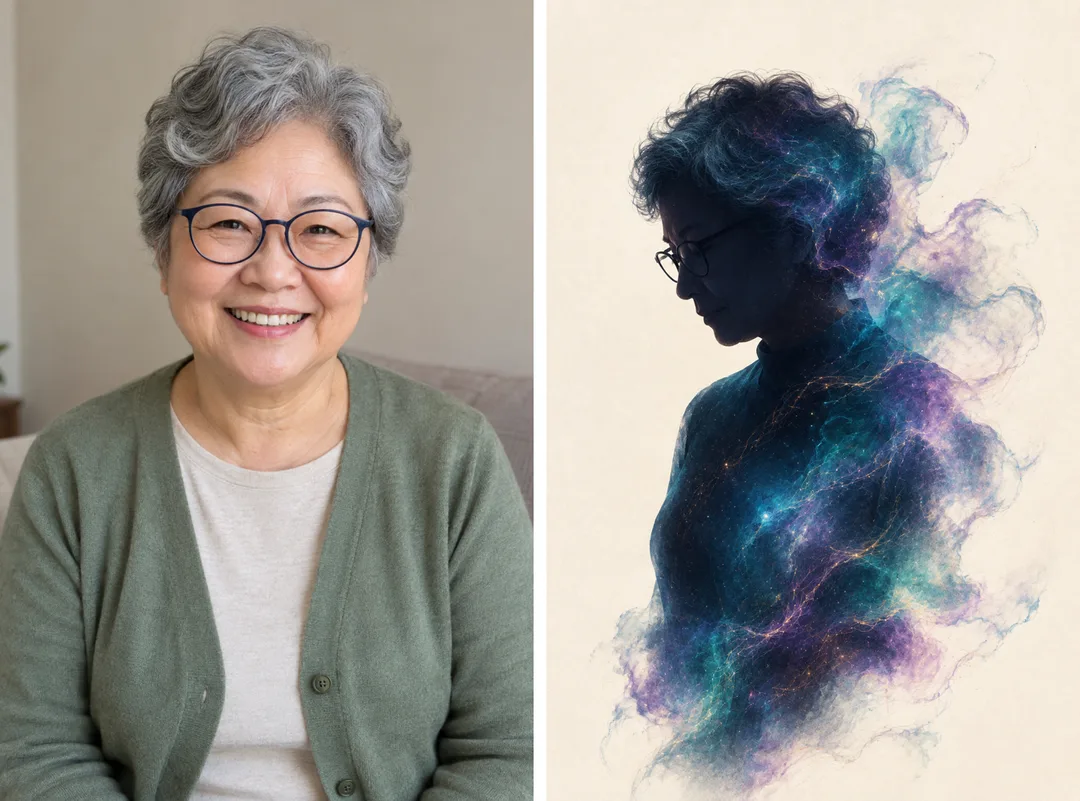
274우주 연기로 풀리는 내 실루엣 — 흰 여백과 별빛 섬유
짙은 옆모습 안의 우주빛이 몸 가장자리에서 연기와 가는 빛줄기로 풀려요. 풍경을 채워 넣는 대신 실루엣 자체가 성운처럼 변하는 한 장이에요.
ChatGPT 무료 OK
칸 채우기
- 1칸을 채워요
- 2복사 버튼을 눌러요
- 3GPT 채팅창에 붙여넣어요
- 4그대로 보내면 썸네일 예시처럼 나와요
- 5내 사진 한 장 (선택)을 같이 넣으면 그 사진이 반영돼요 선택
프롬프트 원문 보기 8,560자
Generate this image now. Return exactly one finished dark human silhouette transforming into cosmic smoke and fine luminous filaments on an ivory background; draw it directly without explanations, code, plans, or questions.
Output exactly one finished 2:3 portrait image, 1024x1536 pixels. Keep all important text inside the central 73% of image height: leave the top 12% and bottom 15% free of essential lettering.
PHOTO RULE (this overrides any other line in this prompt, before or after it, that calls the photo required or mandatory or says to ask for it): if a photo is attached, use it exactly as the instructions below describe. If no photo is attached, never ask for one and never stop — invent a fitting fictional subject (person, pet, food, product or place, whatever this card is about) in the spirit of the card's example image, and finish the image.

[Resolve the personal outline and atmospheric choices first]
PHOTO_MODE = "【내 사진】".
POSE = "【포즈】".
COSMIC_LIGHT = "【우주빛】".
DISSOLUTION = "【풀어짐】".
Read the Korean menu selections by meaning. Empty or absent optional inputs resolve to PHOTO_MODE no photo, POSE a gently bowed side profile, COSMIC_LIGHT teal and violet, and DISSOLUTION medium. Any "알아서 골라줘", "알아서", or choose-for-me value is a command to choose one concrete listed option here, never text to draw. Teal and violet uses a deep blue-black core with teal and violet gas and tiny warm filament sparks; blue and silver uses a blue-black core with cool blue gas and silver-white threads; magenta and gold uses a dark plum-black core with muted magenta gas and fine gold threads. Keep the pale ivory background and dark central head for every choice. DISSOLUTION changes the extent of the same flowing cosmic-smoke transformation, not the art style or result type. PHOTO_MODE controls only the optional portrait attachment; a personal photo actually present overrides a no-photo choice, and a photo choice without an attachment still finishes a fictional silhouette immediately.

[Use a personal photo for outline identity]
If the user attaches a personal human photo, preserve recognizable head shape, forehead-to-nose-to-lip-to-chin profile, hairstyle outline, characteristic hair lengths and textures, eyeglass silhouette, beard outline and apparent age through the contour. Keep the person's natural presentation rather than replacing everyone with a generic youthful bob-haired figure. This particular style intentionally renders the face as a dark silhouette, so do not promise a detailed photographic likeness or invent illuminated facial features inside it. Distinguishing identity comes from the profile, hair and posture. A front-facing portrait may be reconstructed into a plausible side or three-quarter outline using those visible traits. If multiple people are visible use the clearly dominant person and draw only one. With no personal photo invent one individual fictional adult with a distinctive hair outline. A style reference guides the dark figure, airy pale ground, translucent gas, filament texture and contour dissolution only; do not copy its character's face, exact hair shape, pose arrangement, signature or any existing character design. Make an original image in the same visual series.

[One quiet silhouette with a readable head]
Place one large head-and-upper-body figure within the vertical canvas, its head in the upper half and its torso continuing towards the lower part. Leave calm pale space beside the face and above the crown so the silhouette reads immediately. For a bowed side profile lower the gaze gently and show a clear nose-to-chin contour; for a shoulder-back glance rotate the covered torso away while the head turns partway back into a three-quarter dark outline; for an oblique profile keep the chin level and turn the head just enough to reveal the near cheek contour. All poses stay quiet and physically coherent. No outstretched hand or foreground object is needed. Give the person an opaque closed high-neck long-sleeved garment, with covered shoulders, chest and abdomen and a few restrained fold indications in the dark core. Do not expose a bare torso, neckline, midriff or suggestive body detail. Keep the head, neck and central upper body joined even as peripheral material becomes transparent.

[The figure's material turns into cosmic gas]
Build a deep midnight-colored silhouette with the greatest solidity in the head, near shoulder and central chest. Within the torso, introduce layered semi-transparent teal, violet or selected-palette gas with sparse tiny distant light points and delicately tangled luminous threads. These are the changing material of the figure, not a rectangular photograph masked inside a body outline. At the far shoulder, outer sleeve, back and lower torso let the gas push through the silhouette boundary and loosen it into irregular transparent tendrils. Begin each tendril at a body region, following its local curvature before curling outward into the pale space. Form several broad soft billows and finer hair-like wisps, with some places so thin that the ivory background shines through. Add small wandering filaments that continue from the inner nebula to the outer cloud. Keep the face itself mostly dark and clean; fine rim separation can describe the hair tips without filling the head with a bright second face.

[A spatial flow rather than a pasted double exposure]
Let the strongest smoke trail rise along the figure's back and far shoulder, with a smaller loosening cloud near the lower torso, creating a gentle asymmetrical flow around the stable profile. Vary density, opacity and scale so the smoke has depth: heavier gas close to the body, faint translucent wisps farther away, pin-fine filaments woven between layers. Shadows and light in the gas must connect to the silhouette interior. Leave parts of the outer outline genuinely incomplete where material is dispersing, rather than drawing a fully solid cutout with a decorative smoky halo around it. Do not use a literal landscape, city photograph, inserted galaxy rectangle, planet, moon, astronaut, wings, halo ring, flame plume, paper shards, rectangular glitch bands, glowing sphere or cybernetic face number. The one fixed subject is a person whose body dissolves into cosmic vapor, with the nebula's own texture and curling contour as the distinctive result.

[Strength controls how much outline becomes smoke]
For slight DISSOLUTION retain most of the torso's outer edge and add a few thin escaping wisps around the distant shoulder and lower garment. For medium let the far shoulder and lower torso visibly become transparent cloud, with one larger curling back trail and several fine peripheral threads. For strong open larger gaps along the far body contour and extend more vapor into the surrounding space, while preserving the complete head profile, neck connection and a dark solid central chest. Strong must not erase the figure or turn the entire canvas into a colorful smoke cloud. Keep all important silhouette landmarks inside the requested image bounds and leave enough pale background that the human outline remains the first thing seen. Do not replace these strength changes with alternate subjects, camera layouts or media.

[Soft ivory ground and controlled fine light]
Use a clean warm-ivory ground with a slight paper-like grain and a few very faint pigment washes behind the drifting vapor. This background is opaque artwork, not transparent alpha or a checkerboard. The dark head should have decisive contrast against it, while gas edges become airy and uncertain. Light comes from within the nebula material: tiny concentrated filament highlights, broad diffused colored gas and restrained edge glow on the covered silhouette. Avoid hard plastic highlights, neon oversaturation, uniform glitter, lens-flare bursts or crushed black across every region. Paint hair contour and profile deliberately, with a mix of fine edges and soft dissolution away from the face. Keep the effect spacious, poetic and tactile, combining layered digital painting with luminous fine linework rather than photorealistic smoke pasted onto a portrait. Deliver one finished original artwork edge to edge, with no title, written quote, user name, numbers, interface, logo, watermark, copied artist signature, known character, phone mockup, source-photo panel or before-and-after comparison.

[Final output format]
Output exactly one finished 2:3 portrait image, 1024x1536 pixels. Keep all important text inside the central 73% of image height: leave the top 12% and bottom 15% free of essential lettering.
This selected output format takes priority over any fixed canvas size or aspect ratio elsewhere in this template. Adapt the composition, text zones and margins to the selected canvas without stretching or cropping essential content. Device safe areas apply only when a device is selected. Never print these format instructions on the image.
결과 어땠어요?
이 카드도 많이 사용해요
쓰는 법 · 자주 묻는 것
이런 때 쓰세요
흰 여백 위 짙은 옆모습 실루엣 안에 우주와 별빛이 담기고, 몸 가장자리에서 연기와 가는 빛줄기로 풀려 나가는 한 장이에요. 풍경을 따로 그리지 않고 실루엣 자체가 우주가 되는 게 핵심이에요.
칸 채우는 법
우주빛 하나만 고르면 됩니다. 청록 · 보라가 기본이고, 자주 · 금빛은 따뜻한 성운 느낌이에요. 풀어짐을 「강하게」로 하면 연기가 더 넓게 퍼져요.
사진 없이도, 내 사진으로도
사진 없이 보내면 표지처럼 가상의 인물로 그려요. 나를 닮게 하려면:
① 옆얼굴과 머리 윤곽이 보이는 사진을 올립니다 — 아직 보내지 않아요
② 같은 칸에 복사한 프롬프트를 붙여넣어요
③ 둘 다 들어간 걸 확인하고 보내요
그림이 나오면 꼭 볼 것
- 머리 윤곽이 또렷하게 읽히나요?
- 연기가 어깨와 몸에서 자연스럽게 이어지나요?
틀린 곳 고치는 법
같은 대화에 「연기를 더 많이」, 「실루엣을 조금 더 크게」처럼 말하세요.
자주 묻는 것
- 얼굴이 보이나요? 실루엣이라 얼굴 대신 머리 모양 · 옆선으로 나를 닮게 해요.
예시 보는 법
목록 표지는 사진 없이 프롬프트만으로 낸 결과예요. 카드 안 예시는 가상 인물의 평범한 원본 사진(왼쪽)을 넣었을 때의 결과(오른쪽)예요. 사진 없이도, 내 사진으로도 쓸 수 있어요.