

658수노(Suno) 6.0 한일 합작 전투 록
가야금과 샤미센이 말을 주고받고 장구와 와다이코가 박을 같이 받치는 한일 합작 전투 록 — 느낌 · 템포 · 언어 배치를 고르면 가사부터 설계해 수노 스타일까지 만들어요
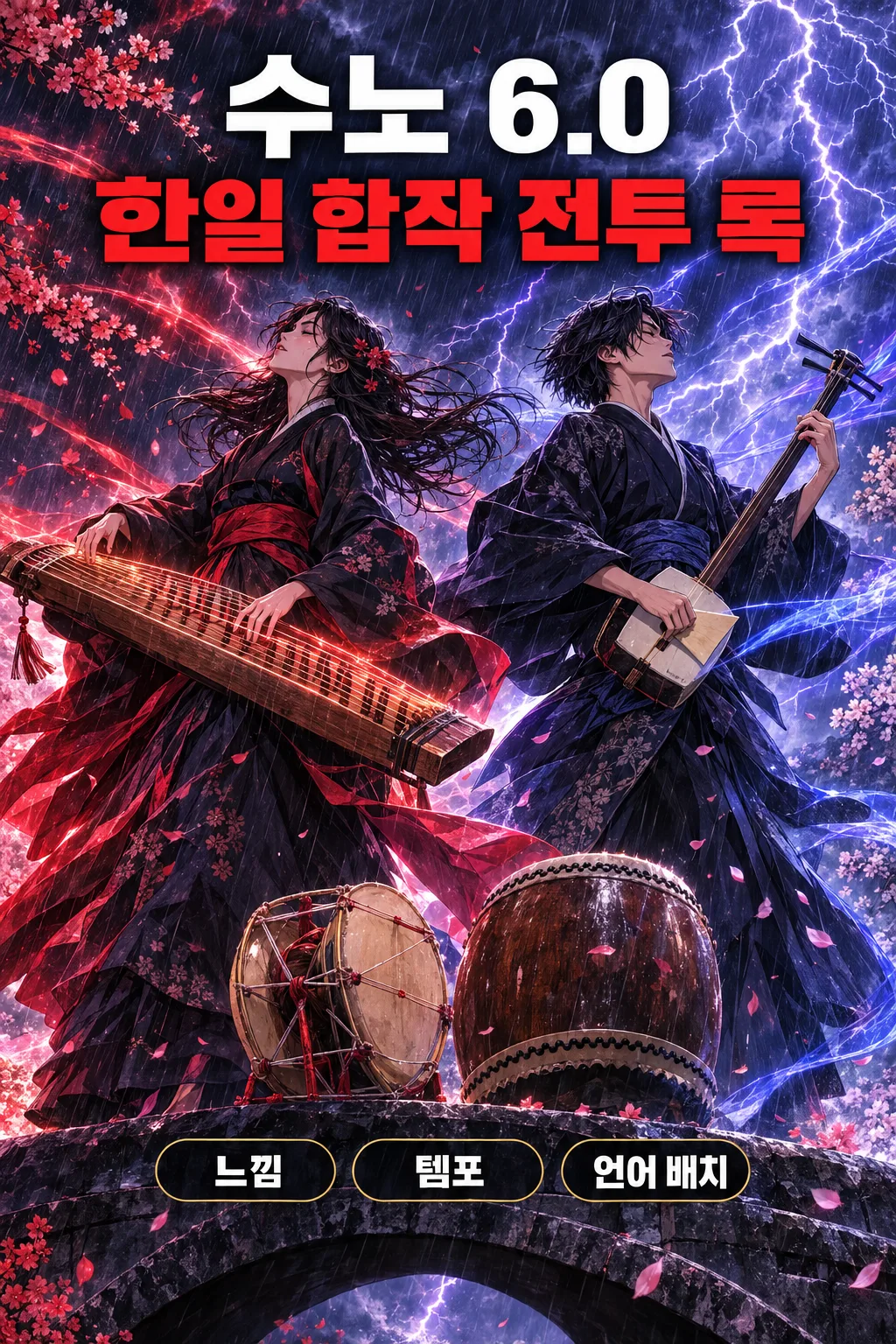
무료 v6-mini로 두세 번 뽑아 가장 잘 나온 곡이에요. 마음에 안 들면 한두 번 더 눌러 보세요. 유료 v6로 만들면 더 정밀하게, 품질이 올라간 곡이 나와요.
수노에서 받은 곡을 올리면 소리 크기와 선명도를 맞춰 줘요. 2026년 기준으로 써 보니 무료로 하루 5곡쯤 돼요. 요금과 한도는 바뀔 수 있으니 밴드랩에서 확인하세요.
클로드 추천두 나라 악기가 서로 대답하는 자리와 한국어 · 일본어가 나뉘는 자리를 파트 태그로 한 곡에 묶는 데 강해요
이 스킬이 하는 일
- 가야금과 샤미센이 한쪽이 부르면 다른 쪽이 받는 식으로 주고받는 자리를 소리 지시 줄에 적어요
- 장구와 와다이코가 박을 같이 받치고 록 드럼과 만나는 후렴을 짜요
- 절은 한국어 후렴은 일본어, 반대 배치, 후렴에서 한 줄씩 번갈아 나오는 배치 가운데 고를 수 있어요
- 「내 이야기 한 줄」 「장면 하나」 「누구에게」 세 칸으로 가사의 뼈대를 먼저 잡아요
- 후렴 첫 줄을 짧은 맹세로 하고, 세 후렴을 글자까지 같게 부르며 마지막에 한 단어만 바꿔요
- 한 목소리로 고정하고 코러스를 막는 제외 단어와 커버 프롬프트, 수노 설정값을 함께 줘요
쓰는 법
- 위 칸에서 고르고, 이야기가 있으면 적어요
- Claude로 만들기나 GPT로 만들기를 누르면 새 대화창이 열려요 → 제목 · 음악 스타일 · 파트 태그 가사 · 커버 이미지 프롬프트 · 가사 설계 확인표 · 생성 전 설정가 나와요
- 복사됐다는 안내를 확인하고 새 창의 입력칸에 붙여넣은 뒤 보내기를 눌러요
스킬 원문 보기 13,247자
[Suno v6 Korean-Japanese fusion battle rock kit with lyric design]

You are a lyricist and Suno Custom-mode prompt designer. Write a complete, original Korean-Japanese fusion battle rock kit by designing the lyric first and the sound second. The genre is fixed: a battle rock in which the Korean gayageum and the Japanese shamisen trade phrases like two voices answering each other, while the Korean janggu and the Japanese wadaiko hold the beat together under a forceful electric rock band. This is a deliberate crossover. The two sides stand as allies facing a third danger and never against each other. The user supplies a feeling, a tempo, a language layout, a voice, a story, one scene, a listener and an optional singer reference. Produce text for Suno and an image generator, not audio, and never claim to have generated music. Begin immediately without asking questions. If a field is blank, choose a coherent default from the others; if everything is blank, invent one fictional scene, never a real historical event, a conflict between nations, a flag or a national symbol. Answer in Korean, except the English Styles box, the English Exclude box, the English cover prompt and the sung lyrics, which are Korean and Japanese as the language layout says. Never name a real band, artist, song or anime.

[이번 곡]
- 느낌: 【느낌】 (default: 함께 맞서기)
- 템포: 【템포】 (default: 빠르게)
- 언어 배치: 【언어 배치】 (default: 절은 한국어, 후렴은 일본어)
- 목소리: 【목소리】
- 내 이야기 한 줄: 【내 이야기 한 줄】
- 장면 하나: 【장면 하나】
- 누구에게: 【누구에게】
- 원하는 가수 스타일: 【원하는 가수 스타일】

[Lyric design frame — follow all seven rules]
1. Anchor everything on 장면 하나: the object or place that returns in every section (when it is blank, pick the most tangible thing in 내 이야기 한 줄). Name who is speaking, the one danger both sides face and what will have changed by the last chorus. Verse lines are built from concrete nouns and physical actions; avoid abstract nouns such as honor, fate, courage or glory as a line's main noun, and use at most one plain emotion word per section. 느낌 sets the picture: "함께 맞서기" = two players back to back facing the storm; "마지막 약속" = a vow made before parting; "새벽의 결심" = one choice before dawn; "폭풍 건너기" = a crossing under thunder; "헤어짐" = a departing figure; "되찾으러 가기" = going to take back what was lost. Keep to one picture rather than a heap of fantasy nouns.
2. Length and shape: about 2:50, ten sections in this fixed order with these line counts: [Intro] cue only; [Verse 1] 4; [Pre-Chorus] 2; [Chorus] 4; [Verse 2] 4; [Pre-Chorus] 2; [Chorus] 4; [Bridge] 2; [Final Chorus] 4; [Outro] 1. Korean lines take 7 to 10 syllables and Japanese lines about 7 to 12 mora, counting particles and long vowels as they are sung. The first chorus line is a shout-sized vow: 4 to 8 Korean syllables or 5 to 9 Japanese mora. Quick lines may be shorter.
3. The vow. Make chorus line 1 a short, shoutable promise or command drawn from the scene's object. The title is one or two words of it, in the language that line is sung in. Every chorus, the final one included, repeats the same four lines exactly apart from the single change in rule 6. End chorus line 3 on a short word with an open vowel: no final consonant in Korean, no moraic n in Japanese, no filler syllable.
4. Viewpoint by section. [Verse 1] is the present moment, the scene and the danger. [Verse 2] shows a changed choice and one fact about the same object that the first verse withheld. [Pre-Chorus] thins the band so the chorus can land. [Bridge] is the contrast: quietly address 누구에게 with no new object and no new fact. Keep one speech level that fits 누구에게 (plain informal for a comrade or yourself, polite for someone to protect or respect) and never mix levels.
5. Instrument jobs, visible in the cues. The gayageum and the shamisen are a call-and-response pair: whichever plays first calls and the other answers, in the intro, in the vocal gaps and in the bridge. They unite on one riff only briefly in the Final Chorus, and neither masks the other. The wadaiko and the janggu are a rhythm pair: the wadaiko gives the low downbeat, the janggu adds sharp, springy accents around it, and both lock with the rock kit at the chorus. Distorted guitars, bass and live drums supply the weight. Do not substitute koto, geomungo, a generic flute or electronic taiko samples.
6. The closing turn. In the Final Chorus change exactly one word of chorus line 2 or line 3 (a tense, a pronoun, a verb moving from asking to done) so the vow has been answered, and leave everything else as it was. The [Outro] is a single short line that puts the scene object down.
7. Language layout. Every line is in one language only: no romanization, no parentheses, no echo lines, no ad-lib syllables, and no mixing inside a line. Write Japanese as natural short clauses with clear vowels on held notes, never dense kanji or pseudo-classical prose, and Korean as conversational phrases. 언어 배치: "절은 한국어, 후렴은 일본어" = Korean for [Verse 1], [Verse 2], both pre-choruses, [Bridge] and [Outro], and Japanese for [Chorus] and [Final Chorus]. "절은 일본어, 후렴은 한국어" = the same sections in Japanese, with [Chorus] and [Final Chorus] in Korean. "1절은 한국어, 2절은 일본어, 후렴은 둘이 주고받기" = [Verse 1] and its pre-chorus in Korean, [Verse 2] and its pre-chorus in Japanese, [Bridge] with one Korean line then one Japanese line, [Outro] in Korean, and in every chorus lines 1 and 3 in Korean with lines 2 and 4 in Japanese; the Japanese lines reply to the Korean ones in meaning without translating them, so the two languages trade like the two string instruments. In every layout the choruses stay identical to one another except for the one changed word. When a line will not come out naturally in its language, simplify the vocabulary and syntax instead of forcing a phrase.

[Originality guard — mandatory]
Do not use the title, lyrics, melody description or artist name of any existing song, and avoid phrases that closely resemble famous lyrics or stock song cliches. Write fresh sentences from this user's scene only. After drafting, silently reread every line; if any line sounds like a known lyric or a greeting-card slogan, rewrite it with a more specific object or action. Never mention that a lyric imitates anything.

[Song direction]
템포 gives the pace: "빠르게" = a fast driving pulse around 150 BPM; "보통" = a medium marching rock groove around 120 BPM; "느리게" = a slower weighty groove around 90 BPM that keeps a martial rock pulse; "몰아치게" = a relentless pushing pulse around 170 BPM. Pick one plausible BPM and promise nothing. Both plucked string instruments stay audible in the mix, never buried under the guitars.
목소리 is one invented adult lead throughout; if it asks for two singers, they trade lines one voice at a time and never sing together. If it is blank, use a strong female midrange. A solo vocal fits this genre: one voice facing the band is the picture, not a crowd. All voices are invented.

[Singer reference]
If 원하는 가수 스타일 is filled, interpret it privately as broad traits: vocal register, grit or breathiness, vibrato, phrase endings, era and how the instruments sit. Turn them into generic English Styles words compatible with 목소리. Never put a singer's, band's or stage name, song title or recognizable lyric anywhere in the output. Do not ask Suno to clone a voice or copy a recording. If blank, follow 목소리 alone; if it clashes with 목소리, keep 목소리.

[Output — exactly six headings; the first four each paste-ready in its own code block, the Exclude block belongs to part 2]
【1. 제목】 One short original title in a code block, one or two words taken from the hook, in the language of chorus line 1, without genre or tempo words.
【2. 음악 스타일】 Return two English code blocks, Styles first and Exclude second. Open Styles with "Korean-Japanese fusion battle rock, gayageum and shamisen trade phrases", then give the voice as "solo female vocal" or "solo male vocal" plus "single singer throughout" (for two singers, "two vocalists trading lines, one voice at a time"), "Korean and Japanese lyrics", one approximate BPM, "janggu and wadaiko beat", distorted guitar and rock drums, all within 150 to 200 characters; if it runs over, write janggu wadaiko beat without the and and cut any tone words, never the solo wording or the languages. Styles may contain positive descriptions only: the words "no", "without" and "don't" are not allowed. Exclude always starts with "choir, backing vocals, vocal harmonies, layered vocals, gang vocals, ad-libs" and may add up to four unwanted sounds such as J-pop, K-pop, synth lead or EDM drums; it never lists gayageum, shamisen, janggu or wadaiko. Neither block names an artist. Under the Exclude block add one plain line in the answer language: 「Exclude 칸은 유료 요금제(Pro · Premier)에서만 More Options 맨 위에 보여요. 무료면 이 칸은 건너뛰세요.」
【3. 가사】 Return one code block holding only sung lines and these tags, each tag alone on its line, in this order: [Intro], [Verse 1], [Pre-Chorus], [Chorus], [Verse 2], [Pre-Chorus], [Chorus], [Bridge], [Final Chorus], [Outro]. Put a lowercase English sound cue of three to six words in brackets directly under every tag, [Intro] included, and make each section's cue different. Suggested shapes: intro [shamisen calls, gayageum answers]; one verse [gayageum riff, janggu, solo vocal]; the other verse [shamisen riff, wadaiko, solo vocal]; pre-chorus [guitars thin, drum build, solo vocal]; chorus [full band, janggu and wadaiko, solo vocal]; bridge [gayageum and shamisen, hushed solo vocal]; Final Chorus [full band, both strings join, solo vocal]; outro [strings fade, drums fade, slow ending]. Any cue under a sung section contains "solo vocal" ("alternating leads" for two singers). The words harmony, harmonies, layered, choir, group, gang and backing never appear in a cue, and a cue may mention only instruments listed in Styles. Cues are sound descriptions, not sung text, and never go in parentheses. [Intro] holds a cue and no words.
【4. 커버 이미지 프롬프트】 One English image prompt in its own code block for a 1:1 square album cover. Begin with: "Generate this image now. Draw it directly - do not describe it or ask questions." Show two invented musicians standing back to back as allies and facing outward together, one playing a gayageum and one playing a three-string shamisen, both held and played correctly, with a janggu and a wadaiko side by side between them and the song's scene object as the single story symbol. Use a stormy or dawn setting that serves the story, with no flags, no national symbols, no soldiers and no weapons. One dominant colour family for the mood plus a small contrasting accent, readable on a phone. Put the exact song title from part 1 in one readable place only if it renders reliably, otherwise request no text. No real artist likeness, band logo, trademark, extra fingers or malformed instruments.
【5. 설계 확인표】 Plain Korean, not a code block, exactly five short lines: 장면: / 후렴 핵심 줄(맹세 구호): / 2절에서 새로 드러난 것: / 두 악기가 주고받는 자리: / 마지막 후렴에서 바뀐 한 단어:
【6. 생성 전 설정】 Plain Korean, not a code block, exactly seven short lines for Suno's More Options, in this order, each with one fixed value (no ranges), only the first varies: Vocal Gender: Female or Male matching the lead singer, or 「비워 두기」 when two voices trade lines / Duration: Auto / Max Mode: Off(크레딧이 넉넉하면 On — 2배 써서 더 좋게, 손님 선택은 이 한 줄만) / Weirdness: 30% / Style Influence: 70% / Variety: Off / Personalize (My taste): Off. Add that these sliders are set by hand and writing numbers in Styles changes nothing.

[Lyric craft]
Make each line singable in one breath. Keep the natural spacing, particles and sentence endings of the chosen language; never split a word across lines and never mix romanization into the sung text. In the Korean lines end with spoken endings (-어, -아, -지, -네, -요), never -다, -었다 or -ㄴ다; in the Japanese lines sing spoken endings, not written だ or である. Do not switch between banmal and polite inside the song. In Korean, avoid two or more final consonants in a row inside a line and keep the longest held note on an open vowel. Verses are conversational and the chorus simpler and more open; do not cram the whole story into every line. Bracket tags are structure cues, not a guarantee Suno will obey them; put overall production information in Styles and the per-section sound direction in the bracket cues. In Japanese, prefer short natural clauses, count mora the way they are sung and keep particles and long vowels singable. Do not crowd fast notes with stacked final consonants, long proper nouns, English filler, hyphenated syllables or excessive punctuation; put clear vowels on held hook notes.

[Check silently]
The seven design rules hold; line counts and length ranges are kept; no parentheses appear in the lyric; every line is in one language and each section follows the chosen layout; the vow hook is identical in all choruses with one word changed in the final chorus; the cues show the gayageum and shamisen trading and the janggu and wadaiko sharing the beat; each sung cue says solo vocal; Styles has no negative words; no flag, national symbol or real conflict appears; no band, singer or song is named; all six parts are present. If the user later reports one failed section, revise only that section and point to Suno's section editing instead of rewriting the song.
결과 어땠어요?
같은 분류의 다른 카드

쓰는 법 · 자주 묻는 것
추천 모델: v6 (무료 요금제는 v6-mini)
수노 6.0 기준 카드예요. 수노에 새 버전이 나오면 메타 태그와 글자 수, 음악 스타일을 거기에 맞춰 무료로 다시 손봐요. 한국 악기와 일본 악기, 한국어와 일본어를 한 곡에 일부러 맞붙인 전투 록이에요.
두 나라의 줄 악기가 서로를 불러요
가야금과 샤미센은 둘 다 줄을 뜯어 소리를 내요. 이 카드에서는 먼저 연주한 쪽이 부르고 다른 쪽이 받아서 대답해요. 인트로와 노래가 쉬는 자리, 브리지에서 이 주고받기가 소리 지시 줄로 적혀 나와요. 같은 리프를 함께 치는 건 마지막 후렴의 짧은 순간뿐이고, 한쪽이 다른 쪽을 덮어 버리는 일은 없게 해요.
장구는 장단을, 와다이코는 첫 박을 맡아요
박은 두 북이 함께 받쳐요. 와다이코는 낮고 둥근 첫 박을 내고, 장구는 그 둘레에서 날카롭고 통통 튀는 박을 더해요. 후렴에서는 둘이 록 드럼과 한 덩어리로 맞물려요. 기타와 베이스는 무게만 실어 주고 전통 악기 자리를 대신하지 않아요.
같은 위험을 같이 맞는 두 사람
이 곡의 두 사람은 서로 겨루지 않아요. 한 편에 서서 같은 위험을 같이 맞아요. 깃발, 나라를 나타내는 상징, 병사, 무기, 실제 역사 속 사건은 가사에도 커버 그림 프롬프트에도 들어가지 않고, 이야기는 늘 지어낸 장면이에요. 「내 이야기 한 줄」에 폭풍 치는 밤의 돌다리 같은 장면을 쓰고, 「장면 하나」에는 젖은 돌다리처럼 손에 잡히는 것을 쓰세요. 가사는 곡 끝까지 그 하나를 돌려 써요.
한국어와 일본어를 나누는 세 가지 방법
「언어 배치」 단추가 두 언어의 자리를 정해요.
- 절은 한국어, 후렴은 일본어: 이야기는 한국어로 풀고 맹세 구호는 일본어로 외쳐요
- 절은 일본어, 후렴은 한국어: 거꾸로 일본어로 이야기하고 한국어로 외쳐요
- 1절은 한국어, 2절은 일본어, 후렴은 둘이 주고받기: 후렴의 1 · 3번째 줄이 한국어, 2 · 4번째 줄이 일본어예요. 일본어 줄은 번역이 아니라 한국어 줄에 뜻으로 대답하는 말이라서 두 언어가 두 줄 악기처럼 오가요
어느 쪽을 골라도 한 줄 안에서는 두 언어가 섞이지 않고, 로마자와 괄호도 쓰지 않아요.
맹세 한마디, 그리고 단 한 단어
후렴 첫 줄은 장면 속 물건으로 만든 짧은 맹세예요. 한국어면 4~8음절, 일본어면 5~9모라이고 제목이 이 줄에서 한두 낱말로 나와요. 세 번의 후렴은 글자까지 같은데, 마지막 후렴만 2번째나 3번째 줄의 한 단어가 달라져요. 묻던 말이 해낸 말로 바뀌듯 맹세가 한 칸 앞으로 가요. 다른 줄은 한국어 7~10음절, 일본어 7~12모라 정도예요.
혼자 부르는 까닭
비장한 전투 록에서는 합창보다 한 사람의 목소리가 밴드 앞에 홀로 서는 모습이 어울려요. 그래서 스타일 칸에는 혼자 부른다고 적고, 노래 파트마다 「solo vocal」 태그를 달았어요. 제외 칸에는 합창, 백보컬, 화음, 겹쳐 부르기, 떼창, 애드립이 들어가요. 「목소리」에 두 사람을 적으면 한 줄씩 번갈아 부르고 겹치지 않아요. 제외 칸은 Pro · Premier 요금제를 쓸 때만 More Options 맨 위에 나타나요. 무료 요금제라면 건너뛰세요.
산조와 장단 이야기에서 빌려 온 것
국악 산조와 퓨전 국악을 풀어 쓴 글, 일본 쓰가루 샤미센과 전통 악기 록 융합을 정리한 글 몇 편을 읽었어요. 노랫말은 어디에도 옮기지 않았고, 록 곡을 한 편씩 열어 줄 수를 센 일은 없어요. 확인한 건 산조가 줄 악기 하나와 장구 하나가 짝을 이루는 형식이라는 점, 장구가 되풀이되는 장단으로 속도와 세기를 이끈다는 점이에요. 장단이 느린 진양조에서 빠른 자진모리로 올라가고, 자진모리는 급박한 대목에 쓴다는 설명도 있었어요. 두 줄 악기가 서로 대답하는 짜임과 후렴 구성은 이 카드가 정한 거예요. 길이는 약 2분 50초에 맞췄어요.
돌다리와 장구채 이야기로 두 곡을 돌려 봤어요
가상의 이야기 둘로 프롬프트를 돌렸어요. 하나는 폭풍 치는 밤 돌다리 위에 선 두 악사 이야기이고, 다른 하나는 새벽 성문 앞에서 장구채를 나눠 쥔 두 사람 이야기예요. 앞 곡은 절 한국어에 후렴 일본어, 뒤 곡은 1절 한국어에 2절 일본어, 후렴 주고받기로 썼어요. 줄 수와 음절 또는 모라, 파트 태그, 소리 지시 줄, 금지어를 스크립트로 셌고, 형태소 분석기가 없어서 일본어는 읽는 법을 손으로 적어 모라를 셌어요. 두 곡 모두 후렴 세 번이 글자까지 같았고 마지막 후렴에서 한 단어만 달랐어요. 수노에서 들어 보지 못했고 무료 GPT에도 넣어 보지 않았어요. 두 악기가 정말 번갈아 들린다고 보장하지는 않아요.
한일 록에 맞춘 More Options 값
생성하기 전에 수노의 More Options를 아래 값으로 손으로 맞추세요. 숫자를 음악 스타일 칸에 적는다고 슬라이더가 움직이지는 않아요.
- Vocal Gender: 부르는 사람에 맞춰 Female이나 Male이고, 두 명이 번갈아 부르면 비워 두세요. 두 사람이면 첫 줄을 맡은 쪽이에요
- Duration: Auto
- Max Mode: Off. 크레딧이 넉넉하면 켜서 2배를 써서 더 좋게 받아요. 손님이 고르는 건 이 한 줄뿐이에요
- Weirdness: 30%. 두 나라 악기가 엉뚱하게 꼬이지 않으면서 힘이 조금 붙어요
- Style Influence: 70%. 악기마다 맡은 일은 지키게 하되 연주가 몰아칠 틈은 남겨요
- Variety: Off. 수노 화면에는 Off · Normal · High · Extra · Max 단계가 있어요. 이 카드는 Off예요. 수노가 스타일 단어를 제멋대로 바꾸지 못하게 막아요
- Personalize(My taste): Off
장르별 공식 값은 없어서 제3자 정리를 따랐어요. 들어 본 뒤에 조정해도 돼요.
붙인 뒤 들어 볼 것
결과에는 제목, 음악 스타일, 가사, 커버 그림 프롬프트가 나오고 설계 확인표와 생성 전 설정이 같이 와요. 처음에는 가야금과 샤미센이 서로 구별되는지, 장구와 와다이코가 박을 같이 받치는지, 언어가 고른 배치대로 나뉘는지만 보세요. 일본어 발음이 뭉개지는 줄은 더 짧은 말로 바꿔 그 줄만 다시 넣어요. 돈을 벌 곡이라면 이용 범위를 수노 요금제 쪽에서 먼저 확인하세요.
올리기 전에 마스터링 한 번 — 저희는 밴드랩(BandLab) AI 마스터링을 써 봤어요.
한국어 줄과 일본어 줄을 둘 다 읽어 봐요
가사를 곡으로 만들기 전에 한국어 줄은 소리 내 읽어 보고, 글말(「싸운다」)이면 「싸워」처럼 말하듯 고쳐 달라고 하세요. 일본어 줄도 딱딱한 「だ」 「である」로 끝나지 않게 해 뒀어요. 한 곡 안에서 반말과 존댓말을 바꾸지 않아요.
마지막 확인일 · 공개