
All · Comics & illustration · Coloring book
345Cozy Room Coloring Book — A Reading Nook
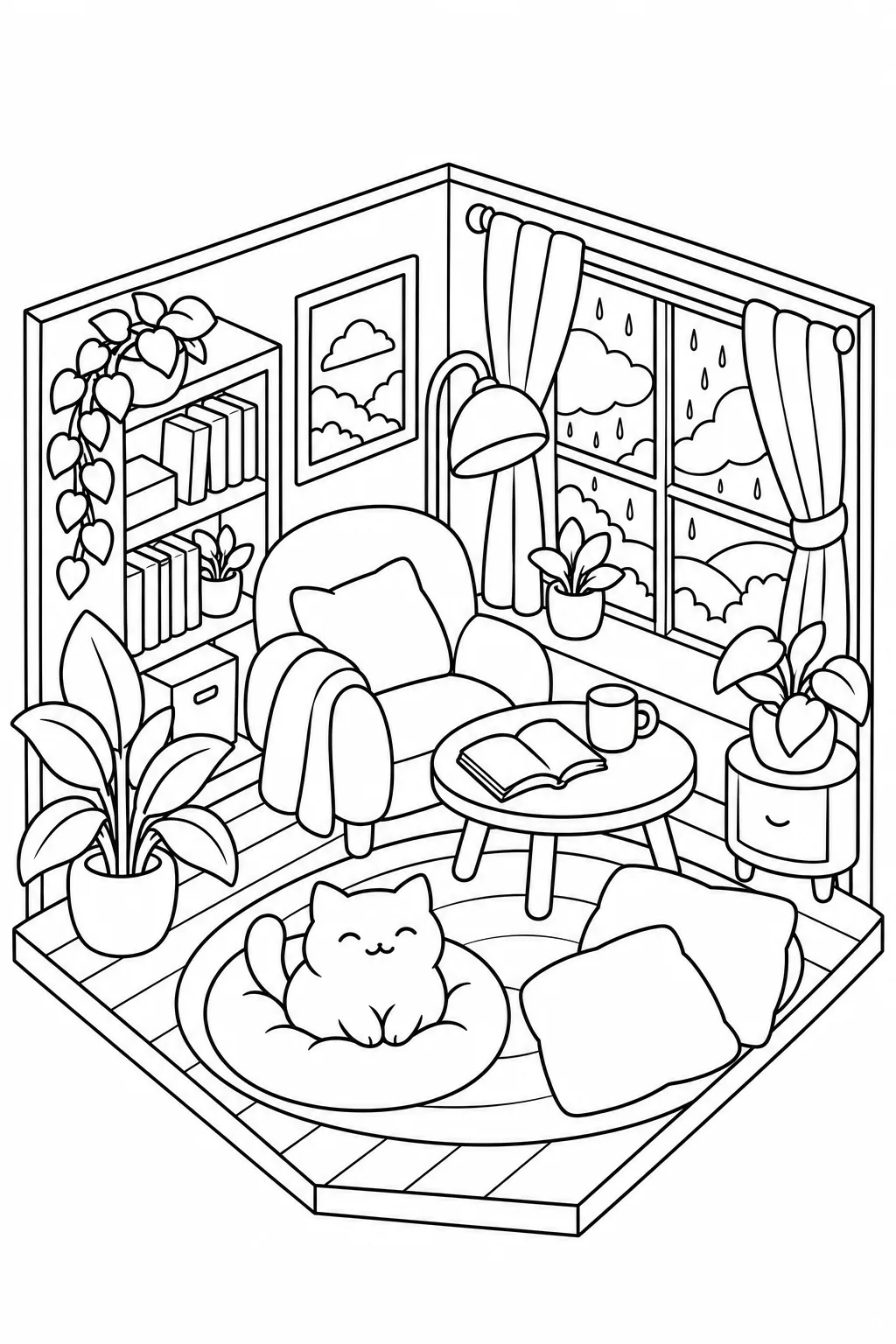
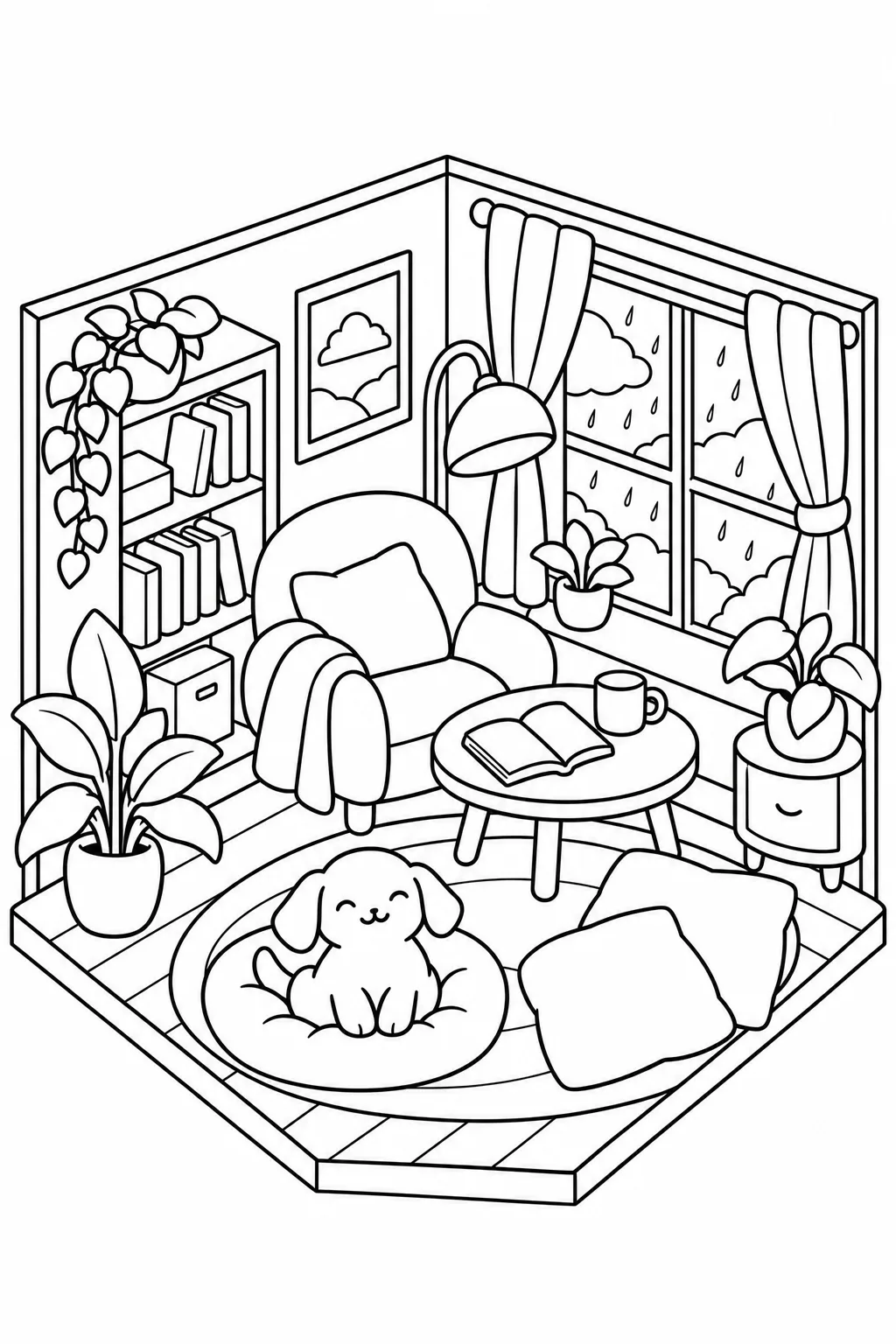
Make one black-and-white reading-room scene with an animal, rounded furniture, books and cushions.
What you get
- One black-and-white coloring page
- Black outlines with blank white coloring areas
- Target: 1–2 hours and approximately 120–250 areas for middle-school students
Fill in the fields
- 1Fill in the fields
- 2Copy the prompt
- 3Paste it into a GPT chat
- 4Send it as is and you get an image like the thumbnail example
- 5Attach a real photo that fits the card and it is used in the result: a background photo for background cards, a person or food photo for those cards Optional
Full prompt 3,751 characters
Directly generate one completed black-and-white coloring page image now. Return only one flat printable page, without explanations, questions, code or colored examples.
Output size 2480x3508 pixels, A4 portrait, 300dpi, print-ready poster.
If the ratio is empty, use portrait A4 (210:297). Keep the entire scene and every object inside the paper with 10–12mm blank white margins on all sides. For another selected ratio, rearrange the same scene within that ratio without cropping.

Main animal: 【Main animal】
Room theme: 【Room theme】
Animal pose: 【Animal pose】
Main furniture: 【Main furniture】
Key props: 【Key props】

An empty Main animal selection means Cat. Draw only the selected species; changing the animal keeps the scene and line-art style. The Main animal selection overrides any different species mentioned in the pose, activity or theme. With None (props only, no people), omit all people, animals and animal-face decorations, using only props, furniture and plants. Ignore pose and activity in this case and fill their space with suitable objects. All subsequent animal placement, activity and appearance instructions apply only when an animal is selected. For other empty optional fields, choose values that suit the theme.

View one small room corner where two walls meet, slightly from above. Show the complete animal on a cushion at the bottom. Clearly show the three furniture pieces and the supplied props. Connect 14–18 household objects on one floor: window, curtains, books, lamp, plants, cups, boxes and rug. The complete miniature-room scene occupies 85–90% of the paper width. Simplify the outside view to large clouds and hills. Use broad furniture areas, book spines, large curtain folds, broad floorboards, pots and large leaves. Target about 10 areas for animal and cushion, 30 for furniture, 35 for books and props, 25 for window/curtains/lamp, 25 for plants and 20 for floor/rug/walls. A rug has only two or three wide bands; baskets are smooth.

Aim for approximately 120–250 closed white coloring areas and 1–2 hours of coloring for a middle-school student. Except for the dense doodle, preferably target 140–180 areas. This counts coloring areas, not objects. Most areas are at least 6–15mm wide at A4; the smallest intended decorative areas are at least 4mm. The wider-area instructions for the prop collections take priority. Never add tiny repetitive patterns to reach the count. Merge narrow bands, wedges and tiny holes into neighboring areas or open them to the background.

Animals are original rounded characters with clear species-specific ears, bodies and tails. Cats have triangular ears and long tails; dogs have floppy ears; rabbits long ears and short tails; otters small round ears, long bodies and thick tails; hamsters small round ears, plump cheeks and short tails; bears round ears and broad muzzles. Eyes and mouths use short open curves; faces remain broad white areas. No tiny closed noses, dot pupils or fine fur texture. Keep bodies, paws and tails separate from objects.

Use only smooth black continuous lines on white. At A4, outer lines are about 0.5–0.7mm and inner lines about 0.35–0.5mm. Close every coloring contour. No black fills, color, gray shading, hatching, grids, checks, fine decorations, texture, shadows, mandalas, letters, numbers, titles, brands, existing characters, signatures, watermarks, book mockups or multiple panels. Do not render the input sentences as text.

[Final output format]
Output size 2480x3508 pixels, A4 portrait, 300dpi, print-ready poster.
This selected output format takes priority over any fixed canvas size or aspect ratio elsewhere in this template. Adapt the composition, text zones and margins to the selected canvas without stretching or cropping essential content. Device safe areas apply only when a device is selected. Never print these format instructions on the image.
How did it turn out?
You may also like
- 350Dense Doodle Coloring Book — Space Desserts
- 349Bold Props Coloring Book — Bakery Picnic
- 348Animal Shop Coloring Book — Toys and Cushions
- 347Sewing Room Coloring Book — Fabric and Spools
- 346Plant Corner Coloring Book — Leaves and Pots
- 343A certificate for your child — crayon rabbits, rainbows and a line of praise

How to use it · FAQ
Cozy Room Coloring Book — A Reading Nook
Make one black-and-white reading-room scene with an animal, rounded furniture, books and cushions. Use this card for an art club or a coloring session at home. It produces one finished line-art page with the composition shown on the cover.
How the fields work
Main animal defaults to Cat. Choose Dog, Rabbit, Otter, Hamster or Bear to change the character. None (props only, no people) removes every animal and person. This selection takes priority over animal names in the theme or pose.
- Room theme: use “A reading room on a rainy day”. Other ideas: A home baking room or A music attic.
- Animal pose: use “Sitting on a round cushion with front paws together”. Other ideas: Sleeping on a low chair or Curling up on a cushion.
- Main furniture: use “A rounded armchair, low bookcase and small round table”. Other ideas: A workbench, cupboard and low stool or A sofa, bookcase and side table.
- Key props: use “An open book, mug and two large cushions”. Other ideas: Bread, oven mitts and a round teapot or Headphones, records and a teacup.
The first theme field and animal selector start with defaults. Clearing another optional field removes its line from the copied prompt; the image tool chooses suitable props or a pose. With None selected, poses and animal activities are ignored.
Cover and second animal
Example 1 and the catalog cover show Cat; example 2 shows Dog. The theme and props stay the same while the animal changes.
Coloring books, curtains and furniture
The chair, bookcase and low table form one connected reading nook. Color individual book spines differently, then use related shades for the large cushions and curtains. For a music attic, change the key props to records and headphones as well as changing the theme; otherwise the original books and mug may remain.
Choose three furniture pieces instead of a long shopping list. If the chair dominates, ask to show the bookcase and table too. Replace crowded book shelves with fewer broad spines rather than adding tiny rain drops or rug patterns. Check that the paws stay separate from the cushion when changing the pose.
If furniture hides the character, request a fully visible animal before replacing the furniture. None creates a quiet interior; an empty cushion, books and plants can occupy the animal's former space.
Difficulty and repairs
The target is 1–2 hours for a middle-school student and approximately 120–250 coloring areas. Areas are not object counts. Generated counts and coloring times vary with the result, tools and approach. Keep the three main furniture pieces; shorten the prop list if the room gets crowded. Check closed lines and paws that merge into objects. For tiny areas, ask: “Keep the composition and merge narrow areas into neighboring white areas, leaving approximately 120–250 broad coloring areas.”
A4 printing
Portrait A4 is recommended. Preserve the aspect ratio, inspect the print preview for clipped outlines and make a test print. Turn off borderless enlargement. If side margins are narrow, reduce the print scale to approximately 90% and leave at least 10mm of white space on every side. Confirm that only black lines and white interiors remain, then color the broad areas first.
About trying it in free GPT
- A separate test in a free GPT account has not yet been verified.
- Paste the completed prompt once into a conversation with image generation available.
- These examples were checked with Codex subscription image generation; coloring time was not measured.