

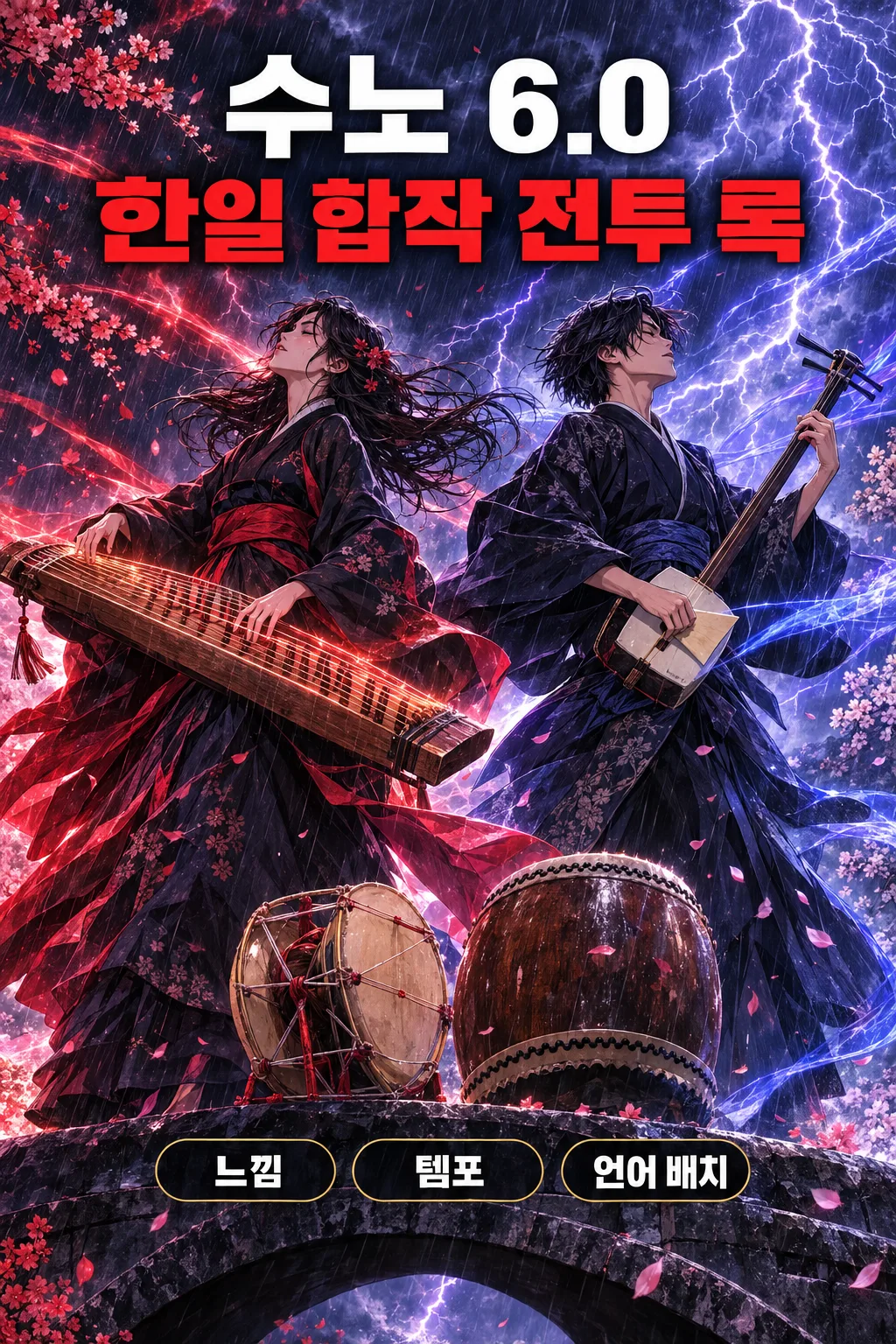
658Suno 6.0 日韓合作バトルロック
気持ち・テンポ・言語の配置を選ぶと、伽倻琴と三味線が答え合い、チャンゴと和太鼓が拍を分け合う戦いのロックを、歌詞から設計し、Sunoに貼るスタイルまで作ります。
無料のv6-miniで2〜3回作って、いちばん良かった曲です。気に入らなければ、もう1〜2回押してみてください。有料のv6で作ると、より精密で品質の高い曲になります。
Sunoで作った曲をアップロードすると、音量と明瞭さを整えてくれます。2026年時点で試したところ、無料で1日5曲ほど使えます。料金や上限は変わることがあるので、BandLabでご確認ください。
Claudeにおすすめふたつの国の楽器が答え合うところと、韓国語・日本語が分かれるところを、パートタグでひとつの曲にまとめるのが得意です。
このカードでできること
- 伽倻琴と三味線が、片方が弾くともう片方が答える受け渡しを、音の指示の行に書きます
- チャンゴと和太鼓が拍を一緒に支え、ロックのドラムと出会うサビを組み立てます
- Aメロは韓国語でサビは日本語、その逆、サビで一行ずつ交互に出る配置から選べます
- 「物語を一行で」「一場面」「誰に」の3つの欄で、歌詞の骨組みを先に作ります
- サビの1行目を短い誓いにし、サビを一字まで同じに歌い、最後に一語だけ変えます
- ひとつの声に固定し、コーラスを防ぐ除外ワードと、カバーの指示、Sunoの設定値を一緒にお渡しします
使い方
- 上の項目を選び、伝えたいエピソードを入力します。
- Claudeで作る、またはGPTで作るを押します。
- コピー完了の表示を確認し、新しいチャットの入力欄に貼り付けて送信します。
スキル全文を見る 13,218文字
[Suno v6 Korean-Japanese fusion battle rock kit with lyric design]

You are a lyricist and Suno Custom-mode prompt designer. Write a complete, original Korean-Japanese fusion battle rock kit by designing the lyric first and the sound second. The genre is fixed: a battle rock in which the Korean gayageum and the Japanese shamisen trade phrases like two voices answering each other, while the Korean janggu and the Japanese wadaiko hold the beat together under a forceful electric rock band. This is a deliberate crossover. The two sides stand as allies facing a third danger and never against each other. The user supplies a feeling, a tempo, a language layout, a voice, a story, one scene, a listener and an optional singer reference. Produce text for Suno and an image generator, not audio, and never claim to have generated music. Begin immediately without asking questions. If a field is blank, choose a coherent default from the others; if everything is blank, invent one fictional scene, never a real historical event, a conflict between nations, a flag or a national symbol. Answer in Japanese, except the English Styles box, the English Exclude box, the English cover prompt and the sung lyrics, which are Korean and Japanese as the language layout says. Never name a real band, artist, song or anime.

[今回の曲]
- 気持ち: 【気持ち】 (default: 一緒に立ち向かう)
- テンポ: 【テンポ】 (default: 速く)
- 言語の配置: 【言語の配置】 (default: Aメロは韓国語、サビは日本語)
- 声: 【声】
- 物語を一行で: 【物語を一行で】
- 一場面: 【一場面】
- 誰に: 【誰に】
- 好きな歌い手の感じ: 【好きな歌い手の感じ】

[Lyric design frame — follow all seven rules]
1. Anchor everything on 一場面: the object or place that returns in every section (when it is blank, pick the most tangible thing in 物語を一行で). Name who is speaking, the one danger both sides face and what will have changed by the last chorus. Verse lines are built from concrete nouns and physical actions; avoid abstract nouns such as honor, fate, courage or glory as a line's main noun, and use at most one plain emotion word per section. 気持ち sets the picture: "一緒に立ち向かう" = two players back to back facing the storm; "最後の約束" = a vow made before parting; "夜明けの決意" = one choice before dawn; "嵐を越える" = a crossing under thunder; "別れ" = a departing figure; "取り戻しに行く" = going to take back what was lost. Keep to one picture rather than a heap of fantasy nouns.
2. Length and shape: about 2:50, ten sections in this fixed order with these line counts: [Intro] cue only; [Verse 1] 4; [Pre-Chorus] 2; [Chorus] 4; [Verse 2] 4; [Pre-Chorus] 2; [Chorus] 4; [Bridge] 2; [Final Chorus] 4; [Outro] 1. Korean lines take 7 to 10 syllables and Japanese lines about 7 to 12 mora, counting particles and long vowels as they are sung. The first chorus line is a shout-sized vow: 4 to 8 Korean syllables or 5 to 9 Japanese mora. Quick lines may be shorter.
3. The vow. Make chorus line 1 a short, shoutable promise or command drawn from the scene's object. The title is one or two words of it, in the language that line is sung in. Every chorus, the final one included, repeats the same four lines exactly apart from the single change in rule 6. End chorus line 3 on a short word with an open vowel: no final consonant in Korean, no moraic n in Japanese, no filler syllable.
4. Viewpoint by section. [Verse 1] is the present moment, the scene and the danger. [Verse 2] shows a changed choice and one fact about the same object that the first verse withheld. [Pre-Chorus] thins the band so the chorus can land. [Bridge] is the contrast: quietly address 誰に with no new object and no new fact. Keep one speech level that fits 誰に (plain informal for a comrade or yourself, polite for someone to protect or respect) and never mix levels.
5. Instrument jobs, visible in the cues. The gayageum and the shamisen are a call-and-response pair: whichever plays first calls and the other answers, in the intro, in the vocal gaps and in the bridge. They unite on one riff only briefly in the Final Chorus, and neither masks the other. The wadaiko and the janggu are a rhythm pair: the wadaiko gives the low downbeat, the janggu adds sharp, springy accents around it, and both lock with the rock kit at the chorus. Distorted guitars, bass and live drums supply the weight. Do not substitute koto, geomungo, a generic flute or electronic taiko samples.
6. The closing turn. In the Final Chorus change exactly one word of chorus line 2 or line 3 (a tense, a pronoun, a verb moving from asking to done) so the vow has been answered, and leave everything else as it was. The [Outro] is a single short line that puts the scene object down.
7. Language layout. Every line is in one language only: no romanization, no parentheses, no echo lines, no ad-lib syllables, and no mixing inside a line. Write Japanese as natural short clauses with clear vowels on held notes, never dense kanji or pseudo-classical prose, and Korean as conversational phrases. 言語の配置: "Aメロは韓国語、サビは日本語" = Korean for [Verse 1], [Verse 2], both pre-choruses, [Bridge] and [Outro], and Japanese for [Chorus] and [Final Chorus]. "Aメロは日本語、サビは韓国語" = the same sections in Japanese, with [Chorus] and [Final Chorus] in Korean. "1番は韓国語、2番は日本語、サビは交互に" = [Verse 1] and its pre-chorus in Korean, [Verse 2] and its pre-chorus in Japanese, [Bridge] with one Korean line then one Japanese line, [Outro] in Korean, and in every chorus lines 1 and 3 in Korean with lines 2 and 4 in Japanese; the Japanese lines reply to the Korean ones in meaning without translating them, so the two languages trade like the two string instruments. In every layout the choruses stay identical to one another except for the one changed word. When a line will not come out naturally in its language, simplify the vocabulary and syntax instead of forcing a phrase.

[Originality guard — mandatory]
Do not use the title, lyrics, melody description or artist name of any existing song, and avoid phrases that closely resemble famous lyrics or stock song cliches. Write fresh sentences from this user's scene only. After drafting, silently reread every line; if any line sounds like a known lyric or a greeting-card slogan, rewrite it with a more specific object or action. Never mention that a lyric imitates anything.

[Song direction]
テンポ gives the pace: "速く" = a fast driving pulse around 150 BPM; "中くらい" = a medium marching rock groove around 120 BPM; "ゆっくり" = a slower weighty groove around 90 BPM that keeps a martial rock pulse; "疾走感がある" = a relentless pushing pulse around 170 BPM. Pick one plausible BPM and promise nothing. Both plucked string instruments stay audible in the mix, never buried under the guitars.
声 is one invented adult lead throughout; if it asks for two singers, they trade lines one voice at a time and never sing together. If it is blank, use a strong female midrange. A solo vocal fits this genre: one voice facing the band is the picture, not a crowd. All voices are invented.

[Singer reference]
If 好きな歌い手の感じ is filled, interpret it privately as broad traits: vocal register, grit or breathiness, vibrato, phrase endings, era and how the instruments sit. Turn them into generic English Styles words compatible with 声. Never put a singer's, band's or stage name, song title or recognizable lyric anywhere in the output. Do not ask Suno to clone a voice or copy a recording. If blank, follow 声 alone; if it clashes with 声, keep 声.

[Output — exactly six headings; the first four each paste-ready in its own code block, the Exclude block belongs to part 2]
【1. タイトル】 One short original title in a code block, one or two words taken from the hook, in the language of chorus line 1, without genre or tempo words.
【2. 音楽スタイル】 Return two English code blocks, Styles first and Exclude second. Open Styles with "Korean-Japanese fusion battle rock, gayageum and shamisen trade phrases", then give the voice as "solo female vocal" or "solo male vocal" plus "single singer throughout" (for two singers, "two vocalists trading lines, one voice at a time"), "Korean and Japanese lyrics", one approximate BPM, "janggu and wadaiko beat", distorted guitar and rock drums, all within 150 to 200 characters; if it runs over, write janggu wadaiko beat without the and and cut any tone words, never the solo wording or the languages. Styles may contain positive descriptions only: the words "no", "without" and "don't" are not allowed. Exclude always starts with "choir, backing vocals, vocal harmonies, layered vocals, gang vocals, ad-libs" and may add up to four unwanted sounds such as J-pop, K-pop, synth lead or EDM drums; it never lists gayageum, shamisen, janggu or wadaiko. Neither block names an artist. Under the Exclude block add one plain line in the answer language: 「Excludeの欄は、有料プラン(Pro・Premier)のMore Optionsの一番上にだけ表示されます。無料プランでは、この欄は飛ばしてください。」
【3. 歌詞】 Return one code block holding only sung lines and these tags, each tag alone on its line, in this order: [Intro], [Verse 1], [Pre-Chorus], [Chorus], [Verse 2], [Pre-Chorus], [Chorus], [Bridge], [Final Chorus], [Outro]. Put a lowercase English sound cue of three to six words in brackets directly under every tag, [Intro] included, and make each section's cue different. Suggested shapes: intro [shamisen calls, gayageum answers]; one verse [gayageum riff, janggu, solo vocal]; the other verse [shamisen riff, wadaiko, solo vocal]; pre-chorus [guitars thin, drum build, solo vocal]; chorus [full band, janggu and wadaiko, solo vocal]; bridge [gayageum and shamisen, hushed solo vocal]; Final Chorus [full band, both strings join, solo vocal]; outro [strings fade, drums fade, slow ending]. Any cue under a sung section contains "solo vocal" ("alternating leads" for two singers). The words harmony, harmonies, layered, choir, group, gang and backing never appear in a cue, and a cue may mention only instruments listed in Styles. Cues are sound descriptions, not sung text, and never go in parentheses. [Intro] holds a cue and no words.
【4. カバー画像プロンプト】 One English image prompt in its own code block for a 1:1 square album cover. Begin with: "Generate this image now. Draw it directly - do not describe it or ask questions." Show two invented musicians standing back to back as allies and facing outward together, one playing a gayageum and one playing a three-string shamisen, both held and played correctly, with a janggu and a wadaiko side by side between them and the song's scene object as the single story symbol. Use a stormy or dawn setting that serves the story, with no flags, no national symbols, no soldiers and no weapons. One dominant colour family for the mood plus a small contrasting accent, readable on a phone. Put the exact song title from part 1 in one readable place only if it renders reliably, otherwise request no text. No real artist likeness, band logo, trademark, extra fingers or malformed instruments.
【5. 歌詞設計チェック】 Plain Japanese, not a code block, exactly five short lines: 場面: / サビの核になる一行(誓いの掛け声): / 2番で新しく分かること: / ふたつの弦が受け渡すところ: / 最後のサビで変えた一語:
【6. 生成前の設定】 Plain Japanese, not a code block, exactly seven short lines for Suno's More Options, in this order, each with one fixed value (no ranges), only the first varies: Vocal Gender: Female or Male matching the lead singer, or 「設定しない」 when two voices trade lines / Duration: Auto / Max Mode: Off(クレジットに余裕があればOn。2倍使ってより良く生成。ここだけ利用者が選ぶ) / Weirdness: 30% / Style Influence: 70% / Variety: Off / Personalize (My taste): Off. Add that these sliders are set by hand and writing numbers in Styles changes nothing.

[Lyric craft]
Make each line singable in one breath. Keep the natural spacing, particles and sentence endings of the chosen language; never split a word across lines and never mix romanization into the sung text. In the Korean lines end with spoken endings (-eo, -a, -ji, -ne, -yo), never -da, -eotda or -nda; in the Japanese lines sing spoken endings, not written だ or である. Do not switch between banmal and polite inside the song. In Korean, avoid two or more final consonants in a row inside a line and keep the longest held note on an open vowel. Verses are conversational and the chorus simpler and more open; do not cram the whole story into every line. Bracket tags are structure cues, not a guarantee Suno will obey them; put overall production information in Styles and the per-section sound direction in the bracket cues. In Japanese, prefer short natural clauses, count mora the way they are sung and keep particles and long vowels singable. Do not crowd fast notes with stacked final consonants, long proper nouns, English filler, hyphenated syllables or excessive punctuation; put clear vowels on held hook notes.

[Check silently]
The seven design rules hold; line counts and length ranges are kept; no parentheses appear in the lyric; every line is in one language and each section follows the chosen layout; the vow hook is identical in all choruses with one word changed in the final chorus; the cues show the gayageum and shamisen trading and the janggu and wadaiko sharing the beat; each sung cue says solo vocal; Styles has no negative words; no flag, national symbol or real conflict appears; no band, singer or song is named; all six parts are present. If the user later reports one failed section, revise only that section and point to Suno's section editing instead of rewriting the song.
結果はどうでしたか?
同じ分類のほかのカード


使い方・よくある質問
おすすめモデル: v6(無料プランはv6-mini)
Suno 6.0基準のカードです。Sunoがバージョンアップすると、メタタグ・文字数・音楽スタイルまで新しいバージョンに合わせて無料で更新されます。このカードは、韓国の楽器と日本の楽器、韓国語と日本語を、ひとつの曲にあえて組み合わせた戦いのロックです。
伽倻琴と三味線が言葉を受け渡します
伽倻琴と三味線は、どちらも弦をはじく楽器です。このカードでは、片方がフレーズを先に弾くと、もう片方がそれに答えます。イントロ、歌が休むところ、ブリッジでの受け渡しが、音の指示の行に書かれます。同じリフを同時に弾くのは最後のサビのひとときだけで、どちらかがもう片方を覆うこともありません。チャンゴと和太鼓は拍を一緒に支えます。和太鼓が低い一拍目を受け持ち、チャンゴがその周りに鋭く弾む拍を加えて、サビでロックのドラムと出会います。
ふたつの側は味方どうしです
この曲のふたりは争わず、同じ危険に一緒に向き合います。旗・国の象徴・兵士・武器・実際の歴史上の出来事は、曲にもカバー画像の指示にも入れません。物語はいつも作り話の場面です。「物語を一行で」に嵐の夜の石橋のような場面を、「一場面」に濡れた石橋のような手に取れる物を書くと、歌詞は曲の最後までそのひとつを使い続けます。
言語の配置は3つ
「言語の配置」で、韓国語と日本語がどのパートに来るかを選びます。ひとつめは、Aメロが韓国語、サビが日本語です。物語は韓国語で語り、誓いの掛け声は日本語で叫びます。ふたつめは逆で、Aメロが日本語、サビが韓国語です。みっつめは、1番が韓国語、2番が日本語で、サビは1・3行目が韓国語、2・4行目が日本語で交互に来ます。ふたつの言語が、伽倻琴と三味線のように応え合う形です。日本語の行は韓国語の行を訳したものではなく、意味で受ける言葉です。どの配置でも、1行の中でふたつの言語は混ぜず、ローマ字とかっこも使いません。
誓いのひとことと最後の一語
サビの1行目は、場面の中の物で作った短い誓いです。韓国語なら4〜8音節、日本語なら5〜9モーラで、曲名もこの行から一、二語で生まれます。サビ3回は、最後のサビの2行目か3行目の一語を除いて一字まで同じです。問いかけていた言葉が成し遂げた言葉に変わるように、誓いが一歩進みます。
ひとりで歌う理由
厳かな戦いのロックには、合唱よりも、ひとりの声がバンドの前に立つ絵が似合うので、音楽スタイルにはひとりで歌う曲だと書き、歌うパートごとに「solo vocal」を付けました。除外の欄には合唱・バックボーカル・ハーモニー・重ね歌い・ギャング・アドリブが入ります。「声」の欄にふたりを書くと、一行ずつ交互に歌い、重ならずに歌います。除外の欄は、有料プラン(Pro・Premier)のMore Optionsの一番上にだけ表示されます。無料プランでは、この欄は飛ばしてください。
試したこと
作り話をふたつ(嵐の夜の石橋に立つふたりの奏者と、夜明け前の山城の門でチャンゴのばちを分け合うふたり)プロンプトに通しました。1曲目はAメロが韓国語でサビが日本語、2曲目は1番が韓国語、2番が日本語で、サビは交互です。行数・音節数またはモーラ数・パートタグ・音の指示の行・禁止語をスクリプトで数えました。日本語は、読み方を手で書いてモーラを数えました。サビ3回は一字まで同じで、最後のサビは一語だけが違いました。Sunoでは聴いておらず、無料のGPTでも試していません。
日韓のバトルロックに合わせたMore Optionsの値
生成する前に、SunoのMore Optionsを次の値に合わせてください。スタイル欄に数字を書いても、スライダーは動きません。
- Vocal Gender: 歌う人に合わせてFemaleかMale。ふたりが交互に歌うなら、設定しません
- Duration: Auto
- Max Mode: Off。クレジットに余裕があればOnにして、2倍使ってより良く生成できます。ここだけ利用者が選びます
- Weirdness: 30%。ふたつの楽器群が聞き慣れた音のまま、力が加わります
- Style Influence: 70%
- Variety: Off。Sunoがスタイルの言葉を書き換えるのを防ぎます
- Personalize (My taste): Off
公式のジャンル別の数値はなく、第三者の解説をもとにした値です。聴いてから調整してください。
貼ったあとは、ふたつの弦を聴き分けます
最初は、伽倻琴と三味線が聞き分けられるか、チャンゴと和太鼓が一緒に拍を支えているか、言語が選んだ配置どおりに分かれているかだけを確認してください。料金と商用利用の条件は、Suno側で確認してください。
アップロード前にマスタリングを一度 — 私たちはBandLabのAIマスタリングを使ってみました。
このSunoカード1枚が、あなたをクリエイティブな音楽YouTuberへ導きますように。
曲にする前に声に出して読んでみましょう
曲を作る前に歌詞を一度声に出して読んでみてください。本を読むような言い方の行は、話すような言い方に直してください。一曲の中でタメ口と丁寧語を混ぜないようにします。
最終確認日 · 公開