전체 · 만화/일러스트 · 캐릭터 · 인물
255만화책에서 걸어 나온 나 — 실사 주인공 + 펜 잉크 만화 컷
펼친 만화책 위로 실사 주인공이 걸어 나오고, 주위에 같은 얼굴의 만화 컷들이 말풍선과 함께 떠 있어요. 성별과 스타일만 고르면 되고, 내 사진을 넣으면 내 얼굴로 나와요.
ChatGPT 무료 OK
칸 채우기
- 1칸을 채워요
- 2복사 버튼을 눌러요
- 3GPT 채팅창에 붙여넣어요
- 4그대로 보내면 썸네일 예시처럼 나와요
- 5내 사진 한 장 (선택)을 같이 넣으면 그 사진이 반영돼요 선택
프롬프트 원문 보기 12,167자
Generate this image now. Render the finished image directly; do not explain it, describe a plan, or ask questions.
Output size 1080x1440 pixels, 3:4 portrait, social media post.
PHOTO RULE: If a photograph is attached, use its subject's identity in BOTH the central photoreal figure and every ink-drawn version in the surrounding panels and open book. If no photo is attached, invent an original fictional subject matching the selected subject type and finish immediately. Never ask for a photograph, pause for clarification, or replace a supplied face with a stock face. This rule takes precedence over any instruction that might otherwise require a reference.

[The image]
Create one cinematic full-bleed image of a photoreal protagonist emerging into a richly detailed room from a large open comic book on the floor, surrounded by floating, curved comic-paper panels. The defining visual contrast is the lifelike central subject versus ink-and-halftone drawings of THAT SAME SUBJECT on tangible paper. This is one continuous physical scene, not a split-screen comparison, flat collage, comic page layout, toy photograph or illustration of an illustrated person. Follow the requested aspect ratio; default to a vertical 3:4 frame.

SUBJECT_TYPE = "【성별】". Resolve this once: woman or man means exactly one human protagonist; couple means exactly two distinct people; pet means exactly one animal protagonist. If blank or automatic, choose one fictional adult woman. A couple photo supplies both identities; preserve their individual faces without blending them. If only one identifiable person is provided for a couple, retain that person and invent the other without asking. For a pet, use the attached pet's species, coat patterns, muzzle, ears and eye color, and carry those features into every drawing. With a group photo for a solo subject, use the most prominent person, breaking ties by proximity to the center.

WARDROBE = "【스타일】". Resolve this into ONE complete original costume design, then reuse that exact design in the live subject, all floating panels and every visible book-page drawing. Street casual means a modest opaque cropped top, high-waisted camouflage cargo trousers and unbranded sneakers; fantasy warrior means detailed practical armor, boots and one sheathed sword; dark sorcerer means layered dark robes, a cloak and restrained arcane details; wuxia swordsman means flowing martial robes, a sash and one sheathed straight sword; cyberpunk means a layered technical jacket, utility trousers and subtle luminous trims; romance protagonist means refined contemporary layers and elegant footwear. A blank or automatic value defaults to street casual. For a couple, choose complementary outfits, then lock each person's design separately. For a pet, adapt the selected theme into a comfortable species-appropriate vest, cloak or harness; keep its body quadrupedal and its face uncovered.

[Defaults and named values]
The complete default scene has the protagonist stepping out of the book, an old comic artist's workshop, warm golden light and delicate golden sparks. The default PRIMARY_SPEECH is one original short English line: "I CHOOSE MY OWN PATH." Each active optional owner-input line below defines one named value once and changes only that feature. If such a line is absent, keep its default. If an input reads "알아서 골라줘" or "알아서", decide a fitting value yourself without asking or printing that phrase. Treat blank inputs and "고르지 않음" as absent. Maintain a single identity-and-wardrobe reference for each protagonist throughout the finished image; do not redesign a face or costume for individual panels.

[Photoreal central protagonist]
Render the central subject as a convincing full-body live-action photograph: natural skin pores, believable hair strands, realistic eyes, fabric weave, seams, footwear construction and coherent shadows. Keep normal human proportions and anatomically sound hands. Preserve the reference face's proportions, skin tone, hairstyle, glasses, facial hair and apparent age; do not recolor skin, change age or smooth it into a generic beauty portrait. Without a photo, invent a distinctive adult with natural features, never a real person's or celebrity's likeness. Keep clothing tasteful and opaque; for an adult, a modest crop top is the maximum suggested exposure. For a younger reference subject, use an age-appropriate full-length top. Armor and robes cover the torso. For a pet, render a lifelike animal with natural fur and posture, not a human body with an animal head.

In the default pose, show the whole protagonist moving forward from the open book, with one foot still contacting a page and the other stepping onto the room's floor. Make the foot-to-page contact and forward motion physically readable. For a couple, both move together with separate limbs and distinct silhouettes; for a pet, show a natural paw step out of the book. The central subject's face is the sharpest, clearest element and remains unobstructed. Show the complete body and footwear or paws; do not crop at knees or turn the hero into a small distant figure.

[Open book and transition]
Place one oversized, thick comic book across the lower foreground, open wide with a visible central binding, page thickness, lifted paper edges and convincing perspective. Its pages contain several bordered sepia ink panels of the SAME protagonist wearing WARDROBE. The nearest page and the stepping foot should make it unmistakable that this person is walking out of this book. Give the pages genuine paper texture and small ink imperfections. Use subtle ink wisps, a few lifted paper fragments and light particles at the transition; keep the live body fully photoreal above it. Do not replace the open book with a portal ring, screen, plain blank notebook or pile of closed books.

[Seven floating paper panels]
Arrange exactly SEVEN distinct floating comic panels around the central subject, within the visual range of six to eight. Make them tangible rectangular sheets with slim ink borders, slight thickness, curved corners, bends and cast shadows. Some sit behind the shoulders, some beside the torso, and one or two approach the foreground edges. Vary their tilt, distance and size to build depth and a lively arc around the protagonist while leaving the live face and forward step unobstructed. Each sheet contains one clearly composed scene; no extra grid of tiny floating rectangles.

Draw their contents with confident black-and-sepia pen lines, cross-hatching, strong ink shadows, halftone dots and aged cream paper. These are graphic-novel drawings, visibly different from the photoreal central figure. Use varied views of the SAME subject: a face close-up, a turning three-quarter portrait, a confident full-body stance, a hand or paw detail, a dynamic movement and two other small story moments appropriate to WARDROBE. Keep a recognizable face and key wardrobe details visible in most panels. Reuse the same hair silhouette, facial landmarks, glasses if present, exact garment colors translated into sepia values, camouflage or trim pattern, and footwear design. For a couple, show either one or both of the same two people while preserving their separate identities; introduce no third protagonist. For a pet, every illustrated appearance is the same animal, with consistent markings. The open-book drawings follow this same identity rule.

[Speech lettering]
Put one short speech balloon inside each of the seven floating panels. Print PRIMARY_SPEECH exactly once in the clearest panel near the protagonist's upper body, preserving its supplied language, spelling and punctuation. Invent six different brief original ENGLISH lines for the remaining balloons, two to six words each, fitting the selected character mood. Use readable lettering, quiet cream balloon interiors and clear tails pointing to the appropriate drawn subject. Keep every line short enough to read without filling the panel; do not put a balloon across the central photoreal face. The additional lines must not repeat the primary line, attribute a quote to a real person, borrow franchise catchphrases or add personal biography. If PRIMARY_SPEECH is automatically chosen, write one original concise English line and apply it consistently. The illustrated book pages may contain small generic balloons without readable lettering; avoid extra accidental words.

[Workshop, lighting and density]
The default setting is a dim old comic artist's workshop with manuscript sheets covering the wall, shelves packed with books, a crowded drawing desk, pen cups, brushes, stacked paper, a task lamp and a textured floor. Make these believable objects with depth, thickness and wear. Keep them lower in contrast than the hero and use shallow atmospheric falloff; the room is dense and lived-in but the central silhouette is clear. Wall manuscripts show anonymous ink sketches and panel grids rather than recognizable published characters or readable brand names.

In the default lighting, use warm golden backlight that catches hair, shoulders and curved paper edges, a soft neutral frontal fill for the face, and restrained golden sparks drifting around the book. Light all live objects and physical panel sheets consistently. The drawings inside the sheets retain their ink graphic style. Let thin paper transmit a little warm light at its edges. Maintain rich dark shadows, controlled warm highlights and sharp facial detail rather than a washed-out gold filter. A selected place or light changes the environment coherently; preserve the central photo-versus-ink contrast.

[Composition and finish]
Fill the vertical frame with the live full-body subject, the large open book and the surrounding paper arc. The main subject spans roughly 70-80% of the image height, with enough room for the complete book-to-floor step and upper floating panels. A couple uses two readable full-body silhouettes; a pet is scaled prominently as the sole hero. Use cinematic photographic depth for the room and live subject, finely resolved ink marks for the panels, and crisp short speech text. No added headline, title banner, author name, logo, watermark, border template or second image. Use original designs only, with no imitation of a named real person, existing comic character, franchise costume or recognizable brand. Finish as one cohesive image.

[OPTIONAL OWNER INPUT - each line exists only when supplied]
POSE = "【포즈】". Replace the default stepping action with the requested pose while preserving the visible connection to the open book: perch on its raised edge, look back with the whole body visible, or stand on the pages with hands in pockets. Adapt a human-specific pose naturally to a pet's paws and anatomy.
SPEECH CHOICE (a menu selection, not lettering): 【말풍선 한 줄】
If that selection is the Korean menu phrase meaning "choose for me" (알아서 골라줘 or 알아서), it is NOT text: write your own short English line as PRIMARY_SPEECH and never letter that Korean phrase anywhere. Otherwise PRIMARY_SPEECH is that supplied sentence, printed verbatim in its original language exactly once in the clearest floating-panel balloon. Keep the other six balloons independently written in short English.
PLACE = "【장소】". Set the entire physical room here: an old comic artist's workshop has manuscripts, books and drawing tools; an old library at night has deep bookcases and a reading table; an attic study has sloped beams, books and a writing desk. Preserve the open comic book on the floor and the floating ink panels.
LIGHT = "【빛】". Apply this light to the whole physical scene: golden sparkle uses warm backlight and delicate gold motes; cold moonlight uses blue-silver window light and restrained silver motes; warm task-lamp light uses a localized amber lamp source and soft room shadows. Keep the photoreal face readable and panel lettering clear.

[Final output format]
Output size 1080x1440 pixels, 3:4 portrait, social media post.
This selected output format takes priority over any fixed canvas size or aspect ratio elsewhere in this template. Adapt the composition, text zones and margins to the selected canvas without stretching or cropping essential content. Device safe areas apply only when a device is selected. Never print these format instructions on the image.
결과 어땠어요?
이 카드도 많이 사용해요
쓰는 법 · 자주 묻는 것
이런 때 쓰세요
만화 주인공이 책장을 찢고 현실로 걸어 나오는 장면을 한 장으로 만들어요. 가운데에는 실사 주인공이 펼친 만화책 위를 걸어 나오고, 주위에는 같은 얼굴을 펜과 잉크로 그린 만화 컷들이 종이처럼 휘어 떠 있어요. 컷마다 짧은 말풍선이 붙어서 「이 사람의 이야기」가 한눈에 보입니다. 실사와 만화가 한 화면에 같이 있는 대비가 이 카드의 맛이에요. 인스타 피드, 프로필, 폰 배경화면으로 쓰기 좋아요.
칸 채우는 법
성별과 스타일 두 개만 고르면 바로 됩니다. 스타일은 주인공의 옷과 분위기예요. 스트릿 캐주얼이면 크롭 티와 카고 바지, 판타지 전사면 갑옷과 검, 어둠의 마법사면 검은 망토로 바뀌고, 만화 컷 속 주인공도 같은 옷을 입어요. 커플을 고르면 두 사람이 함께 걸어 나오고, 반려동물을 고르면 강아지나 고양이가 주인공이 됩니다. 말풍선 한 줄은 비워 두면 알아서 지어요. 영어 짧은 문장이 그림 속에서 가장 정확하게 나옵니다.
내 사진을 넣으면 내 얼굴로
사진은 선택이에요. 넣지 않으면 새로운 가상의 인물로 그리고, 넣으면 실사 주인공과 만화 컷 속 얼굴이 모두 내 얼굴을 따라갑니다.
① 얼굴이 잘 보이는 사진을 올립니다 — 아직 보내지 않아요
② 같은 칸에 복사한 프롬프트를 붙여넣어요
③ 둘 다 들어간 걸 확인하고 보내요
커플이면 두 사람이 함께 나온 사진 한 장, 반려동물이면 그 아이 사진을 올리세요. 사진만 먼저 보내 버렸으면 프롬프트 끝에 「위 사진으로 그려줘」를 붙여 보내세요.
그림이 나오면 꼭 볼 것
- 실사 주인공과 만화 컷 속 인물이 같은 사람으로 보이나요? 머리 모양 · 옷이 같아야 해요
- 만화 컷은 펜 잉크 그림, 가운데는 실사 사진처럼 — 둘이 확실히 달라 보이나요?
- 말풍선 글자가 적은 그대로인가요?
틀린 곳 고치는 법
같은 대화에 이어서 말하면 됩니다. 「얼굴을 사진과 더 닮게」, 「만화 컷을 더 많이」, 「말풍선 글자만 고쳐 줘」처럼 한 가지씩 말하세요. 한 번에 여러 개를 바꾸면 얼굴이 달라지기 쉬워요.
자주 묻는 것
- 사진 없이도 되나요? 됩니다. 성별과 스타일만으로 새로운 주인공을 그려요.
- 말풍선을 한국어로 해도 되나요? 됩니다. 다만 짧을수록 정확하게 나와요. 열 글자 안쪽을 권해요.
- 노출이 많은 옷으로 나와요. 「옷을 더 단정하게」라고 이어서 말하면 바뀝니다.
예시 두 장 보는 법
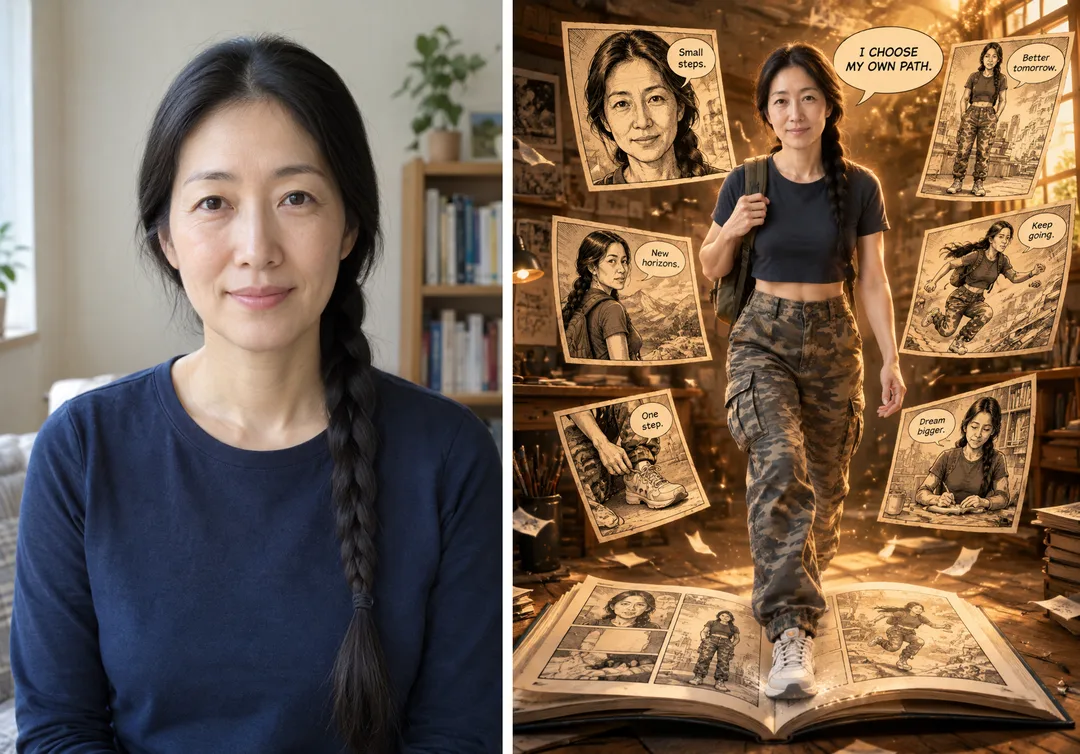
- 예시 1(A): 가상 인물 한서린 · 48세 · 여성 — 조용하고 신중한 독서가. 긴 검은 생머리를 낮은 땋은 머리로 묶음, 안경 없음.
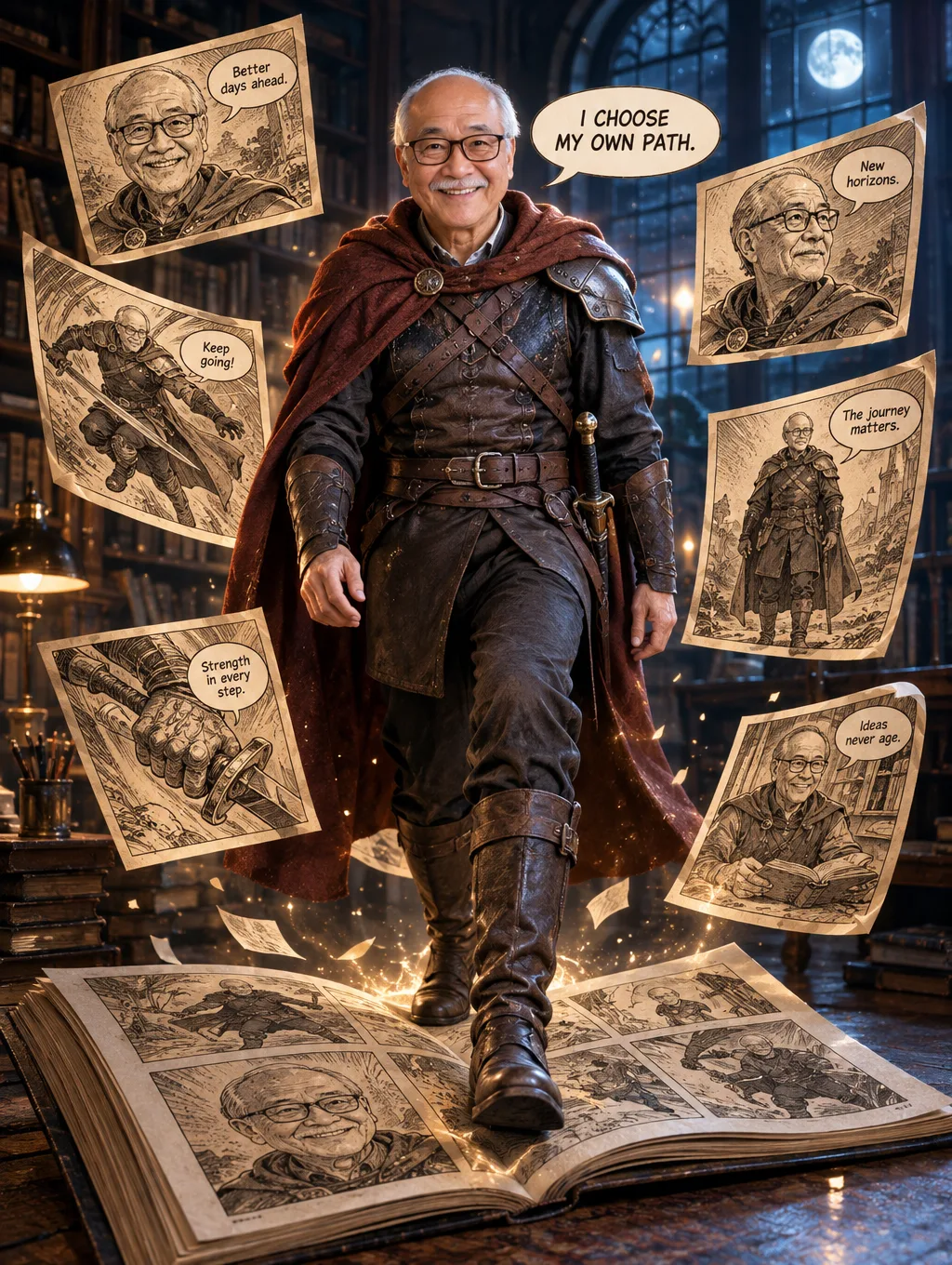
- 예시 2(B): 가상 인물 서만수 · 73세 · 남성 — 유쾌하고 모험을 좋아하는 할아버지. 정수리는 벗겨지고 옆머리는 은회색, 흰 콧수염·직사각 안경.
예시 1은 A의 평범한 원본 사진과 변환 결과를 「원본 사진 → 결과」 한 쌍으로 보여 줍니다. 예시 2는 다른 사람인 B의 변환 결과 한 장을 보여 줍니다.
수줍은 48세 독서가와 모험을 좋아하는 73세 할아버지예요. A는 일상 옷을 입고 금빛 작업실의 책에서 걸어 나오고, B는 갑옷을 입고 달빛 도서관의 책 위에 걸터앉습니다.
채운 칸 값
| 칸 | 예시 1(A) | 예시 2(B) |
| --- | --- | --- |
| 성별 | 여성 | 남성 |
| 스타일 | 스트릿 캐주얼 | 판타지 전사 |
| 포즈 | 책에서 걸어 나오기 | 책 위에 걸터앉기 |
| 말풍선 한 줄 | This is just the beginning. | I write my own story. |
| 장소 | 낡은 만화가 작업실 | 밤의 오래된 도서관 |
| 빛 | 금빛 반짝임 | 차가운 달빛 |
| 결과 추천 크기 | 3:4 세로 | 3:4 세로 |
| 원본 사진 크기 | 2:3 세로 | 2:3 세로 |