

All · Comics & illustration · People · Characters
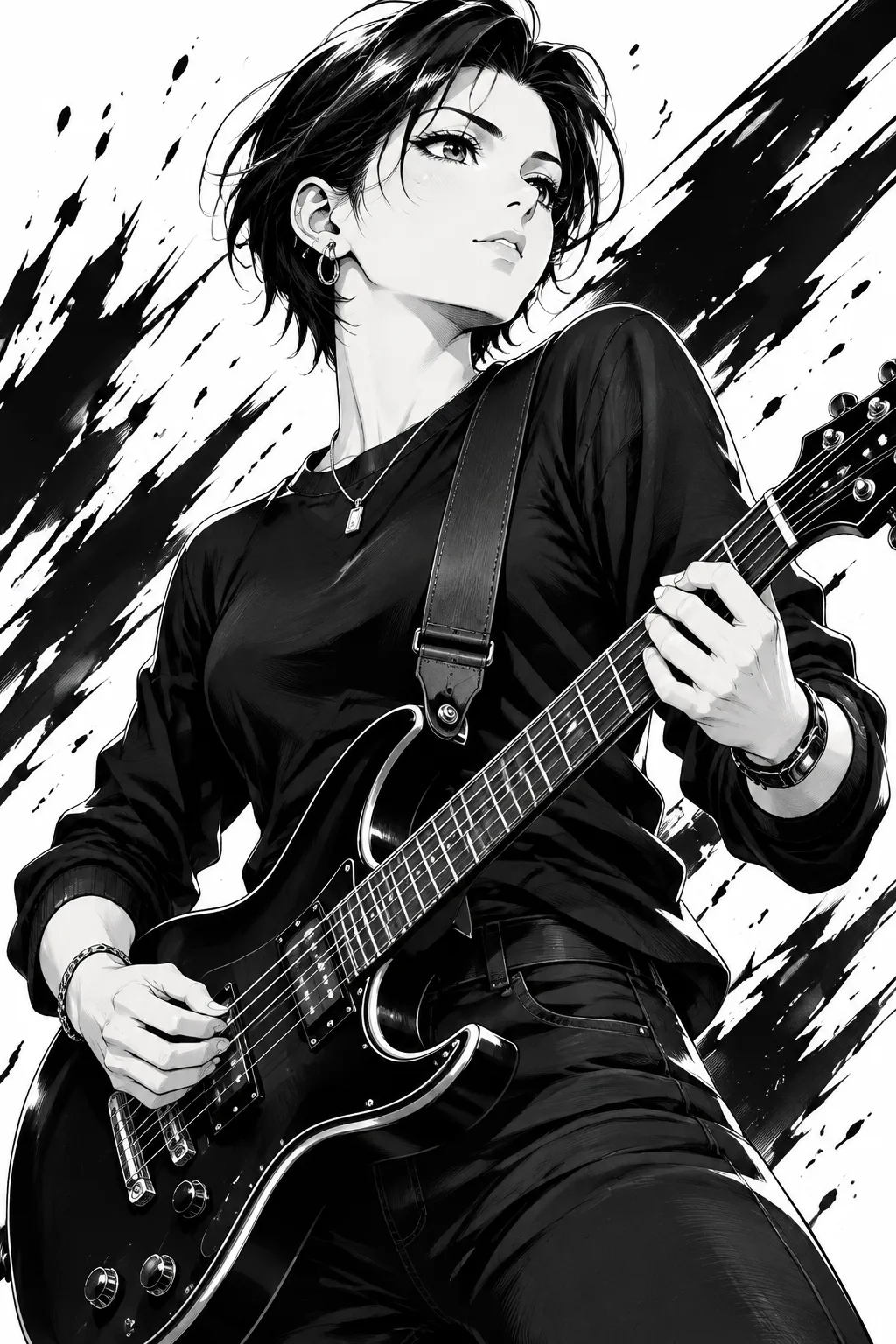
198Black-and-White Manga Ink Guitar
Separate face, hair and guitar metal through hatching, black masses and white cuts.
What you get
- One manga guitarist, three distinct ink surfaces
- Adjustable ink bleed with protected eyes and metal cuts
Fill in the fields
- 1Fill in the fields
- 2Copy the prompt
- 3Paste it into a GPT chat
- 4Send it as is and you get an image like the thumbnail example
- 5Attach One adult portrait, optional with the prompt and your photo is used in the result Optional
Full prompt 3,618 characters
Draw a single original adult electric guitarist as a contemporary black-and-white manga key visual. Build three visibly different surfaces using ONE black ink: face = sparse fine hatching on exposed white paper; hair = joined solid-black locks cut by long white slits; guitar hardware = hard black silhouettes pierced by short white cuts and isolated white pinpoints. These three ink behaviors are the subject of the image, legible before any background. No gray paint, gray wash, airbrush, gradient, screentone or color; apparent half-tones come only from separated black strokes and untouched paper.
Output exactly one finished 2:3 portrait image, 1024x1536 pixels. Leave the top 12% and bottom 15% free of essential text.

PERFORMER: 【Performer】. One adult, head-to-hip diagonal performance pose, focused eyes and mature facial proportions. Without a photo invent this person immediately. With an adult reference photo, translate its facial identity, hairstyle, glasses and facial hair into manga ink; retain the three-surface ink grammar. No printed words.
BLACK COVERAGE: 【Black coverage】. Target fraction of the entire page occupied by solid black; keep facial planes mostly paper-white even at high coverage. Allocate black to hair, clothing and the guitar body before increasing the background.
HATCH VECTOR: 【Hatch direction】. On cheek, neck and sleeve, make distinct parallel nib strokes follow this direction; vary spacing rather than adding gray. Hair highlights follow the locks instead.
PAPER RESERVE: 【White space】. Leave this region open white paper, interrupt background marks there and keep the face silhouette readable.
METAL MARKS: 【Metal highlights】. On bridge, pickups, tuning pegs and frets use the specified white incisions or pinpoints inside black shapes; keep metal edges sharply angular and different from the long hair glints.
GUITAR FOCUS: 【Guitar focus】. Enlarge and expose this part of an unbranded rounded double-cut electric guitar. Keep both playing hands visible, one at the fretboard and one over the pickups; six strings and six tuning pegs. Avoid hiding the focused hardware behind the fingers.
INK BLEED: 【Ink bleed】. Apply exactly the matching rule:
Almost none → dry crisp nib edges on face, hair and hardware, at most three tiny detached black drops behind the shoulder, no fuzzy ink fringe.
Stroke tips only → small ragged blooms at terminating hatch strokes and several small drops, long contours remain crisp.
Spreads widely → visibly frayed, capillary branching BLACK stroke edges around outer hair locks, sleeve and guitar perimeter; broad irregular BLACK pools and many detached drops spreading into background paper. Use broken black fibers separated by white paper rather than gray haze. Preserve eyes, finger separation and hard white metal cuts as small protected islands; outer contours must be less crisp than in the dry setting.
Metal and hair only → ragged black edge blooms and small black droplets only around hair and hardware, keep face, clothes and background dry.

Compose a deliberate rhythm of big black blocks, medium white cuts and tiny nib marks. Fine eyelashes, articulated hair locks, layered cuffs and original small jewelry retain polished contemporary anime drawing. Deliver one finished 2:3 illustration, no panels, captions, signature, logo, existing character or named creator imitation.

[Final output format]
Output exactly one finished 2:3 portrait image, 1024x1536 pixels. Leave the top 12% and bottom 15% free of essential text.
This selected output format takes priority over any fixed canvas size or aspect ratio elsewhere in this template. Adapt the composition, text zones and margins to the selected canvas without stretching or cropping essential content. Device safe areas apply only when a device is selected. Never print these format instructions on the image.
How did it turn out?
More cards in this category



How to use it · FAQ
The cheek hatching and tuner dots describe different surfaces
Both baseline images showed fine diagonal strokes on the cheeks and neck, broad black braids divided by long white slits, and short white rims and dots on the tuners and pickups. Spaced ink strokes model the face instead of smooth gray shading, keeping hair and metal visually distinct.
More bleed pushed ink beyond the shoulder
Only Ink bleed changed from Almost none to Spreads widely. The third image developed large black pools and branching edges behind the hair, shoulder and lower guitar. Outer contours grew rougher while the eyes and white metal cuts stayed readable. The difference is in stroke edges and drops within the same black-and-white palette.
The dry baselines still produced more than the requested three background drops. Almost none does not guarantee spotless paper. If needed, ask: “Remove only the drops outside the shoulder; preserve cheek hatching and white metal cuts.” The 45% black coverage is an allocation instruction, not a measured area guarantee.
The headstock is exposed; fingers conceal some strings
Both baseline images exposed the headstock with the neck-and-headstock focus. Overlapping fingers make it difficult to trace all six strings end to end. For accurate instrument diagrams, inspect the fretting hand and string spacing closely. These tests used a fictional person without a photo; facial likeness preservation was not tested.
Last checked · Published