

All · Comics & illustration · Scenery
283Risograph Still-Life Poster
A mug’s small floral print spreads across cloth and backdrop in a maximalist risograph still life. Choose a shared table or separate cabinet cubbies.
What you get
- One maximalist risograph still-life wall poster
- A shared tabletop or a partitioned collection cabinet
- Fluorescent pink, green and yellow with grainy spot-ink texture
ChatGPT Free OK
Fill in the fields
- 1Fill in the fields
- 2Copy the prompt
- 3Paste it into a GPT chat
- 4Send it as is and you get an image like the thumbnail example
- 5Attach a real photo that fits the card and it is used in the result: a background photo for background cards, a person or food photo for those cards Optional
Full prompt 2,569 characters
Create a finished maximalist risograph still-life wall poster, portrait A4. Return the flat artwork itself.
Output size 2480x3508 pixels, A4 portrait, 300dpi, print-ready poster.

COLLECTED OBJECTS: 【Objects】
PATTERN DONOR: 【Pattern source】
PATTERN ROUTE: 【Pattern destination】
DISPLAY STRUCTURE: 【Display structure】

Make the pattern donor a recognizable member of the collected objects. Borrow its surface motif and print enlarged versions of that SAME motif on the supplied pattern-route surfaces. Keep the donor's original small motif visible so the eye can trace the family resemblance from object to textile to backdrop. This is printed decoration, not objects melting together. Preserve the silhouettes and functional openings of every supplied object. Invent supporting leaves and small patterned vessels only around the supplied focal group.

Follow the selected DISPLAY STRUCTURE exclusively:
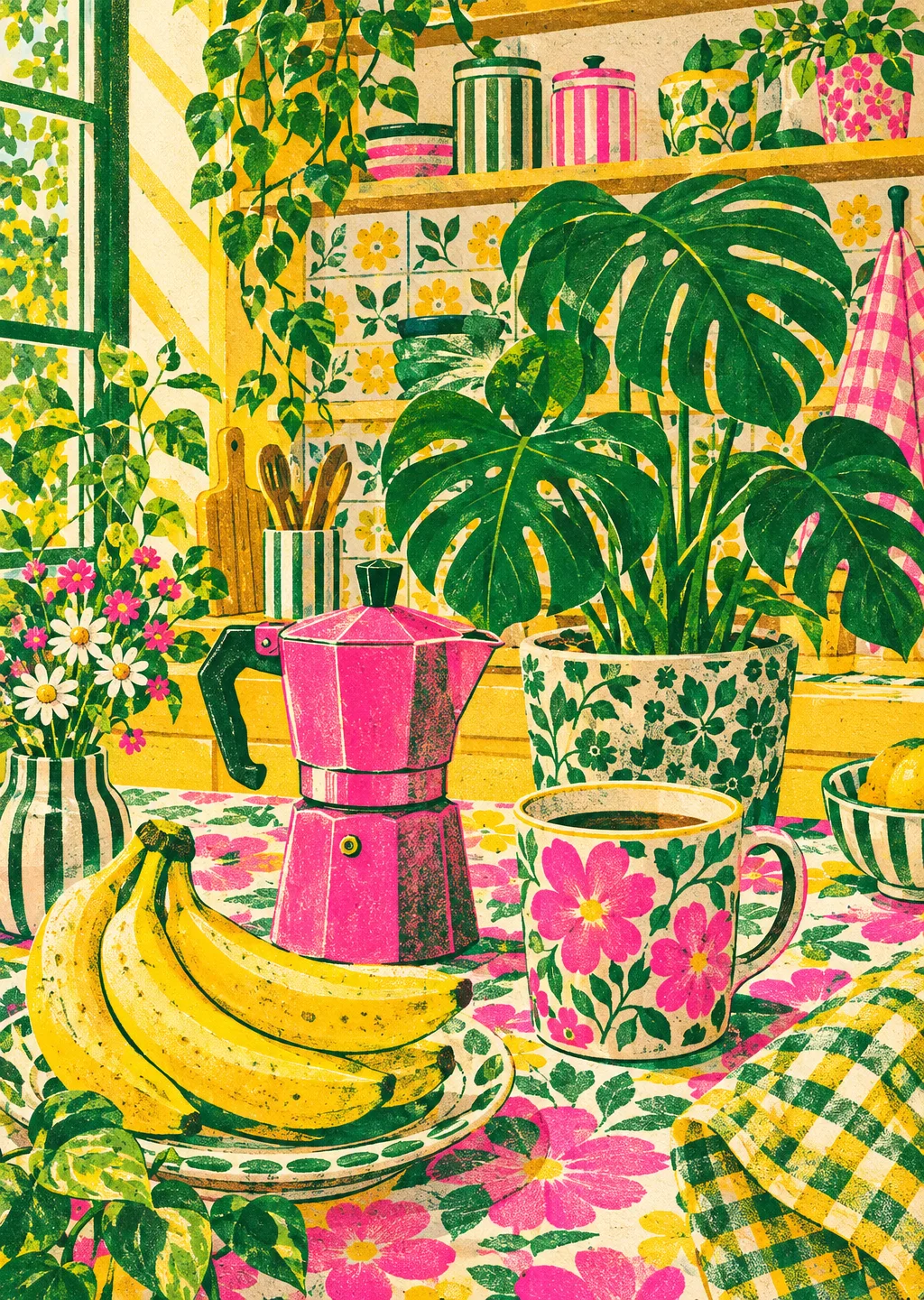
Shared tabletop: one continuous tabletop still life. The objects overlap across a common patterned tablecloth, tall objects behind low fruit and cups. A patterned wallpaper fills the upper background. No cabinet, cubbies or dividing bars.
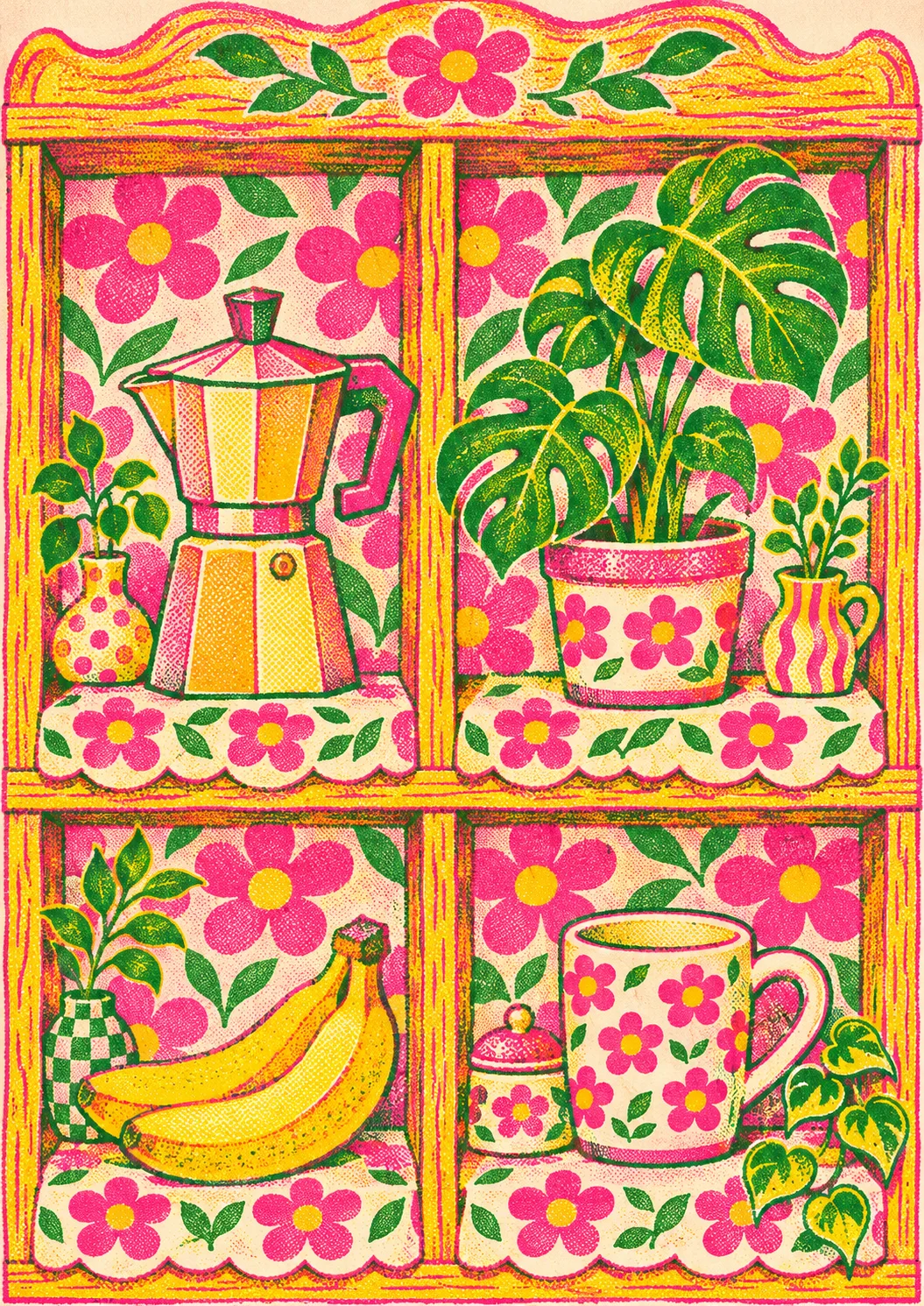
Cabinet cubbies: a front-facing open wooden curiosity cabinet fills the poster. Thick horizontal shelves and vertical partitions create separate visible cubbies. Put each collected object in its own open cubby, fully recognizable; no shared tabletop and no objects overlapping across partitions. Print the donor motif on fabric shelf liners and the cabinet's rear panels, adapting the pattern route to these surfaces. The wooden grid is a major visible structure, not thin decorative lines over the tabletop scene.
Empty selection means Shared tabletop.

Use fluorescent pink, saturated green and golden yellow spot inks on warm cream stock. Dense interlocking shapes, playful flattened perspective, bold uneven drawn contours, coarse halftone dots, slight registration offsets, darker overprinted intersections and dry ink grain. Keep the maximalist abundance but make the collected objects readable. No photographic shading or glossy 3D. Original invented household objects only, no brands, existing artwork or recognizable characters. No lettering, signature, watermark, frame or room mockup. Edge-to-edge poster art.

[Final output format]
Output size 2480x3508 pixels, A4 portrait, 300dpi, print-ready poster.
This selected output format takes priority over any fixed canvas size or aspect ratio elsewhere in this template. Adapt the composition, text zones and margins to the selected canvas without stretching or cropping essential content. Device safe areas apply only when a device is selected. Never print these format instructions on the image.
How did it turn out?
More cards in this category


How to use it · FAQ
The little flowers on the mug grew across the wall
We drew a moka pot, bananas, a potted monstera and a floral mug twice. In both results the mug’s pink flowers reappeared at a larger scale on the tablecloth and wallpaper. One small cup tied the whole composition together, while the foreground bananas and tall leaves stayed recognizable. All three images retained the grainy fluorescent pink, green and yellow ink treatment.
A table became a collection cabinet
Changing only “Display structure” to “Cabinet cubbies” introduced thick vertical dividers and horizontal shelves. The pot and plant occupied separate upper cubbies; the bananas and mug sat below. Objects that had overlapped on one table were separated by wood, and the flowers moved onto shelf liners and rear panels. The same belongings can become an abundant tabletop scene or a cabinet of collected treasures.
The petals were not exact copies
We specified six petals, but the petal count varied. The card carries a motif’s character through a scene rather than reproducing an exact pattern tile. Flowers also spread onto the plant pot and cabinet trim, and extra small vases and leaves appeared. The pattern destination suggests where decoration begins; it does not strictly exclude other surfaces.
For your own objects, name both the donor and its motif, such as “blue dots on the cup.” These tests used invented objects described in words; preservation of actual belongings from photos was not tested. The output is a single illustration, not separated plates for a risograph press.
Last checked · Published