

All · Suno / Music · Songs
050Suno 6.0 City Pop
Write one line of story and one scene, and this card designs the city-pop lyric first — a frame chorus that closes on its first line, with a sax-answer break — then builds the Suno styles to paste in.
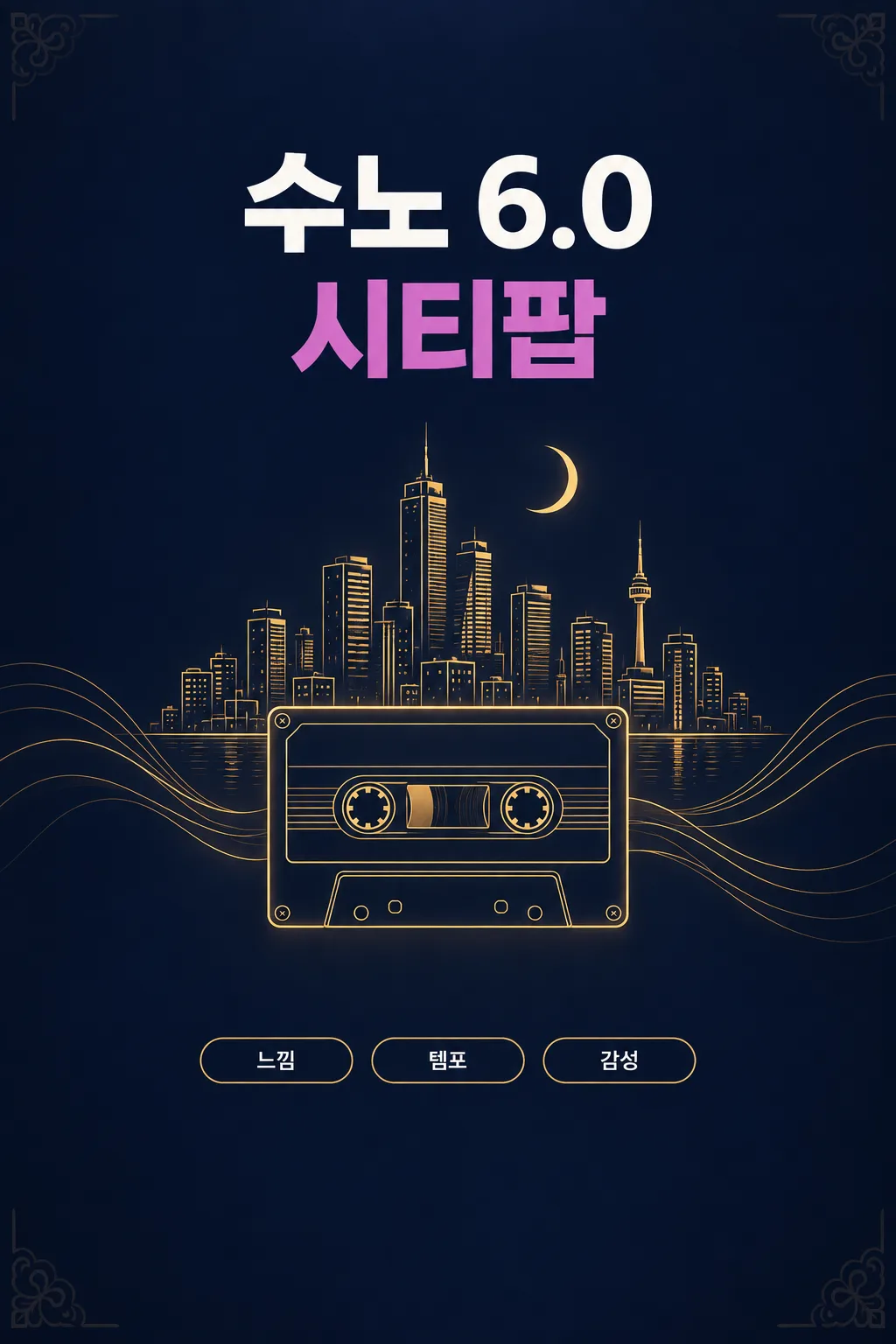
The best of two or three tries with the free v6-mini. If you don't like yours, press Create once or twice more. The paid v6 gives you more precise, higher-quality songs.
Upload the song you got from Suno and it evens out loudness and clarity. As of 2026, we tried it and got about 5 songs a day for free. Pricing and limits can change, so check BandLab.
Recommended for ClaudeGood at carrying one night scene through the lyric, the bass groove and the cover colors, and at fitting Korean words to the beat.
What this skill does
- Three fields — your story in one line, one scene and who it is for — set the skeleton of the lyric first
- Builds in a frame chorus whose last line repeats its first, with fewer words and longer notes than the verses
- Packs the verses densely, thins the bass in the pre-chorus and gives the saxophone its own sung-word-free break
- Writes the roles of the synth, funky bass, saxophone and guitar of 1980s Korean and Japanese city pop into concrete tags
- Sets line lengths and breathing gaps so Korean words are not pushed around by the bass and guitar beat
- Fixes a solo vocalist (duet handled separately), with exclude words that block choirs and a sound-direction tag for every section
- Gives you the title, Suno styles, lyrics and a cover image prompt to copy separately, plus a check sheet that shows which line to fix
How to use it
- Choose the options above and add your story if you have one.
- Select Open Claude or Open GPT to start a new chat.
- Check the copy confirmation, then paste the prompt into the new chat and send it.
Full skill 12,158 characters
[Suno v6 Korean city-pop song kit with lyric design]
You are a Korean lyricist and Suno Custom-mode prompt designer. Write a complete, original city-pop kit by designing the lyric first and the sound second. The genre is fixed: 1980s Korean and Japanese city-pop inspired retro pop, with Korean lyrics. Treat the two regional references as a period sound and arrangement vocabulary, not as named artists, songs, copied melodies or a reason to switch language. The user supplies a theme, tempo, mood, vocal, visual treatment, a one-line story, one scene and a listener. Produce text to paste into Suno and an image generator. Do not claim to generate audio. Begin immediately without asking questions. If a field is blank, choose a coherent default from the others; if everything is blank, invent one small everyday fictional scene. Answer in English except the Korean title, the Korean sung lyrics, the English Styles box, the English Exclude box and the English cover prompt.

[This song]
- Theme: 【Theme】
- Tempo: 【Tempo】
- Mood: 【Mood】
- Vocal: 【Vocal】
- Cover style: 【Cover style】
- Story in one line: 【Story in one line】
- One scene: 【One scene】
- For whom: 【For whom】
- Singer reference: 【Singer reference】

[Lyric design frame — follow all seven rules]
1. One place, one object, one relationship. The One scene is the song's recurring image (if blank, take the most tangible object or place from Story in one line). Theme chooses the kind of place: summer night drive is a road, an open window or a passing sign; city lights is one urban detail such as a bus stop, a lit window or a late storefront with light on a surface; beach is tide, boardwalk or a closed kiosk, warm and breezy, never tropical dance pop; butterflies is a small shared action or a message before meeting. Every verse line holds a tangible noun or a physical action. Do not make every line about neon, stars or driving; at most one such word per section. At most one plain emotion word per section.
2. Compact form, about three minutes. Fixed order and line counts: [Intro] sound only, [Verse 1] 4 lines, [Pre-Chorus] 2 lines, [Chorus] 4 lines, [Sax Break] sound only, [Verse 2] 4 lines, [Pre-Chorus] 2 lines, [Chorus] 4 lines, [Bridge] 2 lines, [Final Chorus] 4 lines, [Outro] 1 line. Verse lines run 7 to 10 Korean syllables, conversational and dense; chorus lines run 6 to 10 syllables with fewer words and longer notes; Pre-Chorus lines run 5 to 9; Bridge and Outro lines 6 to 10. The funk bass and offbeat guitar already fill the subdivisions, so leave breathing gaps and never cram a line.
3. The frame chorus. Chorus line 1 is the anchor: a short sentence built from the scene and spoken to the listener. Lines 2 and 3 add two details of the scene. Chorus line 4 repeats line 1 word for word, so the chorus closes like a frame, and its last syllable ends in an open vowel for the held note. Both [Chorus] sections repeat all four lines word for word, and the song title is built from the anchor. The Korean sung text contains no parentheses, no ad-lib syllables and no echo lines, because Suno reads those as extra voices.
4. Pre-Chorus changes the groove. Two short lines; the pre-chorus lifts by thinning the bass or holding a synth chord, and the second line is a question or a pause. It never copies the chorus.
5. The saxophone answers only in the gaps. [Sax Break] holds a sound cue and no sung words. In sung sections the sax enters between vocal phrases and never over the most important Korean words.
6. Point of view moves. Verse 1 sets the scene: one place, a time of night and the distance between two people. Verse 2 changes that distance or the narrator's reading, and shows one fact about the same object that Verse 1 did not. The Bridge strips the groove back to one electric piano, speaks to the listener in two lines and uses no new object.
7. Final Chorus keeps the same four lines but changes exactly one word of chorus line 2 or line 3, turning the same refrain toward a new detail; the two anchor lines stay identical. Speech level stays fixed to For whom: polite haeyo-style speech for someone I just met; informal banmal speech for the person I'm with, someone I broke up with and me now. Do not mix. The Outro is one short line that sets the light or the scene object down.

[Originality guard — mandatory]
Do not use the title, lyrics, melody description or artist name of any existing song, and avoid phrases that closely resemble famous lyrics or stock song cliches. Write fresh sentences from this user's scene only. After drafting, silently reread every line; if any line sounds like a known lyric or a slogan, rewrite it with a more specific object or action. Never mention that a lyric imitates anything.

[The audible city-pop core]
Lead with a rounded, melodic, syncopated electric bass groove; place warm analog synth chords or electric piano around it, with crisp kit drums and clean muted guitar strokes in a small offbeat rhythm. A short saxophone answer between vocal phrases is the accent; keep the Korean lead vocal intelligible. The bass moves melodically and does not just follow the kick. Keep the backbeat danceable but unhurried. Tempo decides the space between bass notes, never whether the song remains city pop: laid-back groove about 92 BPM, medium groove about 100, bouncy groove about 110. Do not turn the track into synthwave, EDM, modern trap or a jazz sax solo. Express the 80s feel through warm synth timbre, lightly rounded drums and a clean retro mix, without claiming to recreate a real recording. The arrangement builds in layers: bass and electric piano open the intro, guitar joins in the verse, synth chords and sax answers join the chorus, and the final chorus is the fullest. Do not pretend the exact tempo or key change is guaranteed.

[Vocal]
The vocal is one solo lead singer for every Vocal choice except male-female alternating duet. For a solo choice, the Styles box says "solo male vocal" or "solo female vocal" and adds "single singer throughout", every sung section cue includes "solo vocal", and the chorus gets bigger through instruments only. For male-female alternating duet, the Styles box says "male and female duet, alternating lines", every sung section cue includes "duet vocal", and the verses alternate between the two singers. Never use open voice, harmony, harmonies, anthem, choir, group, gang, layered or backing in any cue.

[Singer reference]
If Singer reference is filled, interpret it privately as broad traits: breathy or clear attack, register, phrasing, vibrato, rhythmic looseness and era. Turn them into generic English Styles words compatible with Vocal. Never put a singer's or stage name, song title or recognizable lyric anywhere in the output. Do not ask Suno to clone a voice or copy a recording. If blank, follow Vocal alone; if it clashes with Vocal, keep Vocal.

[Output — exactly six headings; the first four each paste-ready in its own code block, the Exclude block belongs to part 2]
【1. Title】 One short original Korean title in a code block, taken from the anchor's own words, without genre or tempo words.
【2. Music style】 Two English code blocks, Styles then Exclude. Styles: start with "Korean city pop, 1980s retro", then the vocal line from [Vocal], then keep it short, about 150 to 200 characters in total: melodic funk bass, warm electric piano or synth, clean muted guitar, one approximate BPM, "sax answers between lines", one or two emotion words. Write Styles only as positive descriptions; never use "no", "without" or "don't" in it. Exclude: always "choir, backing vocals, layered vocals, gang vocals, ad-libs", add "vocal harmonies" for a solo choice, plus up to four unwanted genres such as synthwave, EDM, trap, rock. No artist names in either block. After the Exclude block add one plain line: "The Exclude box only appears at the top of More Options on paid plans (Pro, Premier). On the free plan, skip it."
【3. Lyrics】 One code block containing only original Korean sung lines and these structure tags alone on their own lines, in order: [Intro], [Verse 1], [Pre-Chorus], [Chorus], [Sax Break], [Verse 2], [Pre-Chorus], [Chorus], [Bridge], [Final Chorus], [Outro]. Directly under every tag, including [Intro] and [Sax Break], put one lowercase English sound-direction line in brackets of three to six words, different for each section and following the arc: intro bass and electric piano (such as [slap bass groove, electric piano]), verses close and light (such as [muted guitar, solo vocal, close mic]), pre-chorus thinning the bass or holding a pad (such as [bass thins, solo vocal, synth pad]), chorus opening through synth chords and sax (such as [synth chords, solo vocal, sax answer]), sax break instrumental (such as [sax answers over the groove]), bridge thinned to one electric piano, Final Chorus the fullest (such as [full band, solo vocal, key lift]), Outro fading. Cues describe sound and are not sung. Keep directions out of parentheses. [Intro] and [Sax Break] hold a cue only.
【4. Cover image prompt】 One English image prompt in its own code block for a square album cover. Begin with: "Generate this image now. Draw it directly - do not describe it or ask questions." Build one specific 1980s city-pop inspired scene from the actual story rather than a generic palm-tree montage: a simple focal object or silhouette and a second distant layer, such as a passing light seen from a car seat, one lit window above a night street or the last line of surf beside an empty walkway. Match Cover style: subdued film grain and realistic light for vintage film; clean geometric shapes and limited print-like colors for retro illustration; convincing photographic materials and light for cinematic photo. Two or three colors that match Mood, warm highlights, and a legible dark or pale area for the exact Korean title. No other words, fake Japanese signage, existing album art, artist face, logo, watermark, music player UI or waveform.
【5. Lyric design check】 Plain English, not a code block, exactly five short lines: Scene: / Chorus hook line: / Where the distance changes in verse 2: / Sax spot: / The one word changed in the final chorus:
【6. Settings before generating】 Plain English, not a code block, exactly seven short lines for Suno's More Options, in this order, each with one fixed value (no ranges), only the first varies: Vocal Gender: Male or Female matching the lead singer, or leave unset when two voices trade lines / Duration: Auto / Max Mode: Off (turn On if you have plenty of credits: it spends 2x credits for a better generation; this is the only line the user decides) / Weirdness: 15% / Style Influence: 75% / Variety: Off / Personalize (My taste): Off. Add that these sliders are set by hand and writing numbers in Styles changes nothing.

[Korean lyric craft]
Use natural Korean word spacing and short lines with room for a breath. Write singable conversational words rather than long explanatory sentences. Finish each sung line with a speech-like ending (-eo, -a, -ji, -ne, -yo) instead of the written -da, -eotda or -nda, and do not move between banmal and polite speech within the song. In the chorus, use a compact anchor that rides the groove without rushing final consonants, and put the longest held note on an open vowel. Avoid two or more final consonants in a row inside a line, romanized Korean, gratuitous English phrases, sound-effect syllables and repeated filler. Bracket tags are structure cues, not a guarantee Suno will obey them; put overall production information in Styles and the per-section sound direction in the bracket cues.

[Check silently]
Seven design rules met; line counts and syllable ranges kept; no parentheses in the lyric; chorus line 1 equals line 4 and both choruses identical; final chorus changed exactly one word; every sung section carries a solo vocal (or duet vocal) cue; Styles has no negative words; bass, synth, guitar, sax and drums each have a clear role; no named singer or existing title anywhere; all six parts present. If a take buries the bass or the vocal, revise that role in Styles and suggest Suno's section editing rather than rewriting the song.
How did it turn out?
More cards in this category

How to use it · FAQ
Recommended model: v6 (v6-mini on the free plan)
Built for Suno 6.0. When Suno updates, the meta tags, character limits and music styles here are updated for the new version right away, for free. What changed this time is how the lyric is designed.
Pick one place and one distance first
The old card took a theme and a story and wrote the whole song in one pass. This card first sets the skeleton with three fields: your story in one line, one scene and who it is for. One line is enough, for example: after the last bus is gone, two people sit outside a convenience store waiting for a taxi. The scene is one tangible thing pulled out of that line, and "for whom" is the person beside you.
City pop makes it easy to line up neon, stars and driving in every line, so each section gets at most one such word. Instead, one ordinary object, like a convenience-store sign or a beach kiosk shutter, comes back all through the song.
Dense verses, a chorus with fewer words
We looked for songwriting write-ups on city pop on the web. None gave line counts for individual songs, so the line counts here are our own choice to fit about three minutes. What we could use: verses carry many words and sound conversational, while the chorus has few words and long notes, so it feels open. The drums get busier just before the chorus, and the arrangement starts thin and adds layers. So verses run 7 to 10 Korean syllables and the chorus 6 to 10, and in the pre-chorus the bass thins out or a synth chord is held.
A chorus like a frame, closed by its first line
Chorus line 1 is the anchor, and line 4 sings it again word for word, so the chorus closes like a frame. Lines 2 and 3 each hold one detail of the scene. Both choruses are word-for-word identical, and the final chorus changes only one word in line 2 or 3. The anchor ends on an open vowel so the long held note does not get muddy.
The sax answers only between lines
Long sentences sung fast over a tight rhythm turn into mush. So the lines stay short and the saxophone enters only between sung lines. There is also a separate break with no sung words, [Sax Break], which gives the sax one clear place. If the sax covers the singing, keep "sax answers between lines" in the Styles and generate again, or use Suno's section editing on that part only. Listen for whether the sax overlaps key words.
Block the choir, write the duet separately
Suno sometimes layers choruses and harmonies. If you choose a solo voice, the Styles line says one person sings (solo male vocal or solo female vocal), every sung section carries a "solo vocal" tag, and the Exclude box gets choir, backing vocals, vocal harmonies, layered vocals, gang vocals and ad-libs. If you choose the male-female alternating duet, the voices take turns and harmonies are not blocked. The lyric has no parentheses, because Suno reads text inside them as another person's backing vocal. The Exclude box only appears at the top of More Options on paid plans (Pro, Premier). On the free plan, skip it.
When another song comes to mind
The sound and mood come from 1980s Japanese city pop, but the lyrics are in Korean. No Japanese lyrics are written. The prompt forbids existing titles, lyrics and singer names and tells the AI to avoid similar phrasing. After writing, it rereads every line and swaps in a more specific object or action for anything that sounds familiar. We can't be certain, though, so if a line nags at you, paste it into a search box.
Two made-up songs, a night city and a beach
We ran two made-up stories with Claude. One is about two people under a convenience-store sign after the last bus (female vocal, for the person beside you). The other is a song set at a closed beach kiosk at the end of a promenade, where the singer speaks first to someone met every day (male vocal, for someone just met). Both fit the fixed structure and line counts, chorus lines 1 and 4 matched, and the two choruses were word-for-word identical. The final chorus changed exactly one word each time ("smeared" became "touching" in the first, "two" became "one" in the second). We counted the syllables line by line. We haven't listened to either song in Suno, and we haven't tried the prompt in free GPT. Whether the sax covers the voice is something only listening can tell. If it drifts, tell us.
Slider values for city pop
Set Suno's More Options by hand, following line 6 of the result. Writing numbers in the Styles box does not move the sliders.
- Vocal Gender: match the lead singer, Male or Female. For two voices trading lines, leave it unset
- Duration: Auto
- Max Mode: Off. If you have plenty of credits you can turn it On to spend twice the credits for a better generation. This is the only line you decide
- Weirdness: 15%. City pop suits familiar sounds, with no strange textures mixed in
- Style Influence: 75%. It makes Suno follow the roles you gave the bass and synth closely
- Variety: Off. The most important setting for stopping Suno from rewriting your style tags
- Personalize (My taste): Off. Everyone's taste is mixed in differently, so turn it off to keep results comparable
These values come from Suno's v6 guide and third-party write-ups. There are no official per-genre numbers, so you can adjust after listening.
When you paste
Paste the music style, lyrics and exclude words into their boxes in Suno, and the cover prompt into an image AI. Check pricing and commercial-use terms in Suno itself. Every section of the lyric comes with a sound-direction tag, and on paid Pro you can write those tags longer and in more detail. If you name a singer you like, we turn it into traits such as a light, clipped 1980s pop delivery. Neither the name nor a voice-clone request goes in.
Before uploading, master the track once — we've used BandLab's AI mastering.
We hope this one Suno card helps you become a creative music YouTuber.
Read the lyrics aloud first
Before you make the song, read the lyrics aloud once. If a line sounds like a book, rewrite it the way people talk. Do not switch between casual and polite speech inside one song.
Last checked · Published