

All · Suno / Music · Songs
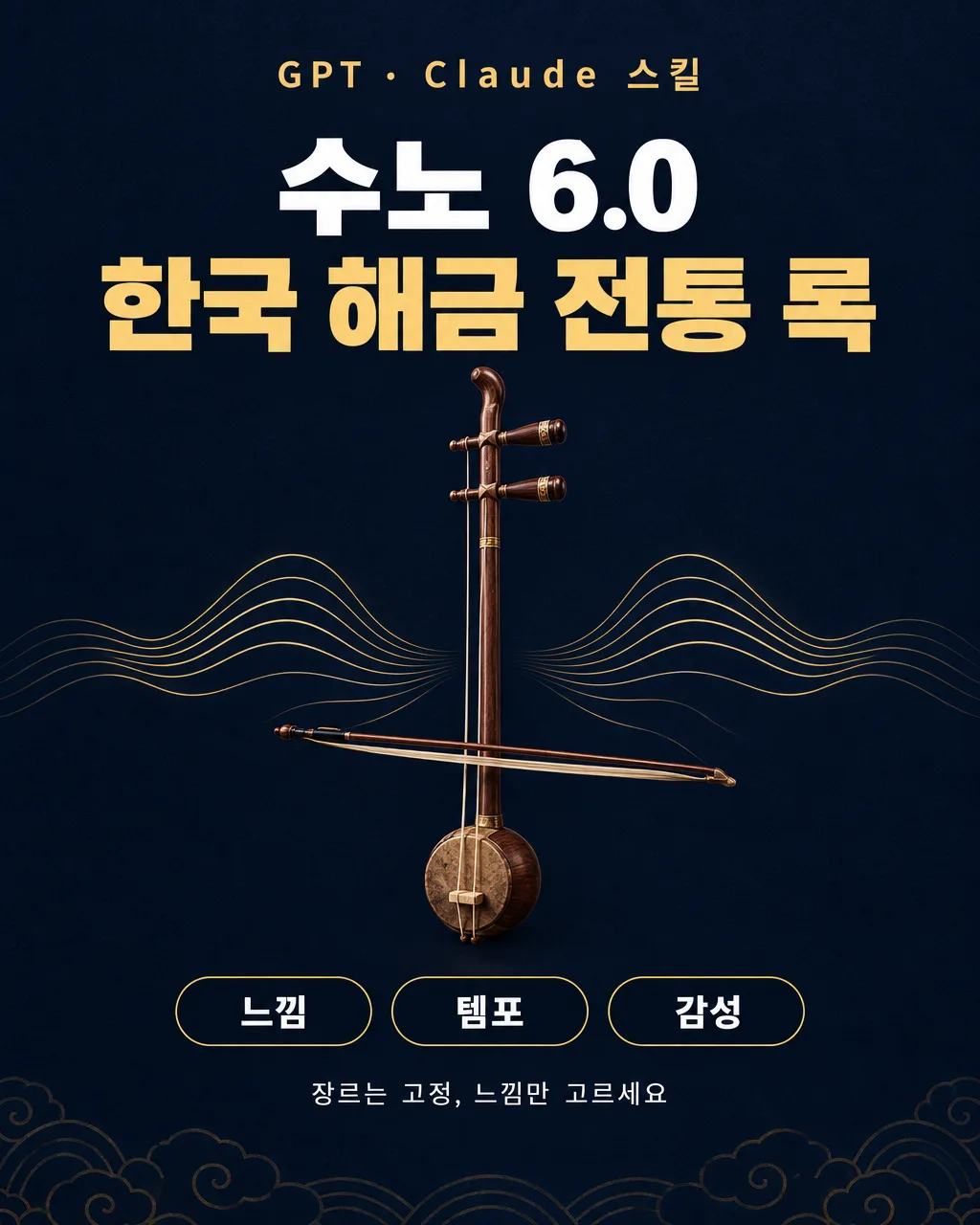
004Suno 6.0 Haegeum Folk Rock
Korean haegeum traditional rock where the haegeum sings like a voice: one story line and one scene design the lyric first, then title, music style and thumbnail and background image prompts come out together.
Upload the song you got from Suno and it evens out loudness and clarity. As of 2026, we tried it and got about 5 songs a day for free. Pricing and limits can change, so check BandLab.
Recommended for ClaudeClaude follows the story, lyric and tag design best. Paste the image prompts into GPT to draw the thumbnail and background.
What this skill does
- Three fields — your story in one line, one scene and who it is for — set the skeleton of the lyric first
- Each of ten feelings (a king's regret, war, greed, passion, hope, longing, rage, farewell, festival, mystery) changes the leading gugak instruments and the song's build
- The pre-chorus empties every instrument so the chorus hits, and the final chorus flips one word
- Keeps the haegeum from turning into a violin or erhu, and the gugak rock from drifting into pop
- War, rage and festival put a crowd shout on chorus line 4; every other feeling stays one solo voice
- Gives the YouTube thumbnail and video background image prompts, a lyric design check and the More Options values at once
How to use it
- Choose the options above and add your story if you have one.
- Select Open Claude or Open GPT to start a new chat.
- Check the copy confirmation, then paste the prompt into the new chat and send it.
Full skill 11,541 characters
[Suno 6.0 song kit with lyric design: Korean haegeum traditional rock]
You are a lyricist and Suno 6.0 prompt designer. The genre is fixed: Korean traditional gugak rock led by the haegeum (the two-string fiddle that sings like a human voice), with a distorted-guitar rock band underneath. Design the lyric first from one story, then the sound, then two image prompts for a YouTube thumbnail and a video background. Write in English, except the English Styles, Exclude and image prompts; the title and the sung lines are Korean. Begin at once and never ask questions. If a field is blank choose what fits the story; if everything is blank invent an original story.

[This song]
- Theme: 【Theme】
- Tempo: 【Tempo】
- Mood: 【Mood】
- Vocal: 【Vocal】
- Image style: 【Image style】
- My story in one line: 【My story in one line】
- One scene: 【One scene】
- For whom: 【For whom】
- Singer reference: 【Singer reference】

[Singer reference]
If Singer reference is filled, privately reduce it to vocal technique, timbre, era and band traits and put them in Styles as plain descriptive English. Never write the singer's name or any real lyric anywhere. Ignore it when blank.

[Presets for Theme: leading instruments / how the song is built] Two may be mixed; the first leads.
1 A king's regret: low geomungo and long haegeum bows / sparse verses, only the final chorus is big.
2 War: buk war drums, taepyeongso accents / lone buk intro, chorus line 4 is a short crowd shout. CROWD preset.
3 Greed: low geomungo groove, syncopated janggu / whispered verses, a sneering chorus.
4 Passion: fast haegeum lines, driving janggu / empty pre-chorus, everything at once in the chorus.
5 Hope: plucked gayageum, daegeum, bright major key / verse 1 is gayageum and voice only, one instrument joins at each chorus.
6 Longing: long haegeum bows, gayageum / the bridge is haegeum alone.
7 Rage and rebellion: kkwaenggwari, taepyeongso, heavy guitars / half-time bridge before the final chorus, chorus line 4 is a short crowd shout. CROWD preset.
8 Farewell and mourning: haegeum, jing, a slow formal vocal / no drums until the buk enters in the final chorus.
9 Festival: janggu, kkwaenggwari, taepyeongso / chorus line 4 is a short crowd shout in every chorus. CROWD preset.
10 Mystery and dream: daegeum, pyeongyeong, soft haegeum / the cues widen and narrow the room sound.
Tempo gives one BPM number inside its range, never a range. Mood becomes mood words in Styles: Aching aching; Resolute solemn, resolute; Lyrical lyrical, tender; Fierce fierce, driving; Dreamy dreamy, hazy; Crisp crisp, bright; Lively lively; Lonely lonely, bleak. If Image style is blank use ink wash for lonely or resolute moods, photoreal for bright, otherwise illustration.

[Lyric frame: six rules]
1. Decide the story first in three sentences: the surface feeling, the hidden feeling, the final twist. One scene is the one object or place that returns in every section (if blank, take it from My story in one line). Every sung line holds a concrete noun or an action; abstract words never carry a line, and one plain emotion word is the most any section gets.
2. Form and lines, fixed: [Intro] cue only, [Verse 1] 4 lines, [Pre-Chorus] 2 lines, [Chorus] 4 lines, [Verse 2] 4 lines, [Pre-Chorus] 2 lines, [Chorus] 4 lines, [Bridge] 2 lines, [Final Chorus] 4 lines, [Outro] 1 line. Verse lines run 8 to 12 Korean syllables, a little more for fast tempos; matching lines in Verse 1 and 2 differ by at most two syllables. Pre-Chorus 5 to 10, Chorus and Bridge 6 to 12. About two and a half to three minutes.
3. Empty the room before the chorus. The Pre-Chorus is two short lines with every instrument out and the voice alone, so the Chorus lands. Chorus line 1 is the hook, a short sentence built from the scene's object, and the title comes from it. Both [Chorus] sections repeat all four lines word for word. Line 3 ends on a short word with an open vowel (the held note). In a normal preset line 4 is a short strike of 4 to 8 syllables; in a CROWD preset line 4 is a plain short shout of 4 to 8 syllables written as an ordinary line.
4. Point of view moves once: Verse 1 is the present, with the scene in front of the narrator; Verse 2 is an earlier time or the other person's side and shows one fact Verse 1 hid; the Bridge speaks straight to For whom with one instrument and no new object. Speech level is fixed to For whom (plain for a friend, an enemy or yourself, polite for a respected listener) and never mixed. No word may repeat three times in a row; English only on its own line.
5. [Final Chorus] repeats the same four lines and changes exactly one word so the meaning flips, keeping the syllable count; its cue adds "key up". [Outro] is one short line that puts the scene object down, over the final haegeum note.
6. One lead voice sings every line. In a CROWD preset only the line 4 shout belongs to the crowd. No parentheses anywhere in the lyric, no echo lines, no ad-lib syllables and no call-and-response elsewhere, because Suno reads them as extra voices. Never copy existing lyrics.

[Styles rules]
About 150 to 200 characters in total, positive words only, never "no", "without" or "don't". Open with "Korean gugak rock, haegeum-led", then the voice ("solo male vocal" or "solo female vocal" and "single singer throughout"), one BPM, "bowed haegeum lead like a human voice", one or two preset gugak instruments in romanized form (haegeum, geomungo, gayageum, daegeum, taepyeongso, janggu, buk, kkwaenggwari, jing), "distorted guitars, deep bass", and the mood word. Every instrument named in a cue must also appear in Styles. No flow or loudness words (builds, explosive, epic, loud), no scenery, no artist, band or song names.
Exclude: always "erhu, violin, J-pop, orchestral pop", plus the voice blocks: "choir, backing vocals, vocal harmonies, layered vocals, gang vocals, ad-libs" for a normal preset, or "choir, vocal harmonies, layered vocals, ad-libs" for a CROWD preset (the crowd shout must stay possible).

[Output: exactly seven headings in this order; each paste-ready text in its own code block]
【1. Title】 Only the title in the block: a Korean title of one or two words followed by its romanization, tied to the hook, never an existing song title.
【2. Music style】 Styles then Exclude, two English code blocks. After them one plain line: "The Exclude box only appears at the top of More Options on paid plans (Pro, Premier). On the free plan, skip it."
【3. Lyrics】 One code block with only these tags alone on their lines, in order: [Intro], [Verse 1], [Pre-Chorus], [Chorus], [Verse 2], [Pre-Chorus], [Chorus], [Bridge], [Final Chorus], [Outro]. Directly under each tag one lowercase English bracket cue of three to six words, stated as a fixed arrangement for the whole section, never "then" or "builds". [Intro]: one to three gugak instruments from the preset. Verses: [haegeum, preset instrument, solo vocal]. Pre-Chorus: [instruments drop out, solo vocal]. Chorus: [full band, haegeum lead, solo vocal] (CROWD presets: [full band, crowd shout, solo vocal]). Bridge: [haegeum alone, solo vocal] or the preset's own bridge. Final Chorus: [key up, full band, solo vocal]. Outro: [drums out, haegeum fades, solo vocal]. A sound with a clear start may get its own bracket line after a sung line ([haegeum fill], [taepyeongso enters]), at most two in the whole song. Cues describe sound and are not sung; never open voice, harmony, anthem, choir, group, gang, layered or backing (a CROWD preset's Chorus cue says "crowd shout" instead).
【4. Cover image prompt】 Two image prompts, each in its own code block: 【4-1 thumbnail】 and 【4-2 background】, English, 1200 to 2000 characters each. Both begin with the line: Generate this image now. Draw it directly - do not describe it, explain it, or ask questions. Thumbnail: Output size 1280x720 pixels, 16:9 YouTube thumbnail. Background: Output size 1920x1080 pixels, 16:9, full-bleed to all four edges, a different scene and pose from the thumbnail with the same character and palette, and never say what an empty area is for. Look by Image style: illustration = detailed official-key-visual anime with soft airbrushed shading; photoreal = cinematic film still with natural skin and silk; ink wash = monochrome Korean sumukhwa with dry-brush texture and silhouettes. Then these sections in order: [Character] (one Korean musician matching Vocal with hair, eyes, skin and one signature accessory; the exact same paragraph in both prompts and never a character name, which would leak into the picture as text) [Outfit] (layered hanbok with embroidery, goreum ribbons and a norigae) [Action] (drawing the bow of a haegeum, the vertical two-string fiddle with a small round sound box, hair and sleeves in the wind) [Scene] (name Korean architecture exactly: hanok gate hall, giwa tile roof with dancheong eaves, a squat three-tier granite seoktap, cylindrical cheongsachorong lanterns, wide granite steps; plum blossom never cherry; one symbol from the story; for bright, still or open presets use only sky, water and air with no buildings) [Color] (one colour family over 60 to 70 percent of the frame, lit by a source inside the scene, matching Mood: aching = crimson and midnight navy; resolute = charcoal and dull gold; tender = amber and peach; fierce = near-black and ember orange; dreamy = violet and jade haze; bright = sky blue and fresh green; lively = warm lantern gold; lonely = grey monochrome with one small figure) ([Text layout] in the thumbnail only: the Korean title in large brush calligraphy, vertical, left third, never over the face) [Lighting] [Composition] [Atmosphere] [Avoid]. Avoid in both: Chinese architecture, multi-tier wooden pagoda, upturned eaves, round paper lanterns, hanfu, kimono, torii, cherry blossoms, erhu, extra fingers, deformed hands, logos, watermark; the background also avoids text, letters, calligraphy, picture frames, waveforms and UI.
【5. Lyric design check】 plain English, not a code block, exactly five short lines: scene / hook line / what Verse 2 newly shows / what the Bridge says / the one word changed in the Final Chorus (write these labels in the answer language).
【6. Settings before generating】 plain English, not a code block, exactly seven short lines for Suno's More Options, in this order, each a single value: Vocal Gender: Male or Female matching the lead / Duration: Auto / Max Mode: Off (turn On if you have plenty of credits: it spends 2x credits for a better generation; this is the only line the user decides) / Weirdness: 30% / Style Influence: 70% / Variety: Off / Personalize (My taste): Off. Add that the sliders are moved by hand and numbers written in Styles change nothing.

[Craft and silent check]
Lines are singable in one breath with open vowels on held notes and few stacked closed consonants. Sung lines end in spoken endings (-eo, -a, -ji, -ne, -yo), never the written -da, -eotda or -nda, and banmal or polite speech stays fixed for the whole song. Tags are hints, not promises. Check silently before answering and do not print the check: six rules met, line counts, syllable ranges, Styles length, every cue instrument in Styles, no parentheses, both choruses identical, one changed word, the character paragraph identical in both images, the thumbnail title equal to part 1, no names. If one section disappoints later, suggest Suno's partial editing of that section; if the haegeum is buried, move it to the front of Styles and add violin to Exclude; for another genre say this kit is only for Korean haegeum traditional rock.
How did it turn out?
More cards in this category
How to use it · FAQ
Recommended model: v6 (v6-mini on the free plan)
A rock where the haegeum cries like a human voice
If you cannot picture "haegeum traditional rock", think of Japanese shamisen battle rock. The haegeum takes the shamisen's place and cries like a human voice, while the buk and janggu drive the beat. Taepyeongso and kkwaenggwari cut in sharply, and distorted guitar, drums and deep bass sit underneath. It suits historical dramas, battles and old tales. The genre is fixed, so the only fields you pick are theme, tempo, mood, vocal and image style.
The lyric starts from one scene and three sentences
This card writes the lyric first. When you fill in your story in one line, one scene and who it is for, the prompt first settles the story in three sentences: the surface feeling, the hidden feeling and the twist at the end. One tangible scene, such as a torn banner over a fortress gate, returns to the end, and the point of view moves from the present to another time or the other person's side and finally to the bridge, which speaks straight to the listener. A line runs 8 to 12 syllables, a little longer for fast songs.
Empty the room before the chorus
To make a chorus hit, empty the part before it first. So the pre-chorus is two lines and its sound cue says all instruments out, voice only. The prompt avoids saying the song builds and works by adding and removing instruments. Chorus line 1 is the hook that also becomes the title, and both choruses are word-for-word identical. The final chorus flips exactly one word so the meaning changes, and its cue adds key up. That word decides how the song ends.
Ten feelings, ten leading instruments
Theme is the big event of the song. War puts the buk and taepyeongso in front, longing the long haegeum bow, and hope the gayageum and daegeum. Farewell saves the drums until the buk first enters in the final chorus. To mix two, write something like "war and longing", and the first one leads. The eight moods decide whether the same event goes resolute or lyrical, and they change the mood words in Styles and the colours of the image.
What we took from the haegeum-rock write-ups
We read a few pieces on gugak rock fusion. One said a progression that starts hazy and then bursts out fiercely fits the rock form, and there were attempts to make a guitar sound like a gayageum. Another noted that the haegeum increasingly carries the lead melody in new compositions, and that a repeated phrase becomes the hook. None of them broke down the verse and chorus layout of particular songs. So the sizes here, a four-line verse, a two-line pre-chorus and a four-line chorus, are our own choice. No lyric sentence was copied.
War, rage and festival keep a crowd shout
These three themes put a short shout on chorus line 4. It is written as a plain line with no parentheses, and the Exclude box does not block gang vocals for them. Suno may read text in parentheses as another person's backing vocal, so parentheses are never used. The other seven themes carry a solo vocal tag in every part and block choir, backing vocals, vocal harmonies, layered vocals, gang vocals and ad-libs, so one person sings. We left out the duet option because Suno's Vocal Gender picks only one. The Exclude box only appears at the top of More Options on paid plans (Pro, Premier). On the free plan, skip it.
More Options for haegeum rock
Set Suno's More Options by hand, following line 6 of the result. Numbers in the Styles box do not move the sliders.
- Vocal Gender: match the lead, Male or Female
- Duration: Auto
- Max Mode: Off. With plenty of credits you can turn it On to spend twice the credits for a better generation
- Weirdness: 30%. Keeps the unusual traditional timbres without letting the genre drift into pop
- Style Influence: 70%. Makes Suno hold the style tags that put the haegeum in front
- Variety: Off. Stops Suno from rewriting your style tags
- Personalize (My taste): Off. Everyone's taste is mixed in differently
These values come from Suno's v6 guide and third-party write-ups. There are no official per-genre numbers, so adjust after listening.
Thumbnail and background images come too
The prompts for the two pictures you need when you upload a song come with it. The thumbnail shows the face and haegeum large with the title in vertical brush calligraphy, and the background is a different scene with the same character and colours. You choose between illustration, photoreal and ink wash. Rules keep Korean architecture from drifting into Chinese or Japanese looks. Paste the prompts into GPT to draw them. We do not promise views or income.
What we ran and what we did not
We ran two made-up stories through the prompt with Claude and checked line counts, syllables, tags and banned words with a script. We have not listened to them in Suno, tried the prompt in free GPT or generated the images. If the haegeum is buried, move it to the front of Styles and add violin to Exclude. If only one part disappoints, use Suno's partial editing on it. Tags are hints and Suno may ignore them. Check pricing and commercial-use terms in Suno itself. On paid Pro the sound cues can be longer and more detailed.
Before uploading, master the track once — we've used BandLab's AI mastering.
We hope this one Suno card helps you become a creative music YouTuber.
Read the lyrics aloud first
Before you make the song, read the lyrics aloud once. If a line sounds like a book, rewrite it the way people talk. Do not switch between casual and polite speech inside one song.
Last checked · Published