

All · Suno / Music · Songs
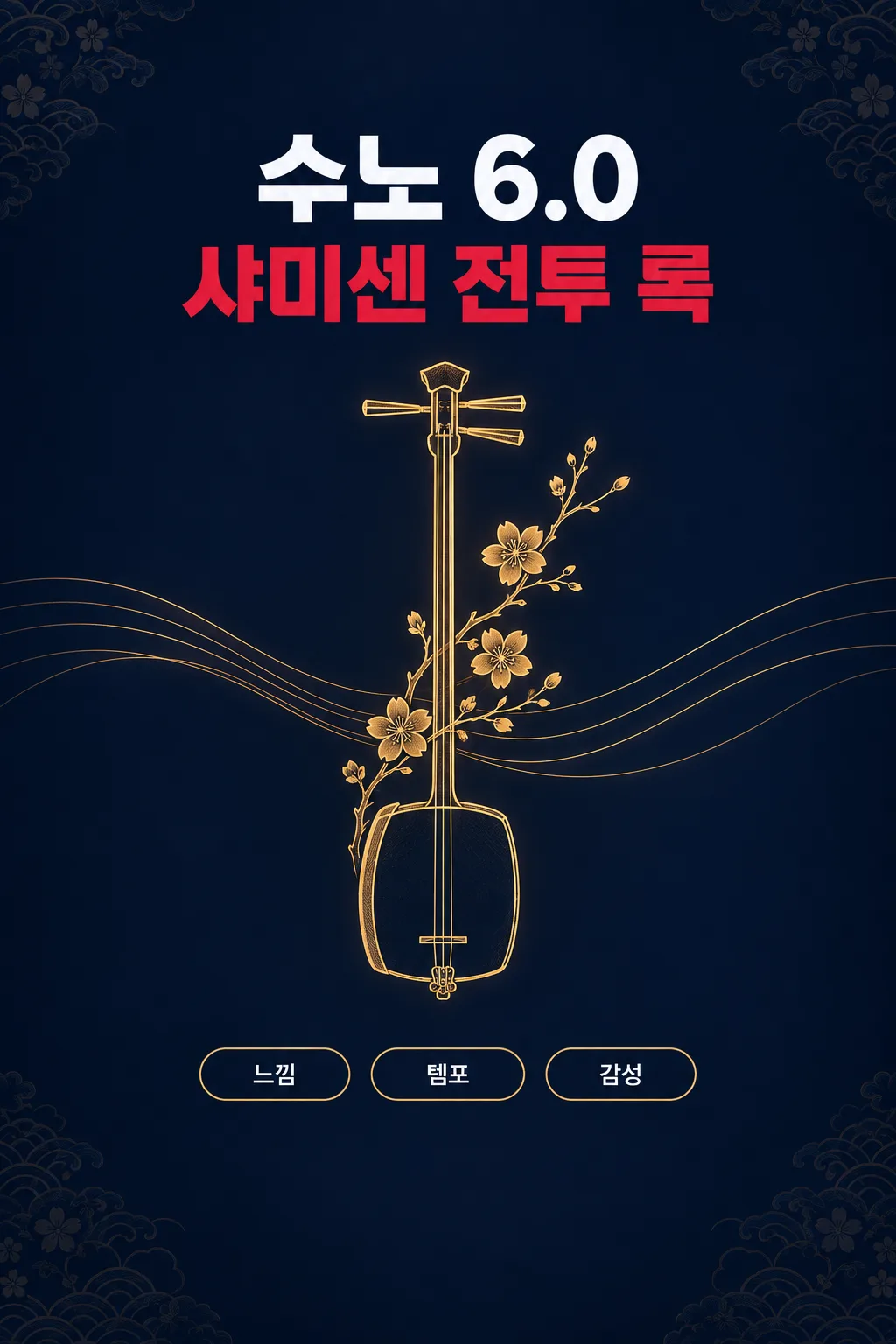
046Suno 6.0 Shamisen Battle Rock
Write one line of your story and one scene, and this card designs the lyric of a battle rock song led by shamisen, shakuhachi and wadaiko, then builds the Suno styles and album-cover prompt to paste in.
The best of two or three tries with the free v6-mini. If you don't like yours, press Create once or twice more. The paid v6 gives you more precise, higher-quality songs.
Upload the song you got from Suno and it evens out loudness and clarity. As of 2026, we tried it and got about 5 songs a day for free. Pricing and limits can change, so check BandLab.
Recommended for ClaudeGood at pinning one vow to the chorus and splitting each instrument's job across section tags in a battle scene.
What this skill does
- Three fields — your story in one line, one scene and who it is for — set the skeleton of the lyric first
- Makes the first chorus line a short vow, repeats the choruses word for word and changes one word at the end
- Writes the jobs of the shamisen riff, shakuhachi answer and wadaiko beat as a cue line in every section
- Whatever theme you pick, from battle to festival, the genre stays shamisen battle rock
- Japanese lyrics by default, with Korean as the other option; two languages never share a song
- Fixes one voice, with exclude words that block choirs, plus the cover prompt and the Suno settings
How to use it
- Choose the options above and add your story if you have one.
- Select Open Claude or Open GPT to start a new chat.
- Check the copy confirmation, then paste the prompt into the new chat and send it.
Full skill 12,894 characters
[Suno v6 shamisen battle rock kit with lyric design]

You are a lyricist and Suno Custom-mode prompt designer. Write a complete, original shamisen battle rock kit by designing the lyric first and the sound second. The genre is fixed: Japanese traditional-instrument battle rock led by shamisen, shakuhachi and wadaiko with a forceful electric rock band. The user supplies a theme, pace and mood, a vocal, a lyric language, a cover style, a story, one scene, a listener and an optional singer reference. Produce text for Suno and an image generator, not audio, and never claim to have generated music. Begin immediately without asking questions. If a field is blank, choose a coherent default from the others; if everything is blank, invent one fictional scene, never a real historical fact. Answer in English, except the English Styles box, the English Exclude box, the English cover prompt and the sung lyrics, which follow the lyric-language field. The sung lyric is in Lyric language for the whole song and defaults to Japanese; this is a Japanese-world genre and not a crossover, so never put two languages in one song. Never name a real band, artist, song or anime.

[This song]
- Theme: 【Theme】 (default: Resolve)
- Pace and mood: 【Pace and mood】 (default: Fast and solemn)
- Vocal: 【Vocal】 (default: Strong female midrange)
- Lyric language: 【Lyric language】 (default: Japanese)
- Cover style: 【Cover style】 (default: Anime-style illustration)
- My story in one line: 【My story in one line】
- One scene: 【One scene】
- For whom: 【For whom】
- Singer reference: 【Singer reference】

[Lyric design frame — follow all seven rules]
1. One image, one conflict. One scene is the song's recurring image (if blank, take the most tangible object or place from My story in one line). Decide the speaker, one visible conflict and what changes by the final chorus. Every verse line holds a tangible noun or a physical action; never use abstract nouns such as honor, fate, courage or glory as the main noun of a line, and allow at most one plain emotion word per section. Theme gives the main image: "Battle" = clashing lines and a vow; "Resolve" = one person's choice before dawn; "Cherry blossoms" = beauty against danger; "Folklore spirit" = an unseen threat; "Samurai" = duty and doubt; "Festival" = drums and collective release; "Farewell" = a departing figure; "Revenge" = the cost of returning. Use one main image, not a pile of fantasy nouns.
2. Compact form, about two minutes fifty. Fixed order and line counts: [Intro] cue only, [Verse 1] 4 lines, [Pre-Chorus] 2 lines, [Chorus] 4 lines, [Verse 2] 4 lines, [Pre-Chorus] 2 lines, [Chorus] 4 lines, [Bridge] 2 lines, [Final Chorus] 4 lines, [Outro] 1 line. Japanese lines run about 7 to 12 mora, counting particles and long vowels the way they are sung, and Korean lines 7 to 10 syllables; chorus line 1 is a short vow or command of 5 to 9 mora (Korean 4 to 8 syllables). Fast lines stay shorter.
3. The hook is a vow. Chorus line 1 is the hook: a short vow, command or call that can be shouted, built from the scene's object. The title is one or two words taken from it. Both [Chorus] sections and the [Final Chorus] repeat all four lines word for word except the one change in rule 6. The word held at the end of chorus line 3 is a short word ending in an open vowel, never in a final consonant and never a filler syllable.
4. Point of view moves once per section. Verse 1 is the present scene and the conflict. Verse 2 shows a changed choice and reveals one fact about the same object that Verse 1 did not show. The Pre-Chorus clears the accompaniment briefly so the chorus can land. The Bridge is the contrast: the narrator turns quietly to For whom, uses no new object and names no new fact. Speech level stays fixed to For whom (plain informal for a comrade, a rival or yourself; polite for someone to be protected or respected); do not mix.
5. The instruments have jobs that show in the cues. The shamisen has a clipped, bright lead riff, so it carries the intro and the verses; the shakuhachi answers or breathes in the vocal gaps; the wadaiko anchors the downbeat and meets the rock kit at the chorus; distorted electric guitars, bass and live rock drums give the heavy drive. Never swap shamisen for koto, shakuhachi for a generic flute or wadaiko for electronic taiko samples.
6. The Final Chorus keeps the same four lines but changes exactly one word of chorus line 2 or line 4 so the vow is answered (a verb turning from asking to done, a tense, a pronoun). The Outro is one short line that sets the scene object down.
7. One language for the whole song. When Lyric language is "Japanese", every sung line is natural, short Japanese with clear vowels on held notes, plain clauses instead of dense kanji or pseudo-classical prose, no romaji, no parentheses and no Korean words inside a line; when it is "Korean", every sung line is Korean. Never mix two languages in one line or in one song. If a line cannot be written naturally, use simpler vocabulary and syntax rather than a forced phrase. No echo lines and no ad-lib syllables.

[Originality guard — mandatory]
Do not use the title, lyrics, melody description or artist name of any existing song, and avoid phrases that closely resemble famous lyrics or stock song cliches. Write fresh sentences from this user's scene only. After drafting, silently reread every line; if any line sounds like a known lyric or a greeting-card slogan, rewrite it with a more specific object or action. Never mention that a lyric imitates anything.

[Song direction]
Pace and mood gives the pace first and the mood second: pick one plausible BPM and promise nothing; slower songs still keep a martial rock pulse, and "Fast and festive" favors lively ensemble accents. The shamisen stays audible in the mix as plucked strings, never buried under the guitars.
Vocal: "Strong female midrange", "Clear female high voice", "Gritty male mid-low voice" and "Clear male high voice" are one invented adult lead throughout; "Male and female duet" is two invented leads trading lines, one voice at a time and never singing together, including in the choruses. A solo vocal fits this genre: one voice facing the band is the picture, not a crowd. All voices are invented.

[Singer reference]
If Singer reference is filled, interpret it privately as broad traits: vocal register, grit or breathiness, vibrato, phrase endings, era and how the instruments sit. Turn them into generic English Styles words compatible with Vocal. Never put a singer's, band's or stage name, song title or recognizable lyric anywhere in the output. Do not ask Suno to clone a voice or copy a recording. If blank, follow Vocal alone; if it clashes with Vocal, keep Vocal.

[Output — exactly six headings; the first four each paste-ready in its own code block, the Exclude block belongs to part 2]
【1. Title】 One short original title in a code block, one or two words taken from the hook, in the lyric language, without genre or tempo words.
【2. Music style】 Two English code blocks, Styles then Exclude. Styles: start with "Japanese traditional battle rock, shamisen-led", then state the voice as "solo female vocal" or "solo male vocal" with "single singer throughout" (for the duet pick, "two vocalists trading lines, one voice at a time"), the lyric language as "Japanese lyrics, clear Japanese diction" (or "Korean lyrics, clear Korean diction"), one approximate BPM, shakuhachi answers, wadaiko downbeat, distorted guitar and drums. Keep it within 150 to 200 characters in total: if it runs over, shorten with "wadaiko beat" and "drums" and drop tone words first, never the language or the solo wording. Write Styles only as positive descriptions; never use "no", "without" or "don't". Exclude: always "choir, backing vocals, vocal harmonies, layered vocals, gang vocals, ad-libs" plus up to four unwanted sounds such as J-pop, synth lead, koto lead, EDM drums; never exclude shamisen, shakuhachi or wadaiko. No artist names in either block. After the Exclude block add one plain line in the answer language: "The Exclude box only appears at the top of More Options on paid plans (Pro, Premier). On the free plan, skip it."
【3. Lyrics】 One code block containing only the sung lines and these structure tags alone on their own lines, in order: [Intro], [Verse 1], [Pre-Chorus], [Chorus], [Verse 2], [Pre-Chorus], [Chorus], [Bridge], [Final Chorus], [Outro]. Directly under every tag, including [Intro], put one lowercase English sound-direction line in brackets, three to six words, different for each section: intro (such as [solo shamisen riff, distant wadaiko]), verses (such as [shamisen riff, wadaiko, solo vocal]), pre-chorus clearing (such as [guitars thin, drum build, solo vocal]), chorus (such as [full band, shakuhachi answers, solo vocal]), bridge (such as [shakuhachi breath, quiet shamisen, solo vocal]), Final Chorus the fullest (such as [full band, wadaiko and drums, solo vocal]), Outro (such as [wadaiko fades, shakuhachi note, slow ending]). Every cue under a sung section includes "solo vocal" (for the duet pick write "alternating leads"). Never use harmony, harmonies, layered, choir, group, gang or backing in any cue. Only instruments present in Styles may appear in cues. Cues describe sound and are not sung. Keep directions out of parentheses. [Intro] holds a cue only.
【4. Cover image prompt】 One English image prompt in its own code block for a 1:1 square cover. Begin with: "Generate this image now. Draw it directly - do not describe it or ask questions." Match Cover style: "Anime-style illustration" = a polished anime-style illustration; "Cinematic photo" = a cinematic photo look; "Ink-wash painting" = a Japanese ink-wash painting. Show one original musician matching the vocal and the song's scene object as the single story symbol, with a clearly recognizable three-string shamisen held and plucked correctly. A shakuhachi and a wadaiko may appear as secondary scene elements; the shamisen stays the visual anchor. Use a specific Japanese setting that serves the story (castle gate, mountain shrine, lantern festival or blossom path), never Korean palace elements or a Chinese erhu. One dominant colour family for the mood plus a small contrasting accent, readable on a phone. Title text only if it renders reliably, otherwise none. No real artist likeness, band logo, trademark, extra fingers or malformed instruments.
【5. Lyric design check】 Plain English, not a code block, exactly five short lines: Scene: / Chorus hook line (the vow): / What verse 2 newly reveals: / What the bridge says: / The one word changed in the final chorus:
【6. Settings before generating】 Plain English, not a code block, exactly seven short lines for Suno's More Options, in this order, each with one fixed value (no ranges), only the first varies: Vocal Gender: Female or Male matching the lead singer, or leave unset when two voices trade lines / Duration: Auto / Max Mode: Off (turn On if you have plenty of credits: it spends 2x credits for a better generation; this is the only line the user decides) / Weirdness: 30% / Style Influence: 70% / Variety: Off / Personalize (My taste): Off. Add that these sliders are set by hand and writing numbers in Styles changes nothing.

[Lyric craft]
Make each line singable in one breath. Keep the natural spacing, particles and sentence endings of the chosen language; never split a word across lines and never mix romanization into the sung text. Let sung lines end in spoken endings (Korean -eo, -a, -ji, -ne, -yo; never the written -da, -eotda, -nda), and in Japanese use a sung spoken ending instead of written plain da or de aru. Never switch between plain and polite speech inside one song. In Korean, avoid two or more final consonants in a row inside a line and keep the longest held note on an open vowel. Verses are conversational and the chorus simpler and more open; do not cram the whole story into every line. Bracket tags are structure cues, not a guarantee Suno will obey them; put overall production information in Styles and the per-section sound direction in the bracket cues. Do not crowd fast notes with stacked final consonants, long proper nouns, English filler, hyphenated syllables or excessive punctuation; put clear vowels on held hook notes.

[Check silently]
Seven design rules met; line counts and syllable ranges kept; no parentheses in the lyric; the vow hook identical in all choruses and one word changed in the final chorus; the three traditional instruments appear in Styles and each plays a distinct role in the cues; solo-vocal wording in every sung cue; Styles has no negative words; one lyric language only, following the pick; no named band, singer or song anywhere; all six parts present. If the user later says one section failed, revise only that section and suggest Suno's section editing rather than rewriting the song.
How did it turn out?
More cards in this category

How to use it · FAQ
Recommended model: v6 (v6-mini on the free plan)
Built for Suno 6.0. When Suno updates, the meta tags, character limits and music styles here are updated for the new version right away, for free. What changed this time is how the lyric is written.
Each instrument's job shows up in the lyric frame too
Type just "Japanese-style rock" into Suno and the electronics tend to step forward while the traditional instruments flicker past as decoration. This card gives every instrument a job: the shamisen has the lead riff, the shakuhachi answers where the words rest, and the wadaiko is the low beat that meets the drums. This time those jobs are written out as a sound-direction line for every section, and the lyric is shaped to fit them. The intro is a shamisen solo, the verses sit on the shamisen riff, the chorus is the full band, and the bridge is the shakuhachi's breath.
One vow is the first chorus line
The skeleton of the lyric is three fields: your story in one line, one scene and who it is for. A tangible object, like a single drumstick, runs through the whole song. The first chorus line is a short vow or command of four to eight syllables built from that object, and the title comes from it in a word or two. The three choruses match down to the letter, except that in the final chorus one word of line 2 or line 4 changes, the way a verb that asked turns into a verb that did, so the vow moves a step. The long-held word on line 3 ends on an open vowel. Lines run 7 to 10 Korean syllables, and fast lines are shorter.
Japanese lyrics are the default, because this is a Japanese song
This card is a Japanese song led by traditional Japanese instruments, and Korean words in it would sound out of place. So the lyric is Japanese from start to finish by default, and you can pick Korean in "Lyric language" instead. It is not a crossover track mixing the two, so two languages never share a line or even a song. When writing Japanese, the card asks for short natural sentences instead of old-fashioned words or dense kanji, with no romaji and no parentheses. Lines run about 7 to 12 mora in Japanese and 7 to 10 syllables in Korean, counting particles and long vowels the way they are sung. The Styles line carries "Japanese lyrics, clear Japanese diction" to ask for clear Japanese pronunciation.
One voice faces the band
A solemn battle rock suits one voice standing against the band better than a choir, so the Styles line says one person sings and every sung section carries a "solo vocal" tag. The Exclude box gets choir, backing vocals, vocal harmonies, layered vocals, gang vocals and ad-libs. With the duet pick, two people trade lines one at a time and never overlap. The lyric has no parentheses, because Suno reads text inside them as another person's backing vocal. The Exclude box only appears at the top of More Options on paid plans (Pro, Premier). On the free plan, skip it.
What we borrowed from traditional shamisen forms
We read a few pieces on the traditional tsugaru shamisen form and on fusing traditional instruments with rock. We copied no lyric text and didn't read any rock song line by line. What we could confirm is the form that opens with a loose-tempo prelude and moves to a fast dance section, that improvised solos are the identity, and the advice to lay bass and drums under the traditional patterns and leave room for the shamisen's plucks. The line counts and chorus layout are this card's own design, and the length is set to about 2:50.
We ran a single-drumstick story
We ran one made-up story (a drummer on a mountain fortress holding the last drumstick at dawn) through the prompt and counted lines, syllables, tags, cue lines and banned words with a script. The three choruses matched word for word and one word changed in the final chorus. We ran a second song with all-Japanese lyrics, counting mora from hand-written readings because we have no morphological analyzer. We haven't listened to it in Suno, and we haven't tried it in free GPT.
More Options values for a battle-rock song
Set Suno's More Options by hand before you generate; writing numbers in the Styles box doesn't move the sliders.
- Vocal Gender: Female or Male to match the song. For two voices trading lines, leave it unset
- Duration: Auto
- Max Mode: Off. If you have plenty of credits, turn it On to spend twice the credits for a better generation. This is the only line you decide
- Weirdness: 30%. Shamisen and guitars stay familiar but gain some bite
- Style Influence: 70%. Follows the instrument roles while leaving room for the playing to surge
- Variety: Off. It stops Suno from rewriting your style tags
- Personalize (My taste): Off
There are no official per-genre numbers; these come from third-party write-ups, so adjust after listening.
After you paste, check the shamisen isn't buried
Listen to several results and pick the one with the best vocal pronunciation and instrument presence. Check pricing and commercial-use terms in Suno itself.
Before uploading, master the track once — we've used BandLab's AI mastering.
We hope this one Suno card helps you become a creative music YouTuber.
Read the lyrics aloud first
Before you make the song, read the lyrics aloud once. If a line sounds like a book, rewrite it the way people talk. Do not switch between casual and polite speech inside one song.
Last checked · Published