

All · Ads & posters · Sales & events · Restaurants
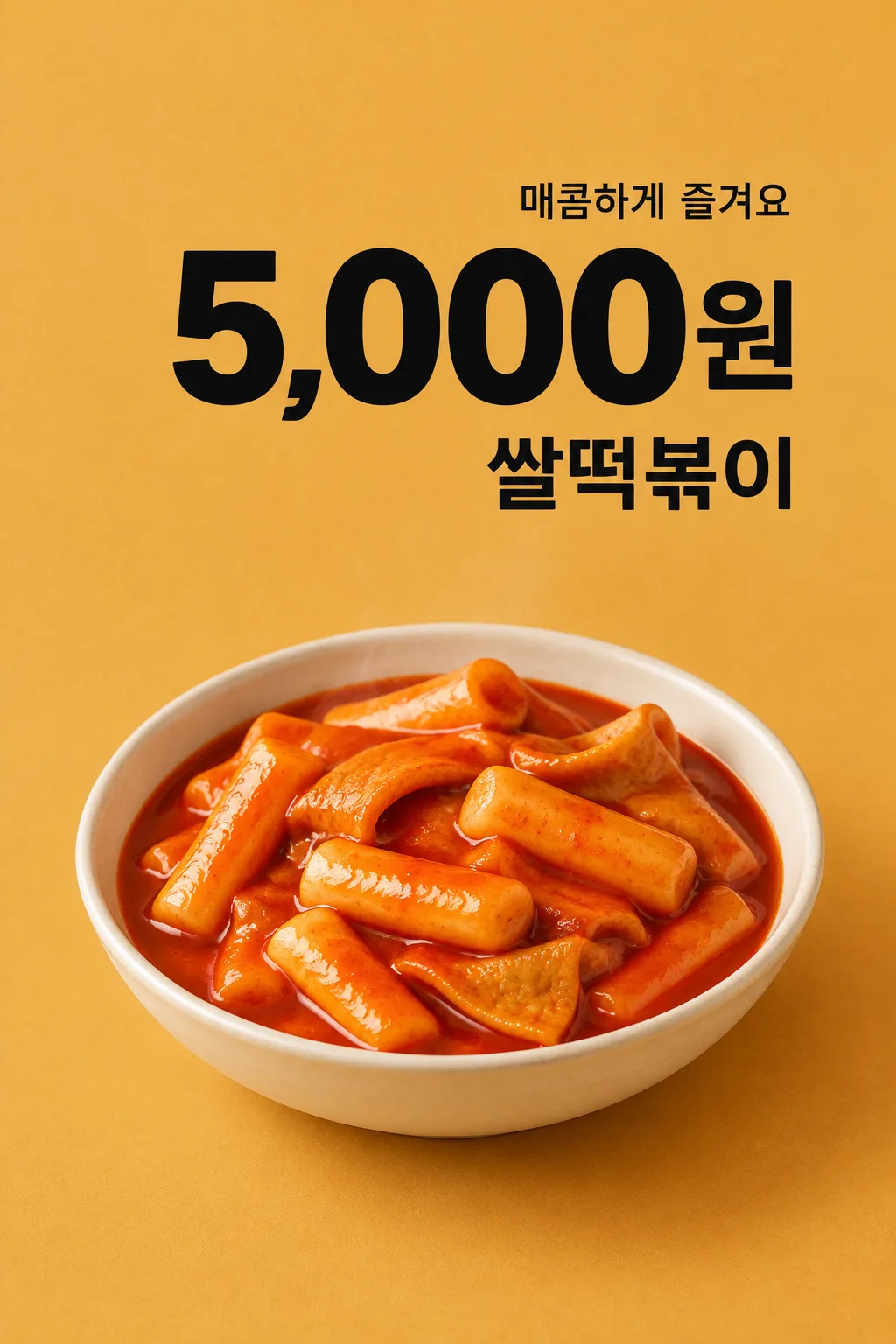
186Store Tteokbokki Deal Poster
A ticket-shaped set-deal poster with the individual-item total, set price and calculated savings together on the stub.
What you get
- One ticket poster with the individual-item total, set price and savings
- Labels for each dish in the set
- An end-date badge and daily set limit
ChatGPT Free OK
Fill in the fields
- 1Fill in the fields
- 2Copy the prompt
- 3Paste it into a GPT chat
- 4Send it as is and you get an image like the thumbnail example
- 5Attach One photograph showing the complete set you sell with the prompt and your photo is used in the result Optional
Full prompt 4,829 characters
Generate this image now. Return ONE finished store poster: a tteokbokki set-deal poster designed as a big TICKET. Its job: answer "how much do I actually save?" The hero is the math: crossed-out single-item total → set price → saved amount.
PHOTO PRIORITY — for the perforated set-deal ticket with savings arithmetic: an attached photograph controls the food as detailed below, overriding any earlier or later demand to require or request a photograph. With no attachment, complete a fictional food image consistent with this card's example; do not ask for a photo or pause production.
Output exactly one finished 2:3 portrait image, 1024x1536 pixels. Leave the top 12% and bottom 15% free of essential text.

[REAL FOOD FIRST]
Use the attached set photograph to fix the rice-cake portion, individual pieces, sauce, dishes and sides. Limit retouching to lighting, exposure, background and contact shadow. Scale all of the serving together and never duplicate food pieces. Rice cakes, fried coatings and sausage slices need believable camera texture, without CGI finishes or mechanically repeated patterns. Typical real look: a bowl of tteokbokki with glossy red-orange sauce clinging to matte chewy rice cakes of uneven length, fish cakes and sliced green onion, a little steam, natural sauce sheen. The photograph wins when it differs from this description.

[THIS CARD'S DESIGN]
The whole poster is one big ticket with a perforated dashed line and two half-circle notches about 72% down. The upper part shows the set laid out from above in a rounded photo window. The stub below the perforation holds the savings math. Retain the food window, perforation, ticket notches and arithmetic stub. MOOD must style the ticket stock, backdrop, inks and lighting, with each alternative immediately suggesting a different snack shop. Empty frames and unfilled offer bursts must disappear.

[OWNER INPUT — an absent optional line means no such information]
STORE: "【Shop name】". Compact wordmark, once.
EVENT: "【Event name】". REQUIRED. The headline at the top.
SETITEMS: "【Set contents】". REQUIRED. Split on "/": the photo window shows exactly these items; list them as small labels under the window.
TOTAL: "【Individual-item total】". REQUIRED. Printed with a single strike-through line, smaller, on the stub.
PRICE: "【Set price】". REQUIRED. Very large on the stub next to TOTAL.
SAVED: Compute TOTAL minus PRICE in dollars and print "Save $X.XX" in a bright burst on the stub. If either number is missing or the result is not positive, omit the burst.
PERIOD: "【Event period】". REQUIRED. A D-day style badge at the top-right, exact wording.
COUNT: "【Quantity limit】". Small line under PERIOD.
HOURS: "【Opening hours】". Exact text once.
LOCATION: "【Shop location】". Exact text once.
MOOD: "【Shop mood】". MANDATORY: sets every material, color and light; the arrangement stays. Yellow or absent → mustard-yellow ticket on a dark red backdrop, chili-red and charcoal type. Mint → mint-green ticket on a navy backdrop, coral and white type. Red → bright red ticket on a cream backdrop, white and black type with yellow burst.
PLACEMENT: "【Placement】". INTERNAL, never printed. Counter/wall: main device readable at 2–3 m. Entrance/window: stronger contrast, food and main device larger. Flyer: same layout, hours and location readable in the hand.

[THIS CARD'S LAYOUT]
On 1024x1536 (other ratios keep the same arrangement proportionally): EVENT y3–14%, PERIOD badge top-right y3–12%, COUNT under it. Wordmark small y15–18%. Photo window x6–94%/y20–60%, SETITEMS labels y61–67%. HOURS, LOCATION y68–71%. Perforation y72%. Stub y74–96%: TOTAL struck through left, PRICE very large center, SAVED burst right. Set ticket lettering within a 5% trim allowance. Crossed-out total, set price and savings device must remain readable at 190px wide. Squeeze extra minor notes into tighter typography, keeping the food window and arithmetic stub at their assigned scale.

[OPTIONAL DATA]
Treat "Not selected" as absent. Remove a missing line entirely and let the food or background fill the space. Never invent a price, discount, origin, rating, count or ingredient.

[FINISH]
Visible wording is English; supplied values stay exact. The perforated set-deal ticket with savings arithmetic contains customer-facing copy only: omit field identifiers, curly brackets and production directions. Deliver a single flat, print-ready perforated set-deal ticket with savings arithmetic poster at the chosen aspect ratio and pixel dimensions. Exclude collages, staged mockups, QR-like graphics and watermarks.

[Final output format]
Output exactly one finished 2:3 portrait image, 1024x1536 pixels. Leave the top 12% and bottom 15% free of essential text.
This selected output format takes priority over any fixed canvas size or aspect ratio elsewhere in this template. Adapt the composition, text zones and margins to the selected canvas without stretching or cropping essential content. Device safe areas apply only when a device is selected. Never print these format instructions on the image.
How did it turn out?
More cards in this category


How to use it · FAQ
The ticket stub showed the savings: 3,600
Both Korean test posters correctly subtracted 15,900 from 19,500 and printed the difference, 3,600, inside a burst. The individual-item total was crossed out, while the set price was the largest number. A perforated line and semicircular notches separated the food section from the savings stub. For the English field examples, $19.50 minus $15.90 should produce “Save $3.60”; English image generation was not tested.
November 30 stayed a date
Both tests kept the exact end-date wording and the daily limit of 30 sets at the upper right. They did not convert the date into a countdown. These are an end date and a daily sales limit, rather than a live stock count or the number of days remaining.
One sundae plate gained an extra side
Both posters showed tteokbokki, assorted fritters and sundae, with all three labels. The first also showed slices resembling liver beside the sundae, although no liver was requested; the second did not. These were fictional meals generated without a reference photo. If liver is not included in your set, ask: “Do not add liver or other offal to the sundae plate.” Preservation of a real set photograph was not tested.
A yellow offer became a mint ticket
Changing only the mood from Yellow to Mint replaced the dark red backdrop and yellow ticket with navy and mint. The heading switched to white lettering with a coral outline. The burst and perforation stayed, as did all three amounts, the end date and the daily limit. The location lost a space after its comma.
The total is supplied, not audited
The dish labels identified tteokbokki for two, assorted fritters and sundae for one, but did not list individual dish prices. The poster subtracts the set price from the total you supply; it cannot establish whether that total matches the three prices on your menu. Changing the dishes while leaving both price fields untouched would retain the old savings calculation.
The portion label was not a measurement of the food in the picture. All three images showed one tteokbokki bowl and two side plates, but the fritter assortment and thickness of the sundae slices varied. Use your actual set photograph to represent the amount served. Only Korean image generation was tested; the English and Japanese price examples were not rendered.
The ticket shape does not make this a redemption voucher. None of the three tests had a serial number or barcode; the detachable-looking section held only the price comparison. Handing it out as a free-meal voucher would change the meaning of a paid set offer. Even on a flyer, the stub groups the savings rather than proving an order.
Last checked · Published