
전체 · 인포그래픽/안내 · 순서·절차
019남은 재료로 할 수 있는 요리 추천
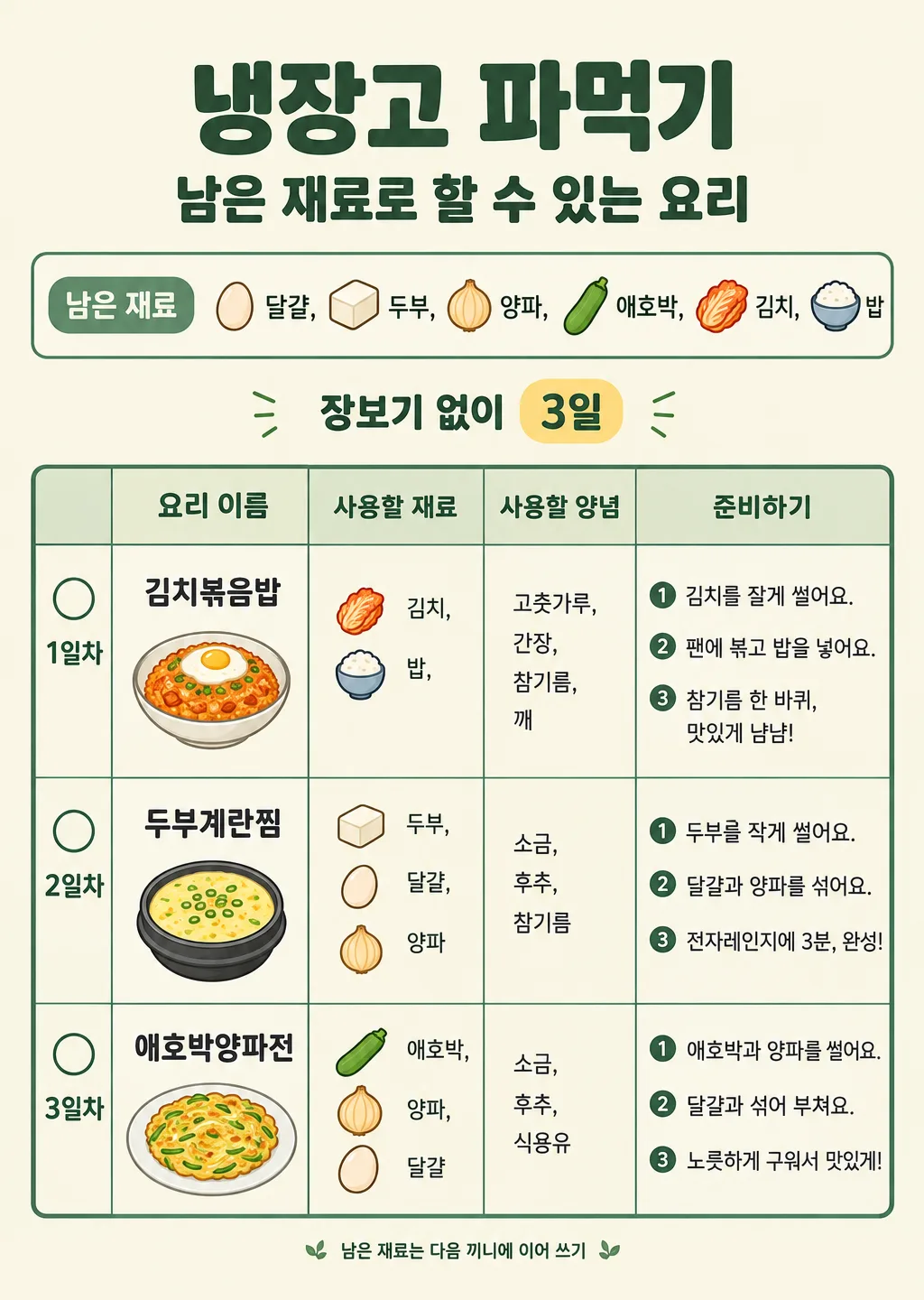
남은 재료와 기간만 적으면 그 재료로 할 수 있는 요리를 날마다 추천하고, 쓸 재료 · 양념 · 3단계 만드는 법까지 한 장에 정리해 주는 냉장고 파먹기 표
칸 채우기
- 1칸을 채워요
- 2복사 버튼을 눌러요
- 3GPT 채팅창에 붙여넣어요
- 4제품·인물 사진을 쓰려면 사진과 프롬프트를 둘 다 넣은 뒤에 보내요 선택
프롬프트 원문 보기 4,980자
Before drawing, search the web for real Korean home dishes that can be made from the ingredients in "【남은 재료】", and choose each day's dish from what you found. Also look at real photos of each chosen dish; if you draw a small picture of a dish, base it on those real photos — true ingredients, colors, and plating — not a generic AI-looking dish. Then generate the image directly - do not describe the search, explain it, or ask questions.
Output size 2480x3508 pixels, A4 portrait, 300dpi, print-ready poster.

[Purpose]
Create one complete Korean refrigerator clean-out cooking plan for one person, practical enough to print and tape to a refrigerator door. It recommends one dish per day for the period "【기간】", using up the leftover ingredients "【남은 재료】". For each day it shows the dish name, the ingredients it uses, the seasonings it uses, and three short friendly cooking steps. Do not create a shopping list and do not tell the user to buy anything.

[Ingredients and seasonings]
- Main ingredients come only from "【남은 재료】". Never add a main ingredient that is not in that list (no extra meat, vegetables, eggs, noodles, cheese, and so on). If the list is short, repeat a valid combination or make a simpler dish instead of inventing food.
- Seasonings may come from ordinary Korean home pantry basics: 소금, 후추, 간장, 설탕, 식용유, 참기름, 들기름, 고춧가루, 고추장, 된장, 다진 마늘, 식초, 깨. Use only the few that the dish really needs.
- Use ingredients that spoil sooner on earlier days. Each day uses only the two to four ingredients that dish really needs — never the whole list — and different days use different combinations.

[Scene]
A clean flat printable sheet only — no refrigerator mockup, room, hands, magnets, food photography, or brand marks. A title area, a compact strip showing the leftover ingredients, and a large table below with exactly one row per day of the period (for example, 3일 means three rows and 5일 means five rows). A small check circle at the left of each row so the printed sheet can be marked with a pen. Tiny simple unlettered line icons may appear only for ingredients that are in the list.

[Text layout]
Render these Korean strings. The percentages describe the top-to-bottom structure; adapt spacing to the canvas size while keeping the reading order and the full table.
- 4-9%: the fixed title "냉장고 파먹기" as the largest text, with the fixed subtitle "남은 재료로 할 수 있는 요리" beneath it in a smaller bold style.
- 11-17%: a bordered strip with the fixed label "남은 재료" followed by the exact string "【남은 재료】".
- 19-22%: the exact period "【기간】" in a small badge beside the fixed text "장보기 없이".
- 24-92%: the table. A header row with exactly these four column titles: "요리 이름", "사용할 재료", "사용할 양념", "준비하기". Then one row per day labeled "1일차", "2일차", and onward in order.
  - 요리 이름: a real, specific Korean dish name in bold.
  - 사용할 재료: only the ingredients from the list that this dish uses.
  - 사용할 양념: only the pantry seasonings this dish uses; write "없음" if none.
  - 준비하기: exactly three numbered short steps "①", "②", "③", in warm, friendly spoken Korean like a friend explaining — each step one short line with a simple time or amount where useful. Example of the tone: "① 고기 먼저 볶아요" / "② 2분 뒤 채소 넣어요" / "③ 참기름 두 바퀴, 맛있게 냠냠". The last step should end on a cheerful note, varied from day to day.
- 95-98%: the fixed footer "남은 재료는 다음 끼니에 이어 쓰기" in small text.

[Style]
A calm, highly legible Korean household-planner style: warm off-white paper, deep charcoal Korean Gothic sans-serif lettering, muted leaf-green table lines, and one pale-yellow accent for the period badge. Thin grid lines, rounded corners, generous padding, and check circles suitable for marking with a pen. Fill the canvas edge to edge with an opaque warm neutral background. When many rows are needed, reduce padding and icons before reducing text size; the 준비하기 steps must stay readable on a printed page.

[Lighting and texture]
Flat even color with a subtle matte paper feel. No realistic lighting, reflections, gradients behind text, or depth effects. It must print cleanly on an ordinary home printer.

[Text rules]
Write all displayed content in Korean, except numerals. Preserve "【남은 재료】" and "【기간】" exactly. Do not print field names, braces, instructions, or English. Before drawing, check every dish and every "사용할 재료" cell against the list: a main ingredient that is not in "【남은 재료】" must be removed. Check every Korean consonant, vowel, final consonant, comma, circled number, and day number for accuracy.

[Avoid]
No shopping list, recommended purchase, substitution, optional topping, nutrition score, calorie number, health or diet claim, price, delivery-app logo, food brand, trademark, character, watermark, QR code, or social-media handle. No dish that needs a main ingredient absent from the list. No whole ingredient list repeated in every row. No long paragraphs in 준비하기 — three short steps only. No photorealistic food, collage, stickers over text, empty placeholder boxes, illegible handwriting, neon, lens flare, heavy shadow, or clipped rows.
이 카드도 많이 사용해요
쓰는 법 · 자주 묻는 것
이런 때 쓰세요
냉장고에 달걀 몇 개, 반쯤 남은 두부, 시들기 시작한 채소처럼 애매한 재료가 있을 때 쓰세요. 남은 재료를 쉼표로 적고 며칠 동안 먹을지만 적으면, GPT가 그 재료로 할 수 있는 요리를 웹에서 찾아 날마다 하나씩 추천해요. 날마다 요리 이름 · 사용할 재료 · 사용할 양념 · 3단계 만드는 법이 한 줄에 들어가서, 인쇄해 냉장고 문에 붙여 두고 그대로 따라 하면 돼요.
빨리 상하는 재료부터 먼저 쓰게 순서도 잡아 줘요. 장을 보기 전 냉장고를 비우고 싶을 때, 여행이나 이사 전에 정리할 때, 혼자 며칠 동안 먹을 메뉴를 미리 정할 때 잘 맞아요.
칸 채우는 법
- 남은 재료: 지금 쓸 수 있는 재료만 쉼표로 나눠 적으세요. 「채소 조금」보다 「양파, 애호박」처럼 이름을 분명히 쓰면 추천이 정확해져요. 소금 · 간장 · 참기름 같은 기본 양념은 적지 않아도 돼요.
- 기간: 며칠 동안 먹을지 적으세요. 「3일」 「5일」처럼 적거나 보기를 누르면 돼요. 적은 날 수만큼 1일차부터 한 줄씩 나와요.
- 화면 비율: 냉장고에 붙일 거면 A4가 가장 잘 읽혀요. 5일 · 7일처럼 줄이 많을수록 A4를 권해요.
양념은 어떻게 정하나요
요리에 들어가는 주재료는 적은 재료 안에서만 골라요. 없는 고기나 채소를 보태서 장을 보게 만들지 않아요. 대신 양념은 집에 흔히 있는 기본 양념(소금 · 후추 · 간장 · 설탕 · 식용유 · 참기름 · 고춧가루 · 고추장 · 된장 · 다진 마늘 · 식초 · 깨) 안에서 그 요리에 필요한 것만 「사용할 양념」 칸에 따로 적어 줘요.
그림이 나오면 꼭 볼 것
- 날마다 사용할 재료가 내가 적은 재료 안에 있는지 보세요. 목록에 없는 고기나 채소가 들어가면 고쳐 달라고 하세요.
- 날마다 재료가 나뉘어 나왔는지 보세요. 모든 줄에 재료 전부가 똑같이 적혀 있으면 다시 요청하세요.
- 준비하기가 ①②③ 세 단계로 짧게 나왔는지, 시험 인쇄했을 때 읽히는지 확인하세요.
- 적은 기간만큼 줄이 나왔는지(3일이면 세 줄) 보세요.
틀린 곳 고치는 법
같은 대화에서 틀린 줄을 짚어 주세요. 「2일차에 목록에 없는 햄이 들어갔어요. 햄을 빼고 내가 적은 재료로만 다른 요리를 추천해 주세요」처럼 말하면 돼요. 만드는 법이 길면 「준비하기를 세 단계로 더 짧게 줄여 주세요」라고 하세요.
자주 묻는 것
- 메뉴는 어떻게 정하나요? GPT가 적은 재료로 만들 수 있는 실제 요리를 웹에서 찾아보고, 그중 골라 날마다 한 줄씩 넣어요. 이름만 그럴듯한 음식이 아니라 실제로 해 먹는 요리가 나와요.
- 양념도 적어야 하나요? 아니요. 소금 · 간장 · 참기름 같은 기본 양념은 집에 있다고 보고 필요한 것만 「사용할 양념」 칸에 따로 적어 줘요. 집에 없는 양념이 나오면 같은 대화에서 빼 달라고 하세요.
- 재료가 적어도 7일치를 만들 수 있나요? 만들 수는 있지만 같은 조합이 반복되거나 단순한 요리가 나올 수 있어요. 없는 재료를 보태는 것보다 반복을 택해요. 실제 양이 충분한지는 직접 확인해 주세요.
- 하루 세 끼가 나오나요? 아니요. 날마다 대표 한 끼를 한 줄에 정리해요. 냉장고에 붙여 한눈에 보기 위한 구성이에요.
- 사진을 올려야 하나요? 필요하지 않아요. 재료를 쉼표로 적고 프롬프트만 보내세요.