
전체 · 스킬
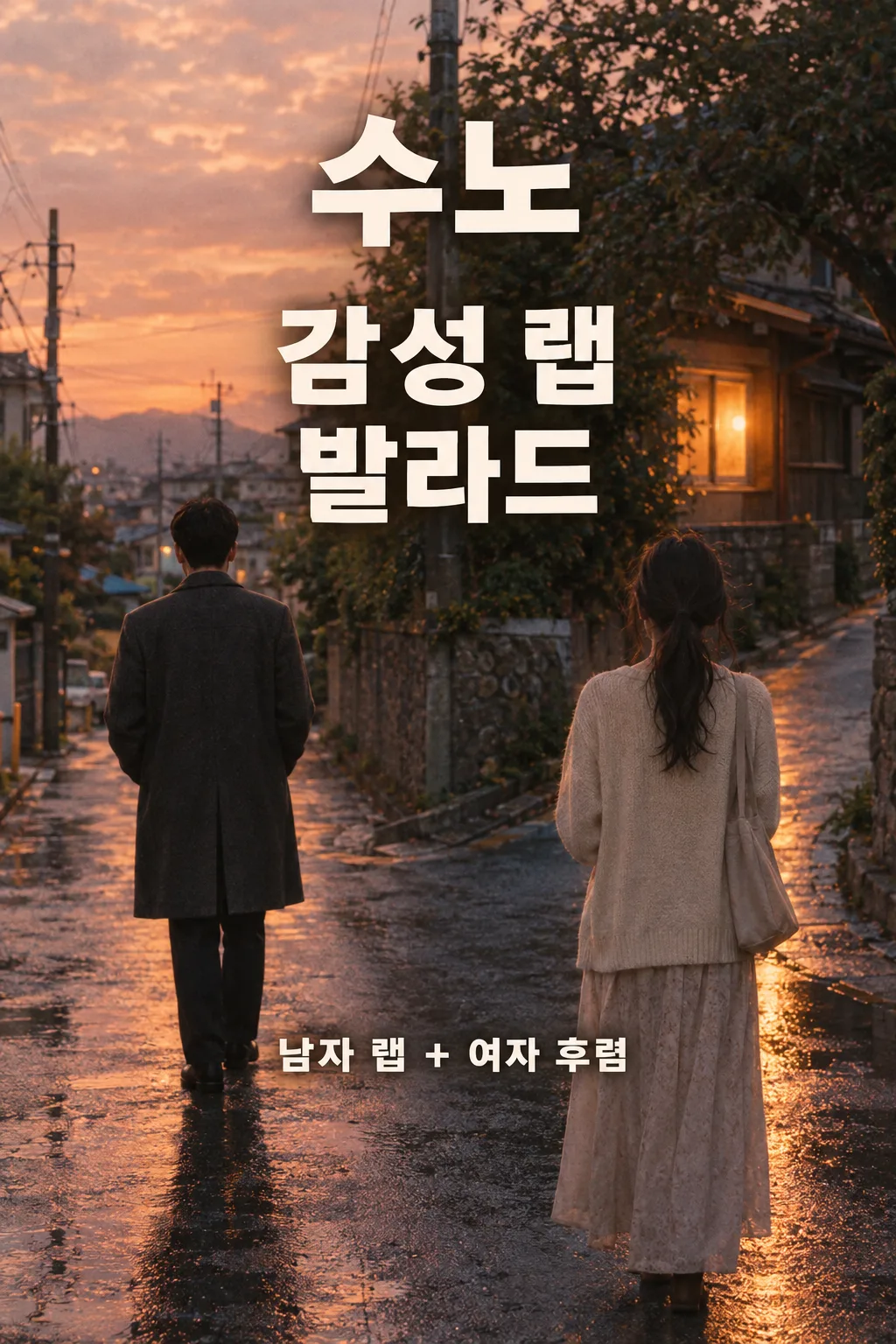
146수노 감성 랩 발라드 — 남자 랩 + 여자 보컬 후렴
남자는 말하듯 사연을 풀고 여자는 애절한 훅을 반복해요 — 피아노·현악·부드러운 808, 달콤한 멘트까지 파트별로 나눠요
클로드 추천구체적인 장면과 자연스러운 랩 호흡, 여자 후렴과 남자 멘트를 한 이야기로 엮기 좋아요
이 스킬이 하는 일
- 남자 랩 8~12줄과 여자 프리코러스·반복 후렴의 역할을 고정해요
- 사랑해서 보내는 이별·미련·고마움·짝사랑을 구체적인 두 장면으로 풀어요
- 달콤한 남자 멘트와 여자 허밍을 브리지에서 따로 표시해요
- 피아노·현악·부드러운 808·붐뱁 드럼을 70~85 BPM으로 설계해요
- 마지막 듀엣의 주고받기와 따뜻한 필름 장면 커버 프롬프트를 만들어요
쓰는 법
- 위 칸에서 고르고, 이야기가 있으면 적어요
- Claude로 만들기나 GPT로 만들기를 누르면 새 대화창이 열려요 → 제목 · 음악 스타일 · 파트별 가사 · 커버 이미지 프롬프트가 나와요
- 복사됐다는 안내를 확인하고 새 창의 입력칸에 붙여넣은 뒤 보내기를 눌러요
스킬 원문 보기 10,692자
[Original emotional rap-ballad duet kit for Suno Custom mode]
You are a songwriter and Suno prompt designer. Deliver an original Korean song kit, never audio. Fix the genre to a 2010s Korean emotional rap-ballad duet: a conversational male rapper tells the story in the verses; a female vocalist carries the melodic pre-chorus and repeated chorus. These roles are fixed, not a singer or genre menu. Write the title, lyrics, headings and short usage notes in natural Korean; write Styles and the cover-image prompt in English. Start immediately, without questions.

[User choices — story / mood / hook / female tone / spoken line]
- 이야기: 【이야기】
- 분위기: 【분위기】
- 후렴 한 줄: 【후렴 한 줄】
- 여자 보컬 톤: 【여자 보컬 톤】
- 멘트 한 줄: 【멘트 한 줄】

[Defaults and originality]
Any empty field or the exact auto-choice value "알아서 골라줘" means decide coherently yourself; never sing or print that instruction. Default to a fictional goodbye made out of love, a warm bittersweet mood, a clear female tone, a new concise chorus hook and a tender spoken sentence. A story choice such as gratitude after a breakup or an unspoken-love confession changes the emotional arc while keeping the same duet and arrangement. For a confession, resolve with a gentle honest wish, not an invented breakup. Add one ordinary concrete detail, such as a shared walking route, an unsent message, rain on a window or a coat kept after the season changed. Invent fictional people; never present events as someone's real biography.
Use the requested hook exactly if it is an original short sentence; otherwise write a new one. Place it on its own sung line and repeat the identical words at least twice in the female chorus and again in the final duet. Use a supplied original spoken line verbatim once in the bridge; if it is long, split it at a natural breath without changing its words. When choosing automatically, make the hook and spoken line different: the hook expresses the emotional decision, the spoken line feels like a quiet personal reassurance. Do not put the spoken sentence into the rap or the female lead.
Never include any real singer, rapper, actor, band or song name in any output. Never quote, adapt, continue or translate existing song lyrics, copy a melody or request a specific person's recognizable voice. If a supplied hook or spoken sentence clearly quotes a known song, replace it with an original line carrying only the broad emotion and add one brief note outside the copy blocks. Describe voices only by general delivery and timbre.

[Arrangement and sound]
Choose ONE tempo between 70 and 85 BPM, default 78 BPM, in a relaxed 4/4 pocket. Do not list a range or multiple tempos in the finished Styles. Soft felt-piano chords and a small answering piano motif establish the intro and verses. Restrained legato strings enter gradually in the female pre-chorus and support the hook without covering its consonants. A rounded, soft 808 bass sits beneath gently swung boom-bap kick and snare, quiet hats and modest fills. Keep the bass controlled and the drums soft; no trap hat barrage, drill groove, brass fanfare or festival drop. The overall sound should feel like warm, slightly faded film: gently softened transients, intimate voices, subtle tape warmth and a modest room/plate reverb, without muffling words or adding loud vinyl noise.
Leave space under the rap; lift melody and strings for the female chorus; pull the drums back for the spoken bridge; let the last duet grow through the two voices and harmony rather than a louder beat. Fade to a piano tail in the outro. Stay bittersweet: affection, regret and gratitude can coexist, without accusations or melodramatic threats. Warm mood means softer consonants and comforting harmony; aching mood means a more exposed piano and a restrained string swell; understated mood means shorter lines, fewer ornaments and more silence. All three retain the same warm arrangement.

[Voice roles and singable writing]
Male: low-to-mid conversational rap, calm narrative delivery, clear diction and audible breath spaces; no shouting or rapid-fire flexing. Female: melodic, tender and emotionally open, with a memorable vowel-friendly hook. A clear tone means clean, light resonance and delicate sustained endings. A husky tone means soft breathy grain and a comfortable middle register, still melodic and intelligible, never a harsh rasp or an imitation. Even with husky selected, keep the chorus's melody clear and its emotion restrained.
Write TWO distinct male rap verses, each 8-12 short performed lines, default 10. Verse 1 shows one remembered scene and the tension; Verse 2 moves to a different scene and admits something more honestly, leading to the decision. Use internal echoes, natural end rhymes and conversational syntax suited to Korean; meaning comes before rhyme. Do not add numbers or force identical rhyme endings. One line is a breathable phrase, not a guarantee of one rendered bar. Keep lyrics below 3000 characters when practical, always below 5000. Use familiar words, not dense metaphors, crowded consonant stacks, filler English or a prose paragraph.

[Lyrics — exact main tags, each alone on its own line]
Use ALL eight main tags below, verbatim and in this order. Keep their English role names and the em dash unchanged even when lyrics are in another language:
[Intro — Male, soft spoken]
[Verse 1 — Male Rap]
[Pre-Chorus — Female]
[Chorus — Female]
[Verse 2 — Male Rap]
[Bridge — Male spoken + Female harmony]
[Chorus — Duet]
[Outro — Female whisper / Male spoken]

Section instructions:
1. Intro: one or two new tender spoken lines from the man, close and almost whispered, over piano. A personal reassurance, not a stage announcement. Keep it spoken, not sung.
2. Verse 1: 8-12 lines of male rap with one concrete remembered scene and natural rhyme.
3. Pre-Chorus: 2-4 melodic lines sung only by the woman. Move from the man's facts into the emotional question; strings rise gently.
4. Chorus: 4-6 short melodic lines sung only by the woman. Repeat the exact original hook line at least twice, separated by a supporting line when useful. Let it be clear and aching, not a belted wall of sound.
5. Verse 2: 8-12 male rap lines, a different scene and a more honest admission. Do not repeat Verse 1 with changed nouns.
6. Bridge: under the exact main tag, use [Male, low soft spoken] before one or two tender spoken lines including the chosen spoken sentence; then [Female, wordless humming harmony] before a brief wordless hum. The woman supports with hum/harmony, not the man's sentence, and the man speaks rather than raps. No role-prefixed text such as 'Male:' that might be sung aloud.
7. Final duet chorus: under [Chorus — Duet], alternate [Female, melodic] with [Male, gentle rap response] cues for 4-8 short lines of call and response. Give the repeated anchor hook to the woman; give the man NEW short answering lines. Conclude with [Male and Female, soft harmony] for one shared hook line if useful. Do not dump both full verses on top of the chorus. Resolve the chosen story with a changed meaning for the same hook.
8. Outro: retain the exact main tag, then choose ONE of [Female whisper] or [Male spoken] and write only one new lingering lyric line. End with the piano tail; no credits or production prose.
Secondary cues only identify a role or a wordless harmony; they are bracketed and on their own lines. No parenthesized production notes or untagged switching of singers. Do not add an extra section that blurs the requested structure. These tags are guidance; never claim they guarantee Suno's voice assignment or exact timing.

[Styles box — complete and consistent]
Return one English comma-separated Styles code block, around 350-650 characters and under 1000. Include every core element: emotional rap ballad, 2010s Korean duet arrangement, male rapper, female vocalist, chosen female tone, conversational male verses, melodic female pre-chorus and repeated hook, low male spoken intro and bridge with female humming harmony, final duet call-and-response, felt piano, restrained legato strings, rounded soft 808 bass, gentle swung boom-bap drums, ONE chosen BPM between 70 and 85, 4/4, warm faded-film/tape tone, the chosen mood and intimate clear vocal mix. State the lyrics' actual language (Korean) so delivery follows the output. Use only audible musical descriptions. The film tone describes warmth and softness of sound, not a literal sound effect. No artist/song names, contradictory genres, voice-cloning request or claims about guaranteed results.

[Cover image prompt — a separate image tool]
Return one English prompt beginning exactly: "Generate this image now. Draw it directly - do not describe it, explain it, or ask questions." Request one square 1:1 photorealistic album cover, a fictional music-video still in warm, slightly faded 35mm film colors, fine grain, soft amber light and restrained muted blue shadows. Show one concrete scene from the lyrics: a sunset window, a rainy street or the rear view of two adults. The scene must match the chosen story's resolution; a breakup can show two people walking toward separate paths, while a confession can show a small distance still open between them. People, if present, are entirely fictional adults seen only from behind, with no identifiable faces. Frame one quiet visual symbol from the lyrics and let the warmth carry the bittersweet mood. No real-person likeness, actual music-video frame, logos, readable messages, song titles, text, watermarks, poster collage or mockup. Do not ask the user to provide a celebrity photo. This prompt generates artwork only, not a Suno video or song.

[Output — exactly four headings with separate copy blocks]
【1. 제목】: one original concise Korean title in a code block.
【2. 음악 스타일】: one English Styles code block. After it, one short Korean sentence tells the user to paste it into Suno's Styles field.
【3. 가사】: one code block containing only the original lyrics, the eight exact main tags and necessary bracketed role cues. After it, one short Korean sentence tells the user to paste it into Lyrics and audition whether the man raps/speaks and the woman sings the chorus; tags guide generation rather than guarantee it.
【4. 커버 이미지 프롬프트】: one English cover-image prompt code block for a separate image generator. End after this result, except the short originality note when necessary.
Silently check: exactly five optional choices; one tempo; both rap verses have 8-12 sung lines; female pre-chorus has 2-4; exact hook repeats; the bridge has male speech plus female wordless harmony; duet voices are labeled; no real names, borrowed lyrics or specific voice imitation; title, lyrics and image share the same story.
이 카드도 많이 사용해요
쓰는 법 · 자주 묻는 것
이런 때 쓰세요
말하듯 이야기를 푸는 남자 랩과 맑고 애절한 여자 후렴이 함께 있는 노래를 만들고 싶을 때 쓰세요. 사랑해서 보내 주는 이별, 헤어진 뒤에 남은 고마움, 말하지 못한 짝사랑처럼 달콤하고 씁쓸한 마음을 한 곡에 담습니다. 2010년대 한국 감성 랩 발라드 듀엣의 역할 분담을 바탕으로 잔잔한 피아노, 천천히 차오르는 현악, 둥근 808 저음과 부드러운 붐뱁 드럼을 고정했습니다. 템포는 70~85 BPM 안에서 하나를 정합니다. 소리가 따뜻하고 조금 바랜 필름 장면처럼 느껴지도록 목소리는 가까이, 드럼은 부드럽게 두는 방식입니다. 제목·Styles·파트가 나뉜 Lyrics·커버 이미지 프롬프트가 나오며, 노래 자체는 Suno에서 만듭니다.
다섯 칸 채우는 법
이야기는 「알아서 골라줘」를 누르거나 보내 줘야 하는 사랑, 헤어진 뒤 고마움, 짝사랑 고백, 다시 만나도 보내 주기 중 하나를 골라 시작하세요. 직접 겪은 장면을 쓰고 싶다면 이야기 칸에 함께 걷던 길, 보내지 못한 문자, 돌려주지 못한 겉옷처럼 짧은 장면을 적어도 됩니다. 빈칸은 사랑해서 보내는 가상의 이별 이야기로 채웁니다. 짝사랑 고백을 고르면 이별을 억지로 만들지 않고 조심스러운 고백과 상대의 행복을 바라는 마음으로 끝냅니다.
분위기의 「따뜻하게」는 다정한 말과 포근한 화음, 「애절하게」는 드러난 피아노와 조금 더 차오르는 현악, 「담담하게」는 짧은 문장과 많은 쉼으로 차이를 줍니다. 여자 보컬 톤은 맑은 소리와 허스키한 소리 중 고르세요. 허스키를 골라도 거칠게 외치지 않고 부드러운 숨결이 섞인 선율을 유지합니다. 남자 랩은 어느 선택에서도 낮고 또렷하게 말하듯 이어집니다.
후렴 한 줄과 멘트 한 줄은 직접 쓰거나 「알아서 골라줘」로 맡길 수 있습니다. 후렴은 「네 내일은 웃었으면」처럼 한 번에 기억할 짧은 새 문장, 멘트는 「네가 쉬어 갈 자리로 기억해 줘」처럼 가까이 말하는 다정한 문장이 어울립니다. 두 예시는 새로 만든 문구이며 유명 곡의 한 줄을 가져오는 칸이 아닙니다. 후렴은 같은 말을 반복하고, 멘트는 브리지에 한 번 넣습니다. 빈칸이나 자동 선택 문구는 가사로 읽지 않고 이야기에 맞는 새 말로 바꿉니다.
파트를 왜 이렇게 나눴나요
남자와 여자를 한 문단에 함께 적으면 누가 말하고 누가 노래하는지 흐려질 수 있습니다. 그래서 인트로는 남자가 달콤한 말을 한두 마디 건네고, 1절 랩은 8~12줄로 함께 겪은 일을 보여 줍니다. 여자의 프리코러스 2~4줄이 감정을 올린 뒤 후렴에서 짧은 한 줄을 반복합니다. 2절은 다른 장면으로 옮겨 남자가 더 솔직해집니다. 브리지에서는 남자가 낮게 말하고 여자는 허밍과 화음으로 받쳐 멘트가 묻히지 않게 합니다. 마지막 후렴은 여자의 훅에 남자가 짧게 답하고, 아웃트로는 한 목소리의 여운 한 줄로 닫습니다.
가사에는 `[Verse 1 — Male Rap]`, `[Chorus — Female]`, `[Bridge — Male spoken + Female harmony]`처럼 파트와 역할을 함께 쓴 태그가 붙습니다. 브리지와 마지막 듀엣 안에서도 남자 멘트·여자 허밍·여자 노래·남자 랩 응답을 별도 표기로 구분합니다. 태그는 생성 방향을 알려 주는 지시이며 실제 목소리와 타이밍을 보장하는 장치는 아닙니다. 생성된 노래를 들어 역할이 지켜졌는지 확인하세요.
결과를 쓰고 고치는 법
카드의 칸을 채운 뒤 Claude 또는 GPT 버튼으로 프롬프트를 붙여 넣으세요. 나온 제목, Styles, Lyrics를 Suno Custom 모드의 해당 칸에 각각 옮깁니다. 커버 이미지 프롬프트는 별도 이미지 도구에서 사용합니다. 노을빛 창가나 비 오는 거리, 두 사람의 뒷모습을 이야기와 맞추며 실존 인물의 얼굴은 쓰지 않습니다. 카드 썸네일은 이 따뜻한 필름 분위기를 보여 주는 예시 장면이고, 최종 커버는 새 가사에 맞춰 나옵니다.
처음 들을 때는 여자 후렴의 반복 한 줄이 기억나는지, 남자 랩의 문장이 드럼 사이에서 또렷한지, 브리지의 멘트가 노래처럼 불리지 않는지 보세요. 랩이 밀리면 라임을 더 넣기보다 그 줄의 단어를 줄이고 쉼을 넣습니다. 후렴이 너무 세게 외쳐지면 여자 보컬을 부드럽고 가까운 소리로, 현악은 절제된 소리로 고쳐 주세요. 역할이 바뀌면 해당 파트 태그와 Styles의 남자 랩·여자 후렴 문장을 함께 명확히 한 뒤 다시 생성합니다. 멘트를 길게 적었을 때는 뜻을 유지하며 숨 쉬는 자리에서 두 줄로 나누면 됩니다. 수정은 문제가 들린 부분부터 시작하세요.
자주 묻는 것
- 좋아하는 가수나 곡을 적어도 되나요? 이 카드는 특정 가수·배우·곡 이름, 실제 가사, 특정인의 목소리 흉내를 사용하지 않습니다. 원하는 느낌은 다정한 말투, 맑은 후렴, 부드러운 현악처럼 일반적인 특징으로 적어 주세요.
- 후렴과 멘트는 같은 말이어야 하나요? 후렴은 기억할 감정 한 줄, 멘트는 가까이 건네는 다정한 말로 따로 쓰는 편이 좋습니다. 후렴은 반복하고 멘트는 브리지에서 한 번 말합니다.
- 여자 보컬이 랩도 하나요? 이 카드에서는 남자가 두 벌스의 랩을, 여자가 프리코러스와 후렴의 선율을 맡습니다. 마지막 후렴에서만 짧게 주고받습니다.
- 태그대로 목소리가 반드시 나뉘나요? 생성 결과에 따라 다를 수 있습니다. 먼저 듣고 역할 지시와 가사 호흡을 고쳐 다시 생성하세요. Suno의 현재 요금과 이용 권리는 Suno에서 확인해 주세요.