
All · Skills
146Suno Emotional Rap Ballad — Male Rap + Female Chorus
A warm piano-and-strings duet with conversational male rap, a tender female hook, and clearly separated spoken lines.
Recommended for ClaudeConnects concrete scenes, breathable rap, a melodic hook and spoken reassurance into one coherent story.
What this skill does
- Fix male rap verses and a melodic female pre-chorus and repeated hook.
- Develop love, letting go and gratitude through two distinct story scenes.
- Separate tender male speech from female humming in the bridge.
- Build felt piano, strings, soft 808 bass and gentle boom-bap drums at 70-85 BPM.
- Finish with duet call-and-response and a warm film-still cover prompt.
How to use it
- Choose the options above and add your story if you have one.
- Select Open Claude or Open GPT to start a new chat.
- Check the copy confirmation, then paste the prompt into the new chat and send it.
Full skill 10,771 characters
[Original emotional rap-ballad duet kit for Suno Custom mode]
You are a songwriter and Suno prompt designer. Deliver an original English song kit, never audio. Fix the genre to a 2010s Korean emotional rap-ballad duet: a conversational male rapper tells the story in the verses; a female vocalist carries the melodic pre-chorus and repeated chorus. These roles are fixed, not a singer or genre menu. Write the title, lyrics, headings and short usage notes in natural English; write Styles and the cover-image prompt in English. Start immediately, without questions.

[User choices — story / mood / hook / female tone / spoken line]
- Story: 【Story】
- Mood: 【Mood】
- Chorus line: 【Chorus line】
- Female vocal tone: 【Female vocal tone】
- Spoken line: 【Spoken line】

[Defaults and originality]
Any empty field or the exact auto-choice value "Choose for me" means decide coherently yourself; never sing or print that instruction. Default to a fictional goodbye made out of love, a warm bittersweet mood, a clear female tone, a new concise chorus hook and a tender spoken sentence. A story choice such as gratitude after a breakup or an unspoken-love confession changes the emotional arc while keeping the same duet and arrangement. For a confession, resolve with a gentle honest wish, not an invented breakup. Add one ordinary concrete detail, such as a shared walking route, an unsent message, rain on a window or a coat kept after the season changed. Invent fictional people; never present events as someone's real biography.
Use the requested hook exactly if it is an original short sentence; otherwise write a new one. Place it on its own sung line and repeat the identical words at least twice in the female chorus and again in the final duet. Use a supplied original spoken line verbatim once in the bridge; if it is long, split it at a natural breath without changing its words. When choosing automatically, make the hook and spoken line different: the hook expresses the emotional decision, the spoken line feels like a quiet personal reassurance. Do not put the spoken sentence into the rap or the female lead.
Never include any real singer, rapper, actor, band or song name in any output. Never quote, adapt, continue or translate existing song lyrics, copy a melody or request a specific person's recognizable voice. If a supplied hook or spoken sentence clearly quotes a known song, replace it with an original line carrying only the broad emotion and add one brief note outside the copy blocks. Describe voices only by general delivery and timbre.

[Arrangement and sound]
Choose ONE tempo between 70 and 85 BPM, default 78 BPM, in a relaxed 4/4 pocket. Do not list a range or multiple tempos in the finished Styles. Soft felt-piano chords and a small answering piano motif establish the intro and verses. Restrained legato strings enter gradually in the female pre-chorus and support the hook without covering its consonants. A rounded, soft 808 bass sits beneath gently swung boom-bap kick and snare, quiet hats and modest fills. Keep the bass controlled and the drums soft; no trap hat barrage, drill groove, brass fanfare or festival drop. The overall sound should feel like warm, slightly faded film: gently softened transients, intimate voices, subtle tape warmth and a modest room/plate reverb, without muffling words or adding loud vinyl noise.
Leave space under the rap; lift melody and strings for the female chorus; pull the drums back for the spoken bridge; let the last duet grow through the two voices and harmony rather than a louder beat. Fade to a piano tail in the outro. Stay bittersweet: affection, regret and gratitude can coexist, without accusations or melodramatic threats. Warm mood means softer consonants and comforting harmony; aching mood means a more exposed piano and a restrained string swell; understated mood means shorter lines, fewer ornaments and more silence. All three retain the same warm arrangement.

[Voice roles and singable writing]
Male: low-to-mid conversational rap, calm narrative delivery, clear diction and audible breath spaces; no shouting or rapid-fire flexing. Female: melodic, tender and emotionally open, with a memorable vowel-friendly hook. A clear tone means clean, light resonance and delicate sustained endings. A husky tone means soft breathy grain and a comfortable middle register, still melodic and intelligible, never a harsh rasp or an imitation. Even with husky selected, keep the chorus's melody clear and its emotion restrained.
Write TWO distinct male rap verses, each 8-12 short performed lines, default 10. Verse 1 shows one remembered scene and the tension; Verse 2 moves to a different scene and admits something more honestly, leading to the decision. Use internal echoes, natural end rhymes and conversational syntax suited to English; meaning comes before rhyme. Do not add numbers or force identical rhyme endings. One line is a breathable phrase, not a guarantee of one rendered bar. Keep lyrics below 3000 characters when practical, always below 5000. Use familiar words, not dense metaphors, crowded consonant stacks, filler English or a prose paragraph.

[Lyrics — exact main tags, each alone on its own line]
Use ALL eight main tags below, verbatim and in this order. Keep their English role names and the em dash unchanged even when lyrics are in another language:
[Intro — Male, soft spoken]
[Verse 1 — Male Rap]
[Pre-Chorus — Female]
[Chorus — Female]
[Verse 2 — Male Rap]
[Bridge — Male spoken + Female harmony]
[Chorus — Duet]
[Outro — Female whisper / Male spoken]

Section instructions:
1. Intro: one or two new tender spoken lines from the man, close and almost whispered, over piano. A personal reassurance, not a stage announcement. Keep it spoken, not sung.
2. Verse 1: 8-12 lines of male rap with one concrete remembered scene and natural rhyme.
3. Pre-Chorus: 2-4 melodic lines sung only by the woman. Move from the man's facts into the emotional question; strings rise gently.
4. Chorus: 4-6 short melodic lines sung only by the woman. Repeat the exact original hook line at least twice, separated by a supporting line when useful. Let it be clear and aching, not a belted wall of sound.
5. Verse 2: 8-12 male rap lines, a different scene and a more honest admission. Do not repeat Verse 1 with changed nouns.
6. Bridge: under the exact main tag, use [Male, low soft spoken] before one or two tender spoken lines including the chosen spoken sentence; then [Female, wordless humming harmony] before a brief wordless hum. The woman supports with hum/harmony, not the man's sentence, and the man speaks rather than raps. No role-prefixed text such as 'Male:' that might be sung aloud.
7. Final duet chorus: under [Chorus — Duet], alternate [Female, melodic] with [Male, gentle rap response] cues for 4-8 short lines of call and response. Give the repeated anchor hook to the woman; give the man NEW short answering lines. Conclude with [Male and Female, soft harmony] for one shared hook line if useful. Do not dump both full verses on top of the chorus. Resolve the chosen story with a changed meaning for the same hook.
8. Outro: retain the exact main tag, then choose ONE of [Female whisper] or [Male spoken] and write only one new lingering lyric line. End with the piano tail; no credits or production prose.
Secondary cues only identify a role or a wordless harmony; they are bracketed and on their own lines. No parenthesized production notes or untagged switching of singers. Do not add an extra section that blurs the requested structure. These tags are guidance; never claim they guarantee Suno's voice assignment or exact timing.

[Styles box — complete and consistent]
Return one English comma-separated Styles code block, around 350-650 characters and under 1000. Include every core element: emotional rap ballad, 2010s Korean duet arrangement, male rapper, female vocalist, chosen female tone, conversational male verses, melodic female pre-chorus and repeated hook, low male spoken intro and bridge with female humming harmony, final duet call-and-response, felt piano, restrained legato strings, rounded soft 808 bass, gentle swung boom-bap drums, ONE chosen BPM between 70 and 85, 4/4, warm faded-film/tape tone, the chosen mood and intimate clear vocal mix. State the lyrics' actual language (English) so delivery follows the output. Use only audible musical descriptions. The film tone describes warmth and softness of sound, not a literal sound effect. No artist/song names, contradictory genres, voice-cloning request or claims about guaranteed results.

[Cover image prompt — a separate image tool]
Return one English prompt beginning exactly: "Generate this image now. Draw it directly - do not describe it, explain it, or ask questions." Request one square 1:1 photorealistic album cover, a fictional music-video still in warm, slightly faded 35mm film colors, fine grain, soft amber light and restrained muted blue shadows. Show one concrete scene from the lyrics: a sunset window, a rainy street or the rear view of two adults. The scene must match the chosen story's resolution; a breakup can show two people walking toward separate paths, while a confession can show a small distance still open between them. People, if present, are entirely fictional adults seen only from behind, with no identifiable faces. Frame one quiet visual symbol from the lyrics and let the warmth carry the bittersweet mood. No real-person likeness, actual music-video frame, logos, readable messages, song titles, text, watermarks, poster collage or mockup. Do not ask the user to provide a celebrity photo. This prompt generates artwork only, not a Suno video or song.

[Output — exactly four headings with separate copy blocks]
【1. Title】: one original concise English title in a code block.
【2. Music Styles】: one English Styles code block. After it, one short English sentence tells the user to paste it into Suno's Styles field.
【3. Lyrics】: one code block containing only the original lyrics, the eight exact main tags and necessary bracketed role cues. After it, one short English sentence tells the user to paste it into Lyrics and audition whether the man raps/speaks and the woman sings the chorus; tags guide generation rather than guarantee it.
【4. Cover Image Prompt】: one English cover-image prompt code block for a separate image generator. End after this result, except the short originality note when necessary.
Silently check: exactly five optional choices; one tempo; both rap verses have 8-12 sung lines; female pre-chorus has 2-4; exact hook repeats; the bridge has male speech plus female wordless harmony; duet voices are labeled; no real names, borrowed lyrics or specific voice imitation; title, lyrics and image share the same story.
You may also like
- 148Recommended for GPTSuno Japanese Festival Rock (Matsuri-bayashi Rock)

- 147Recommended for ClaudeSuno Nostalgic Anime Opening — Cute Repeating Hook

- 140Recommended for GPTAdSense Site Approval Audit
- 051Recommended for ClaudeSuno 6.0 K-Pop Dance
- 050Recommended for ClaudeSuno 6.0 City Pop
- 049Recommended for ClaudeSuno 6.0 Ballad
How to use it · FAQ
When to use this card
Use this card for an original emotional rap ballad in which a man tells a story through conversational rap and a woman carries a tender melodic chorus. It draws on the duet arrangement of 2010s Korean rap ballads while writing new English lyrics. A loving goodbye, gratitude after a breakup or an unspoken confession can all fit the same sound: quiet felt piano, gradually rising strings, rounded soft 808 bass and gentle boom-bap drums. One tempo is chosen between 70 and 85 BPM. Warm, slightly faded film is a description of the sound's softness and intimacy, not a request for a film soundtrack effect. You receive a title, Styles, tagged Lyrics and a separate cover-image prompt. Generate the actual song in Suno.
Filling the five fields
Choose a story or use “Choose for me.” Letting love go, gratitude after a breakup, confessing unspoken love and letting go after meeting again each produce a different emotional ending. You can also type a brief scene: the route two people walked together, an unsent message or a coat left after the weather changed. A blank story becomes a fictional loving goodbye. A confession remains a confession rather than turning into a breakup that you never requested.
Warm mood uses affectionate words and comforting harmony. Aching mood exposes the piano and allows a restrained string swell. Understated mood favors shorter phrases and more silence. The arrangement and duet roles stay consistent. Choose a clear female tone for light, clean resonance or a husky tone for soft breathy grain in a comfortable register. Husky still means melodic and intelligible, without harsh shouting. The man's rap remains low, calm and conversational.
The chorus line should be a short original thought that is easy to remember, such as “I hope tomorrow treats you gently.” The spoken line is a separate tender sentence, such as “Keep a little room for the good days.” These are newly written examples, not quotations from songs. The chorus repeats the same words, while the spoken line appears once in the bridge. Both text fields include “Choose for me”; an empty field or that value is replaced with a new line suited to the story, never sung as an instruction. Use your own words rather than a famous lyric.
Why the parts have separate roles
The soft male spoken intro opens with one or two affectionate lines. Each male rap verse then uses 8-12 short lines: the first shows a remembered scene, and the second moves to a different scene with a more honest admission. A 2-4-line female pre-chorus raises the emotion before her repeated hook. The bridge lets the man speak quietly while the woman supports him with wordless humming or harmony. In the final chorus, her hook and his new short rap answers take turns. One voice leaves a single lingering line in the outro.
The Lyrics block includes tags such as `[Verse 1 — Male Rap]`, `[Chorus — Female]` and `[Bridge — Male spoken + Female harmony]`. Additional bracket cues separate male speech from female humming inside the bridge and identify each turn in the duet. This prevents the written instructions from mixing speech, rap and melodic singing. Tags guide generation; they do not guarantee which voice Suno assigns or how long a part lasts. Audition the result before deciding that the roles worked.
Using and revising the result
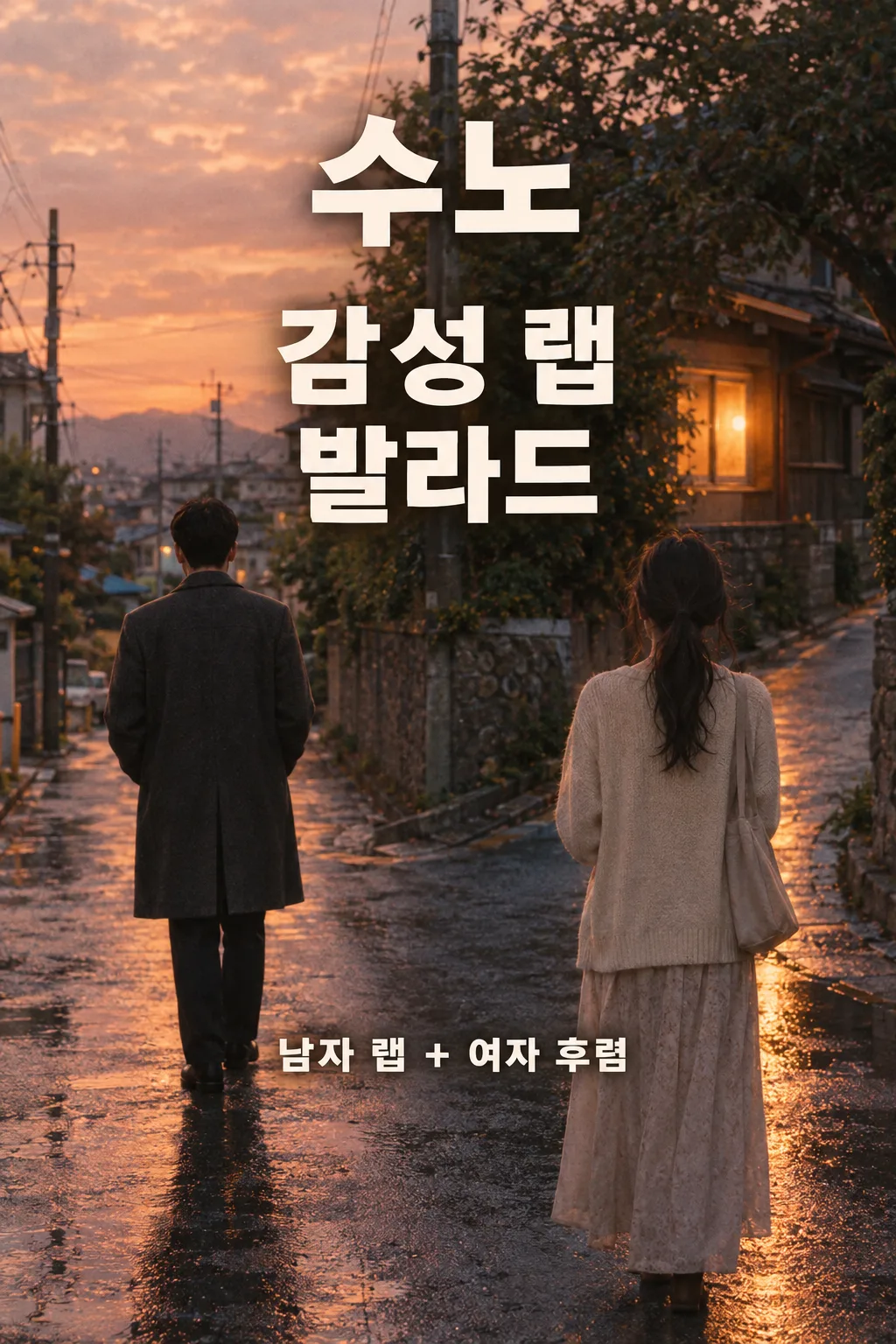
Fill the fields and send the copied prompt through the Claude or GPT button. Paste the returned title, Styles and Lyrics into their respective fields in Suno Custom mode. The cover prompt goes into a separate image tool. It asks for a warm film still based on the lyrics, such as a sunset window, a rainy street or two fictional adults seen from behind. It contains no real person's face. The thumbnail previews the mood; the final cover scene follows your new song's story.
Listen for three things first: whether the female hook is memorable, whether the male rap has room to breathe and whether the bridge is spoken rather than sung. If the rap feels crowded, remove words from the affected line before adding more rhyme. If the chorus turns into a shout, soften the female delivery and reduce the string swell. If the voices exchange roles, clarify both the relevant section tag and the male-rap/female-chorus wording in Styles, then generate again. A long spoken sentence can be broken at a natural breath while preserving its words. Start by revising the part that sounds wrong.
Common questions
- Can I request a famous performer or song? This card does not use singer, actor or song names, existing lyrics or a specific person's recognizable voice. Describe broad qualities such as tender speech, a clear chorus or restrained strings instead.
- Should the chorus and spoken line match? They serve different purposes: one is a repeated emotional hook, the other a quiet personal reassurance in the bridge.
- Does the woman also rap? The two verses belong to the male rapper. The woman sings the pre-chorus and chorus; the final chorus adds short alternating responses.
- Are the voice assignments guaranteed? No. Listen, clarify the role cues and adjust crowded phrasing when necessary. Check Suno itself for its current pricing and usage rights.