
전체 · SNS/카드뉴스 · 밈·공감
053오늘 뭐 입지
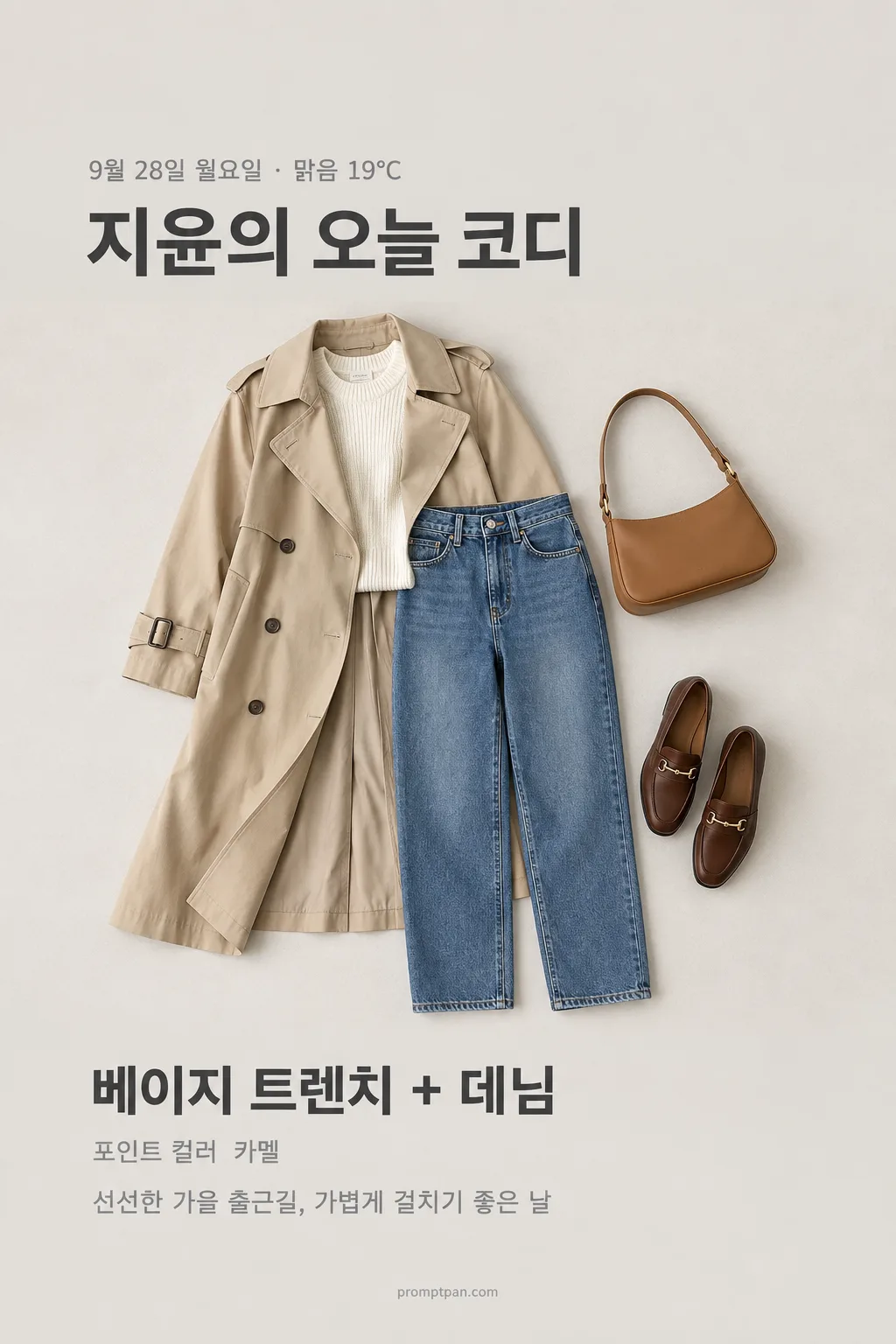
이름 · 생일 · 오늘 약속 · 원하는 스타일을 넣으면 지금 날짜와 확인한 날씨에 맞는 코디 한 벌을 사진처럼 보여 주는 스토리용 밈 카드
칸 채우기
- 1칸을 채워요
- 2복사 버튼을 눌러요
- 3GPT 채팅창에 붙여넣어요
- 4제품·인물 사진을 쓰려면 사진과 프롬프트를 둘 다 넣은 뒤에 보내요 선택
프롬프트 원문 보기 11,211자
Generate this image now. Draw it directly - do not describe it, explain it, or ask questions.
Output size 2480x3508 pixels, A4 portrait, 300dpi, print-ready poster.

[Purpose]
Create ONE finished Korean social-story meme card that answers "오늘 뭐 입지?" for "【이름】". The birthday is "【생일】"; today's plan is "【오늘 약속】"; the clothing presentation preference is "【스타일】". Recommend one complete, wearable outfit for TODAY: top, bottom, shoes, and one accessory. Include a practical outer layer as part of the top when the checked temperature or weather calls for it. The result is a playful personal suggestion, not a prediction, personality diagnosis, shopping ad, or promise that the clothes will fit. The recipient should be able to save the card and say "오늘 이거 입으래". First produce exactly one image. AFTER the image, write exactly one short Korean caption as a separate plain chat-text line, such as "나 오늘 이거 입으래ㅋㅋ"; do not put that caption inside the image or add a second image, explanation, or list.

[Optional MBTI input]
MBTI: "【MBTI】"

[Current moment, weather, and outfit decision — silently resolve before drawing]
Check the actual current local date, clock time, and weekday when this prompt is run. Use Korea Standard Time if the user's time zone is unknown. Do not reuse a date from the birthday, an example, or earlier conversation. Determine the current season from the checked date and the location's climate. Find the user's location only from information genuinely available in the conversation or tools. If none is known, use SEOUL, KOREA as an explicitly labeled reference location, never as a claim that the user is in Seoul. Use a live weather or forecast lookup yourself, before choosing clothes: verify the location, current air temperature, today's expected high/low or the temperature during the likely outing, rain or snow, and wind when available. For a morning outfit that may be worn into evening, consider the day's range rather than only the current reading. Do not ask the user for date, time, season, weather, temperature, or location. Never invent a number, condition, forecast, or holiday. If live weather cannot be checked, say "날씨 확인 안 됨" on the card instead of displaying made-up weather, and choose adjustable seasonal layers without claiming a verified temperature. If the default location is used, print "서울 기준" with any weather or temperature line. Weather should influence FABRIC WEIGHT and layering, not just the color of a background.
Pick one coherent outfit that a person could really wear for "【오늘 약속】" in the checked conditions. For 출근, favor an ordinary usable commute and workplace outfit; for 데이트, a neat but comfortable look; for 친구, a relaxed social look; for 집콕, comfortable indoor pieces with season-appropriate warmth; for 운동, activity-appropriate breathable clothes and practical shoes, with a removable layer if cool. Adapt rain or snow to suitable footwear and outerwear; adapt heat and humidity to breathable, lighter fabric; adapt cold and wind to warmer layers and covered shoes. The exact fabrics and thickness must make physical sense for the verified temperature range. Do not call a thin tee enough for freezing weather or a heavy padded coat necessary in heat. "【스타일】" expresses a requested clothing silhouette or presentation only: "여성" can use a feminine styled look, "남성" a masculine styled look, and "상관없음" a freely chosen gender-neutral or mixed look. Do not infer the person's gender, body, size, profession, budget, or existing wardrobe from it. Give only ONE outfit, no alternate looks, no brand, no shopping link, and no price.
Use the birthday as a light personal motif: when "【생일】" is valid, derive the Western sun sign from month and day accurately and let it influence only the playful one-line interpretation or color choice. It must never override weather, occasion, or comfort. If the birthday is malformed or the sign is uncertain near a boundary, use the readable birth month without inventing a sign. If the optional MBTI line is absent, omit MBTI entirely, including empty tags; if present, use the four letters only as a tiny joke, never a fixed trait claim. Choose exactly one point color that appears on one real garment or accessory, not a random decorative color. Compose one short, natural Korean interpretation tying "【이름】", the plan, and a playful birthday or MBTI cue to the chosen outfit. Keep "재미로 보는" visible beside that interpretation.

[Scene]
One flat vertical finished social card, without a phone frame. The hero is a single carefully styled overhead flat-lay photograph of the COMPLETE recommended outfit on a plain warm-neutral studio surface. Show one clearly identifiable top or top-plus-necessary-outer-layer, one bottom, one pair of shoes, and one accessory, all belonging to the same coordinated look. Arrange them as real garments with natural folds, believable scale, contact shadows, and a little breathing room. Keep a clear, quiet zone for readable labels. Make the items photographically real, not a fashion sketch, collage of unrelated catalog cutouts, mannequin, avatar, or person. Before drawing, if web reference is available, look at real flat-lay clothing photographs and real fabric close-ups for natural drape, weave, seams, stitching, leather or suede grain, knit loops, denim twill, and shoe construction. Use references for physical texture and arrangement only; do not reproduce one source image, a recognizable product design, brand mark, or embedded text. If reference search is unavailable, use general knowledge of real clothing photography and maintain the same realism. The materials shown must match the fabrics and warmth named in the labels.

[Attached photo]
No upload is required. If the user attaches a photo of a garment in the same conversation, use it only as an optional visual reference for that garment's actual color, cut, and texture if it fits today's coherent outfit. Do not copy logos or printed brand names. Do not let an unrelated attachment force unsuitable clothes for the weather or plan. Do not add a person's face or body.

[Text layout]
Use this top-to-bottom order. On 9:16, keep all meaningful writing inside the central story-safe area, roughly 10–90% of the full canvas height. On shorter portrait ratios, compress blank space while keeping the same reading order and legibility. Render the resulting Korean strings exactly, with verified date, weather, selected garment names, and point color. Quotation marks are instructions, not characters to draw.
- At the top: "【이름】의 오늘 코디" in large bold Korean type. It must be the first and most prominent line.
- Directly under it: one compact checked date-and-weekday line. Add the weather in the form "서울 기준 · 18°C · 흐림" ONLY if those exact location, temperature, and condition were genuinely verified for generation time; replace the example values with the real checked values. For a known user location, use its real name instead. If weather was unavailable, use only "날씨 확인 안 됨" after the checked date. Never print this example's 18°C as though it were live data.
- Next: "재미로 보는" plus ONE short personalized Korean interpretation line, approximately 35 characters or fewer. No claim of fate or stable personality.
- Middle 34–72% of the usable area: the large, single realistic outfit flat lay. All four categories are visible at once. Place no text over busy cloth, shoe details, or the point-color item.
- Below or beside the photograph in clean high-contrast type: exactly four compact labels, "상의  [specific top and necessary outer layer]", "하의  [specific bottom]", "신발  [specific shoes]", and "소품  [specific accessory]". Each label must name what is actually visible, with coherent color and material. Keep the item names short enough to read on a phone.
- Under those labels: "오늘의 포인트 컬러  [one specific Korean color name]" with one small solid swatch matching an actual item. Also show "옷 두께  [short, practical thickness/layering phrase]". The thickness phrase must reflect the checked temperature and conditions if available; if weather was unavailable, phrase it as an adjustable seasonal layer, not an observed forecast.
- Very bottom, lower than all other text: "promptpan.com" alone, tiny, pale, and still legible. It is a quiet source credit, not a second headline.

[Style]
A polished but lightly funny Korean daily outfit result card for posting to an Instagram story or sharing in chat. Clean editorial layout with warm white, pale gray, or another restrained surface, dark charcoal text, thin rules, and one small point-color swatch. Let the actual clothing and its tactile quality dominate. Use consistent margins, clear section spacing, and text large enough to survive a phone screenshot. The presentation can change with the day's outfit, but every result should feel like a real person's practical daily choice rather than a fashion advertisement.

[Visual hierarchy]
First read "【이름】의 오늘 코디". Second read the complete photographed outfit. Third read the four garment labels and their actual color/material. Fourth read the checked date and weather, thickness, one-line interpretation, and small footer. Keep the weather and thickness readable enough that the viewer knows why these clothes suit today. Do not let decorative badges consume the space needed for the outfit.

[Lighting and texture]
Soft side window or large studio-softbox light with plausible highlights and soft contact shadows. Show cotton weave and slight creasing, knit loops, denim diagonal twill and stitching, wool nap, linen slubs, shoe laces, leather grain, rubber soles, and metal hardware only where those materials actually occur. Clothes should have realistic gravity and flexible fabric edges rather than hard plastic outlines. A jacket or coat must appear as a real wearable layer with an opening, collar, and sleeves; shoes must be a matching pair with normal anatomy and scale. Avoid waxy surfaces, melted seams, impossible folds, hyper-smooth synthetic-looking cloth, and over-sharpened catalog gloss.

[Text rules]
All image text is Korean except an optional four-letter MBTI and the exact footer "promptpan.com". Render the exact entered name. If MBTI was blank, show no MBTI mention or placeholder. Do not print input menu words merely because they were selected; incorporate the plan naturally into the interpretation. Never print bracketed instructions, the example weather, an unverified temperature, a stock product name, a brand, or the separate social caption inside the card. The garment labels must correspond one-to-one with the photographed items. If space is tight, shorten the interpretation and garment descriptions before shrinking the name, the four category labels, or the temperature/thickness line. Keep Korean syllables accurate and uncropped.

[Avoid]
multiple outfits or backup looks; human models, faces, hands, mannequins; repeated or missing garments; mismatched label and photo; garments too thin or thick for the checked conditions; fabricated weather or location; fortune certainty; fixed MBTI personality claims; gender or body assumptions; brands, logos, shopping links, prices, storefronts; illustration, 3D render, fantasy fabric, plastic shine; neon, lens flare, busy props, giant URL, watermark, or caption text inside the image
이 카드도 많이 사용해요
쓰는 법 · 자주 묻는 것
이런 때 쓰세요
아침에 옷장 앞에서 시간을 보내거나 약속에 뭘 입을지 막막할 때, 오늘 입을 한 벌을 재미로 골라 주는 카드예요. 이름과 생일, 오늘 약속, 원하는 스타일을 넣으면 상의·하의·신발·소품이 한 장에 나옵니다. 코디는 여러 벌의 후보 목록이 아니라 사진처럼 펼쳐 놓은 한 벌이라 바로 저장해 스토리나 카톡에 올리기 좋아요. 맨 위에는 내 이름, 아래에는 오늘의 포인트 컬러와 옷 두께가 들어갑니다. 친구에게 “오늘 이거 입으래” 하고 보여 주거나, 다음 날 다시 돌려 보는 가벼운 밈으로 쓰세요. 생일과 MBTI에서 가져오는 한 줄은 성격 진단이나 운세가 아니라 웃으면서 읽는 말입니다.
칸 채우는 법
- 이름: 결과 카드 맨 위에 들어갈 이름이나 별명을 적어 주세요. 사진에 찍힌 옷보다 이름이 먼저 보여 누구의 오늘 코디인지 바로 알 수 있습니다.
- 생일: `1997년 5월 17일`처럼 적어 주세요. 태어난 달과 날은 재미 해석이나 색 선택에 가볍게 참고합니다. 입력한 생일을 오늘 날짜로 착각해서 쓰지 않도록 지시했습니다.
- MBTI: 알면 네 글자를 적고, 모르면 비워 두세요. 비워도 한 벌의 코디와 한 줄 해석이 완성됩니다. MBTI가 옷 취향을 결정한다는 뜻은 아닙니다.
- 오늘 약속: 출근, 데이트, 친구, 집콕, 운동 중 오늘과 가장 가까운 것을 고르세요. 움직임과 장소에 맞춰 신발과 소재를 달리 고르게 됩니다. 집콕도 실내에서 편하게 입는 한 벌로 만듭니다.
- 스타일: 여성, 남성, 상관없음 중 원하는 옷의 느낌을 고르세요. 사람의 성별이나 체형을 추측하는 칸이 아닙니다. `상관없음`이면 코디가 가장 잘 맞는 실루엣을 자유롭게 고릅니다.
오늘 날짜·날씨와 실제 옷 질감
날짜, 기온, 계절을 적는 칸은 없습니다. GPT가 그림을 만들 때 현재 시각과 요일, 확인 가능한 지역의 실시간 날씨를 직접 조회하도록 지시했습니다. 위치 정보가 없으면 서울 날씨를 서울 기준으로 표시합니다. 확인되지 않은 기온이나 비를 지어내지 않고, 조회할 수 없다면 카드에 날씨를 확인하지 못했다고 적은 뒤 겹쳐 입기 좋은 옷을 고릅니다. 특히 옷 두께는 장식 문구가 아니라 실제 선택 기준입니다. 더운 날에는 통기성 좋은 가벼운 소재, 쌀쌀하거나 바람 부는 날에는 필요한 겉옷, 비 오는 날에는 맞는 신발을 고르게 했습니다. 웹에서 실제 옷 사진을 참고할 수 있으면 면직물의 짜임, 니트 코, 데님 결, 신발의 재질과 주름을 살펴 그 질감으로 그리도록 했습니다. 남의 브랜드나 상품 사진을 그대로 복제하지는 않습니다.
그림이 나오면 꼭 볼 것
이름과 오늘 날짜부터 확인해 주세요. 날씨 줄에 지역이 적혀 있다면 내가 있는 곳과 맞는지, 기온과 옷 두께가 실제로 어울리는지도 보세요. 서울 기준으로 나온 결과라면 다른 지역에 계실 때 그 지역 날씨에 맞춰 옷을 판단해 주세요. 그림 속 상의·하의·신발·소품이 글자 네 줄과 각각 같은 물건인지, 신발이 한 켤레인지 확인하면 좋습니다. 재질이 비닐처럼 번들거리거나 니트와 데님이 같은 표면으로 뭉개졌다면 같은 채팅창에서 “옷의 실제 섬유 결, 자연스러운 주름과 봉제선으로 다시 그려줘”라고 말해 보세요. 캡션은 그림 안이 아니라 GPT가 뒤에 따로 주는 한 줄입니다. 올릴 때 스토리 글 입력칸에 붙이면 됩니다.
자주 묻는 것
- 오늘 뭐 입지 카드는 매번 같나요? 생성 시점의 날짜와 확인된 날씨, 오늘 약속, 선택한 스타일을 다시 반영하므로 다른 한 벌이 나올 수 있어요.
- 내 지역 날씨를 몰라도 되나요? 네. 위치가 주어지지 않으면 서울 기준으로 조회하고 그 기준을 카드에 밝힙니다. 날씨 자체를 확인할 수 없으면 숫자를 꾸며 넣지 않습니다.
- MBTI를 모르면 못 만드나요? 아닙니다. 선택 칸이라 비워도 됩니다. 생일도 과학적 성격 판정에 쓰지 않고 재미있는 문장이나 색의 단서로만 씁니다.
- 옷 사진을 따로 올려야 하나요? 아니요. 한 벌을 사진처럼 그리도록 지시한 카드입니다. 내가 가진 옷 사진을 참고로 붙일 수는 있지만 필수는 아닙니다.
- 어떤 크기로 만들면 좋나요? 추천크기는 9:16 세로형입니다. 인스타 스토리에 올리기 편하고 이름과 코디, 작은 출처까지 한 장에 담기 좋습니다.