전체 · SNS/카드뉴스 · 정보·꿀팁
059주제만 넣으면 정보 카드뉴스
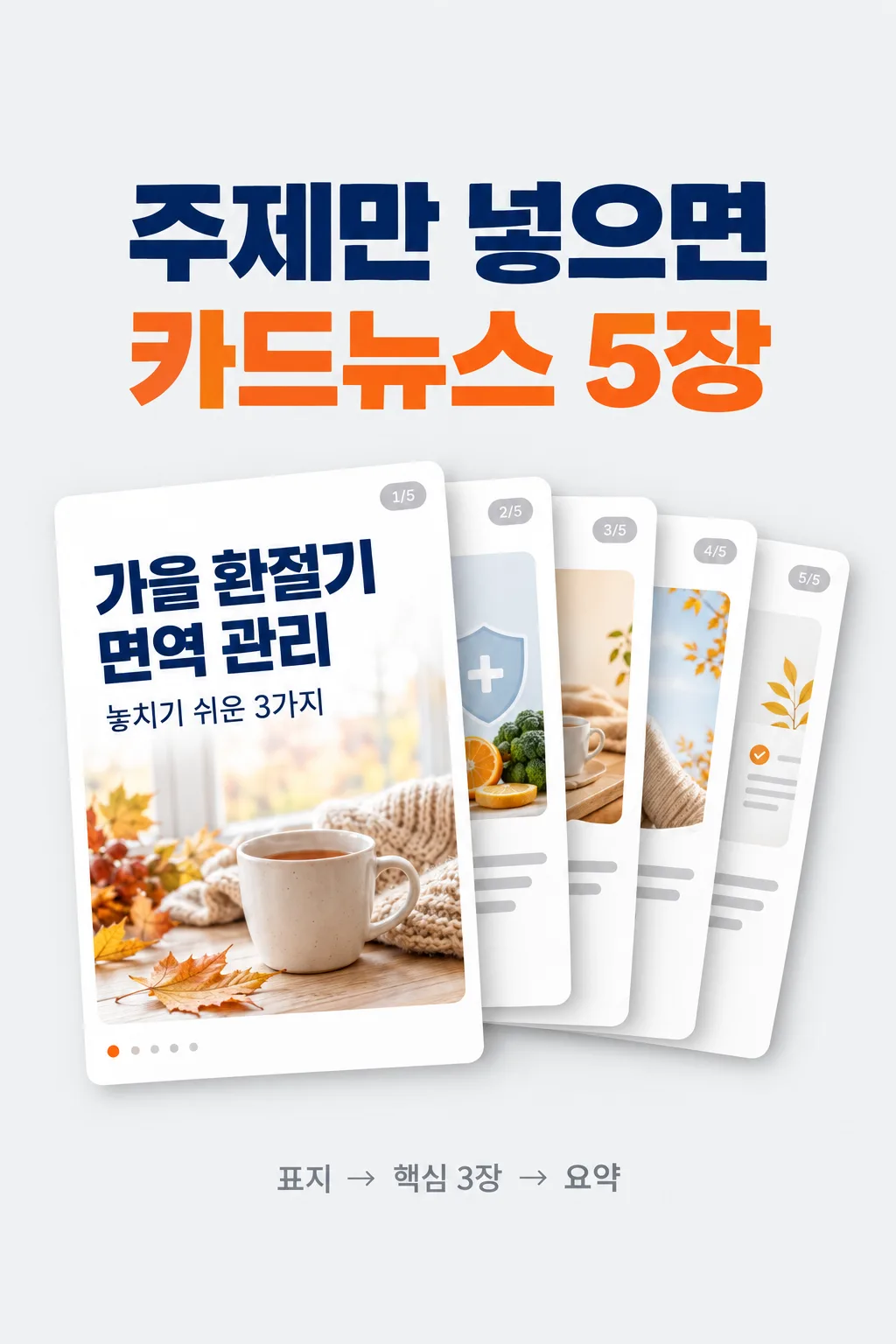
주제 하나만 적으면 GPT가 웹에서 사실을 확인하고 표지부터 요약까지 같은 디자인의 4:5 정보 카드뉴스 5장을 차례로 만듭니다.
칸 채우기
- 1칸을 채워요
- 2복사 버튼을 눌러요
- 3GPT 채팅창에 붙여넣어요
- 4제품·인물 사진을 쓰려면 사진과 프롬프트를 둘 다 넣은 뒤에 보내요 선택
프롬프트 원문 보기 9,488자
Generate this image now. Draw it directly - do not describe it, explain it, or ask questions.
Create exactly five separate images, each 1080x1350 pixels in a 4:5 portrait ratio. Follow the research and sequence gates below before drawing the first one.

[Purpose]
Turn the single user topic "【주제】" into a ready-to-publish Korean informational carousel. Make exactly FIVE individual image files, never one sheet containing five panels. The narrative is fixed: card 1 is a useful hook and topic promise; cards 2, 3, and 4 each explain ONE distinct, verified key point; card 5 recaps the three points and gently invites the reader to save the post. The topic must be replaceable without changing this prompt: choose the actual three useful points from current research, not from a fixed example or an assumed subject area. Do not ask for additional content, a headline, colours, or a layout.

[Optional audience and voice]
Audience: "【누가 볼까】"
Voice: "【말투】"
If no audience line is present, write for a general adult Korean social-media reader. If no voice line is present, use plain, friendly Korean. When present, use the selected audience and voice to adjust reading level and phrasing, never the accuracy of a claim.

[Research gate — complete before any image]
Browse the live web yourself for "【주제】" BEFORE writing image text or generating card 1. Check the three points against suitable primary or authoritative sources, such as a government or public-health body, academic or professional institution, official product or service documentation, or an original research publication. For a current rule, price, deadline, eligibility condition, or recommendation, check its date, jurisdiction, and whether it still applies. Do not use search-result snippets as the sole evidence. Keep a private claim-to-source map for the hook and each of the three points. Any number, percentage, age threshold, duration, legal condition, medical recommendation, or other precise standard may appear only when a consulted source directly supports that exact claim and its scope. When a number is unnecessary, use clear non-numeric wording. If credible sources disagree, narrow the claim or omit it. If browsing is unavailable or the topic cannot be verified, state the verification problem briefly in chat and stop before generating images; do not pretend to have researched it. For a broad topic, choose one practical angle that matters to the selected audience or a general reader and title the series accordingly. Do not present general information as personal health, financial, or legal advice.

[Plan and sequential generation]
After research, silently outline the five cards and lock their exact Korean copy before the first image. Use one common palette, one Korean Gothic sans-serif font family, the same title and body type sizes, margins, accent, illustration stroke, footer position, and page-number style on every card. Generate card 1 and wait for its image to finish; then generate card 2, wait; card 3, wait; card 4, wait; finally card 5. Finish all five in this same response without asking the user to say "continue". Each image must be a distinct 4:5 asset in the correct sequence, not a collage, contact sheet, slideshow mockup, or text-only outline. Keep the five-card plan consistent if a later image requires another image-generation call. After all five images, give a compact Korean source list in chat text with working direct links, publication or update dates where available, and which card or claim each source supports. Do not put raw URLs or citations inside the artwork.

[Scene]
Build an editorial information series that reads instantly on a phone. Every image has a full-bleed, opaque, calm background, a generous empty margin, one strong line of Korean headline text, up to two short explanation lines, and one simple topic-relevant visual metaphor or unlettered icon. Use the same graphic system across all five images while changing the illustration to fit the specific point. Card 1 has the strongest hook and sets the series topic; cards 2–4 show three distinct points, one per card; card 5 brings back the three ideas in very short phrases and includes a natural save reminder. Avoid the look of a poster packed with paragraphs. Do not use an uploaded photograph or reproduce another account's layout, logo, illustrations, or copy.

[Optional account signature]
Account name: "【계정 이름】"

[Text layout]
Render the chosen Korean copy exactly, with no translated labels or decorative filler text. Use the same zones on EVERY 4:5 canvas:
- 5–10%: A small series marker derived from the topic, using at most a few Korean syllables; cards 2–5 use the same marker.
- 15–31%: ONE concise main headline on ONE visual line, preferably no more than 16 Korean syllables. On card 1 this is a concrete hook, not a sensational or unverified promise. On cards 2–4 it names the individual point. On card 5 it gives the one-line takeaway. If the idea will not fit, rewrite it shorter before drawing.
- 35–58%: Exactly one or two short lines of explanation. Keep each line near 20 Korean syllables or fewer when practical, and no more than two visual lines total. A single verified fact or simple action is enough; do not squeeze in a paragraph.
- 61–82%: One quiet unlettered illustration or icon related to that card's point, with no text inside the drawing. For card 5, three small related marks may represent the three recap phrases without turning them into new points.
- 87–91%: On card 5 only, a small, legible Korean save invitation such as "저장해 두고 다시 보기". On cards 1–4 keep this area clear.
- 93–97%: The page marker "1/5" through "5/5", placed in the same corner on every card. If the optional account name is present, put that exact name once in a small but legible footer on EVERY card, aligned consistently opposite the page marker. If absent, omit the signature entirely without an empty label.
Card 5 may put the three recap phrases in its two-line explanation area, separated clearly; do not add a third body line. Do not print the input field names, the audience choice, the voice choice, prompt instructions, research notes, or sources on the images.

[Style]
Use a polished, original Korean editorial-card style: warm off-white or soft cream background, deep charcoal text, one restrained accent colour chosen to suit the topic, precise Korean Gothic sans-serif, generous line spacing, and flat vector illustration. Lock the exact palette and graphic language from card 1 and repeat it on all four later cards. Strong contrast and visibly different headline/body weights are essential. If a voice is selected, it changes copy only: "친근하게" uses plain warm language; "전문가처럼" uses clear qualified wording without jargon or credential claims; "짧고 굵게" trims text without losing the condition that makes a statement true. Never print the voice label itself.

[Visual hierarchy]
The headline is read first, the two short explanatory lines second, then the image, then the small page marker and optional account signature. Keep the composition, baseline, safe area, and type scale consistent even when headline lengths differ. Break long Korean phrases at natural boundaries instead of reducing them to tiny text. Card 1 should invite the next swipe, cards 2–4 should each stand alone as one shareable fact or action, and card 5 should let a reader recall all three points at a glance. Do not repeat the same point under new wording or add a fourth tip on the closing card.

[Lighting and texture]
Use flat, evenly lit colour with a clean matte finish. Keep every Hangul stroke sharp at phone size. Let colour blocks and whitespace organise the page rather than glows, photographs, texture, or heavy shadows. Paint the entire image edge to edge; there must be no transparent or black letterbox area.

[Text rules]
Draft all Korean image copy from the verified source map, then inspect every rendered card for missing or malformed Hangul, changed numerals, duplicated lines, and cropped text. Give each card one main thought and at most two explanation lines. Rephrase cautiously when the source supports only an association, possibility, or general recommendation. On health topics, never claim that a food, supplement, habit, or product prevents, treats, cures, or guarantees an outcome unless the exact authorised claim and context have been verified; prefer ordinary evidence-based information without efficacy promises. On legal topics, name the relevant place and effective date in chat when needed, avoid universal statements, and never promise a legal result. If a verified qualification cannot fit in the two explanation lines, choose a simpler point instead of deleting that qualification. Do not invent sources, credentials, experts, testimonials, study results, metrics, or current standards. No clickbait fear, guarantees, or absolute wording such as "무조건" when the evidence is conditional.

[Avoid]
No sixth image; no combined five-card sheet; no unfinished sequence; no card numbering out of order; no inconsistent colours or font changes; no long paragraphs; no tiny footnotes; no raw URLs or citation blocks on the images; no unsupported numbers, dates, rules, or health claims; no diagnosis or personal treatment advice; no legal verdicts; no brand logos, copyrighted characters, celebrity likenesses, QR codes, watermarks, phone frames, fake charts, decorative English, or irrelevant stock-photo scenes. Never fill gaps in research by making up a fact.
이 카드도 많이 사용해요
쓰는 법 · 자주 묻는 것
이런 때 쓰세요
인스타 정보 계정에 올릴 소재를 매번 처음부터 기획하기 어렵다면 주제 하나로 시작해 보세요. 블로그에 길게 쓴 글의 핵심을 짧은 카드뉴스로 소개하거나, 사장님이 손님에게 자주 설명하는 내용을 게시물로 정리할 때도 쓸 수 있어요. 한 번 정한 분야 안에서도 주제를 계속 바꿔 쓸 수 있습니다. 예를 들어 생활 관리, 공부 습관, 여행 준비, 동네 가게 이용 팁처럼 독자가 궁금해할 만한 한 가지를 넣으세요.
GPT는 그림을 만들기 전에 웹에서 그 주제의 사실을 확인하도록 지시받습니다. 확인된 내용을 세 가지로 추린 뒤 표지, 핵심 세 장, 요약 장을 각각 4:5 이미지로 차례로 만듭니다. 카드 다섯 장을 한 이미지에 붙인 결과가 아니라 게시물에 순서대로 올릴 파일 다섯 개가 목표예요. 웹 검색이 막혀 확인할 수 없다면 근거를 꾸며서 그리지 않고 멈추게 했습니다.
칸 채우는 법
- 주제: 「가을 환절기 면역 관리」처럼 독자가 궁금해할 내용을 한 줄로 적으세요. 너무 넓다면 「직장인을 위한 수면 습관」처럼 대상이나 상황을 붙여도 좋습니다. 주제를 바꾸기만 하면 같은 틀로 다음 게시물을 만들 수 있어요.
- 누가 볼까: 20~30대, 40~50대, 60대 이상, 사장님, 학생 중 하나를 눌러 넣거나 직접 적으세요. 비워 두면 일반 성인 독자가 읽기 쉬운 말로 씁니다.
- 말투: 친근하게, 전문가처럼, 짧고 굵게 중 원하는 느낌을 고르세요. 비워 두면 쉬운 말로 씁니다. 말투가 달라져도 근거가 필요한 사실을 추측으로 채우지 않습니다.
- 계정 이름: 넣으면 다섯 장 아래 같은 자리에 작게 표시됩니다. 비워 두면 계정명 없이 완성됩니다.
칸을 채운 프롬프트를 웹 검색과 이미지 만들기가 가능한 GPT 대화에 붙여 넣으세요. 사진은 필요하지 않아요. 다섯 장이 한 장씩 나오는 동안 대화가 끝났다면 같은 대화에서 「다음 장을 같은 색과 글꼴로 이어서 만들어 줘」라고 보내고, 이미 나온 장을 다시 만들지 않게 번호를 확인하세요.
우리 제품·인물 사진을 넣고 싶을 때
이 카드는 사진보다 읽기 쉬운 정보가 중심입니다. 기본 결과는 글자와 단순한 삽화로 완성되므로 제품이나 인물 사진을 올릴 필요가 없어요. 가게의 실제 제품을 다루는 주제라면 먼저 카드 다섯 장을 만든 뒤, 사진이 꼭 필요한 장 하나에만 실제 사진을 참고해 수정해 달라고 요청하세요. 그때도 기존 글자와 출처에 맞춘 설명은 유지되는지 다시 확인해 주세요. 제품 사진만으로 효능이나 성능을 증명하는 표현은 넣지 마세요.
그림이 나오면 꼭 볼 것
이미지가 다섯 개이고 비율이 모두 4:5인지, 1/5에서 5/5까지 번호가 차례인지 먼저 보세요. 표지는 주제를 한눈에 말하고, 2~4장은 서로 다른 핵심 한 가지씩, 마지막은 세 가지를 떠올리게 하는 요약과 저장 문구인지 확인하세요. 색, 글꼴, 제목 크기, 계정 이름 위치가 장마다 달라지지 않았는지도 살펴보세요.
특히 숫자와 기준이 적힌 장은 그림 뒤에 나온 출처 링크를 열어 실제 문장과 적용 범위를 대조하세요. 건강 정보는 질병 예방이나 치료를 보장하는 말로 바뀌지 않았는지, 법 관련 정보는 어느 지역에서 언제 적용되는지 확인해야 합니다. 글자가 한 글자라도 깨졌거나 중요한 단서가 빠졌다면 그 장을 올리지 말고 수정하세요. 게시물 설명에 출처를 적어 두면 독자가 원문을 확인하기 쉽습니다.
틀린 곳 고치는 법
한 장만 틀렸다면 「3/5 카드만 다시 만들어 줘. 1·2·4·5장의 색과 글꼴은 유지하고, 둘째 줄을 ○○로 고쳐 줘」처럼 번호와 고칠 글자를 정확히 적으세요. 출처가 맞지 않으면 그림을 고치는 것보다 먼저 근거를 다시 찾게 하세요. 검색 결과의 제목만 보고 판단하지 말고 원문에서 해당 수치와 조건을 확인해 달라고 하면 됩니다. 글자가 길어졌다면 글씨를 무작정 줄이기보다 핵심을 다시 한 줄로 덜어 내는 편이 읽기 좋아요.
자주 묻는 것
- 주제만 적어도 다섯 장이 나오나요? 네. 주제만 필수입니다. GPT가 확인한 자료에서 핵심 세 가지를 고릅니다. 독자, 말투, 계정 이름은 비워도 됩니다.
- 웹 검색이 안 되는 GPT에서도 쓸 수 있나요? 이 카드는 사실 확인을 먼저 요구하므로 검색할 수 없는 대화에서는 그림을 만들지 않고 알려 주도록 했습니다.
- 출처가 카드 그림 안에 들어가나요? 그림은 짧게 읽히도록 만들고, 출처 링크는 다섯 장 뒤 대화 글에 따로 받습니다. 게시 전에 링크의 원문과 카드 문장을 직접 비교해 주세요.
- 건강이나 법 주제도 되나요? 일반적인 정보를 조심스럽게 정리할 수 있지만, 효능이나 결과를 단정하는 문장은 피하고 적용 범위와 최신 출처를 확인해야 합니다.