
전체 · SNS/카드뉴스 · 밈·공감
057오늘 갈 곳 추천
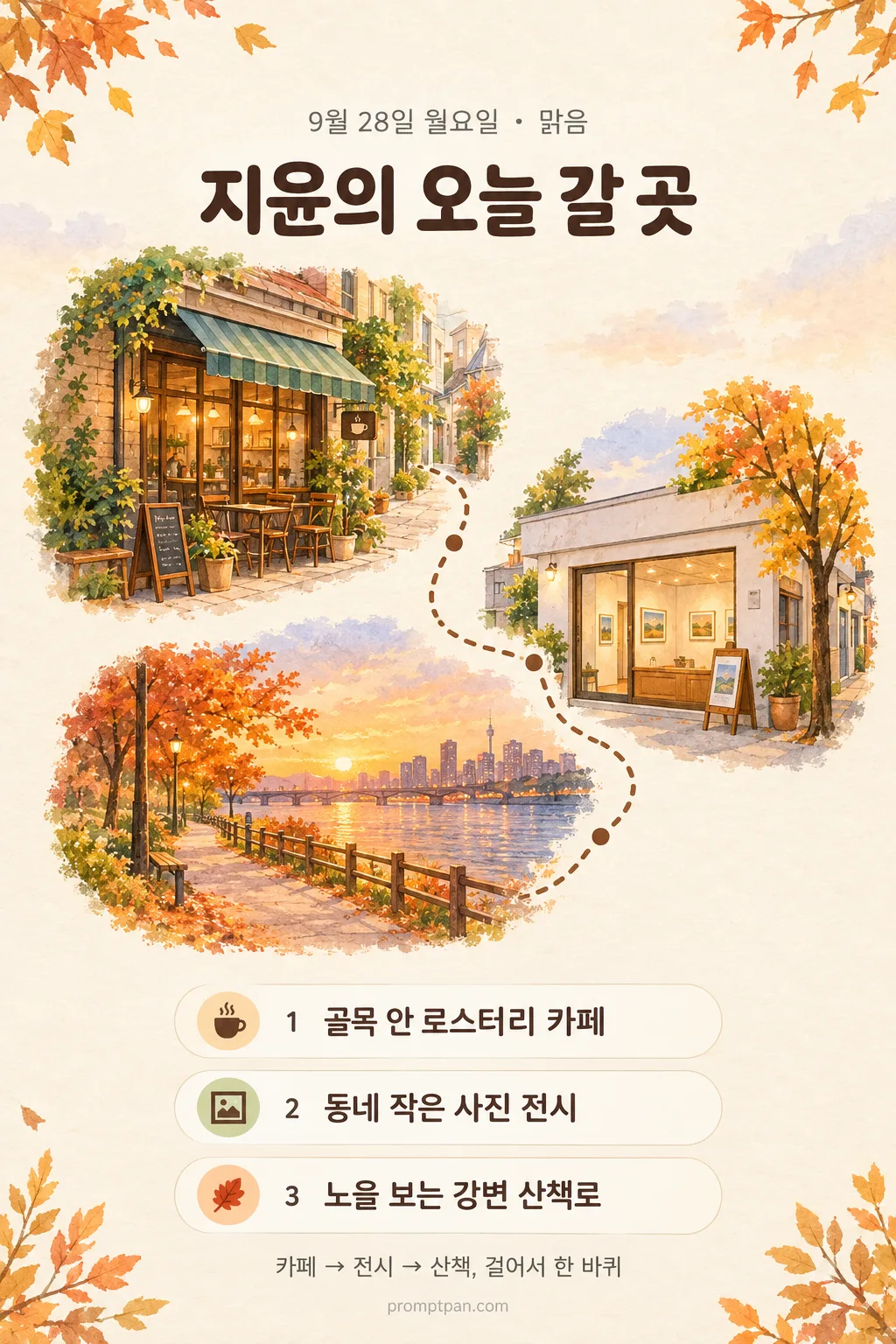
이름 · 생일 · 동네 · 동행 · 예산 · 기분을 넣으면 오늘 날짜와 확인한 날씨에 맞춰 실제 동네 장소 세 곳과 동선을 담아 주는 나들이 밈 카드
칸 채우기
- 1칸을 채워요
- 2복사 버튼을 눌러요
- 3GPT 채팅창에 붙여넣어요
- 4제품·인물 사진을 쓰려면 사진과 프롬프트를 둘 다 넣은 뒤에 보내요 선택
프롬프트 원문 보기 11,091자
Generate this image now. Draw it directly - do not describe it, explain it, or ask questions.
Output size 2480x3508 pixels, A4 portrait, 300dpi, print-ready poster.

[Purpose]
Create exactly ONE finished Korean social-story card headed "【이름】의 오늘 갈 곳 추천". It helps "【이름】" decide where to go on a day off in or very near "【동네】" with "【누구랑】", considering a budget of "【예산】" and a mood of "【오늘 기분】". The birthday is "【생일】". Recommend exactly THREE distinct, real, named places the person could actually visit, such as a cafe, exhibition venue, garden, market, bookshop, or walk. Provide a one-line route connecting the three in a sensible visiting order. The result is a light personal suggestion for trying and sharing, not a personality diagnosis, fate prediction, paid endorsement, or guarantee that a place is open. Draw the single card first. AFTER the image, output exactly ONE short Korean caption as a separate plain chat-text line, suitable to post with the image, such as "오늘은 여기 가보래ㅋㅋ". Do not print the caption in the picture and do not add another image, list, explanation, or source dump after it.

[Optional MBTI input]
MBTI: "【MBTI】"

[Live research and selection — resolve silently before drawing]
Check the actual current date, weekday, local clock time, and season when this prompt is run. Use the verified location's time zone; for a Korean neighborhood, use Korea Standard Time. Do not use the birth date, example text, or a previous chat date as today's date. Check live local weather or the relevant forecast for the outing time in "【동네】" yourself. A morning choice should consider the afternoon, and an evening choice should consider closing times and daylight. If live weather is unavailable, print only "날씨 확인 안 됨" as the weather status and choose a flexible indoor/outdoor mix; do not invent temperature, rain, or sunshine. If the live clock cannot be checked, do not invent today's date or time.

Use live web search to find real venues or named public places in "【동네】". Search their names and locations using trustworthy current sources: an official venue site, local government or cultural institution page, an official map listing, or another source that actually identifies the place and address. Cross-check that each result refers to the same real place in the requested neighborhood, or an immediately adjacent area clearly named as such. Never fabricate a business, exhibit, event, street address, ticket price, opening hour, availability, or walking time. Do not use a permanently closed venue, a past-only exhibition, or a place whose location cannot be checked. A currently running exhibition can be suggested only if its dates are verified. Do not infer that a listing guarantees the doors are open right now. If the neighborhood name is ambiguous, resolve it from reliable context before searching; if it still cannot be identified, ask one brief clarifying question instead of making a card for the wrong city. If live place search is unavailable and three real places cannot be established with high confidence, say briefly that place verification is unavailable and request a web-enabled run instead of drawing invented recommendations.

Choose three places with different experiences where possible, and make them a practical short outing rather than three unrelated attractions scattered across the city. "【누구랑】" should affect pace and suitability: solo can be quiet and easy to enter alone, 연인 can be comfortable for conversation, 친구 can allow shared activity, 가족 can favor mixed ages, and 아이랑 should favor a genuinely suitable child-friendly visit. Do not claim stroller access, child programs, or accessibility features without checking them. Respect "【예산】" as written. Treat a stated amount as a per-person limit only if it says "1인"; never silently turn a group total into a per-person budget. Free public places work well for "0원". For paid places, verify prices if making any budget or ticket claim; otherwise omit the amount and do not assert that the plan fits a tight budget. If "【오늘 기분】" is "알아서 골라줘", choose the mood yourself and do not print those input words as the result. Let checked weather, season, date, and time genuinely affect whether indoor or outdoor stops lead the route. A closed-today venue should not be presented as a visitable stop today.

Use "【생일】" only for a tiny, playful personal cue. If it is a valid date, the Western sun sign may inform one light joke; if the birthday is malformed or near an uncertain sign boundary, omit the sign rather than guessing. If the optional MBTI line is absent, omit MBTI completely, including an empty label. If present, use its four letters only as an optional joke, never a fixed claim about the person. The verified trip facts and suitability outweigh this playful cue. Keep a visible "재미로 보는" label by the one-line interpretation.

[Scene]
Draw a flat, vertical, finished social card with one original illustrated neighborhood panorama as the visual anchor. Show the feel of the selected area and season through believable street scale, paths, trees, storefront shapes, public space, and weather-appropriate light. Let the three recommendation rows read as stops along one little trip. A small dotted route can visually connect them, but the written route must still be clear. This is an illustration, not a satellite map, exact navigation map, travel agency ad, or photo collage. Do not invent a distinctive real landmark, facade, storefront sign, or exhibition poster. If a real landmark is visually recognizable, verify it belongs in the named area before drawing it; otherwise use generic but locally plausible streetscape details. No brand logos, recognizable characters, faces, or people are needed. Leave quiet solid areas for every line of type.

[Attached photo]
No user photo is required. If a photo is attached, use it only as loose atmosphere reference when it really depicts the requested neighborhood. Do not copy a photographed person's face, a shop logo, a map label, or copyrighted signage. Keep the researched place names and outing decision based on live place information, not on guesses from the photo.

[Text layout]
Use this reading order from top to bottom. In 9:16, keep the headline, place names, and route comfortably clear of story interface overlays. On a shorter portrait ratio, reduce illustration height and decorative space before reducing the type. Render these exact Korean strings where fixed; replace descriptive brackets below with the actually checked date, names, and short content. Quotation marks are not characters to draw.
- Top 8–15%: "【이름】의 오늘 갈 곳 추천" as the largest, boldest text and the very first line.
- Next line: the checked current month, day, weekday, and requested locality in the form "9월 28일 월요일 · 서울 망원동". This is ONLY a format example: replace all date and place parts with the real checked values. Add a concise verified local weather phrase if available, such as "흐림". Otherwise show "날씨 확인 안 됨". Do not print an unverified temperature.
- Below that: the small label "재미로 보는" and ONE brief, natural Korean sentence about "【이름】" wanting this sort of outing today. The sentence may echo a verified birthday cue or supplied MBTI, but must not state a personality verdict. Keep it short enough for a phone screen.
- Middle, roughly 28–52%: ONE appealing neighborhood-atmosphere illustration, with enough visual breathing room around its edge. It should look like a place worth exploring, not a background of random destination icons.
- Below the illustration, three high-contrast numbered rows, each with one concise venue type, the EXACT verified Korean place name, and a very short reason suited to this visit. Use the same three names throughout. Format each row as "1  [type] · [real place name]" plus a short reason, then 2 and 3. The names are the important part: never replace a verified name with a vague category such as "예쁜 카페".
- Under the rows: exactly one route line beginning "동선" and giving the SAME three selected names in visit order with arrows. If the names are long, use unambiguous short forms that still identify those places. The path must be geographically plausible; never include an invented exact travel duration.
- Then one small but readable fixed line: "가기 전 영업 확인".
- Very bottom, below all other content: "promptpan.com" alone, tiny and pale but legible, centered. This is a quiet source credit, not a headline or logo.

[Style]
Contemporary Korean day-out meme card, warm, gently witty, and easy to share. Use a restrained seasonal palette and friendly editorial illustration with a few locally plausible details. Build a clear hierarchy with dark readable Korean lettering, clean separators, and comfortable margins. Draw just enough scenery to make the card feel like a small outing someone could actually take. The atmosphere may change with the checked weather and season, but never turn an unverified weather guess into a factual label. Place names should be as readable as the headline on a phone screenshot.

[Visual hierarchy]
First read the person's headline. Second read the three actual place names and the neighborhood illustration together. Third read the route and the date, locality, and verified weather. Last read the playful line, the opening-hours reminder, and the faint site credit. Keep illustration details away from the recommendation rows. Show exactly three recommended places, no extra stop hidden in decorations, and no additional venue names in tiny type.

[Lighting and texture]
Use soft, believable natural light appropriate to the checked time and season. Make trees, pavement, building fronts, awnings, and sky coherent with verified weather where available. If weather could not be checked, use a neutral seasonally plausible sky without implying a specific live forecast. Crisp printed-card edges, subtle paper texture, and modest shadows are fine. Avoid glowing neon, plastic 3D scenery, fake map pins crowding the text, and illegible lettering blended into the art.

[Text rules]
All writing inside the image is Korean except an optional four-letter MBTI and the exact footer "promptpan.com". Print the entered name exactly. Use the exact three researched place names consistently in the list and route, with correct Korean spelling. The current date and weekday must come from the live check, never from this prompt's examples. Do not print an unverified weather observation, exact price, open-now claim, address, or travel minute. Do not draw search citations, placeholder brackets, input field labels, or the words "알아서 골라줘". If a line is too long, shorten its reason or playful sentence before shrinking a venue name, route, or headline. Keep the one-line post caption out of the image.

[Avoid]
Invented or closed destinations; old events presented as current; unsupported weather, hours, prices, travel times, or accessibility claims; horoscope certainty; MBTI stereotypes; medical or safety claims; a precise-looking but false route map; copied shopfronts or signs; brand marks; a fourth stop; duplicated place names; crooked or misspelled Korean; small gray venue text; large URL; an in-image social caption.
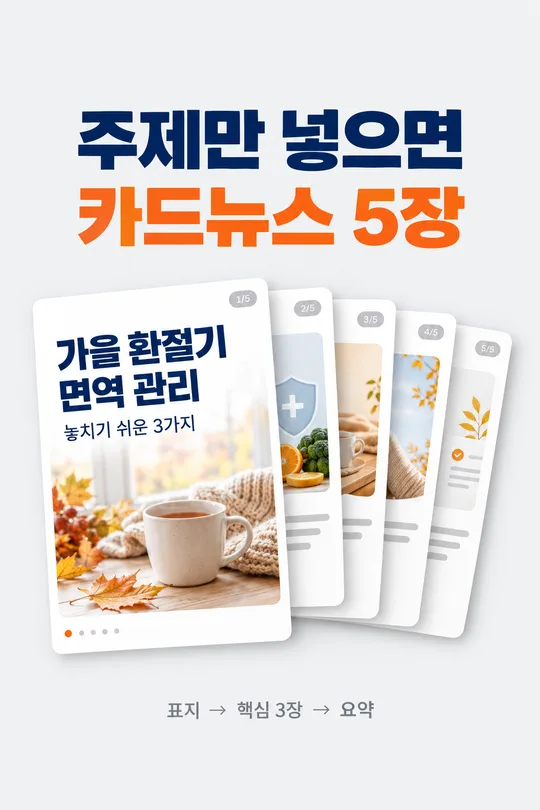
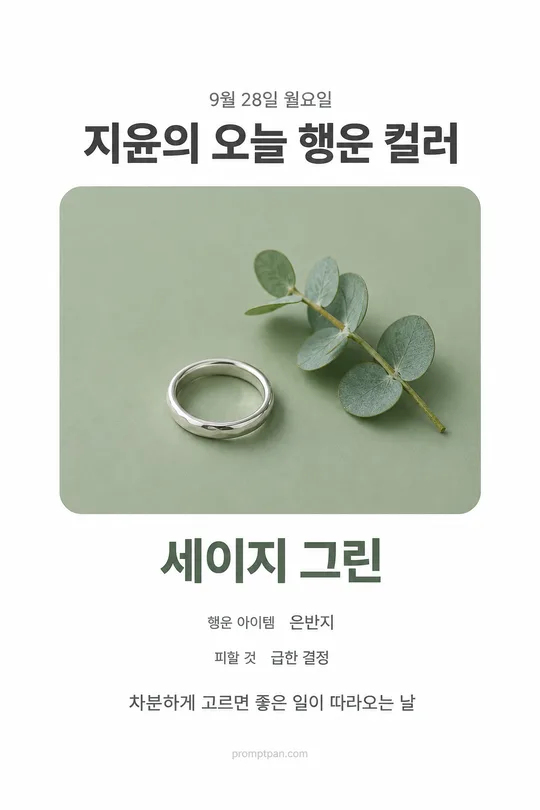
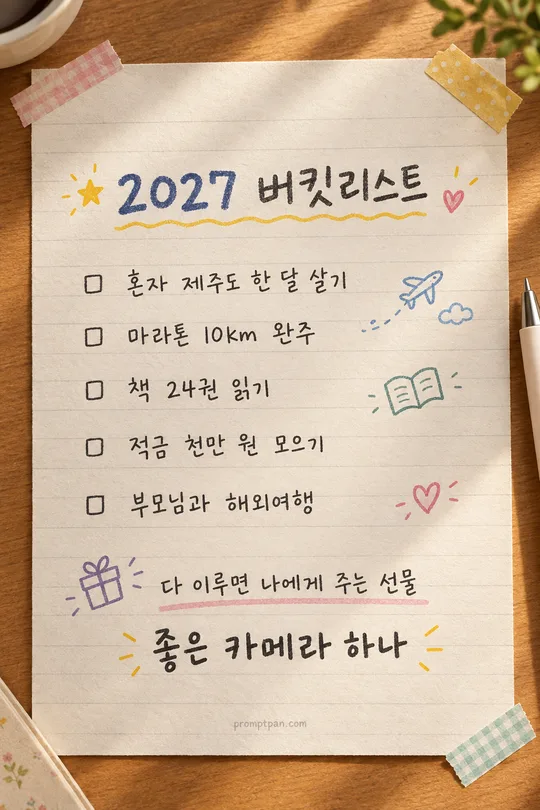
이 카드도 많이 사용해요
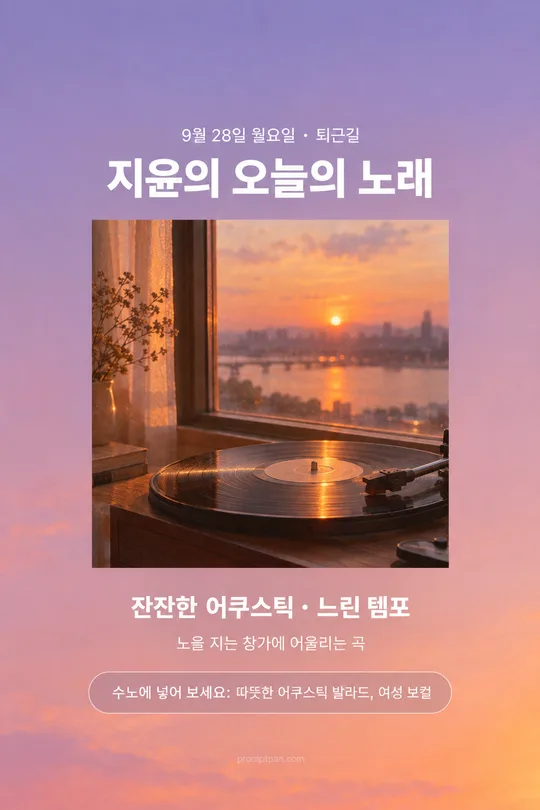
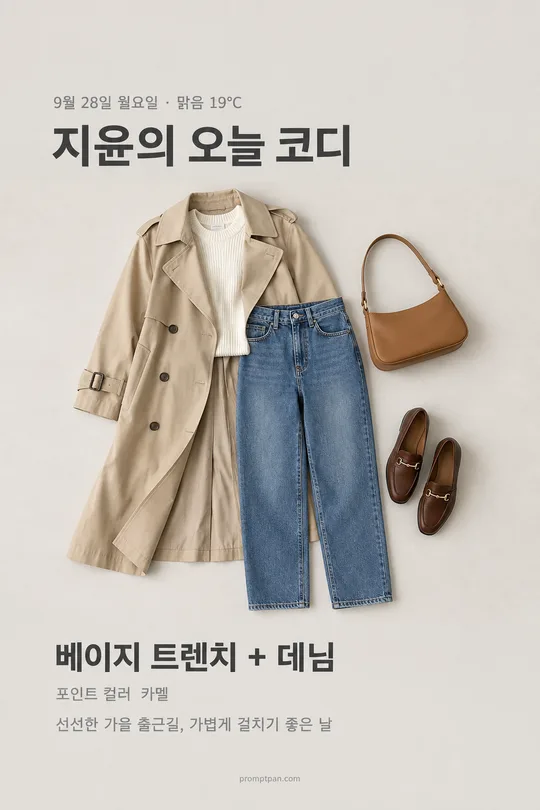
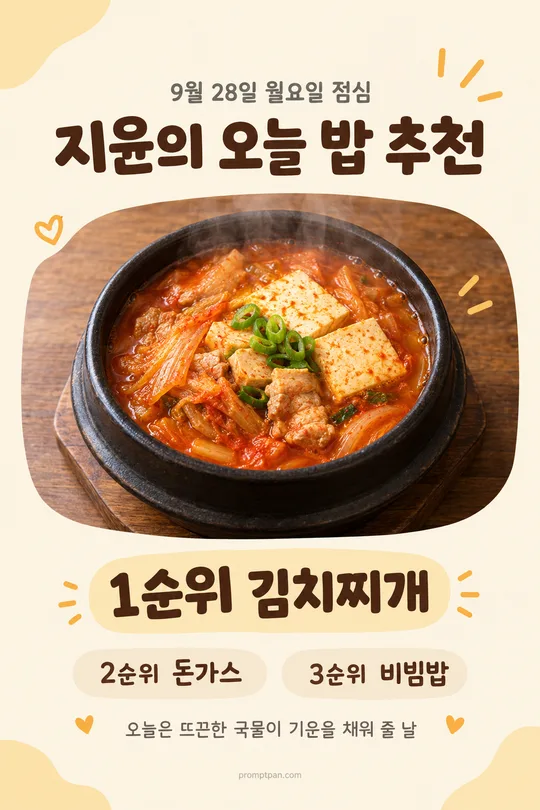
쓰는 법 · 자주 묻는 것
이런 때 쓰세요
쉬는 날이 생겼는데 어디로 나갈지 정하지 못했을 때 써 보세요. 혼자 가볍게 걷고 싶은 날에도, 연인·친구·가족과 한 동네에서 놀고 싶은 날에도 맞습니다. 카드는 막연한 "핫플" 목록 대신 동네 안팎의 실제 장소 세 곳과 들를 순서 한 줄을 담습니다. 결과를 스토리나 카톡에 올려 "오늘 여기 가볼까?" 하고 이야기하기 좋습니다. 추천은 재미로 보는 개인 맞춤 제안이지, 예약이나 운영을 보장하는 일정표는 아닙니다.
칸 채우는 법
- 이름은 카드 맨 위에 그대로 들어갑니다. 본명이나 친구끼리 쓰는 별명 모두 괜찮습니다.
- 생일은 연도·월·일을 적어 주세요. 오늘 날짜를 적는 칸이 아닙니다. 생일은 짧은 재미 문구에만 쓰고 장소의 실제 정보보다 우선하지 않습니다.
- MBTI는 선택입니다. 모르면 비워 두세요. 비어 있으면 결과에도 MBTI 표기가 나오지 않습니다.
- 동네는 "서울 망원동"처럼 시·도와 동네를 함께 적는 편이 정확합니다. 같은 이름의 지역을 헷갈리지 않고 실제 장소를 찾는 데 필요합니다.
- 누구랑은 혼자·연인·친구·가족·아이랑 가운데 떠올리기 쉬운 말을 골라 적으세요. 아이와 간다면 실제로 가기 알맞은 곳인지 더 신중하게 고릅니다.
- 예산은 "1인 3만 원 이하"처럼 기준을 분명히 써 주세요. 0원이면 무료로 갈 수 있는 장소를 우선합니다. 여러 사람의 총예산이라면 "모두 합쳐 3만 원"이라고 직접 적으면 됩니다.
- 오늘 기분은 느긋함, 설렘, 답답함처럼 지금 마음에 가까운 말로 적어 주세요. 생각이 안 나면 "알아서 골라줘"를 누르면 됩니다.
오늘 날짜와 동네 장소
GPT가 카드를 만드는 시점의 날짜·시간·계절과 해당 동네의 날씨를 직접 확인하도록 지시했습니다. 비가 오거나 늦은 시간이면 야외 장소와 운영 시간을 더 조심해서 고릅니다. 장소 이름도 웹에서 찾아 실제로 그 동네에 있는지 확인한 뒤 세 곳만 추천하도록 했습니다. 검색이 되지 않아 실제 장소를 확인할 수 없는 환경이라면 그럴듯한 가게 이름을 지어내지 않고 확인이 필요하다고 알려 주게 했습니다. 날씨를 확인하지 못했을 때도 기온이나 강수량을 꾸며 쓰지 않습니다.
그림이 나오면 꼭 볼 것
맨 위 이름과 동네, 날짜·요일이 맞는지 먼저 보세요. 세 장소가 실제로 서로 가까운지, 카드의 장소 이름과 "동선" 줄이 일치하는지도 확인하세요. "가기 전 영업 확인"은 출발 직전에 직접 살펴볼 일입니다. 가게 영업일, 전시 일정, 요금과 예약 가능 여부는 바뀔 수 있습니다. 아래의 작은 `promptpan.com`은 친구가 카드를 어디서 만들었는지 찾을 수 있는 출처입니다. GPT가 그림 뒤에 적은 짧은 캡션은 그림 안의 글자가 아니므로, 올릴 때 함께 붙여 주세요.
틀린 곳 고치는 법
장소 이름의 한글이 틀렸거나 다른 동네 장소가 섞였다면 같은 대화에서 정확한 장소명을 알려 주고 카드를 다시 그려 달라고 하세요. 그림은 괜찮지만 날짜나 날씨가 어긋났다면 현재 정보부터 다시 확인해 달라고 하세요. 사람이 많은 곳이 부담스럽거나 이동 거리를 줄이고 싶다면 "조용한 곳으로 다시" 또는 "걸어서 이어지는 동선으로 다시"처럼 원하는 조건을 짧게 더하면 됩니다.
자주 묻는 것
- 서울 밖 동네도 되나요? 네. 동네를 시·도와 함께 적으면 GPT가 그 지역의 실제 장소를 찾는 데 도움이 됩니다.
- 아이와 가도 되는 곳만 나오나요? "아이랑"을 고르면 그 조건을 우선하지만, 시설과 프로그램은 출발 전 해당 장소에서 다시 확인해 주세요.
- 예산 0원도 되나요? 네. 무료로 접근 가능한 공원·산책길·공공 공간 등을 우선하도록 했습니다. 별도 교통비나 유료 프로그램은 직접 확인해 주세요.
- 오늘 영업 중인 곳만 확정해 주나요? 아닙니다. 웹에서 확인한 운영 정보도 바뀔 수 있어 카드에 "가기 전 영업 확인"을 넣었습니다.
- MBTI가 없으면 만들 수 없나요? 만들 수 있습니다. MBTI를 비워도 동네·동행·예산·기분을 바탕으로 세 곳을 고릅니다.