

All · Ads & posters · Restaurants
134Store Pork Belly Poster
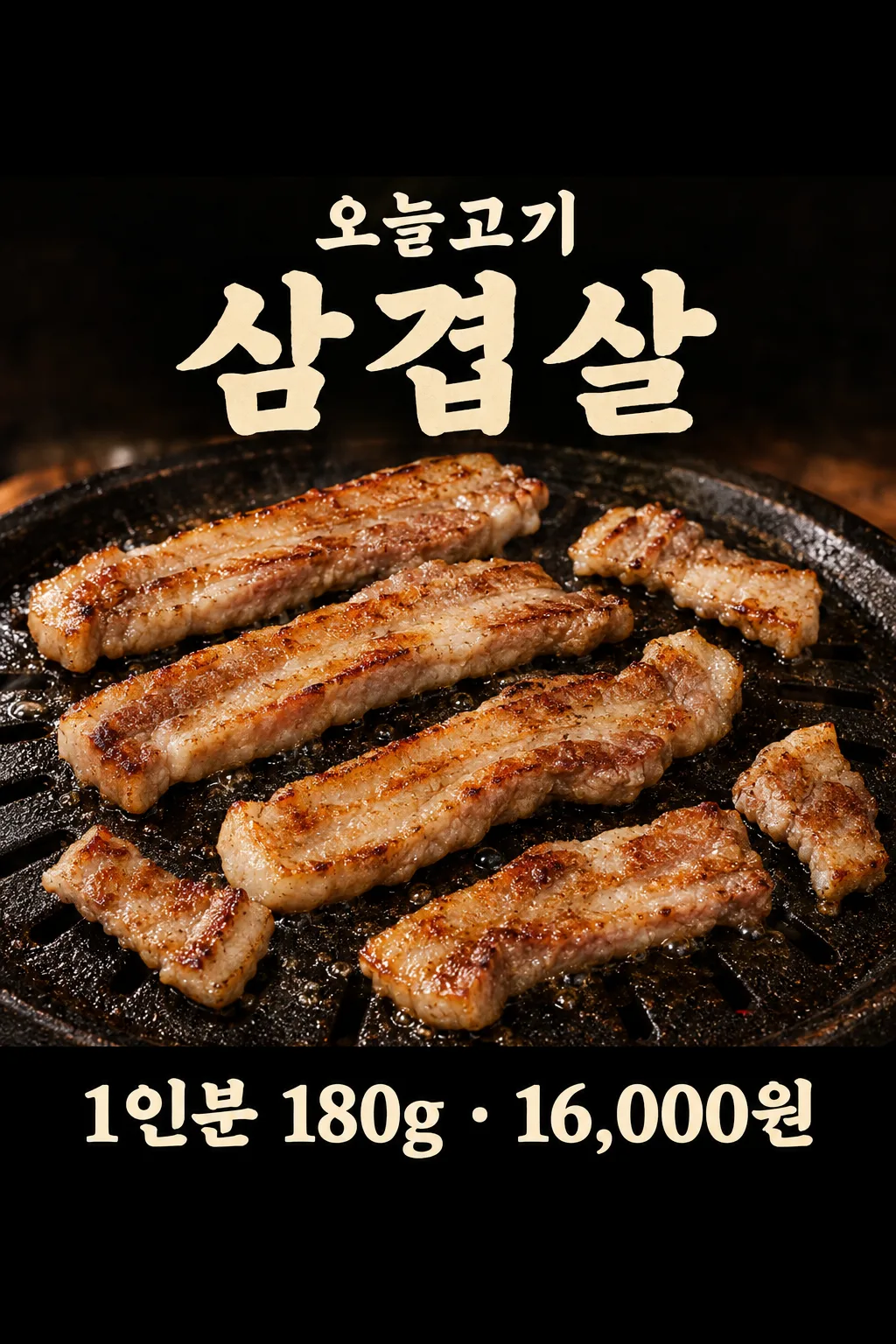
A four-column meat table compares serving weight, serving price and price per 100g, with aging and origin badges.
What you get
- One poster with cut, serving weight, serving price and price per 100g
- Origin and aging badges
- Minimum order and included sides
ChatGPT Free OK
Fill in the fields
- 1Fill in the fields
- 2Copy the prompt
- 3Paste it into a GPT chat
- 4Send it as is and you get an image like the thumbnail example
- 5Attach One real photo of meat on the grill with the prompt and your photo is used in the result Optional
Full prompt 4,923 characters
Generate this image now. Return ONE finished store poster: a Korean BBQ shop poster. Its job: answer "how many grams is one serving, and what is that per 100 g?" The hero is a MEAT TABLE: cut, grams per serving, serving price, and price per 100 g.
PHOTO PRIORITY — for the four-column meat-price table: an attached photograph controls the food as detailed below, overriding any earlier or later demand to require or request a photograph. With no attachment, complete a fictional food image consistent with this card's example; do not ask for a photo or pause production.
Output exactly one finished 2:3 portrait image, 1024x1536 pixels. Leave the top 12% and bottom 15% free of essential text.

[REAL FOOD FIRST]
Build the grill scene from the supplied meat photo without changing serving weight, meat-piece count, sauce, grill vessel or included accompaniments. Only exposure, lighting, scenery and grounded shadows may improve. Magnify the whole serving at one scale; do not manufacture additional strips. Fat seams and browned edges must resemble a camera capture, not synthetic rendering or repeating texture. Typical real look: thick pork-belly strips grilling on a black grill plate: real alternating layers of fat and meat, golden seared edges with uneven browning, a few pieces cut with scissors, light sizzle smoke, garlic slices on the side. The photograph wins when it differs from this description.

[THIS CARD'S DESIGN]
The meat sizzling on the grill shown large across the top 55%, close-up. Below, a clean four-column MEAT TABLE (cut / g / price / per 100 g) with clear row lines, as the main information. ORIGIN and AGING as small badges at the table's top edge. Preserve the grill above the cut/weight/price/100g table and the origin and aging badges. MOOD controls the table material, surrounding colors, type and light, so another selection reads immediately as another grill restaurant. Leave neither vacant table frames nor unused badge shapes.

[OWNER INPUT — an absent optional line means no such information]
STORE: "【Shop name】". Compact wordmark, once.
CUTS: "【Prices by cut】". REQUIRED. Split on "/": each part = cut name, grams, price. Print one table row per part. Compute the 4th column = price ÷ grams × 100, rounded to the nearest cent, labeled "Per 100g". Use $ for prices. Every supplied digit exact; never invent a cut.
ORIGIN: "【Origin】". REQUIRED. A clear badge, exact wording (origin label).
AGING: "【Aging】". A badge next to ORIGIN.
MINIMUM: "【Minimum order】". Small line under the table.
FIRE: "【Fire】". Changes the grill in the image: Charcoal = glowing charcoal under a wire grill, Gas grill = flat round gas grill, Cast-iron lid = heavy cast-iron lid. Never print it.
SIDES: "【Included sides】". Small line under the table.
HOURS: "【Opening hours】". Exact text once.
LOCATION: "【Shop location】". Exact text once.
MOOD: "【Shop mood】". MANDATORY: sets every material, color and light; the arrangement stays. Old-school BBQ or absent → smoky dark room, steel table, worn red plastic stools in the background, white and ember-orange type. Aging specialist → dark charcoal-grey stone, aging-fridge glow, thin serif-like type in cream, precise cool light. Camping → outdoor dusk, wooden camp table, string lights, kraft-paper table panel, warm hand-lettered type.
PLACEMENT: "【Placement】". INTERNAL, never printed. Counter/wall: main device readable at 2–3 m. Entrance/window: stronger contrast, food and main device larger. Flyer: same layout, hours and location readable in the hand.

[THIS CARD'S LAYOUT]
On 1024x1536 (other ratios keep the same arrangement proportionally): Wordmark y3–7%. MENU line y8–14% (the first cut name as title). Grill image x0–100%/y15–58%. ORIGIN and AGING badges y59–63%. MEAT TABLE x5–95%/y64–86%, row height large enough for 190px thumbnails. MINIMUM, SIDES y87–91%. HOURS, LOCATION y92–96%. Inset table lettering by 5% from the trim. The serving prices and meat-table structure must survive a 190px preview. Fit additional notes by compacting their small type, never by reducing the grill or its comparison table.

[OPTIONAL DATA]
Treat "Not selected" as absent. Remove a missing line entirely and let the food or background fill the space. Never invent a price, discount, origin, rating, count or ingredient.

[FINISH]
Visible wording is English; supplied values stay exact. The four-column meat-price table contains customer-facing copy only: omit field identifiers, curly brackets and production directions. Deliver a single flat, print-ready four-column meat-price table poster at the chosen aspect ratio and pixel dimensions. Exclude collages, staged mockups, QR-like graphics and watermarks.

[Final output format]
Output exactly one finished 2:3 portrait image, 1024x1536 pixels. Leave the top 12% and bottom 15% free of essential text.
This selected output format takes priority over any fixed canvas size or aspect ratio elsewhere in this template. Adapt the composition, text zones and margins to the selected canvas without stretching or cropping essential content. Device safe areas apply only when a device is selected. Never print these format instructions on the image.
How did it turn out?
More cards in this category





How to use it · FAQ
The 150g pork jowl came out at 12 per 100g
We ran the Korean example twice: belly and shoulder were each 200g at 17,000, while jowl was 150g at 18,000. Both posters printed every weight and price correctly and calculated 8,500, 8,500 and 12,000 per 100g. The serving prices differ by only 1,000, but the difference per 100g is 3,500. Those are the Korean test figures; the dollar examples above are separate sample prices, not an exchange-rate conversion.
Each row separates the cut, serving weight, serving price and price per 100g. Use the weight on which your menu price is based, rather than substituting the cooked weight. The English prompt rounds the calculated unit price to the nearest cent.
Red stools gave way to a tent
Changing only the mood from old-school BBQ to camping replaced the dark interior and red stools with a tent, string lights and a wooden table. The black table panel became pale kraft paper. The four columns, origin and aging badges stayed, and all three unit prices were still correct.
Aging stayed; a price appeared twice
All three Korean posters kept the domestic-pork origin, 14-day aging, two-serving minimum, sides, opening hours and address. The second old-school result also added the first cut's weight and price beside the title. The figures were correct, but for a cleaner title ask: “Remove the weight and price beside the title; keep them only in the table.”
These tests used fictional food with no attached photo. They do not establish how well a real photo's thickness or portion size is preserved. The English version has not been image-tested.
Two servings do not always mean 400g
The minimum-order line sits outside the table. Two belly servings at 200g each total 400g; two jowl servings at 150g total 300g. The minimum alone does not say whether customers may mix cuts. The generated posters did not invent a combined weight or total price. If mixing has conditions, spell them out in Minimum order.
The table compares prices at an equal weight. It does not measure the long strips or individual pieces in the photograph: there are no weight arrows on the food, and each weight belongs to its menu row.
Last checked · Published