

All · Wallpapers · Fantasy
097My Neighborhood Fantasy Map
Keep familiar place names and turn them into adventure landmarks connected by mountains, rivers, and winding paths.
What you get
- One fantasy adventure map with your place names preserved
- Mountains, rivers, and distinctive adventure landmarks
- Default 16:9 wallpaper
ChatGPT Free OK
Fill in the fields
- 1Fill in the fields
- 2Copy the prompt
- 3Paste it into a GPT chat
- 4Send it as is and you get an image like the thumbnail example
- 5Attach a real photo that fits the card and it is used in the result: a background photo for background cards, a person or food photo for those cards Optional
Tested by us
- Test date
- 2026-11-01
- Tool
- ChatGPT image model (run via Codex) — same model as free ChatGPT, only limit differs
- Result
- Pass
- What worked
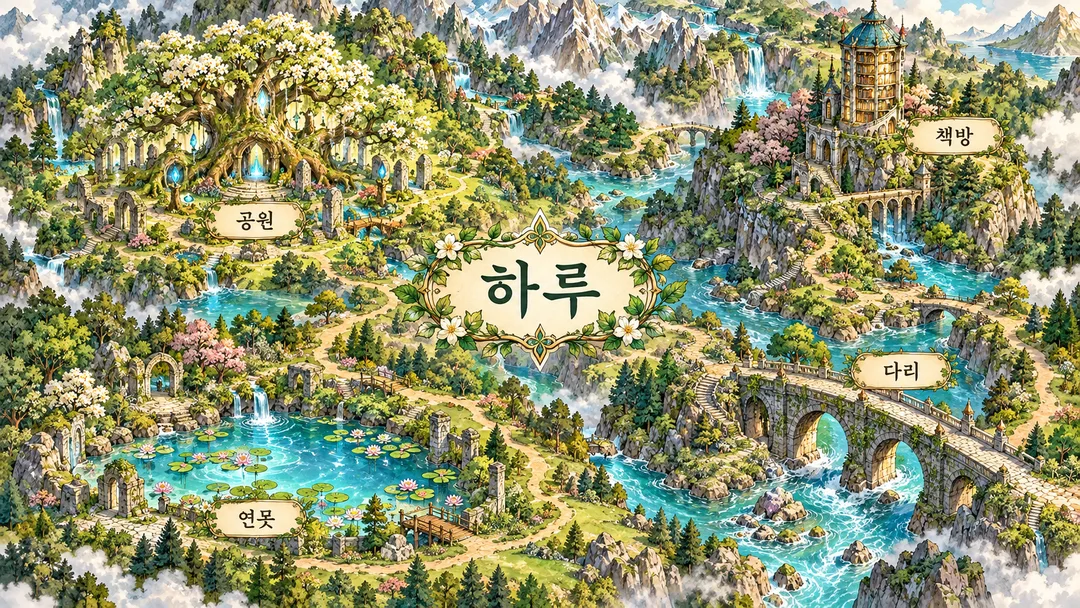
- Title "Haru" and locations "park," "bookstore," "pond," and "bridge" are each accurately displayed once. Cream-colored nameplates are placed near their respective hubs. The park is depicted as a magical forest garden, the bookstore as a tall tower of records, and the pond as a bright teal waterfront. A central stone bridge crosses the river, and winding paths connect the four hubs. Overhead fantasy map with mountains, valleys, and rivers; watercolor and ink rendering in sunlight, moss green, cream, and gold; landscape wallpaper composition verified. No extra text, legend, numbers, people, or logos.
- What did not work
- None
- How to improve
- No further modifications were tested. The initial result using the exact input values from the above example passed.
Full prompt 3,772 characters
Generate this image now. Return ONE finished full-bleed original fantasy adventure map wallpaper, no explanation, code, mockup or collage.
Canvas: Output size 1920x1080 pixels, 16:9 landscape thumbnail. Keep all text large and readable at thumbnail size.. Default 16:9; adapt the composition to the shared size selection.
MAP TITLE: "【Map name】". PLACE LABELS: "【Places】".
Split places at commas or newlines and preserve every allowed supplied name verbatim, including spaces and digits. Do not rename, translate, abbreviate, or add fantasy epithets. Draw each distinct supplied place once with exactly one matching label. Use 3–8 places; above eight use the first eight, one or two stays as given without inventing extra names. Blank title becomes Haru; blank places becomes Park, Bookshop, Pond, Bridge.
Create an overhead cartographic fantasy realm: layered mountain ridges, rivers, valleys, coastlines as appropriate, dense varied terrain detail, clear winding adventure paths connecting landmarks, coherent waterways, and deliberate open patches for legible labels. Convert ordinary neighborhood functions into original fantasy landmarks while preserving their supplied LABELS: park becomes an enchanted grove, bookshop an archive tower, pond a luminous pool, bridge a fantasy stone bridge visibly spanning a river; market becomes a plateau caravan bazaar, hill a rocky summit, well an oasis well; harbor becomes a sheltered fantasy dock, lighthouse a sea beacon, island a separate garden island, beach a crescent coast, lookout a cliff observatory. Infer other generic places by their ordinary function.
Automatically derive the environment and rendering from the place set, never ask for a style: sets dominated by coast/harbor/lighthouse/island use a midnight archipelago, navy/lilac/cyan, silver etched contour lines and flat luminous screenprint planes; otherwise sets containing market/hill/well use volcanic highlands, charcoal/rust/turquoise and matte gouache with bold woodcut contours; all other sets use a sunlit forest realm, moss/cream/gold, luminous watercolor and fine ink. Sea rule takes priority. Keep this one cohesive adventure-map result. No UI or style menu.
Print ONLY the title and supplied allowed place names, each once, in clean high-contrast cream plaques near the matching feature. Title prominent but subordinate to the map. Labels must not cover essential terrain or cross paths confusingly. No invented legend, coordinates, scale, numbers, dates, weekdays, compass letters, decorative pseudo-writing or verification notes. Preserve supplied digits exactly. Keep essential text between 12% and 85% of canvas height in portrait compositions.
Fictional geography only; do not infer actual locations, distances or directions from names. Ignore attachments. Do not reproduce real businesses, brands, logos, real famous buildings, recognizable product designs, celebrities, existing characters, game worlds or any named artist's style. Use only fictional original architecture and unbranded objects, with no people. If a supplied item is a recognizable real brand or business, omit that item instead of printing or silently renaming it; if the title is such an item use the blank-title fallback. Preserve all other allowed names exactly.
Before returning, enlarge and compare every visible character to the source, verify place count and label-to-landmark matches, remove duplicate labels and overlaps, and check connected adventure paths. Return only ONE completed image.

[Final output format]
Output size 1920x1080 pixels, 16:9 landscape thumbnail. Keep all text large and readable at thumbnail size.
This selected output format takes priority over any fixed canvas size or aspect ratio elsewhere in this template. Adapt the composition, text zones and margins to the selected canvas without stretching or cropping essential content. Device safe areas apply only when a device is selected. Never print these format instructions on the image.
How did it turn out?
You may also like
How to use it · FAQ
Turn familiar stops into the setting for a personal adventure. A park becomes an enchanted grove, a bookshop becomes an archive tower, and a pond becomes a luminous pool, while their supplied names remain unchanged. Mountain ridges and branching rivers give the map depth, and winding paths connect the landmarks. Use the image as desktop wallpaper or as a setting illustration for a personal story. The geography is invented rather than a depiction of actual streets.
There are two required fields: Places and Map name. List 3–8 generic place names separated by commas or newlines, then give the map a short title such as Haru. Spelling, spaces, and supplied digits should be preserved without translation or fantasy suffixes. A blank title uses Haru; blank places use Park, Bookshop, Pond, Bridge. More than eight entries uses the first eight. One or two entries stays as supplied without invented extra names. Repeated names appear once.
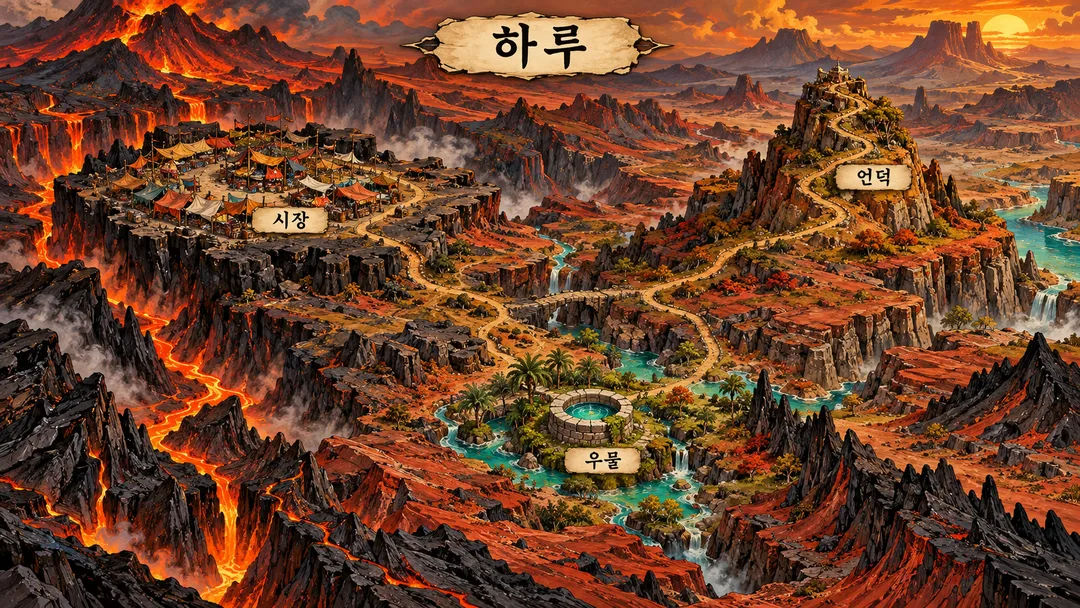
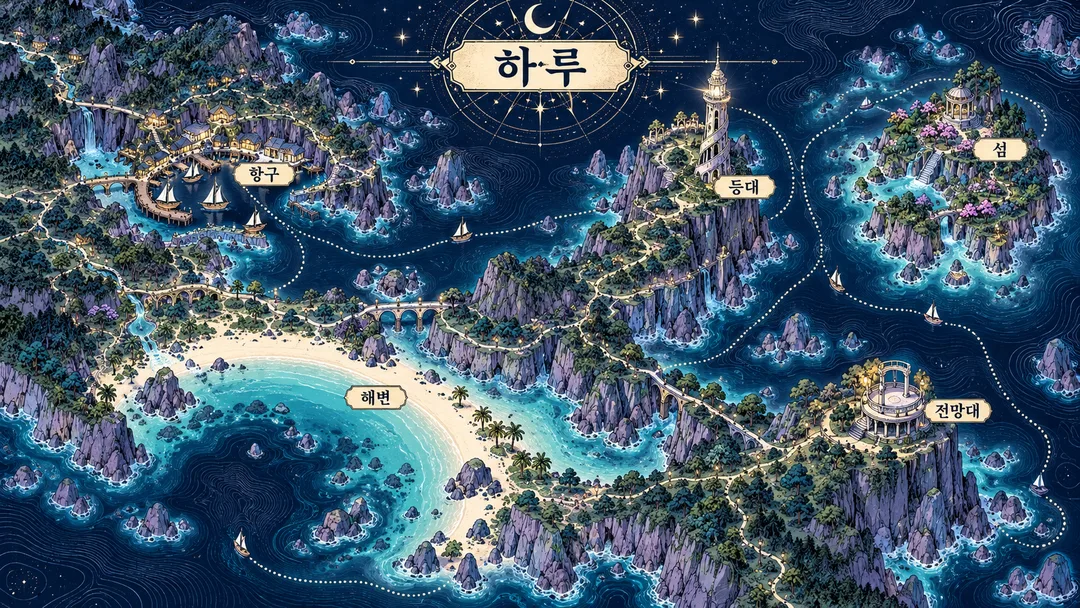
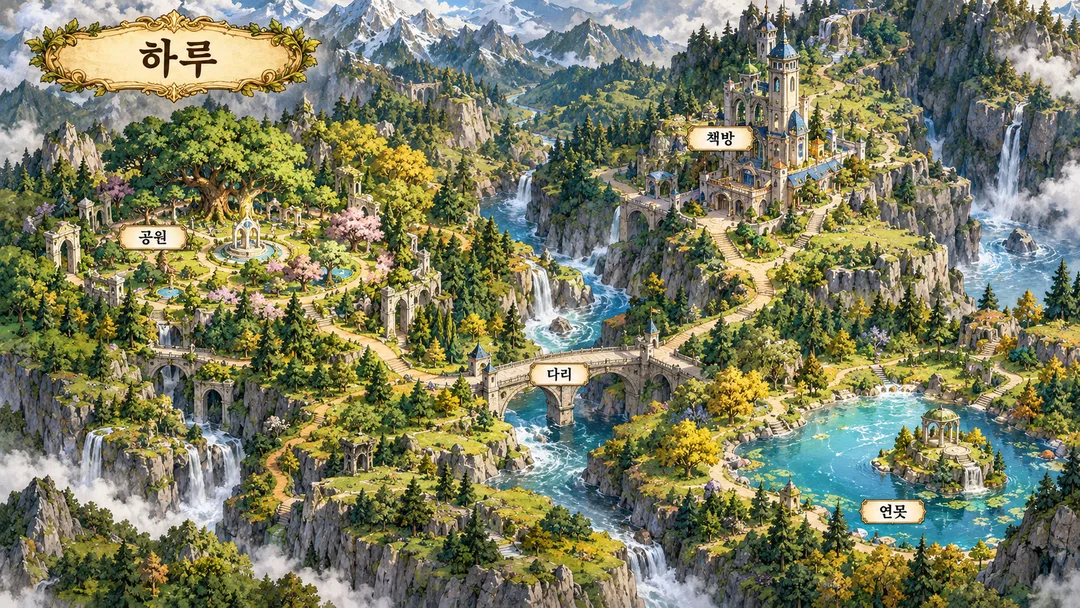
The place set determines the environment automatically. Coastal sets centered on harbors, lighthouses, or islands become midnight archipelagos with silver engraved contours and luminous blue screenprint planes. Other sets containing a market, hill, or well become volcanic highlands with matte gouache and woodcut contours. Remaining sets become sunlit forests in watercolor and fine ink. The coastal rule takes priority. There is no separate mood or style field. The three gallery examples demonstrate four woodland places, three highland places, and five coastal places; their lettering is Korean. Your supplied labels remain in the language you type. The separate portrait listing cover is a different map. The default output is 16:9; the shared size menu adapts the same map format.
No photograph is needed, and attachments are ignored. Paste the finished prompt into an image AI once to request one image. Enlarge the title and every label, compare each character, and inspect whether bridges cross water and routes reach their landmarks. Correct misspellings by giving the exact text in quotation marks and requesting the same map again. Use generic names instead of real businesses or brands. Recognizable brand entries are omitted; a branded title uses the default title. This decorative map does not establish actual directions or distances and is unsuitable for navigation. This card supplies a prompt; consult the external service for pricing and usage terms.