

All · Comics & illustration · People
482Time Travel Fashion Portrait
Keep your face in a cinematic fashion editorial from your chosen decade.
Fill in the fields
- 1Fill in the fields
- 2Copy the prompt
- 3Paste it into a GPT chat
- 4Send it as is and you get an image like the thumbnail example
- 5Attach One clear adult portrait (optional) with the prompt and your photo is used in the result Optional
Full prompt 3,540 characters
Generate this image now. Return only ONE finished cinematic fashion editorial photograph.
Canvas: Output size 1080x1350 pixels, 4:5 portrait, Instagram standard.. Default 4:5 portrait, full bleed. One person in one scene, no comparison panels, collage, border or mockup.
Photo context, never printed: 【Photo】
Era selected, never printed: 【Era】
Use the attached portrait as the identity reference. Preserve the person's face shape, eye spacing, brows, nose, lips, skin tone, apparent age, hairline and distinctive asymmetries or marks. Keep glasses and facial hair if present. Keep the face large, clearly visible and recognizably the same person; do not beautify into another face, alter ethnicity or substitute a celebrity. Change only styling, clothing, pose, setting and light. Use the largest foreground adult if the photo contains several people. Photo context is a note, not an upload. Without an attached photo, invent one original fictional adult unlike any public figure and finish immediately without questions.
Choose only the selected decade from 1920s, 1930s, 1940s, 1950s, 1960s, 1970s, 1980s, 1990s. The number or decade in the selected value controls the era in any language. Blank means 1970s. Keep the same cinematic photographic medium; vary wardrobe, setting, palette and light by decade:
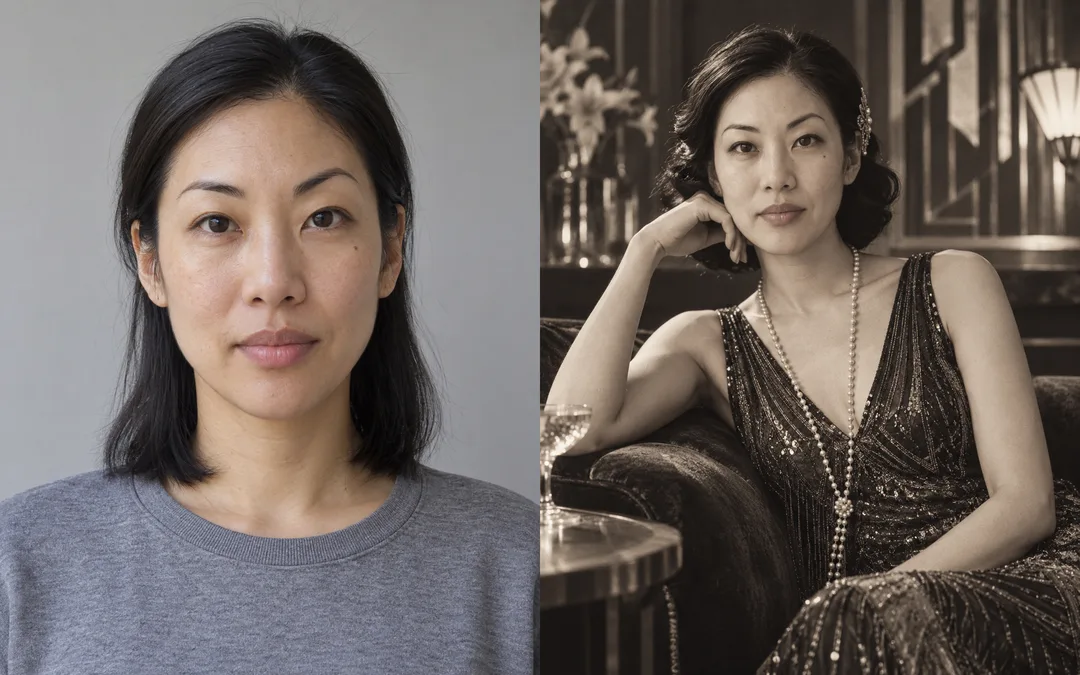
1920s: monochrome silver-gelatin mood, geometric salon, satin and fine pleats or tailored wool evening suit, soft side light, quiet dramatic elegance.
1930s: champagne and ivory, fluid bias-cut evening fabric or softly draped tailoring, curved staircase, diffused luminous studio light.
1940s: charcoal and olive, structured wool coat and practical tailoring, rain-dark station platform without signs, restrained hard sidelight.
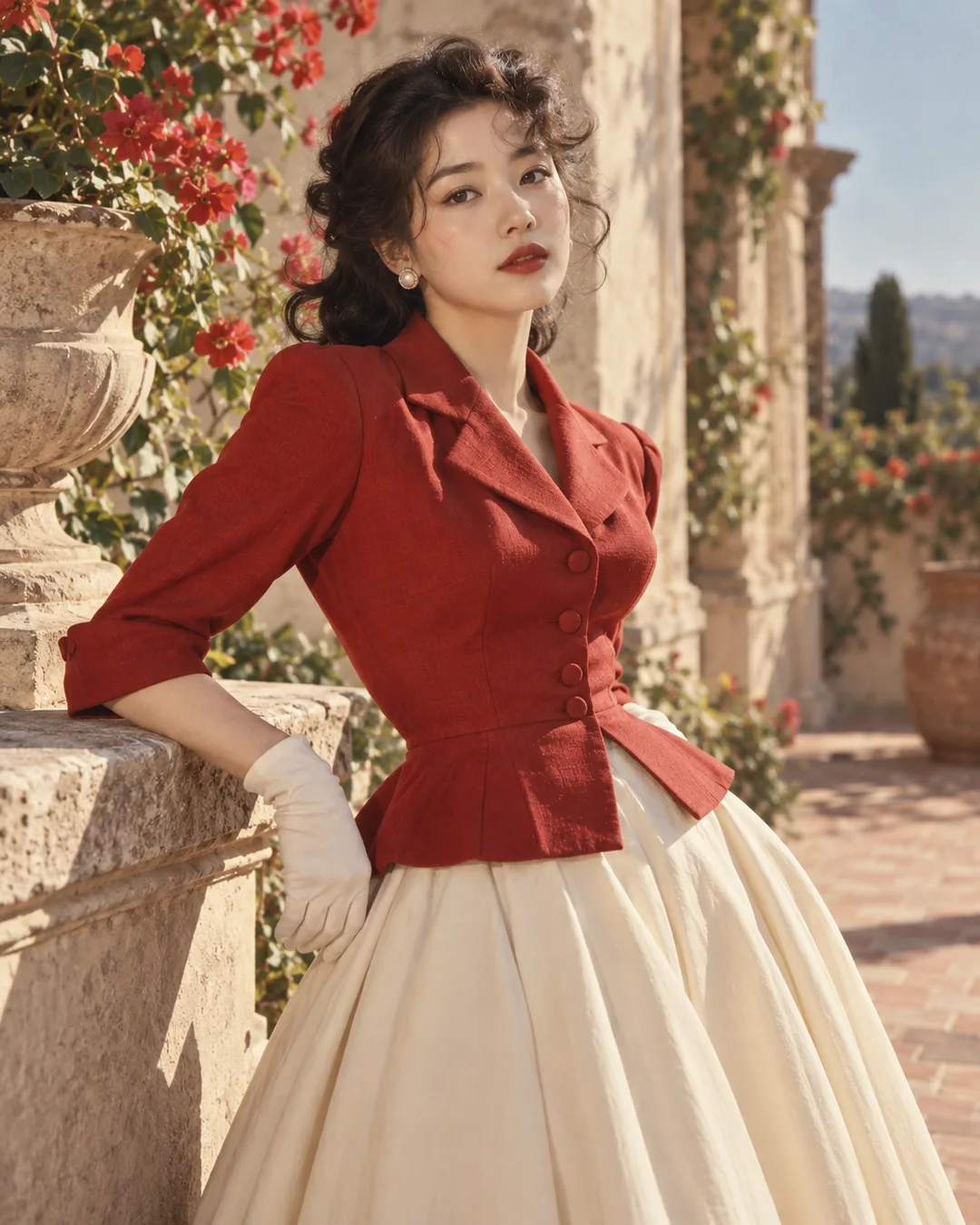
1950s: cherry and cream, sculptural fitted jacket and full skirt or high-waisted tailored trousers, sunlit tiled courtyard, poised optimism.
1960s: cobalt and white, clean geometric shift silhouette or slim high-collar tailoring, abstract architectural wall, graphic daylight.
1970s: rust and cream, suede belted jacket and wide-leg trousers, amber glass-block wall, warm low sunlight, tactile relaxed sophistication.
1980s: plum and steel, broad-shoulder jacket with generous tailoring, dark concrete atrium, crisp magenta edge light, assertive editorial stance.
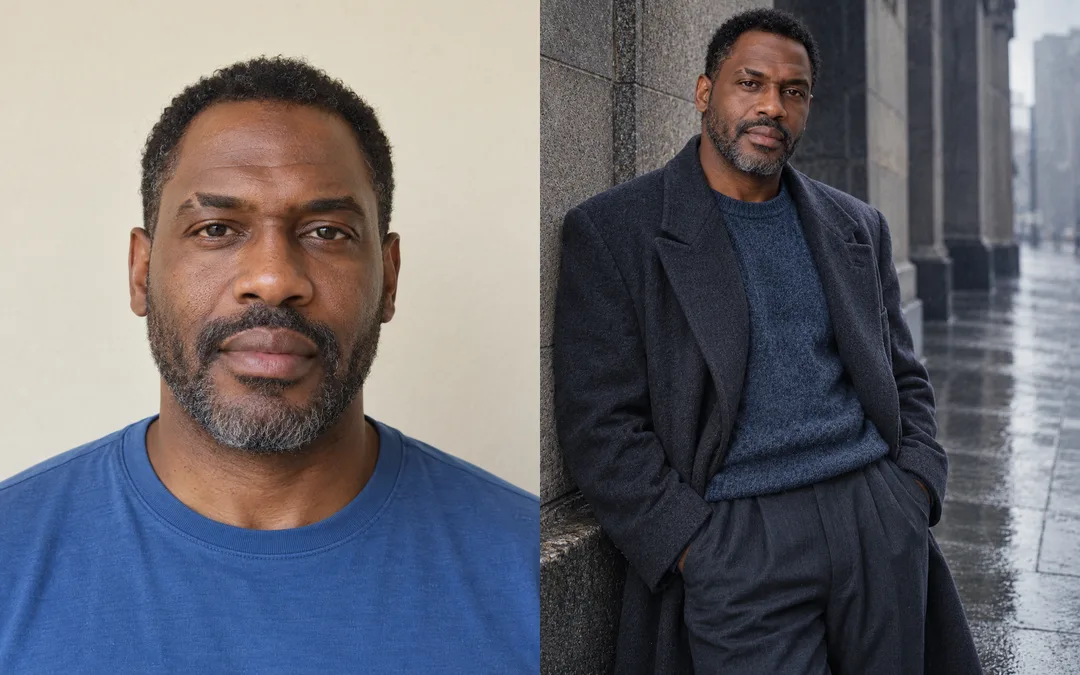
1990s: slate and muted blue, spare unbranded oversized jacket and straight trousers, wet urban concrete street without signs or vehicles, cool overcast light, candid restrained attitude.
Adapt the selected decade's clothes to the person without changing their identity. Original fictional clothing and accessories only. Use believable fabric construction, natural skin texture, subtle film grain, coherent shadows and depth. Compose a prominent three-quarter-length figure with unobscured face, hands naturally resting or inside pockets, background extending to every edge. No modern phones or commercial products. No real brands, logos, recognizable product designs, public figures, named-artist imitation, letters, numerals, names, labels, captions, signatures or watermarks anywhere. Do not print field values. Before output compare facial landmarks with the attachment and correct identity drift. Deliver only the image.

[Final output format]
Output size 1080x1350 pixels, 4:5 portrait, Instagram standard.
This selected output format takes priority over any fixed canvas size or aspect ratio elsewhere in this template. Adapt the composition, text zones and margins to the selected canvas without stretching or cropping essential content. Device safe areas apply only when a device is selected. Never print these format instructions on the image.
How did it turn out?
You may also like
How to use it · FAQ
Create a cinematic fashion photograph with your own face for a personal profile or keepsake. One person fills one scene, with a default 4:5 portrait canvas. Both fields are optional; none is required. In Photo, describe a clear adult portrait, then attach the actual image in the same message as the copied prompt. A written note does not upload a file. Use your own photo or one you have permission to use. If several people appear, the largest foreground adult is selected.
Era offers eight decades from the 1920s through the 1990s. It changes the clothing silhouette, setting, palette and lighting together. The 1920s use a monochrome salon and fine pleats, the 1970s use rust suede and a warm glass-block wall, and the 1990s use restrained jackets on a wet street in cool light. An empty Era defaults to the 1970s. Without an attachment, an original fictional adult is generated immediately. The shared size selector adapts the same composition to another ratio.
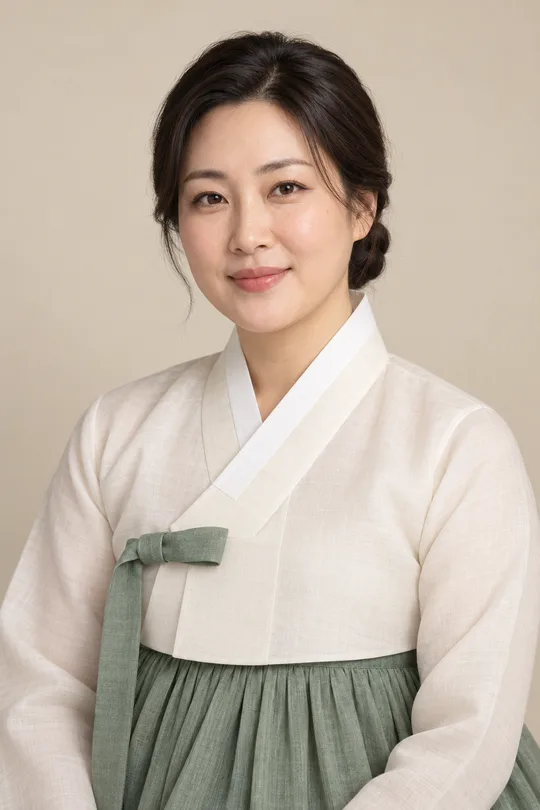
Compare face shape, eye spacing, nose tip, lips, moles and facial hair against the original. Styling changes while skin tone and apparent age should remain recognizable. If identity drifts, attach a clearer frontal photo and identify the facial feature that changed. Clothing is fictional and no brands or lettering are requested. This is decade-inspired fashion, rather than a historical reconstruction. Comparison examples place fictional source photos on the left and results on the right: two different adults in 1920s and 1990s settings. The cover is a separate 1970s portrait. This site provides the prompt; your image tool generates the photograph.