
전체 · SNS/카드뉴스 · 정보·꿀팁
063레시피 카드
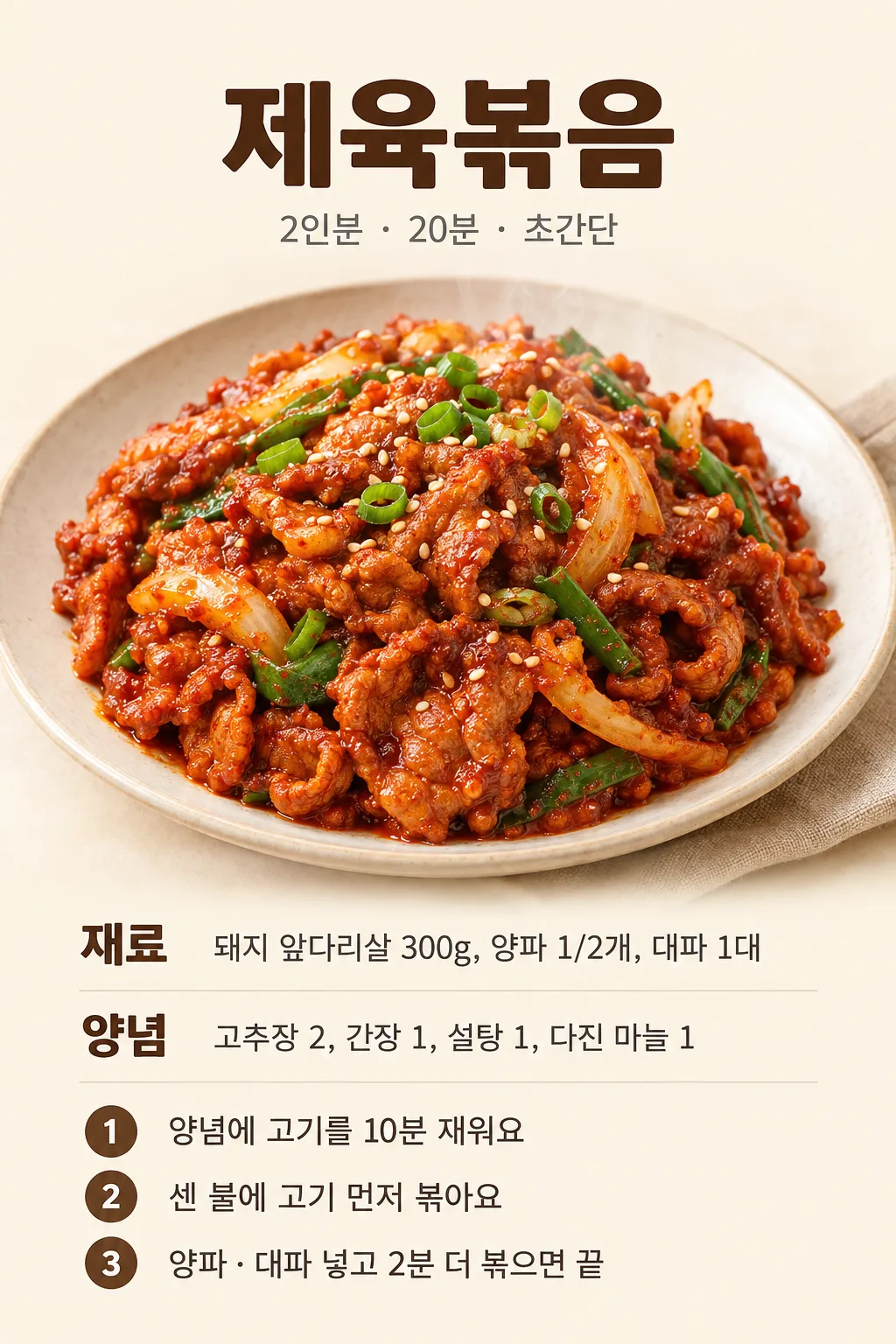
요리 이름과 인분만 정하면 실제 음식 사진 같은 완성 컷, 재료·양념 분량, 쉬운 3단계와 조리 시간이 한 장에 담기는 레시피 카드
칸 채우기
- 1칸을 채워요
- 2복사 버튼을 눌러요
- 3GPT 채팅창에 붙여넣어요
- 4제품·인물 사진을 쓰려면 사진과 프롬프트를 둘 다 넣은 뒤에 보내요 선택
프롬프트 원문 보기 9,306자
Generate this image now. Draw it directly - do not describe it, explain it, or ask questions.
Create one 4:5 portrait image at 1080x1350 pixels, with all information inside comfortable social-post safe margins.

[Purpose]
Make one complete Korean recipe card for the requested dish "【요리 이름】", serving exactly "【몇 인분】" at difficulty "【난이도】". A home cook must be able to save this single image and understand what to prepare and how to cook it. Show one appetizing finished-dish image with the believable texture of real food photography, a separate list of main ingredients and their amounts, a separate list of seasonings and their amounts, exactly three short numbered cooking steps, and one realistic total cooking-time line. This is one recipe for one dish, never a weekly meal plan or a grid of different dishes.

[Web reference — required before drawing]
Search the web first for actual photographs of the finished dish "【요리 이름】" and for a real home-cooking recipe for that dish. Inspect at least two distinct real food photos when available. Use them to check the dish's recognizable ingredients, cooked color, cut size, sauce thickness, bowl or plate, and natural plating. Cross-check the recipe's ingredient roles, plausible quantities, cooking order, and time. The finished image must look like a believable photograph of that specific cooked dish, not a generic illustration or a made-up dish. Learn visual facts from the references without recreating any one photographer's exact composition, watermark, logo, or branded tableware. Do not imply the generated picture is an untouched documentary photograph. If browsing is unavailable, do not pretend to have checked real photos: stop and state that the required web reference could not be checked.

[Recipe planning]
Choose a familiar, workable home version of "【요리 이름】" that matches the selected difficulty. For "초간단", simplify preparation and the ingredient count while keeping the dish recognizable and cooked safely; for "보통", use a standard home method. Calculate all main-ingredient and seasoning quantities for "【몇 인분】"; avoid amounts suited to another serving count. Include only ingredients actually used by the three steps and actually represented in the finished dish. Use ordinary Korean kitchen units such as g, 개, 컵, 큰술, 작은술, or ml, with numbers that a home cook can follow. Keep main ingredients and seasonings separate. Do not bury a sauce component among the main ingredients or leave a used seasoning off its list. Make the total time plausible for the stated method, including the necessary preparation and cooking; do not promise an unrealistically fast result. When an ingredient has to be cooked through, describe the visible doneness or sufficient cooking rather than guessing a dangerously short time.

Unavailable ingredient: "【없는 재료】"

If the optional line above names any unavailable ingredients, remove every named item completely from the main list, seasoning list, three steps, and finished-food image. Choose an ordinary, workable substitute only when the dish still makes culinary sense; write the substitute and its amount in the appropriate list and use it in the steps. Do not silently keep the excluded item as garnish, broth, sauce, or powder. If the excluded item defines the original dish, use an honestly named, recognizable variation rather than falsely labeling a different food as the original. Never tell the viewer to buy the missing item. If the optional line is absent, plan the normal recipe without mentioning exclusions.

[Scene]
Design one finished editorial recipe card. Put a short header at the top, one large hero photograph of the fully cooked dish below it, then a clean two-column information area for "재료" and "양념", followed by a three-step strip and one cooking-time line. The hero image is the visual anchor: one plate or bowl of the cooked food, visible authentic ingredients, natural sheen and irregular food texture, softly lit on a simple home table. Keep food entirely clear of the type areas. No tiny preparation-photo sequence, no collage of web images, no hands, people, shopping bags, raw ingredient scatter, or secondary dishes. If the dish contains broth, show its real broth-to-solid balance; if it is stir-fried, show individual cooked pieces rather than a smooth invented mass.

[Attached photo]
No uploaded photo is needed. The web search above supplies factual visual reference, not an image to paste. Generate an original finished-dish scene with photographic food texture. If the user happens to attach a photo of their own finished dish, use it only as a reference for the dish's true appearance and do not copy any visible brand, label, or watermark.

[Text layout]
Render these exact Korean labels and the selected values without the surrounding quotation marks. The percentages describe the top-to-bottom structure of the canvas.
- 5-12%: Main title "【요리 이름】" in the largest Korean type. If a defining excluded ingredient requires an established variation, use that truthful variation name here and nowhere present it as the unchanged original.
- 13-17%: Compact line "【몇 인분】 · 【난이도】". Do not alter the chosen serving count or difficulty.
- 19-49%: One unobstructed photorealistic image of the finished dish. Do not place text, badges, or labels across the food.
- 52-71%: Two clearly separated columns headed "재료" and "양념". Under each heading, generate short Korean item-and-amount lines for this recipe, with amounts suited to "【몇 인분】". Put each item once, and keep every essential ingredient readable. If a category has no seasoning, print "없음" under "양념" rather than inventing one.
- 74-92%: Heading "만드는 법" and exactly three numbered lines, "①", "②", "③". Each line is one plain, friendly Korean action sentence, with a useful heat, minute, sequence, or doneness cue where it matters. Write like a cook talking to a beginner: "고기 먼저 볶으세요", "몇 분 뒤 채소 넣으세요", "참기름 두 바퀴 둘러요". Follow the real recipe's sequence; do not use these example ingredients if they are wrong for the selected dish.
- 94-97%: One small line beginning "조리 시간 약" followed by one plausible number and "분". Include this time line once only.

[Style]
Use a polished Korean home-cooking editorial card made for saving and sharing. Warm ivory opaque background edge to edge, dark charcoal Korean Gothic lettering, restrained deep-green section heads, and one soft terracotta accent for the step numbers. Use thin dividers and generous padding rather than heavy boxes. Make the photo rich and natural while keeping all information panels matte and quiet. The two lists should align cleanly and the three steps should read in order on a phone screen. If the recipe has many items, simplify to a legitimate home version and reduce decorative whitespace before shrinking the text; never omit an essential item merely to preserve a visual flourish.

[Visual hierarchy]
The dish name reads first, the real-food hero photo second, then the ingredient and seasoning lists, the three steps, and the time. Keep the image large enough to recognize the particular dish, but reserve enough space for every amount and step to remain legible. Place the ingredient and seasoning headings directly above their own lists so readers cannot confuse the categories. Make ① ② ③ prominent but never let a numeral replace its instruction. Keep a consistent left edge and full safe margins; no line may run off the card.

[Lighting and texture]
Photograph-like food only: soft daylight, believable highlights on oil or broth, natural shadows, true cooked surface texture, slight human imperfection in plating, realistic depth of field, and accurate food color learned from the real-photo search. Keep the background and text panels clean with no glossy effects. Avoid waxy plastic shine, repeated ingredient shapes, unnaturally smooth sauce, floating garnish, fantasy steam, oversaturated red, or a staged AI-food look.

[Text rules]
Write all visible copy in Korean except standard units and numerals. Preserve "【몇 인분】" and "【난이도】" exactly. Keep the dish name "【요리 이름】" exact unless the unavailable defining ingredient forces a truthful named variation. Ensure the printed food title, photo, both lists, steps, and time all describe the same recipe. Check serving-size math, quantities, cooking order, exclusions, every Korean consonant and final consonant, numerals, circled step numbers, and units before finishing. Do not print field names, braces, source URLs, research notes, English prompts, a web-search badge, a nutrition calculation, or an unexplained substitute warning. Only the headings "재료", "양념", "만드는 법" and the required recipe content should appear.

[Avoid]
No fake or generic dish photo, copied web photograph, third-party watermark, food brand, trademark, logo, restaurant name, QR code, social handle, or invented source credit. No health, diet, immunity, disease, or weight-loss claim. No mismatched raw and finished ingredients, duplicate ingredient lines, missing amounts, seasoning in the wrong column, excluded ingredients in any form, uncooked meat presented as cooked, more or fewer than three steps, tiny unreadable type, cramped photo overlays, decorative text, black bars, transparency, or cropped content. Do not add a second dish, shopping list, price, calories, or a long recipe essay.
이 카드도 많이 사용해요
쓰는 법 · 자주 묻는 것
이런 때 쓰세요
요리 블로그에 집밥 만드는 법을 올리거나 인스타그램 요리 계정에 저장하기 좋은 한 장을 만들고 싶을 때 쓰세요. 요리 이름을 적고 인분과 난이도를 고르면, 완성 음식의 실제 사진 같은 질감과 함께 재료·양념의 분량, 세 단계 만드는 법, 조리 시간이 한 장에 정리됩니다. 여러 날의 메뉴를 추천하는 식단표와 달리, 이 카드는 요리 하나를 바로 따라 할 수 있게 보여 줍니다. 휴대폰에 저장해 장을 본 뒤 다시 펼쳐 보거나, 만든 음식을 소개하는 게시물에 붙이기에도 좋습니다.
GPT는 그림을 그리기 전에 웹에서 그 요리의 실제 완성 사진과 조리법을 찾아봐야 합니다. 사진에서 음식의 색, 재료 모양, 담음새를 확인하고, 조리법에서 분량과 순서를 확인하도록 프롬프트에 적어 두었습니다. 웹 사진을 그대로 가져다 붙이는 방식은 아닙니다. 웹 검색이 안 되는 대화에서는 참고했다는 말을 지어내지 않고 검색할 수 없다고 알려 주도록 했습니다. 사진 파일을 따로 올릴 필요는 없습니다.
칸 채우는 법
- 요리 이름: 「제육볶음」처럼 실제로 만들 음식 이름을 적으세요. 「저녁 반찬」처럼 넓은 표현보다 특정 요리 이름이 사진과 조리법을 맞추기 쉽습니다. 원하는 변형이 있다면 「버섯 제육볶음」처럼 이름에 넣어도 됩니다.
- 몇 인분: 1인분, 2인분, 4인분 중 실제 먹을 양을 고르세요. 재료와 양념의 분량을 이 수에 맞춰 적게 됩니다. 접시에 담긴 음식의 양과 글에 적힌 인분도 어긋나지 않는지 확인해 주세요.
- 난이도: 「초간단」은 익숙한 재료와 짧은 준비를 쓰는 집밥 버전, 「보통」은 일반적인 집밥 순서에 가깝습니다. 초간단이라도 고기나 달걀을 덜 익혀 끝내라는 뜻은 아닙니다.
- 없는 재료: 집에 없는 것을 적으면 재료·양념·만드는 법에서 빼고 가능한 대체 재료를 쓰게 합니다. 「대파, 양파」처럼 여럿 적어도 됩니다. 요리의 핵심 재료를 빼면 음식 이름이 달라질 수 있으니, 예를 들어 고기 없는 불고기를 원한다면 처음부터 「버섯 불고기」라고 적으면 더 분명합니다. 해당 사항이 없으면 비워 두세요.
그림이 나오면 꼭 볼 것
완성 음식이 적은 요리와 같은 모습인지 먼저 보세요. 예를 들어 김치볶음밥인데 하얀 밥 위에 김치만 올려 둔 모습이면 다시 만들어야 합니다. 재료 목록과 양념 목록에 각각 분량이 있는지, 적은 인분에 비해 수치가 지나치게 크거나 작지 않은지도 확인하세요. 세 단계에는 재료를 넣는 순서와 필요한 조리 시간이 읽히고, 한 줄 조리 시간은 실제 준비까지 감안해 무리 없는 값이어야 합니다. 이미지를 게시하기 전에는 한글, 숫자, 빠진 재료, 빠진 양념을 한 번 더 살펴보세요.
틀린 곳 고치는 법
같은 대화에서 틀린 부분을 구체적으로 짚으면 됩니다. 「양념 목록에는 간장 1큰술인데 ②에는 간장 3큰술이라고 적혀 있어요. 두 곳을 같은 분량으로 맞춰 다시 그려 주세요」처럼 말해 보세요. 없는 재료가 사진이나 순서에 남아 있다면 그 재료의 이름과 남아 있는 위치를 함께 알려 주세요. 요리 사진이 실제 음식과 다르면 「웹에서 완성 사진을 다시 확인하고 제육볶음의 재료 모양과 색에 맞춰 주세요」처럼 요청하세요. 사진만 고치지 말고 글과 사진이 같은 요리를 가리키는지 함께 확인하는 편이 좋습니다.
자주 묻는 것
- 사진을 꼭 올려야 하나요? 아니요. 프롬프트가 GPT에 실제 음식 사진을 웹에서 찾아 참고하도록 지시합니다. 사진을 직접 갖고 있다면 같은 대화에 첨부해 모습을 참고하게 할 수도 있습니다.
- 없는 재료를 여러 개 적어도 되나요? 네. 쉼표로 나눠 적으면 됩니다. 빠진 재료가 요리를 결정하는 핵심이면 음식 이름까지 알맞은 변형으로 바뀔 수 있습니다.
- 재료와 양념은 어떻게 구분하나요? 고기, 채소, 두부처럼 음식의 몸체가 되는 것은 재료에, 간장, 소금, 고춧가루처럼 맛을 내는 것은 양념에 적습니다. 둘 다 쓴 양을 함께 표시합니다.
- 초간단을 고르면 조리 시간이 무조건 짧아지나요? 준비와 순서는 단순해지지만, 제대로 익히는 데 필요한 시간까지 줄이지는 않습니다. 카드의 시간은 그 요리를 만드는 데 드는 대략적인 기준입니다.
- 블로그와 인스타그램에 그대로 올려도 되나요? 4:5 세로 카드로 만들어집니다. 올리기 전에 오탈자와 분량을 확인하고, 직접 조리해 본 요리라면 실제 경험과 다른 표현이 없는지도 살펴보세요.