
전체 · SNS/카드뉴스 · 계절·명절 · 정보·꿀팁
068이달의 제철 음식 달력
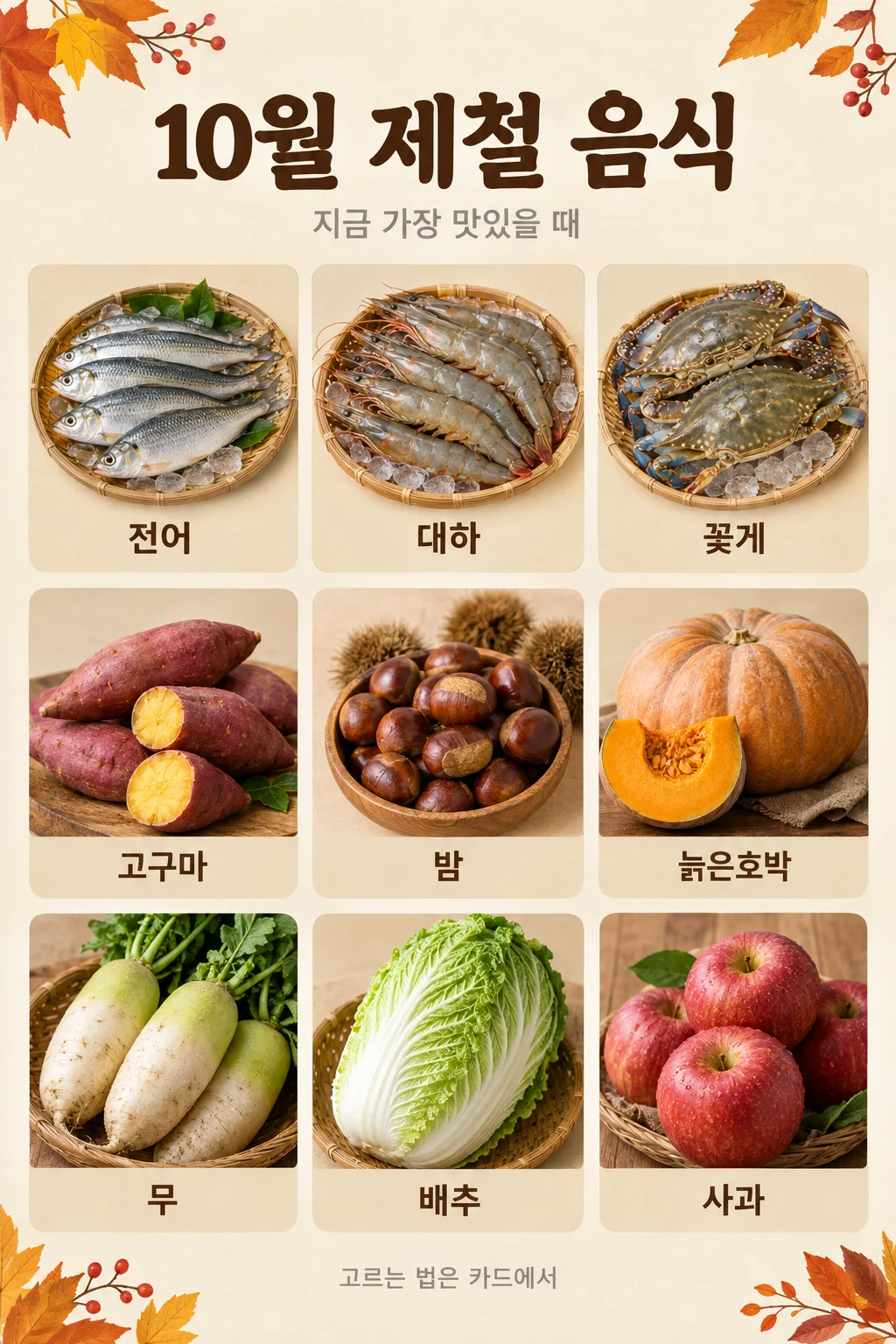
월과 분류를 고르면 기관 자료로 확인한 제철 재료 8~12가지의 실제 사진 같은 그림과 고르는 법을 한 장에 정리합니다.
칸 채우기
- 1칸을 채워요
- 2복사 버튼을 눌러요
- 3GPT 채팅창에 붙여넣어요
- 4제품·인물 사진을 쓰려면 사진과 프롬프트를 둘 다 넣은 뒤에 보내요 선택
프롬프트 원문 보기 10,588자
Generate this image now. Draw it directly - do not describe it, explain it, or ask questions.
Create one finished 2:3 portrait Korean seasonal-food calendar image, with all essential content inside generous print-safe margins. Keep the canvas ratio fixed at 2:3; do not ask for a size choice.

[Purpose]
Make one genuinely usable monthly Korean seasonal-ingredient reference sheet. A home cook can print and put it on a refrigerator, and a blogger, side-dish shop, or restaurant owner can post the same finished page as a monthly information card. Select 8 to 12 distinct ingredients genuinely in season in Korea for the resolved month, then show each ingredient's short Korean name, a small original image with the believable texture of real food photography, and, only when requested, one concise practical buying cue. The month is part of the title and must match every ingredient. This is an ingredient calendar, not a prepared-dish recipe, nutrition chart, sales flyer, or list of health benefits.

The next standalone line is an optional month chosen by the user. If the line is absent, find the current date at the time of generation in the Asia/Seoul time zone and use that month's number. Do not use the date when this reusable prompt was written, a sample date, or the model's unverified memory. If the line is present, parse its number as a month from 1 through 12 and use that month regardless of the current date. The selected month has no implied year-specific harvest guarantee.
"【월】"

The requested category is exactly "【분류】". For "전체", choose a useful mix across 채소, 과일, and 수산물 where institutionally verified monthly choices permit; never force an unverified category just to achieve balance. For "채소", "과일", or "수산물", use only that category. Treat edible greens, roots, and mushrooms as 채소 for this card, fruit crops as 과일, and fish, shellfish, and other seafood as 수산물. Do not show a category badge for an item that contradicts the chosen category. The buying-cue option is exactly "【고르는 법 넣기】"; "넣기" means one line beneath every ingredient name and "빼기" means no buying-cue lines or empty cue placeholders anywhere.

[Web research — required before drawing]
Browse the web before selecting a single ingredient. Check current or archived month-by-month seasonal information from Korean public institutions such as the Ministry of Agriculture, Food and Rural Affairs (농림축산식품부), Ministry of Oceans and Fisheries (해양수산부), Korea Agro-Fisheries & Food Trade Corporation (aT/KAMIS), Rural Development Administration (농촌진흥청), National Institute of Fisheries Science (국립수산과학원), or comparable public institutions. For each candidate, verify that the institution actually associates that ingredient or its documented harvest/landing season with the resolved month. Prefer a source that gives the precise month or range. A shop promotion, generic SEO list, search snippet alone, or another AI answer is insufficient evidence. Cross-check disputed seasons with a second institutional source where possible. Do not confuse year-round retail availability, imports, stored produce, greenhouse supply, or a regional specialty with a nationally reliable peak-season claim. If evidence differs by region or weather, choose a better-supported item or word the entry conservatively. Verify buying cues from a reliable institutional or extension source when cues are requested; use observable signs such as firmness, surface, color, weight, or freshness only when applicable to that particular food. Keep a factual source list internally and put only the names of institutions actually consulted in the small footer. Do not invent a ministry citation, URL, survey result, or source name. If web browsing is unavailable, or fewer than eight qualifying items in the chosen category can be verified, stop and state that a reliable 8-to-12-item card cannot be made; do not draw a guessed calendar.

[Real-food photo reference]
After the factual list is fixed, inspect real photographs of each selected raw ingredient, preferably photographs from public institutions or other reputable photographic references. Check its natural shape, cut or whole form, skin or leaf texture, color variation, and how it is normally sold. Generate a new small photographic-looking image for each item; do not paste, trace, or closely recreate one existing photograph. Do not portray a cooked dish where the label names a raw ingredient. Similar items must remain visually distinguishable: the labels and pictures should describe the same food. If photographic browsing is unavailable, do not claim to have visually checked the items.

[Scene]
Design one flat, complete 2:3 portrait sheet, not a refrigerator, framed print, phone screen, collage of web screenshots, or app interface. Give it a compact title area, then a regular two-column grid of 8 to 12 ingredient entries, followed by a small source and seasonality note. Use four to six rows according to the verified count. Each entry has one modest rounded photo window for one raw ingredient on a quiet neutral surface, a strong short name, and optionally one buying-cue line. Make every row consistent and roomy. Show no empty cells, numbered days, dates, checkboxes, price tags, product packaging, cooking instructions, or categories without a corresponding ingredient. If "고르는 법 넣기" is "빼기", enlarge the images and names to use the freed space rather than leaving blank strips.

[Attached photo]
No uploaded photograph is required. The searched real-food photographs are factual visual references only. Generate original ingredient pictures with realistic detail and do not reproduce a reference's exact arrangement, watermark, brand, label, or recognizable background. If the user attaches their own ingredient photo, it may help identify texture and color, but still make the full card coherent; an attachment must never override the verified month and item list.

[Text layout]
Render these exact Korean strings, without quotation marks, and generate only the verified item names and buying cues needed for the chosen list. Percentages refer to the top-to-bottom layout of this 2:3 sheet.
- 5-9%: Small eyebrow "한눈에 보는 제철 재료".
- 10-17%: Main heading in the largest type: "N월 제철 음식" where N is the resolved month number, for example "10월 제철 음식" only if the resolved month is 10. Do not print the literal letter N or a sample month when another month is selected.
- 18-22%: One small line "【분류】". If the value is "전체", render "채소 · 과일 · 수산물" instead of the vague word "전체"; otherwise render the chosen category exactly.
- 24-90%: Exactly 8 to 12 entries in normal Korean reading order, left to right then top to bottom. In each entry show one realistic raw-ingredient thumbnail and one verified Korean ingredient name. If "【고르는 법 넣기】" is "넣기", put one short, specific, observable buying cue on a separate line directly below its own name, such as "잎이 탄탄한 것" only if that advice is actually verified for that ingredient. If "빼기", show names only beneath images. Use neither a generic repeated cue nor any cue that cannot be verified.
- 92-96%: One quiet note "제철 시기는 지역·기후에 따라 달라요" and a compact "자료: " line naming only the institutions whose pages you actually used. Do not print full web addresses on the art.
The only generated visible text is the resolved month number, the verified food names, their verified cues when enabled, and the accurately named institutions. Do not print research notes, source titles, or search results in the grid.

[Style]
Use a crisp Korean editorial food-calendar style suitable for a refrigerator and social sharing. Use an opaque warm ivory background edge to edge, dark charcoal Korean Gothic type, fine sage-green rules, and one restrained seasonal accent. The ingredient images should have natural photographic color and surface detail, while the page itself remains matte, calm, and easy to print. Use clean gutters and a consistent baseline, not scrapbook stickers or a busy market scene. Keep the heading large enough to recognize in a social feed and the small captions legible when printed. Preserve approximately 6% safe margin around the whole sheet.

[Visual hierarchy]
The month and "제철 음식" should read first, the ingredient photographs second, the names third, and the optional buying cues fourth. Keep the photos large enough to identify but never let an image crowd a name or cue. Align each cue directly with its own image and name so rows cannot be misread. When 12 items are verified, reduce decorative padding before reducing type; when eight are verified, distribute the rows evenly. Do not silently turn one entry into two because a photograph contains multiple pieces of the same ingredient.

[Lighting and texture]
Each ingredient should look as if photographed in soft natural daylight: true skin, leaf, scale, or shell texture; realistic irregularities; gentle shadows; believable color; and no plastic gloss. Food windows may have subtle depth, while all text sits on plain opaque backgrounds for contrast. Avoid waxy surfaces, identical cloned pieces, fantasy colors, heavy depth of field that obscures identity, glossy cards, lens flare, neon, or haze over type.

[Text rules]
Use Korean food names a general shopper can recognize. The heading's month, selected category, all 8 to 12 items, all pictures, and every optional cue must agree. Print one distinct name per entry. Keep each buying cue to one short line, phrased as a purchasing observation rather than a health, storage, cooking, or safety promise. Do not infer medicinal properties, immunity effects, disease prevention, diet or weight-loss effects, nutrition quantities, or a guaranteed harvest. Do not print field labels, braces, English prompt text, URLs, unverified official logos, invented certifications, or the words "넣기" and "빼기". Check every Korean consonant, vowel, final consonant, numeral, and institution name before finishing.

[Avoid]
No guessed seasonal items, imported or stored items represented as newly harvested domestic seasonal food, unreliable citations, unrelated photos, copied reference photographs, watermarks, trademarks, grocery brands, packaging, prices, discounts, shopping links, QR codes, account handles, calendars with daily date boxes, long paragraphs, blank photo placeholders, unreadable tiny cues, cropped items, clipping, black bars, transparent margins, extra cards, health claims, or claims that a food treats any condition. Do not imply one month has the same harvest everywhere in Korea. Do not add a shop name, slogan, recipe, nutrition score, or endorsement by a public agency.
이 카드도 많이 사용해요
쓰는 법 · 자주 묻는 것
이런 때 쓰세요
이번 달 장을 볼 때 어떤 재료를 살지 한눈에 보고 싶거나, 손님에게 계절 재료를 소개하는 게시물을 올릴 때 쓰세요. 완성된 한 장에는 월 제목과 제철 재료 8~12가지가 들어갑니다. 재료마다 실제 사진처럼 보이는 작은 그림과 이름이 붙고, 원하면 고르는 법도 한 줄씩 보입니다. 냉장고에 붙여 장보기 전에 훑어보거나, 반찬가게·식당의 계절 소식으로 공유하기에 맞춘 구성입니다. 특정 요리의 조리법이나 효능을 알려 주는 카드는 아닙니다.
칸 채우는 법
- 월: 「10월」처럼 적거나 1월부터 12월까지의 보기에서 누르세요. 비워 두면 GPT가 그림을 만드는 시점의 한국 날짜를 확인해 그달을 제목에 씁니다. 지금이 아닌 다른 달 게시물을 미리 준비한다면 반드시 월을 골라 주세요.
- 분류: 「전체」는 채소·과일·수산물을 함께 살펴봅니다. 한 종류만 소개하고 싶다면 채소, 과일, 수산물 가운데 고르세요. 선택한 분류에 해당하는 재료만 싣도록 적었습니다.
- 고르는 법 넣기: 「넣기」를 고르면 각 재료 아래에 장볼 때 살펴볼 만한 특징을 한 줄씩 넣습니다. 「빼기」를 고르면 재료 그림과 이름을 더 크게 보는 카드가 됩니다.
실제 사진은 어떻게 참고하나요
사진 파일을 직접 올릴 필요는 없습니다. 프롬프트가 GPT에게 먼저 농림축산식품부·해양수산부, aT/KAMIS, 농촌진흥청, 국립수산과학원 같은 기관의 월별 자료를 웹에서 확인하게 합니다. 제철 여부를 확인한 다음, 고른 재료의 실제 사진을 찾아 생김새와 질감을 참고하도록 했습니다. 웹 사진을 카드에 그대로 붙이거나 특정 사진의 구도를 베끼는 방식은 아닙니다. 검색이 되지 않거나 선택한 분류에서 여덟 가지를 확인하지 못하면 억지로 재료를 채우지 않고 중단하도록 했습니다. 제철 시기는 지역과 그해 날씨에 따라 조금씩 달라질 수 있습니다.
그림이 나오면 꼭 볼 것
제목의 월이 고른 달과 같은지, 재료가 8~12가지인지 먼저 세어 보세요. 과일만 골랐다면 채소나 수산물이 섞이지 않았는지도 봐 주세요. 작은 그림이 이름과 같은 재료를 보여 주는지 확인하는 것이 중요합니다. 예를 들어 조개 이름 아래에 생선 사진이 붙었다면 게시하기 전에 고쳐야 합니다. 고르는 법을 넣었다면 모든 재료에 한 줄씩 붙었는지, 「빼기」를 골랐다면 빈 설명 줄이 남지 않았는지 확인하세요. 맨 아래 기관 이름은 실제 확인한 자료의 기관과 일치해야 합니다. 게시 전에 한글 글자와 숫자도 한 번 더 살펴보세요.
틀린 곳 고치는 법
같은 GPT 대화에서 위치와 내용을 함께 짚어 주세요. 「왼쪽 셋째 재료 사진이 이름과 다릅니다. 기관 자료와 실제 재료 사진을 다시 확인하고 그 칸만 맞춰 전체 카드를 다시 그려 주세요」처럼 요청하면 됩니다. 월이 틀렸다면 「10월로 골랐습니다. 제목과 재료 목록을 모두 10월 기준으로 다시 확인해 주세요」라고 말해 주세요. 단순히 이름만 바꾸면 그림·고르는 법·출처가 어긋날 수 있으므로 카드 전체의 일치를 다시 확인하는 편이 좋습니다.
자주 묻는 것
- 월을 비우면 어느 달로 만드나요? GPT가 생성할 때 한국의 오늘 날짜를 확인해 이번 달로 만듭니다. 다음 달 게시물을 준비한다면 월을 직접 골라 주세요.
- 사진을 올려야 하나요? 아니요. GPT가 실제 재료 사진을 웹에서 참고해 새로운 그림을 만듭니다. 웹을 사용할 수 없는 대화라면 확인했다고 꾸미지 않고 생성을 멈추도록 했습니다.
- 고르는 법을 빼도 재료 수는 같나요? 네. 재료는 8~12가지로 유지하고, 설명이 빠진 자리를 그림과 이름에 돌립니다.
- 모든 지역에서 같은 시기에 제철인가요? 아닙니다. 산지와 기후에 따라 시기가 달라질 수 있어 기관 자료를 확인하고 카드 아래에도 그 점을 짧게 적도록 했습니다.