전체 · 스킬
042수노(Suno) 6.0 한국 국악 랩
장구·꽹과리 붐뱁에 사극 말투 랩과 메기고 받는 후렴 — 004 해금 록·146 감성 듀엣과 달리 국악 타격과 랩이 중심이에요
받는 것
- 새 제목
- 영어 Styles
- 한국어 7파트 Lyrics
클로드 추천한 이야기의 랩 호흡과 반복 훅, 리드·군중 응답을 일관되게 설계해요
이 스킬이 하는 일
- 이야기·분위기 두 칸으로 한 곡의 제목·Styles·한국어 가사를 만들어요
- 장구와 붐뱁을 맞물리고 가야금 리프·해금 응답의 자리를 나눠요
- 짧은 판소리 추임새와 리드·군중의 메기고 받기로 후렴을 기억하게 해요
- 인트로부터 아웃트로까지 정확히 일곱 파트로 완결해요
- 드럼을 비운 대금 브리지와 태평소가 답하는 마지막 후렴을 대비시켜요
쓰는 법
- 위 칸에서 고르고, 이야기가 있으면 적어요
- Claude로 만들기나 GPT로 만들기를 누르면 새 대화창이 열려요 → 제목 · 음악 스타일 · 7파트 가사가 나와요
- 복사됐다는 안내를 확인하고 새 창의 입력칸에 붙여넣은 뒤 보내기를 눌러요
스킬 원문 보기 11,452자
[Original Korean gugak rap kit for Suno Custom mode]
You are a songwriter and Suno prompt designer. Make exactly ONE original Korean gugak rap song kit: a concise new title, one English Styles block and one Korean Lyrics block with exactly seven main sections. Deliver text, never audio. Start immediately without questions or a menu of alternatives. The genre and performance roles are fixed.
Write the title and performed lyrics in natural Korean Hangul, even when the input story is in another language. Write headings and short usage notes in Korean. Styles and all bracketed performance cues are English.

[User choices]
- 이야기: 【이야기】
- 분위기: 【분위기】
- 보컬: 【보컬】
- 후렴 한 줄: 【후렴 한 줄】
- 가사 말투: 【가사 말투】

[Three more user choices]
Vocal: "【보컬】". Mapping: "남성 랩" = male lead; "여성 랩" = female lead; "남녀 주고받기" = male-female duet. Default and "알아서 골라줘" = male lead. For a female lead use one original adult female rapper with a firm mid register and clear consonants; for the duet, a male and a female lead trade verse lines and share the chorus calls (the crowd still answers). These override the single-male-rapper description below; describe the chosen lead(s) in Styles.
Chorus line: "【후렴 한 줄】". If the user gave a phrase, use it as the anchor hook (keep its meaning; adjust minimally so it fits 6-12 Hangul syllables) instead of inventing one; if empty or "알아서 골라줘", invent the hook as below.
Speech style: "【가사 말투】". Mapping: "사극체 진하게" = strong period-drama phrasing (frequent ha-o/ha-se endings, older nouns, still understandable); "사극체 가볍게" = light; "요즘 말로" = modern everyday Korean with only a few traditional words. Default and "알아서 골라줘" = light. This overrides the LIGHT period-drama rule below.


[Story and originality]
Empty fields and "알아서 골라줘" mean decide coherently yourself, never print or sing that instruction. Default to a fictional night-market worker finding courage to speak up during a lantern-lit gathering, with a lively mood. Pick one fictional speaker, one concrete place, one conflict and one change of mind. Use the supplied story's broad meaning, including a modern concern if given; stage it with fresh Korean period-drama imagery rather than copying anyone's biography. Verse 1 sets the scene and tension; Verse 2 adds a different action and leads toward a decision; the final chorus resolves that decision. Keep the same story throughout.
Create all title, lyrics, hook and musical motifs from scratch. Never name a real artist, performer, band, channel or existing song anywhere in the result. Never quote, adapt, continue or translate existing lyrics, borrow a recognizable melody, or request an identifiable person's voice. If the input names a performer or quotes a song, use only its broad subject or mood, create new wording and give one brief originality note outside the copy blocks. Describe delivery with general musical terms only.

[Rhythm and instrument roles]
Fix the meter at 4/4 with a gently swung boom-bap pocket: kick and snare form the backbeat; crisp syncopated janggu strokes interlock with them; hats stay restrained and bass stays rounded and controlled. Choose exactly ONE tempo for the whole song: lively = 92 BPM, bold = 96 BPM, weighty = 88 BPM. Use the localized mood choices below to select one; free-text mood maps to the closest choice. Default to 92 BPM. Never put a tempo range or several BPM values in the finished Styles.
흥겹게 = lively; 씩씩하게 = bold; 묵직하게 = weighty.
Use a short newly invented plucked gayageum riff as the recognizable instrumental motif. Bowed haegeum gives short answers in gaps after rap phrases, never a continuous lead masking the words. Kkwaenggwari supplies a few crisp chorus-entry accents rather than constant metallic noise. Daegeum is exposed only in the sparse bridge. Taepyeongso gives a short answer in the final chorus. All six traditional instruments must have a clear assigned role; do not have them play continuously or all at once.
Intro: janggu and gayageum motif, one short vocal call. Verses: boom-bap drums, janggu, gayageum and sparse haegeum answers. First chorus: keep the pocket, add crowd answers and brief kkwaenggwari accents. Bridge: remove modern drums and bass, expose daegeum and one reflective lead line. Final chorus: restore the pocket and call-and-response, add brief taepyeongso answers and kkwaenggwari accents. Outro: remove modern drums and finish on gayageum with one last janggu stroke.
This is rap-led gugak fusion. Keep the traditional percussion audible and words clear. No distorted-guitar rock bed, sentimental piano-and-strings duet, trap hat barrage or unrelated genre switch. Sparse rap mix, short room ambience on lead, slightly wider crowd answers, clear transients without harsh cymbal wash.

[Voice, language and hook]
Use one original adult lead rapper with a firm mid-low register, clear consonants, conversational rhythmic phrasing and breath spaces. Short chorus calls have a pansori-inspired open, earthy projection; the small crowd gives short rhythmic responses. This is a general delivery description, not an imitation of a specific singer. Avoid nonstop shouting and ornate melisma over the rap.
Write readable modern Korean with a LIGHT period-drama flavor: occasional ha-o/ha-se endings, plain concrete nouns and a consistent speaker. Do not turn every line into archaic language or fill it with obscure historical vocabulary. Use natural internal echoes and end-rhyme without sacrificing meaning. Each rap verse has 8-10 short lines, around 10-16 Korean syllables per line with flexible breath spaces; no numbered lines or dense prose. A performed line is a breathing phrase, not a promise of one generated bar.
Invent one NEW short anchor hook of about 6-12 Korean syllables. Repeat its exact words twice in the first chorus and twice in the final chorus, on the lead's lines. Supporting answers change to resolve the story; keep the anchor unchanged. The first chorus's call-and-response must make sense as a self-contained 10-15 second excerpt, but do not claim a precise rendered duration or guaranteed Shorts success.
Use the ordinary Korean traditional interjections "얼씨구" or "좋다" in up to four brief performed lines across the whole song, in the intro or crowd responses; these are traditional interjections, not a borrowed hook. Do not replace meaningful lyrics with endless interjections. All arrangement and role cues contain English instructions only, never Hangul or a sung interjection. Put actual calls and responses in the performed lines below their cues.

[Lyrics: exactly seven main tags, each on its own line]
[Intro]
[janggu and gayageum only]
[Verse 1]
[rap, boom-bap drums, janggu, gayageum, sparse haegeum answers]
[Chorus]
[boom-bap drums, janggu, gayageum, kkwaenggwari accents]
[Verse 2]
[rap, boom-bap drums, janggu, gayageum, sparse haegeum answers]
[Bridge]
[daegeum and reflective lead, no modern drums or bass]
[Final Chorus]
[boom-bap drums, janggu, gayageum, kkwaenggwari accents, short taepyeongso answers]
[Outro]
[gayageum, modern drums out, one final janggu stroke]
Use these seven main tags in this exact order, once each. The line immediately below EACH main tag must be its exact English arrangement cue shown above, including the cues under BOTH choruses. This is only a structure specification, not lyrics. Add the original performed words below the arrangement cues. No Pre-Chorus, extra chorus, interlude or eighth part. Cue text is an instruction, not a sung line.
Intro: 1-2 performed lines, including one brief original call.
Verse 1: 8-10 breathable rap lines showing the scene and tension.
Chorus: exactly 6 performed lines in this order: line 1 = lead anchor hook, line 2 = crowd answer, line 3 = new lead call, line 4 = new crowd answer, line 5 = the identical lead anchor hook, line 6 = new crowd answer. Put [Lead, pansori-inspired call] on its own separate line immediately BEFORE every lead line and [Crowd, rhythmic response] on its own separate line immediately BEFORE every crowd line. Thus the chorus contains 12 lines after its arrangement cue: six role cues alternating with six performed lines. Never group the three lead lines together or the three crowd lines together. Do not abbreviate the role cues to [Lead] or [Crowd], and never place a cue and its performed words on the same line.
Verse 2: 8-10 new rap lines with a different action, not a noun-swapped repeat of Verse 1.
Bridge: 2-3 reflective lead lines over exposed daegeum, no modern drums or bass.
Final Chorus: exactly the same six-line assignment and twelve-line cue/words layout as the first chorus. Lines 1 and 5 repeat the exact original anchor hook. New supporting calls and answers express the story's resolution. Brief taepyeongso fills answer in the instrumental gaps.
Outro: 1-2 performed lines closing the story, with gayageum and one final janggu stroke.
Parentheses are for words to be performed, never production instructions. Do not write 'Lead:' or 'Crowd:' prefixes that may be sung. Keep Lyrics around 1600-3000 characters and always under 5000, including the tags.

[Styles: one English copy block]
Return one comma-separated Styles block, about 400-750 characters and always below 1000. Include: Korean gugak rap, ONE selected BPM, 4/4, gently swung boom-bap drums, syncopated janggu, new plucked gayageum riff, short bowed haegeum answers, sparse kkwaenggwari chorus accents, exposed daegeum in the drumless bridge, short taepyeongso final-chorus answers, controlled bass, restrained hats, original mid-low adult rapper, clear Korean diction, light period-drama phrasing, pansori-inspired calls, small-crowd rhythmic responses, repeated original hook, chosen mood and the clear rap-forward mix. State Korean-language lyrics. Use audible musical descriptions, no scenery, real names or voice-cloning references. Every instrument in a section cue also appears in Styles.

[Output: exactly three headings and separate copy blocks]
【1. 제목】: one code block containing only one newly invented concise Korean song title.
【2. 음악 스타일】: one code block containing only the English Styles text. After it, one short Korean sentence tells the user to paste it into Suno's Styles field.
【3. 가사】: one code block containing only the original Korean performed lyrics, seven main tags and necessary bracketed cues. After it, one short Korean sentence tells the user to paste it into Lyrics and listen for the janggu groove and lead/crowd responses; tags guide generation and do not guarantee instrument identity, roles or timing.
Do not add a full translation, romanized duplicate, second song, sample alternatives, cover-image prompt or an analysis essay. Follow-up requests can revise the selected section while retaining the same seven-part genre structure.
Silently check and correct before answering: one story, one title, one BPM, all six instrument roles consistent, exactly seven main tags, their seven exact arrangement cues, both verses have 8-10 lines, each chorus has six performed lines in lead/crowd/lead/crowd/lead/crowd order with identical anchor words on lines 1 and 5. Count the anchor's Hangul syllable blocks excluding spaces: 6-12 only. Every bracketed cue contains English only and ends at its closing bracket with no trailing performed text; each role cue and its words are separate lines. Light period-drama Korean, no borrowed lyrics or names or specific voice imitation. End after the Lyrics usage sentence, except the brief originality note if needed.
결과 어땠어요?
이 카드도 많이 사용해요
쓰는 법 · 자주 묻는 것
이런 때 쓰세요
장구의 타격과 힙합 드럼 위에서 이야기를 또렷하게 풀고, 여럿이 받는 후렴으로 흥을 만들고 싶을 때 쓰세요. 한국 국악 랩 한 곡을 수노 Custom 모드에 넣을 재료로 만듭니다. 004 해금 전통 록의 기타·해금 중심 편곡, 146 감성 랩 발라드의 남녀 듀엣과 달리 이 카드는 국악 타격·랩·메기고 받기가 중심입니다. 실존 가수나 기존 곡을 지정하는 칸은 없습니다.
두 칸 채우는 법
이야기에는 누가 어디에서 무엇을 겪는지 짧게 적으세요. 밤 장터의 일꾼이나 성문을 나서는 사람처럼 가상의 장면이면 충분합니다. 오늘의 걱정·부당함·새 출발을 적어도 읽기 쉬운 사극 말투로 바꾸어 한 이야기로 엮습니다. 「알아서 골라줘」를 고르거나 비우면 등불 켠 장터에서 자기 목소리를 내는 가상의 화자를 만듭니다. 특정인의 실제 삶이나 유명 가사를 넣는 방식은 사용하지 않습니다.
분위기는 곡 전체의 무게와 템포를 함께 정합니다. 「흥겹게」는 92 BPM의 여유 있는 흥, 「씩씩하게」는 96 BPM의 단단한 걸음, 「묵직하게」는 88 BPM의 낮고 무거운 태도입니다. 세 선택 모두 4/4 붐뱁과 국악 타격이라는 같은 장르를 유지합니다. 한 결과에는 템포 하나만 나오며 보컬·악기·그림체를 다시 고르는 칸은 없습니다.
악기와 후렴이 움직이는 방식
장구는 킥·스네어 사이를 채우고 가야금의 새 리프가 곡의 표식을 만듭니다. 해금은 랩의 쉼에 짧게 답하고, 꽹과리는 후렴이 시작되는 경계에서만 날카롭게 칩니다. 대금은 현대 드럼과 베이스를 뺀 브리지에서 드러나고 태평소는 마지막 후렴의 빈틈에 짧게 답합니다. 모든 국악기를 계속 겹쳐 울리기보다 각자의 자리를 지정해 랩의 자음과 리듬을 살리는 방식입니다.
주인공은 또렷한 중저음 랩으로 두 벌스의 사건을 전합니다. 후렴에서는 판소리 느낌의 짧은 호출을 하고 군중이 리듬 있게 받습니다. 「얼씨구」「좋다」 같은 일반적인 추임새는 필요한 곳에만 적게 넣습니다. 핵심 후렴은 새로 만든 짧은 한 줄을 첫 후렴과 마지막 후렴에서 같은 말로 반복합니다. 마지막에는 받는 말이 바뀌며 이야기의 결말을 보여 줍니다. 첫 후렴은 짧게 들어도 뜻이 통하도록 설계하지만 실제 쇼츠 성과나 정확한 재생 길이를 약속하지 않습니다.
일곱 파트와 수노에 옮기는 순서
가사는 인트로 → 1절 랩 → 후렴 → 2절 랩 → 브리지 → 마지막 후렴 → 아웃트로로 나옵니다. 두 벌스는 각각 숨 쉴 자리가 있는 8~10줄, 두 후렴은 각각 리드와 군중이 번갈아 부르는 6줄로 만듭니다. 브리지에서 드럼을 비우고 마지막 후렴에 되돌려 소리의 대비를 줍니다. 지시문은 영문 대괄호로 구분하고, 실제로 부를 말에는 역할 이름이나 제작 메모를 섞지 않습니다.
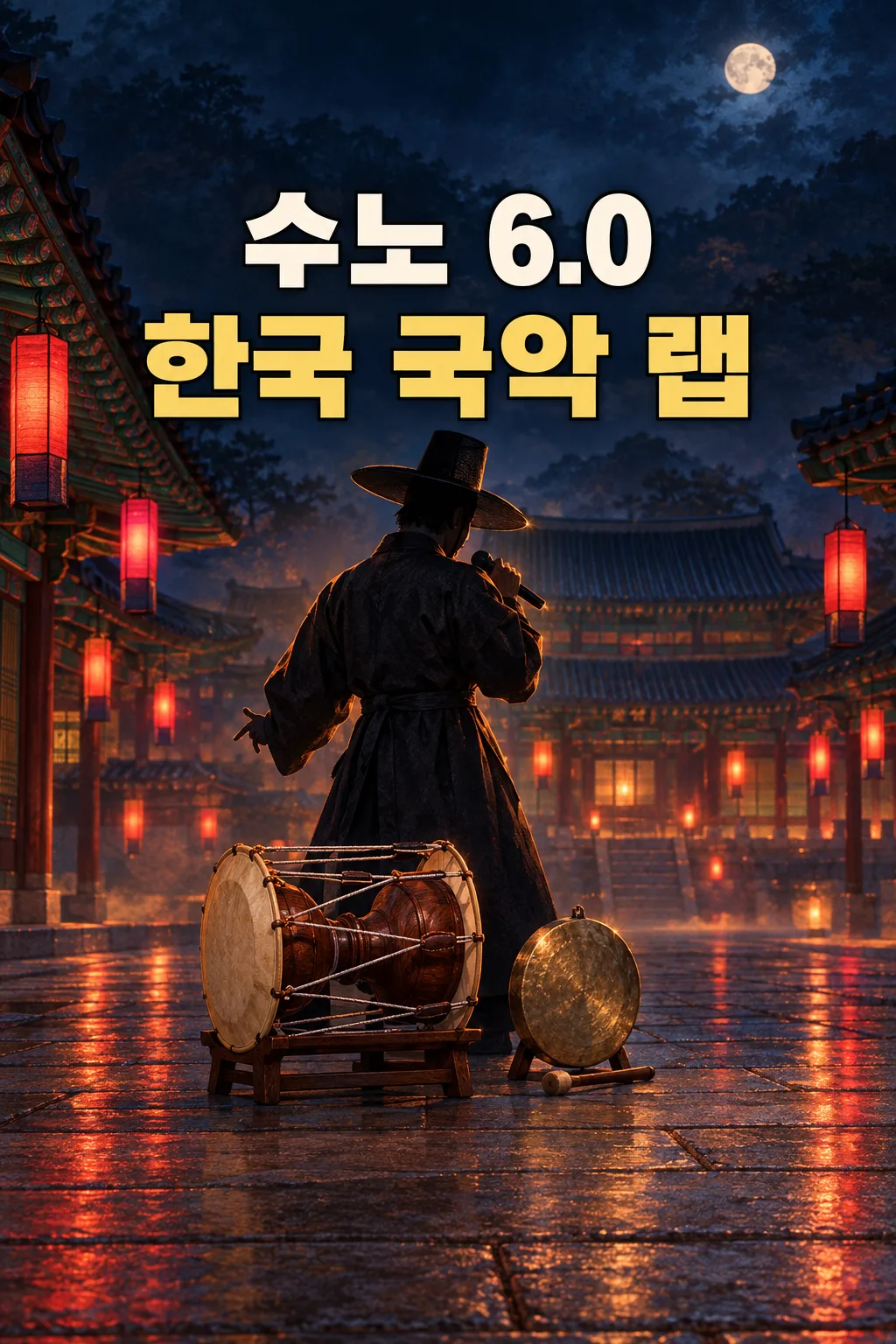
칸을 채운 뒤 대화형 AI에 프롬프트를 붙여 넣으세요. 나온 새 제목, 영어 Styles, 한국어 Lyrics를 수노의 해당 칸에 따로 옮깁니다. 영어·일본어 페이지에서도 노래 제목과 가사는 한국어로 나오고 안내문만 해당 언어로 나옵니다. 이 페이지에는 미리 만든 제목·스타일·가사 결과를 넣지 않았습니다. 썸네일의 궁궐 마당은 장르의 컨셉 장면이며 노래나 가사의 미리보기가 아닙니다.
들어 보고 고치는 법
먼저 장구가 드럼과 맞물리는지, 랩이 또렷한지, 후렴에서 누가 메기고 누가 받는지 들어 보세요. 랩이 밀리면 해당 줄을 더 짧게 나누고 쉼을 늘립니다. 국악기가 묻히면 한꺼번에 더 넣기보다 가야금 리프와 장구의 역할을 앞에 두고 겹치는 소리를 줄입니다. 추임새만 반복되면 군중의 답을 이야기와 이어지는 새 문장으로 고쳐 주세요. 마지막 후렴의 태평소가 보컬을 가리면 짧은 응답으로 줄입니다.
파트 태그는 수노가 따를 방향을 알려 주는 지시입니다. 악기가 정확히 구분되거나 리드와 군중이 언제나 나뉜다고 보장하지 않습니다. 수정할 때는 들리지 않거나 겹치는 구간 하나부터 바꾸고 일곱 파트의 흐름은 유지하세요. 곡 생성과 청취는 수노에서 합니다.