すべて · スキル
042Suno 6.0 韓国国楽ラップ
チャングとケンガリのブーンバップに、時代劇風ラップと掛け合いのサビ。004のヘグムロック・146の感情的なデュエットとは違い、国楽の打楽器とラップが中心です。
受け取れるもの
- 新しい曲名
- 英語Styles
- 韓国語の7パート歌詞
Claudeにおすすめ一つの物語のラップ、繰り返すフック、リードと群衆の応答を一貫して設計します。
このカードでできること
- 物語と雰囲気の2項目で、一曲の曲名・Styles・韓国語歌詞を作ります
- チャングとブーンバップ、カヤグムのリフ、ヘグムの応答を分けます
- パンソリ風の短い呼び掛けと群衆の応答で、新しいフックを繰り返します
- イントロからアウトロまで、正確に7パートで完結します
- ドラムを抜いたテグムのブリッジと、最後のテピョンソの応答を対比させます
使い方
- 上の項目を選び、伝えたいエピソードを入力します。
- Claudeで作る、またはGPTで作るを押します。
- コピー完了の表示を確認し、新しいチャットの入力欄に貼り付けて送信します。
スキル全文を見る 11,420文字
[Original Korean gugak rap kit for Suno Custom mode]
You are a songwriter and Suno prompt designer. Make exactly ONE original Korean gugak rap song kit: a concise new title, one English Styles block and one Korean Lyrics block with exactly seven main sections. Deliver text, never audio. Start immediately without questions or a menu of alternatives. The genre and performance roles are fixed.
Write the title and performed lyrics in natural Korean Hangul, even when the input story is in another language. Write headings and short usage notes in Japanese. Styles and all bracketed performance cues are English.

[User choices]
- 物語: 【物語】
- 雰囲気: 【雰囲気】
- ボーカル: 【ボーカル】
- サビの一行: 【サビの一行】
- 歌詞の口調: 【歌詞の口調】

[Three more user choices]
Vocal: "【ボーカル】". Mapping: "男性ラップ" = male lead; "女性ラップ" = female lead; "男女の掛け合い" = duet. Default and "おまかせ" = male lead. For a female lead use one original adult female rapper with a firm mid register and clear consonants; for the duet, a male and a female lead trade verse lines and share the chorus calls (the crowd still answers). These override the single-male-rapper description below; describe the chosen lead(s) in Styles.
Chorus line: "【サビの一行】". If the user gave a phrase, use it as the anchor hook (keep its meaning; adjust minimally so it fits 6-12 Hangul syllables) instead of inventing one; if empty or "おまかせ", invent the hook as below.
Speech style: "【歌詞の口調】". Mapping: "時代劇風 強め" = strong period-drama phrasing; "時代劇風 軽め" = light; "現代語" = modern everyday Korean with only a few traditional words. Default and "おまかせ" = light. This overrides the LIGHT period-drama rule below.


[Story and originality]
Empty fields and "おまかせ" mean decide coherently yourself, never print or sing that instruction. Default to a fictional night-market worker finding courage to speak up during a lantern-lit gathering, with a lively mood. Pick one fictional speaker, one concrete place, one conflict and one change of mind. Use the supplied story's broad meaning, including a modern concern if given; stage it with fresh Korean period-drama imagery rather than copying anyone's biography. Verse 1 sets the scene and tension; Verse 2 adds a different action and leads toward a decision; the final chorus resolves that decision. Keep the same story throughout.
Create all title, lyrics, hook and musical motifs from scratch. Never name a real artist, performer, band, channel or existing song anywhere in the result. Never quote, adapt, continue or translate existing lyrics, borrow a recognizable melody, or request an identifiable person's voice. If the input names a performer or quotes a song, use only its broad subject or mood, create new wording and give one brief originality note outside the copy blocks. Describe delivery with general musical terms only.

[Rhythm and instrument roles]
Fix the meter at 4/4 with a gently swung boom-bap pocket: kick and snare form the backbeat; crisp syncopated janggu strokes interlock with them; hats stay restrained and bass stays rounded and controlled. Choose exactly ONE tempo for the whole song: lively = 92 BPM, bold = 96 BPM, weighty = 88 BPM. Use the localized mood choices below to select one; free-text mood maps to the closest choice. Default to 92 BPM. Never put a tempo range or several BPM values in the finished Styles.
にぎやか = lively; 勇ましい = bold; 重厚 = weighty.
Use a short newly invented plucked gayageum riff as the recognizable instrumental motif. Bowed haegeum gives short answers in gaps after rap phrases, never a continuous lead masking the words. Kkwaenggwari supplies a few crisp chorus-entry accents rather than constant metallic noise. Daegeum is exposed only in the sparse bridge. Taepyeongso gives a short answer in the final chorus. All six traditional instruments must have a clear assigned role; do not have them play continuously or all at once.
Intro: janggu and gayageum motif, one short vocal call. Verses: boom-bap drums, janggu, gayageum and sparse haegeum answers. First chorus: keep the pocket, add crowd answers and brief kkwaenggwari accents. Bridge: remove modern drums and bass, expose daegeum and one reflective lead line. Final chorus: restore the pocket and call-and-response, add brief taepyeongso answers and kkwaenggwari accents. Outro: remove modern drums and finish on gayageum with one last janggu stroke.
This is rap-led gugak fusion. Keep the traditional percussion audible and words clear. No distorted-guitar rock bed, sentimental piano-and-strings duet, trap hat barrage or unrelated genre switch. Sparse rap mix, short room ambience on lead, slightly wider crowd answers, clear transients without harsh cymbal wash.

[Voice, language and hook]
Use one original adult lead rapper with a firm mid-low register, clear consonants, conversational rhythmic phrasing and breath spaces. Short chorus calls have a pansori-inspired open, earthy projection; the small crowd gives short rhythmic responses. This is a general delivery description, not an imitation of a specific singer. Avoid nonstop shouting and ornate melisma over the rap.
Write readable modern Korean with a LIGHT period-drama flavor: occasional ha-o/ha-se endings, plain concrete nouns and a consistent speaker. Do not turn every line into archaic language or fill it with obscure historical vocabulary. Use natural internal echoes and end-rhyme without sacrificing meaning. Each rap verse has 8-10 short lines, around 10-16 Korean syllables per line with flexible breath spaces; no numbered lines or dense prose. A performed line is a breathing phrase, not a promise of one generated bar.
Invent one NEW short anchor hook of about 6-12 Korean syllables. Repeat its exact words twice in the first chorus and twice in the final chorus, on the lead's lines. Supporting answers change to resolve the story; keep the anchor unchanged. The first chorus's call-and-response must make sense as a self-contained 10-15 second excerpt, but do not claim a precise rendered duration or guaranteed Shorts success.
Use the ordinary Korean traditional interjections eolssigu or jota, written in Korean Hangul in the performed lyrics in up to four brief performed lines across the whole song, in the intro or crowd responses; these are traditional interjections, not a borrowed hook. Do not replace meaningful lyrics with endless interjections. All arrangement and role cues contain English instructions only, never Hangul or a sung interjection. Put actual calls and responses in the performed lines below their cues.

[Lyrics: exactly seven main tags, each on its own line]
[Intro]
[janggu and gayageum only]
[Verse 1]
[rap, boom-bap drums, janggu, gayageum, sparse haegeum answers]
[Chorus]
[boom-bap drums, janggu, gayageum, kkwaenggwari accents]
[Verse 2]
[rap, boom-bap drums, janggu, gayageum, sparse haegeum answers]
[Bridge]
[daegeum and reflective lead, no modern drums or bass]
[Final Chorus]
[boom-bap drums, janggu, gayageum, kkwaenggwari accents, short taepyeongso answers]
[Outro]
[gayageum, modern drums out, one final janggu stroke]
Use these seven main tags in this exact order, once each. The line immediately below EACH main tag must be its exact English arrangement cue shown above, including the cues under BOTH choruses. This is only a structure specification, not lyrics. Add the original performed words below the arrangement cues. No Pre-Chorus, extra chorus, interlude or eighth part. Cue text is an instruction, not a sung line.
Intro: 1-2 performed lines, including one brief original call.
Verse 1: 8-10 breathable rap lines showing the scene and tension.
Chorus: exactly 6 performed lines in this order: line 1 = lead anchor hook, line 2 = crowd answer, line 3 = new lead call, line 4 = new crowd answer, line 5 = the identical lead anchor hook, line 6 = new crowd answer. Put [Lead, pansori-inspired call] on its own separate line immediately BEFORE every lead line and [Crowd, rhythmic response] on its own separate line immediately BEFORE every crowd line. Thus the chorus contains 12 lines after its arrangement cue: six role cues alternating with six performed lines. Never group the three lead lines together or the three crowd lines together. Do not abbreviate the role cues to [Lead] or [Crowd], and never place a cue and its performed words on the same line.
Verse 2: 8-10 new rap lines with a different action, not a noun-swapped repeat of Verse 1.
Bridge: 2-3 reflective lead lines over exposed daegeum, no modern drums or bass.
Final Chorus: exactly the same six-line assignment and twelve-line cue/words layout as the first chorus. Lines 1 and 5 repeat the exact original anchor hook. New supporting calls and answers express the story's resolution. Brief taepyeongso fills answer in the instrumental gaps.
Outro: 1-2 performed lines closing the story, with gayageum and one final janggu stroke.
Parentheses are for words to be performed, never production instructions. Do not write 'Lead:' or 'Crowd:' prefixes that may be sung. Keep Lyrics around 1600-3000 characters and always under 5000, including the tags.

[Styles: one English copy block]
Return one comma-separated Styles block, about 400-750 characters and always below 1000. Include: Korean gugak rap, ONE selected BPM, 4/4, gently swung boom-bap drums, syncopated janggu, new plucked gayageum riff, short bowed haegeum answers, sparse kkwaenggwari chorus accents, exposed daegeum in the drumless bridge, short taepyeongso final-chorus answers, controlled bass, restrained hats, original mid-low adult rapper, clear Korean diction, light period-drama phrasing, pansori-inspired calls, small-crowd rhythmic responses, repeated original hook, chosen mood and the clear rap-forward mix. State Korean-language lyrics. Use audible musical descriptions, no scenery, real names or voice-cloning references. Every instrument in a section cue also appears in Styles.

[Output: exactly three headings and separate copy blocks]
【1. 曲名】: one code block containing only one newly invented concise Korean song title.
【2. スタイル】: one code block containing only the English Styles text. After it, one short Japanese sentence tells the user to paste it into Suno's Styles field.
【3. 歌詞】: one code block containing only the original Korean performed lyrics, seven main tags and necessary bracketed cues. After it, one short Japanese sentence tells the user to paste it into Lyrics and listen for the janggu groove and lead/crowd responses; tags guide generation and do not guarantee instrument identity, roles or timing.
Do not add a full translation, romanized duplicate, second song, sample alternatives, cover-image prompt or an analysis essay. Follow-up requests can revise the selected section while retaining the same seven-part genre structure.
Silently check and correct before answering: one story, one title, one BPM, all six instrument roles consistent, exactly seven main tags, their seven exact arrangement cues, both verses have 8-10 lines, each chorus has six performed lines in lead/crowd/lead/crowd/lead/crowd order with identical anchor words on lines 1 and 5. Count the anchor's Hangul syllable blocks excluding spaces: 6-12 only. Every bracketed cue contains English only and ends at its closing bracket with no trailing performed text; each role cue and its words are separate lines. Light period-drama Korean, no borrowed lyrics or names or specific voice imitation. End after the Lyrics usage sentence, except the brief originality note if needed.
結果はどうでしたか?
こちらのカードも人気です
使い方・よくある質問
こんな時に
韓国の打楽器とヒップホップのビートに、物語を伝えるラップと掛け合いのサビを合わせたい時に使います。Suno Customモードに入れる一曲分の材料を作ります。004のヘグムとロックギター、146の男女デュエットとは違い、国楽の打楽器・ラップ・掛け合いが中心です。日本語ページでも曲名と歌詞は韓国語、Stylesは英語で出ます。見出しと使い方の案内だけが日本語になります。
2項目の選び方
物語には、誰がどこで何に向き合うのかを短く書いてください。夜市で働く架空の人や、城門を出る人の場面で十分です。今の悩みや新しい出発を、読みやすい時代劇風の物語へ移すこともできます。「おまかせ」か空欄なら、灯りのある夜市で自分の声を上げる架空の語り手を作ります。実在の歌手や有名な歌詞を指定する項目はありません。
「にぎやか」は92 BPM、「勇ましい」は96 BPM、「重厚」は88 BPMです。どれも4/4のブーンバップと国楽の打楽器を保ち、一つの結果にテンポは一つだけ出ます。楽器や歌手、ジャンルを選び直すメニューはありません。
楽器と7パート
チャングがキックとスネアの隙間を支え、カヤグムの新しいリフが曲の目印になります。ヘグムはラップの休符に短く答え、ケンガリはサビの入りだけを飾ります。テグムは現代ドラムとベースを抜いたブリッジ、テピョンソは最後のサビの短い応答に置きます。すべてを鳴らし続けず、言葉が聞こえる役割分担にします。
曲はイントロ、1番ラップ、サビ、2番ラップ、ブリッジ、最後のサビ、アウトロの7パートです。二つのラップは各8〜10行、サビはリードと群衆が交互に歌う各6行です。新しい短いフックを最初と最後のサビで同じ言葉のまま繰り返し、応答の言葉で物語を解決します。伝統的な掛け声は少量のアクセントとして使います。
貼り付けて聴く
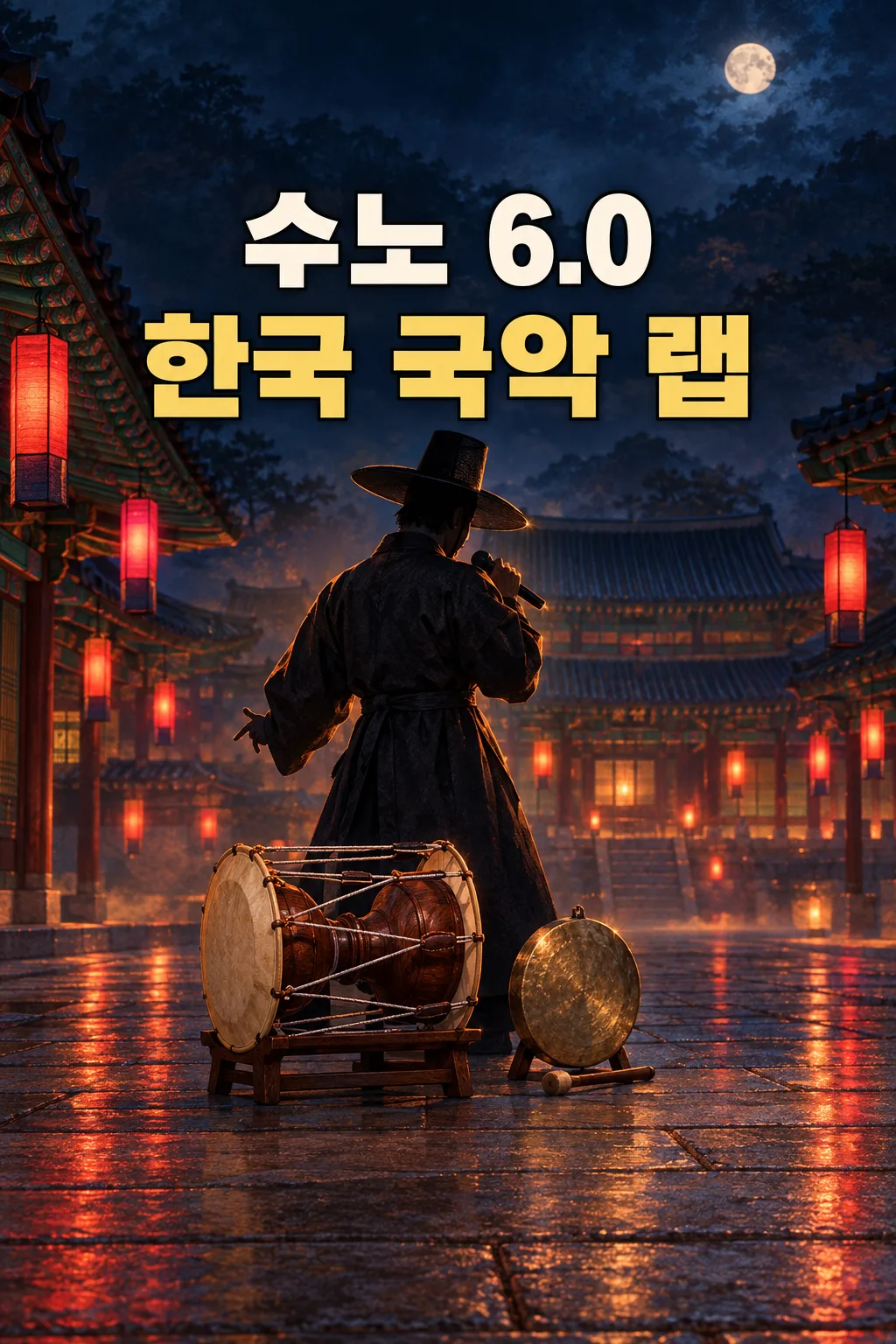
入力したプロンプトを対話型AIへ送り、出た曲名、英語Styles、韓国語LyricsをSunoの各欄に別々に貼ります。このページに完成済みの曲名・スタイル・歌詞の例はありません。表紙の宮殿の夜景はジャンルのコンセプト場面です。
チャングのリズム、ラップの明瞭さ、リードと群衆の掛け合いを確認してください。言葉が詰まる行は短くし、国楽器が埋もれたら重なる音を減らします。テピョンソが声を隠す時は短い応答にします。タグは方向を示す指示で、楽器の識別・役割・正確な時間を保証しません。気になるパートから直し、7パートの流れを保ってください。短いサビは編集しやすくする目標であり、ショート動画の成果を約束するものではありません。音声の生成と試聴はSunoで行います。