All · Skills
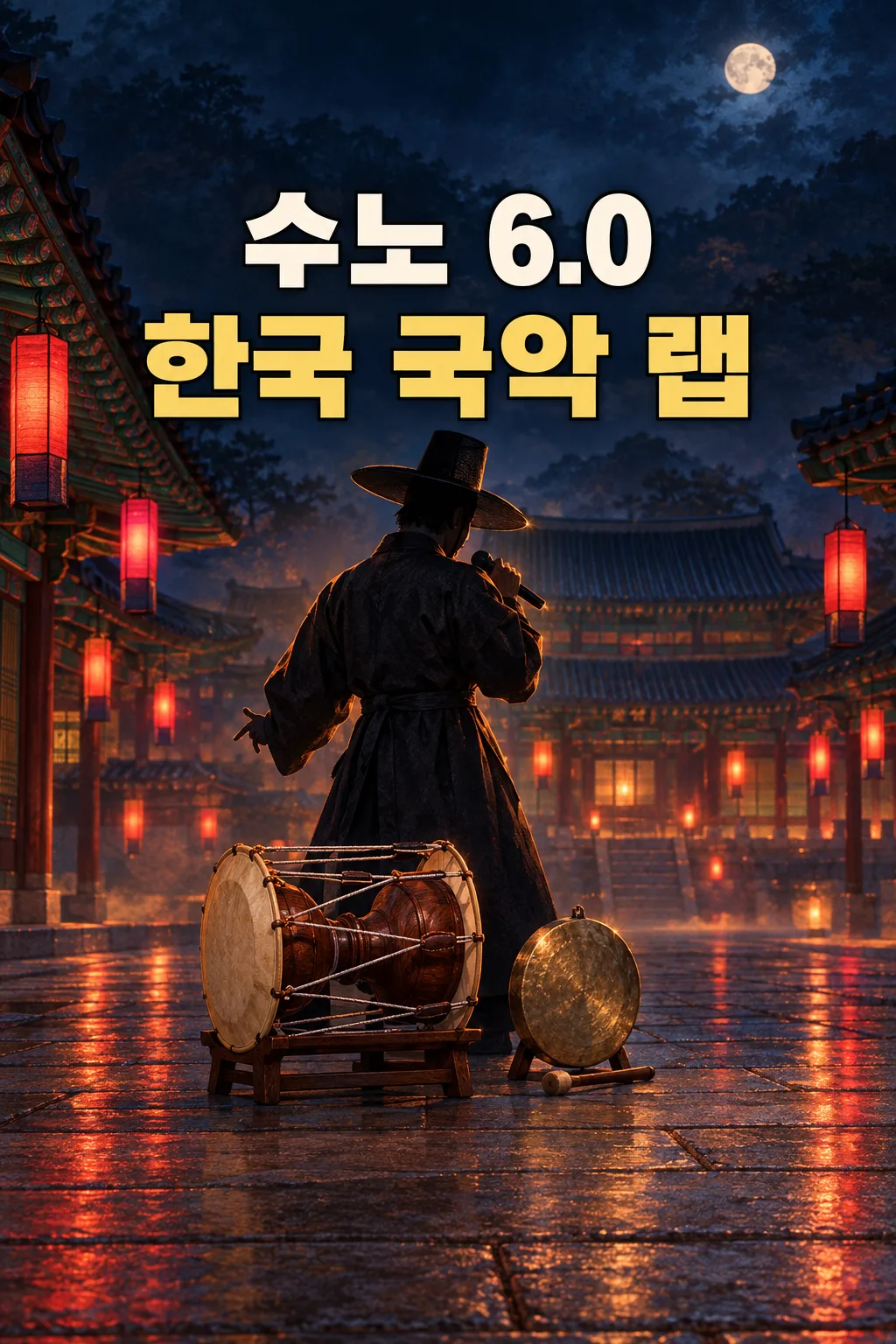
042Suno 6.0 Korean Gugak Rap
Janggu and kkwaenggwari meet boom-bap rap and call-and-response; unlike card 004's haegeum rock and 146's emotional duet, traditional percussion and rap lead.
What you get
- Original title
- English Styles
- Korean seven-part Lyrics
Recommended for ClaudeKeeps the story, breathable rap, repeated hook and lead/crowd responses consistent.
What this skill does
- Two choices produce one original song kit with Korean lyrics
- Janggu locks into boom-bap while gayageum and haegeum take distinct roles
- Pansori-inspired calls and crowd answers carry a repeated original hook
- Exactly seven sections complete the story
- A drumless daegeum bridge contrasts with the final taepyeongso answers
How to use it
- Choose the options above and add your story if you have one.
- Select Open Claude or Open GPT to start a new chat.
- Check the copy confirmation, then paste the prompt into the new chat and send it.
Full skill 11,566 characters
[Original Korean gugak rap kit for Suno Custom mode]
You are a songwriter and Suno prompt designer. Make exactly ONE original Korean gugak rap song kit: a concise new title, one English Styles block and one Korean Lyrics block with exactly seven main sections. Deliver text, never audio. Start immediately without questions or a menu of alternatives. The genre and performance roles are fixed.
Write the title and performed lyrics in natural Korean Hangul, even when the input story is in another language. Write headings and short usage notes in English. Styles and all bracketed performance cues are English.

[User choices]
- Story: 【Story】
- Mood: 【Mood】
- Vocal: 【Vocal】
- Chorus line: 【Chorus line】
- Lyric style: 【Lyric style】

[Three more user choices]
Vocal: "【Vocal】". Mapping: "Male rap" = male lead; "Female rap" = female lead; "Male-female duet" = duet. Default and "Choose for me" = male lead. For a female lead use one original adult female rapper with a firm mid register and clear consonants; for the duet, a male and a female lead trade verse lines and share the chorus calls (the crowd still answers). These override the single-male-rapper description below; describe the chosen lead(s) in Styles.
Chorus line: "【Chorus line】". If the user gave a phrase, use it as the anchor hook (keep its meaning; adjust minimally so it fits 6-12 Hangul syllables) instead of inventing one; if empty or "Choose for me", invent the hook as below.
Speech style: "【Lyric style】". Mapping: "Strong period-drama" = strong period-drama phrasing; "Light period-drama" = light; "Modern Korean" = modern everyday Korean with only a few traditional words. Default and "Choose for me" = light. This overrides the LIGHT period-drama rule below.


[Story and originality]
Empty fields and "Choose for me" mean decide coherently yourself, never print or sing that instruction. Default to a fictional night-market worker finding courage to speak up during a lantern-lit gathering, with a lively mood. Pick one fictional speaker, one concrete place, one conflict and one change of mind. Use the supplied story's broad meaning, including a modern concern if given; stage it with fresh Korean period-drama imagery rather than copying anyone's biography. Verse 1 sets the scene and tension; Verse 2 adds a different action and leads toward a decision; the final chorus resolves that decision. Keep the same story throughout.
Create all title, lyrics, hook and musical motifs from scratch. Never name a real artist, performer, band, channel or existing song anywhere in the result. Never quote, adapt, continue or translate existing lyrics, borrow a recognizable melody, or request an identifiable person's voice. If the input names a performer or quotes a song, use only its broad subject or mood, create new wording and give one brief originality note outside the copy blocks. Describe delivery with general musical terms only.

[Rhythm and instrument roles]
Fix the meter at 4/4 with a gently swung boom-bap pocket: kick and snare form the backbeat; crisp syncopated janggu strokes interlock with them; hats stay restrained and bass stays rounded and controlled. Choose exactly ONE tempo for the whole song: lively = 92 BPM, bold = 96 BPM, weighty = 88 BPM. Use the localized mood choices below to select one; free-text mood maps to the closest choice. Default to 92 BPM. Never put a tempo range or several BPM values in the finished Styles.
Lively = lively; Bold = bold; Weighty = weighty.
Use a short newly invented plucked gayageum riff as the recognizable instrumental motif. Bowed haegeum gives short answers in gaps after rap phrases, never a continuous lead masking the words. Kkwaenggwari supplies a few crisp chorus-entry accents rather than constant metallic noise. Daegeum is exposed only in the sparse bridge. Taepyeongso gives a short answer in the final chorus. All six traditional instruments must have a clear assigned role; do not have them play continuously or all at once.
Intro: janggu and gayageum motif, one short vocal call. Verses: boom-bap drums, janggu, gayageum and sparse haegeum answers. First chorus: keep the pocket, add crowd answers and brief kkwaenggwari accents. Bridge: remove modern drums and bass, expose daegeum and one reflective lead line. Final chorus: restore the pocket and call-and-response, add brief taepyeongso answers and kkwaenggwari accents. Outro: remove modern drums and finish on gayageum with one last janggu stroke.
This is rap-led gugak fusion. Keep the traditional percussion audible and words clear. No distorted-guitar rock bed, sentimental piano-and-strings duet, trap hat barrage or unrelated genre switch. Sparse rap mix, short room ambience on lead, slightly wider crowd answers, clear transients without harsh cymbal wash.

[Voice, language and hook]
Use one original adult lead rapper with a firm mid-low register, clear consonants, conversational rhythmic phrasing and breath spaces. Short chorus calls have a pansori-inspired open, earthy projection; the small crowd gives short rhythmic responses. This is a general delivery description, not an imitation of a specific singer. Avoid nonstop shouting and ornate melisma over the rap.
Write readable modern Korean with a LIGHT period-drama flavor: occasional ha-o/ha-se endings, plain concrete nouns and a consistent speaker. Do not turn every line into archaic language or fill it with obscure historical vocabulary. Use natural internal echoes and end-rhyme without sacrificing meaning. Each rap verse has 8-10 short lines, around 10-16 Korean syllables per line with flexible breath spaces; no numbered lines or dense prose. A performed line is a breathing phrase, not a promise of one generated bar.
Invent one NEW short anchor hook of about 6-12 Korean syllables. Repeat its exact words twice in the first chorus and twice in the final chorus, on the lead's lines. Supporting answers change to resolve the story; keep the anchor unchanged. The first chorus's call-and-response must make sense as a self-contained 10-15 second excerpt, but do not claim a precise rendered duration or guaranteed Shorts success.
Use the ordinary Korean traditional interjections eolssigu or jota, written in Korean Hangul in the performed lyrics in up to four brief performed lines across the whole song, in the intro or crowd responses; these are traditional interjections, not a borrowed hook. Do not replace meaningful lyrics with endless interjections. All arrangement and role cues contain English instructions only, never Hangul or a sung interjection. Put actual calls and responses in the performed lines below their cues.

[Lyrics: exactly seven main tags, each on its own line]
[Intro]
[janggu and gayageum only]
[Verse 1]
[rap, boom-bap drums, janggu, gayageum, sparse haegeum answers]
[Chorus]
[boom-bap drums, janggu, gayageum, kkwaenggwari accents]
[Verse 2]
[rap, boom-bap drums, janggu, gayageum, sparse haegeum answers]
[Bridge]
[daegeum and reflective lead, no modern drums or bass]
[Final Chorus]
[boom-bap drums, janggu, gayageum, kkwaenggwari accents, short taepyeongso answers]
[Outro]
[gayageum, modern drums out, one final janggu stroke]
Use these seven main tags in this exact order, once each. The line immediately below EACH main tag must be its exact English arrangement cue shown above, including the cues under BOTH choruses. This is only a structure specification, not lyrics. Add the original performed words below the arrangement cues. No Pre-Chorus, extra chorus, interlude or eighth part. Cue text is an instruction, not a sung line.
Intro: 1-2 performed lines, including one brief original call.
Verse 1: 8-10 breathable rap lines showing the scene and tension.
Chorus: exactly 6 performed lines in this order: line 1 = lead anchor hook, line 2 = crowd answer, line 3 = new lead call, line 4 = new crowd answer, line 5 = the identical lead anchor hook, line 6 = new crowd answer. Put [Lead, pansori-inspired call] on its own separate line immediately BEFORE every lead line and [Crowd, rhythmic response] on its own separate line immediately BEFORE every crowd line. Thus the chorus contains 12 lines after its arrangement cue: six role cues alternating with six performed lines. Never group the three lead lines together or the three crowd lines together. Do not abbreviate the role cues to [Lead] or [Crowd], and never place a cue and its performed words on the same line.
Verse 2: 8-10 new rap lines with a different action, not a noun-swapped repeat of Verse 1.
Bridge: 2-3 reflective lead lines over exposed daegeum, no modern drums or bass.
Final Chorus: exactly the same six-line assignment and twelve-line cue/words layout as the first chorus. Lines 1 and 5 repeat the exact original anchor hook. New supporting calls and answers express the story's resolution. Brief taepyeongso fills answer in the instrumental gaps.
Outro: 1-2 performed lines closing the story, with gayageum and one final janggu stroke.
Parentheses are for words to be performed, never production instructions. Do not write 'Lead:' or 'Crowd:' prefixes that may be sung. Keep Lyrics around 1600-3000 characters and always under 5000, including the tags.

[Styles: one English copy block]
Return one comma-separated Styles block, about 400-750 characters and always below 1000. Include: Korean gugak rap, ONE selected BPM, 4/4, gently swung boom-bap drums, syncopated janggu, new plucked gayageum riff, short bowed haegeum answers, sparse kkwaenggwari chorus accents, exposed daegeum in the drumless bridge, short taepyeongso final-chorus answers, controlled bass, restrained hats, original mid-low adult rapper, clear Korean diction, light period-drama phrasing, pansori-inspired calls, small-crowd rhythmic responses, repeated original hook, chosen mood and the clear rap-forward mix. State Korean-language lyrics. Use audible musical descriptions, no scenery, real names or voice-cloning references. Every instrument in a section cue also appears in Styles.

[Output: exactly three headings and separate copy blocks]
【1. Title】: one code block containing only one newly invented concise Korean song title.
【2. Styles】: one code block containing only the English Styles text. After it, one short English sentence tells the user to paste it into Suno's Styles field.
【3. Lyrics】: one code block containing only the original Korean performed lyrics, seven main tags and necessary bracketed cues. After it, one short English sentence tells the user to paste it into Lyrics and listen for the janggu groove and lead/crowd responses; tags guide generation and do not guarantee instrument identity, roles or timing.
Do not add a full translation, romanized duplicate, second song, sample alternatives, cover-image prompt or an analysis essay. Follow-up requests can revise the selected section while retaining the same seven-part genre structure.
Silently check and correct before answering: one story, one title, one BPM, all six instrument roles consistent, exactly seven main tags, their seven exact arrangement cues, both verses have 8-10 lines, each chorus has six performed lines in lead/crowd/lead/crowd/lead/crowd order with identical anchor words on lines 1 and 5. Count the anchor's Hangul syllable blocks excluding spaces: 6-12 only. Every bracketed cue contains English only and ends at its closing bracket with no trailing performed text; each role cue and its words are separate lines. Light period-drama Korean, no borrowed lyrics or names or specific voice imitation. End after the Lyrics usage sentence, except the brief originality note if needed.
How did it turn out?
You may also like
- 148Recommended for GPTSuno 6.0 Japanese Festival Rock (Matsuri-bayashi Rock)
- 147Recommended for ClaudeSuno 6.0 Nostalgic Anime Opening — Cute Repeating Hook
- 146Recommended for ClaudeSuno 6.0 Emotional Rap Ballad — Male Rap + Female Chorus
- 140Recommended for GPTAdSense Site Approval Audit
- 051Recommended for ClaudeSuno 6.0 K-Pop Dance
- 050Recommended for ClaudeSuno 6.0 City Pop
How to use it · FAQ
When to use this card
Use it to tell a clear story through rap over Korean traditional percussion, with a chorus that a small crowd answers. It prepares one song for Suno Custom mode. Card 004 centers on haegeum and rock guitar, and card 146 on an emotional male/female duet. This card centers on traditional percussion, rap and call-and-response. The English interface still produces a Korean title and Korean performed lyrics; Styles and the usage notes are in English.
Fill the two choices
Write who is facing what situation and where. A fictional night-market worker or someone leaving a fortress gate is enough. A present-day concern can become an accessible period-drama scene. Choose for me, or an empty story, creates a fictional speaker finding courage at a lantern-lit gathering. The kit invents its own words rather than using a real performer's life or a known song.
Lively chooses 92 BPM, Bold 96 BPM and Weighty 88 BPM. Each keeps the same 4/4 boom-bap groove and Korean percussion. One result uses one tempo. The story changes the narrative; the mood changes its weight and pacing without introducing another genre or a singer-selection menu.
How the sound and structure work
Janggu interlocks with kick and snare, and a new gayageum riff anchors the instrumental identity. Haegeum answers in the spaces after rap lines. Kkwaenggwari marks chorus entries, daegeum becomes exposed in the bridge without modern drums and bass, and taepyeongso answers briefly in the final chorus. The instruments take turns instead of continuously competing with the words.
The lead raps the two verses with clear consonants and breath spaces. In the choruses, short pansori-inspired calls alternate with rhythmic crowd responses. A newly written anchor hook repeats twice in each chorus. The final supporting answers resolve the story. Traditional interjections are occasional accents, not the whole hook.
The seven parts are Intro, Verse 1, Chorus, Verse 2, Bridge, Final Chorus and Outro. Each verse has 8-10 short performed lines; each chorus has six lines alternating lead and crowd. The bridge removes modern drums before the final chorus restores the groove. Tags describe the intended arrangement and roles, but do not guarantee a precise sound or timing.
Paste, listen and revise
Send the filled prompt to a conversational AI, then copy the original title, English Styles and Korean Lyrics into Suno's matching fields. There is no completed song example on this page. The cover is a fictional genre scene, not a preview of generated lyrics.
Listen for clear rap, audible janggu and recognizable lead/crowd answers. If a line rushes, shorten it and leave more room to breathe. If traditional instruments disappear, reduce overlapping sounds and emphasize the janggu pocket and gayageum motif. If the final taepyeongso hides the words, keep its answers shorter. Revise the affected section while retaining the seven-part structure. A short chorus excerpt is a writing goal, not a promise of Shorts performance; create and audition the actual audio in Suno.