
All · Social posts · Memes
168My Bag Essentials
Turn the three objects you carried today into one pencil collage for Stories or Threads.
Fill in the fields
- 1Fill in the fields
- 2Copy the prompt
- 3Paste it into a GPT chat
- 4To use a photo, upload it together with the prompt Optional
Full prompt 5,744 characters
Generate this image now. Draw it directly - do not describe it, explain it, or ask questions.
Output one landscape A3 poster, 420 x 297 mm, aspect ratio 1.414:1. Use the largest supported resolution. Final print target: 4961x3508 pixels at 300dpi. Keep all text at least 10 mm inside the edges.

[Purpose]
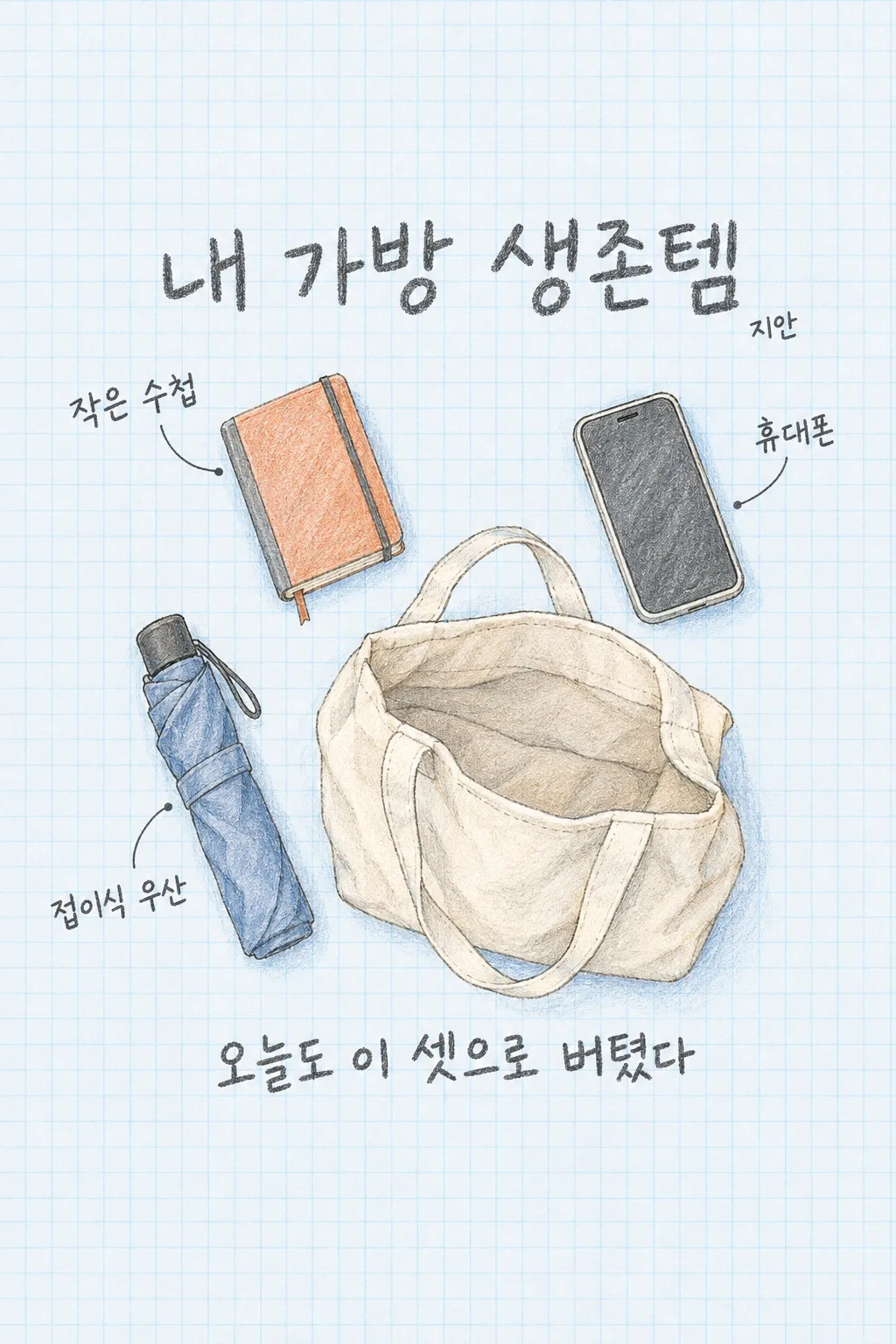
Create one ready-to-share illustrated daily-carry card titled "My Bag Essentials". The user names three actual objects carried today. Turn these objects into one overhead pen-and-colored-pencil arrangement around an open cream canvas tote. This is a personal social post about everyday taste and small comforts, not a product recommendation, shopping list, weight measurement or survival instruction. It is one continuous illustrated sheet, never three separate object cards.

[Scene]
Draw the three supplied objects: "【First object】", "【Second object】" and "【Third object】". Use ordinary recognizable silhouettes with no brand logo or invented specifications. A small notebook has a bound cover, an umbrella has a believable folded shaft, and a phone is a simple unbranded rectangle; follow other supplied objects equally literally. These examples do not add extra objects to the user's selection. If two names mean the same object, show it once and do not fabricate a replacement. There is one fixed off-white canvas tote, with an open mouth, seam lines, two connected handles and natural fabric folds. The tote's shape is fixed; the personal object contents can vary.

[Attached photo]
No photograph is required. Interpret the words as everyday objects using original linework. Do not infer a person's occupation, income, health, secrets or habits from the items. No human face or hands appear. Render only the supplied three distinct items and one tote; add no keys, receipt, identity document, bank card, medication, food or extra phone by default.

[Text layout]
All visible wording is English. Fill the canvas with very pale blue graph paper and loose graphite outlines with small rust and slate-blue pencil accents. Keep top12% and bottom15% free of important words. At15-24% place the exact title "My Bag Essentials" in large dark graphite hand lettering. The tote occupies the lower-center, about x35-76% and y43-70%, viewed from directly above with its opening visible. Arrange one object upper-left at y29-43%, one upper-right at y31-49%, and one lower-left at y53-70%. Give each distinct object ONE handwritten label using its provided name, linked by one thin curved pointer ending beside the object. Keep pointer lines clear of letter interiors. A long object may follow the left edge diagonally. End every object and object label above74% height. Preserve breathing room rather than arranging a rigid grid. Strictly leave top0-12% and bottom85-100% as graph paper only. The title starts BELOW15% and the entire caption ends BEFORE81%; do not push either text block to the image edges.
If supplied, put "【Name】" once as a small personal signature at26-28%, aligned with the title. Omit this signature when the instruction is absent.
The personal caption input is "【Caption】". If it equals "Pick for me", write one original short English line about the three objects keeping the day manageable. Do not invent events, prices, a diagnosis or a real measured bag weight. Otherwise render the user's caption faithfully. Put this single caption at75-80% in large dark pencil handwriting, no more than two short lines. The title, item labels, optional signature and caption are the only text.

[Style and visual hierarchy]
One fixed charming overhead stationery illustration: visible pencil grain, wobbly fine pen contours, translucent colored-pencil filling, natural fabric shading. It feels like a personal notebook page made for sharing. Do not turn it into photorealistic product flat-lay, a retail advertisement, a sticker-pack grid, comic panels or multiple pages. The tote is the main shape, while the objects surround it at different angles. Item labels must remain large enough to read at list size. The whole page should feel connected by the placement of objects and the thin pointing lines, without a box behind each label.

[Lighting and texture]
Use gentle diffuse imagined daylight, light blue paper texture and small soft pencil shadows below each object. Never use glossy neon, bold drop shadows, repeated pattern objects, decorative unreadable script or a barcode. Objects have coherent real shapes: notebook pages join their cover, phone corners agree, tote handles connect to the rim, and folded umbrella ribs stay inside the fabric. Do not claim a diagram measures physical dimensions. Preserve the finished page without requiring users to rearrange anything.

[Text rules]
All quoted visible copy belongs to the artwork, while input labels and instruction headings do not. Resolve any automatic wording control into a short original sentence before drawing; never print that control literally. Preserve provided spelling and numbers, and use the target language consistently. Keep readable letters separate from highlights, folds, shadows and decorative marks. Do not invent a price, discount, date, availability, award, endorsement, biography or purchasing condition. The fixed composition and medium stay the same for every user; personal inputs change its content only.

[Avoid and final delivery]
Deliver exactly ONE finished raster image in this response. Draw it directly with image generation. Do not execute code, give drawing instructions instead of an image, offer multiple versions, create separate pages, ask for a next message, or require cropping and assembly. No phone mockup, browser frame, watermark, publisher logo, branded packaging, existing character or celebrity likeness. Finish all artwork within the selected aspect ratio, preserving the composition and large readable lettering. Leave the upper 12% and lower 15% free of essential lettering and maintain generous side margins.
You may also like
How to use it · FAQ
A small daily introduction
The three things in your bag can say more about a day than a long status update. Record a notebook, a folding umbrella and a phone, or the actual objects you carried today. Their names become one overhead pencil illustration around an open canvas tote. Thin pointer lines connect the labels, and one short caption finishes the page. Share it on Stories or Threads to exchange everyday tastes with friends. You do not need to photograph each object or assemble separate images.
One object per field
Enter one actual item in each of the three fields. A short concrete name such as small notebook or folding umbrella gives the drawing a recognizable shape. Avoid a long comma-separated list in one field: this composition is made for three objects. Brand names are unnecessary. The optional name becomes a small signature; leaving it empty removes only that line. The cream canvas tote, overhead angle and pencil medium stay fixed. There is no bag-style or layout selector.
Let the caption be chosen
Choose Pick for me if you cannot think of a line. GPT will write a short original caption about the supplied objects making the day manageable. You can also enter your own sentence. It should not make up an event you did not describe. This card does not weigh a real bag, calculate spending or recommend products. No invented grams, prices or diagnostic claims belong in the drawing. Only the title, object labels, optional signature and caption appear.
No reference photo needed
Complete the fields, copy the prompt and send it once to GPT. The result is an illustrated page, not a measured product diagram. Leave out private numbers from identity cards or wallets and avoid detailed information that need not be shared. Everyday object names are enough. The drawing interprets those names in original pen and pencil marks; it is not a claim that it knows the exact model of your belongings.
Check the page before posting
Find the objects you entered and make sure extra items have not been added. Every label should point to its own object. Tote handles should join the opening, notebook pages should connect to the cover and an umbrella shaft should have a coherent handle. Read the title and caption on a phone-sized view. A set of separate boxed object panels is different from the intended connected collage. The page should have an open tote and three objects at varied angles.
Make a clear correction
If an object is misunderstood, use a slightly more concrete short name, such as black folding umbrella. If the caption is too long, shorten it. Send the corrected complete prompt in a new message and generate one finished sheet again. There is no step where each item needs to be drawn separately, cropped and pasted together. You can change your real daily contents while keeping the same personal-notebook layout.
Questions
- Does this measure my bag weight? No. It records object names as a picture and does not infer physical weight.
- Must I attach photos? No. This is an illustration made from the three names.
- Can I put six items in it? The layout is designed around three objects. Use one per field for readable labels.
- Was it tried in the free GPT interface? Production checked the cover using the image API. No direct free-interface generation test was run.