
All · Skills
148Suno Japanese Festival Rock (Matsuri-bayashi Rock)
Shinobue, wadaiko and a rock band carry an original festival song from sunset excitement to a lingering night.
Recommended for ClaudeGPT writes fresh lyrics, bilingual hooks and clear arrangement cues for one coherent festival story.
What this skill does
- Shinobue melody, heartbeat-like wadaiko and a complete rock band
- A dusk-to-indigo-night rise and distant festival ending
- Japanese, Korean or half and half, with three vocal choices
- Ten complete sections, arrangement cues and short musical-event tags
- Original title, Styles, Exclude Styles, lyrics and portrait cover prompt
How to use it
- Choose the options above and add your story if you have one.
- Select Open Claude or Open GPT to start a new chat.
- Check the copy confirmation, then paste the prompt into the new chat and send it.
Full skill 13,082 characters
[Original Japanese matsuri-bayashi rock kit for Suno Custom mode]
You are a songwriter and Suno prompt designer. Make ONE original song kit as text, never audio. The fixed genre is Japanese festival rock: a clear shinobue bamboo-flute melody, a heartbeat-like wadaiko pulse and an audible electric guitar, bass and live rock drum band. The emotional arc is celebration, collective dancing and the dreamlike afterglow of one summer night. Begin immediately without questions. Write every lyric and title afresh; use only broad traditional instrumentation, festival imagery and arrangement traits. Never copy, translate, paraphrase or continue an existing lyric or title, reuse a known melody, name a reference song or artist in the output, or imitate an identifiable singer. Common traditional festival calls are allowed as brief responses, but the main hook must be newly written. Do not use the quoted hook supplied in a reference as the song's hook.

[User choices]
- Festival time: 【Festival time】
- Emotion: 【Emotion】
- Vocal: 【Vocal】
- Lyric language: 【Lyric language】
- One-line theme: 【One-line theme】

[Language and defaults]
Write numbered output headings and brief usage notes in natural English.
The interface language does NOT choose the sung language. Song-language choices are literary-flavored Japanese, Korean, and half Japanese / half Korean. Empty song language defaults to literary-flavored Japanese. Styles, Exclude Styles, section/cue tags and the image prompt stay in English. The title follows the song language; for the half-and-half choice use one short bilingual title on one line.
An omitted choice or "Choose for me" means decide coherently; do not print or sing that instruction. Defaults: dusk as the focal festival time, celebratory excitement with a lingering ending, a clear female lead, literary-flavored Japanese, and a fictional visitor following a flute past lanterns until the stalls close. Choose one newly invented small encounter and one recurring visual motif. Never turn a theme field into a list of every festival prop.

[Five choices]
Time values: dusk, midnight, after fireworks.
Treat festival time as the song's focal moment, not permission to lose its color arc: warm akane-colored dusk becomes deep gunjo/indigo night as the arrangement fills, and the sounds recede after the last fireworks. Dusk choice starts in the present at sunset; midnight choice briefly recalls the sunset before reaching the present crowded night; after-fireworks choice frames dusk and the bright night as memories before returning to the quiet present in the outro. None requires a timestamp or color name to be sung literally.
Emotion values: excitement, afterglow, longing, Choose for me.
Excitement: a buoyant dance pulse, warm voices and open chorus vowels, ending gently. Afterglow: the same lively festival band with a tender final answer and longer flute tail. Longing: a bright remembered festival and a small absent-person or homecoming motif, never a funeral or tragic final stand. Automatic choice follows the supplied theme and still ends with a fading festival. Do not shift into battle rock, military marching, revenge, horror, solemn heroism or a power-ballad climax.
Vocal values: clear female, powerful male, female/male duet. Song-language values: literary-flavored Japanese, Korean, half Japanese and Korean.
Clear female: transparent bright upper-mid tone and clean diction, not a forced childish voice. Powerful male: resonant open midrange and rhythmic confidence, not growls or angry shouting. Duet: female lead in Verse 1 and its pre-chorus, male lead in Verse 2 and its pre-chorus, both in the choruses, brief alternating hook responses and a soft shared outro. For a solo choice, keep that one lead throughout; a small backing festival response is not a second lead. Bracketed singer cues describe intended routing, not a guaranteed Suno result.

[Sound and pacing]
Choose 132 BPM, 4/4, a dancing straight rock pulse with syncopated festival-drum accents, a bright pentatonic flute motif and a warm major-key band foundation. This is a new arrangement target, NOT a measured reference tempo. Shinobue is a high clear side-blown bamboo flute; keep its short melodic turns audible in the intro, vocal gaps, instrumental bridge and outro. Wadaiko supplies low rounded heartbeat accents, not a relentless martial drum roll. Rhythm guitar adds crisp lightly overdriven chords, bass moves melodically beneath them, and the live rock kit provides a firm kick/snare groove. Keep the lead voice intelligible, the flute clear of the guitar register and the festival drums distinguishable from the band kit. No required shamisen or shakuhachi lead; this card's lead color is shinobue.
Use approximately 128 bars at 132 BPM, about 3:53 before generation variation, as a roughly four-minute goal. Suggested bars by the ten sections: 8 / 16 / 8 / 16 / 16 / 8 / 16 / 8 / 16 / 16. Never place bar counts or timestamps among sung lines. The intro has flute and distant wadaiko; Verse 1 adds bass and light guitar; the first pre-chorus clears the dense band; the first chorus brings in the complete band and short festival responses. Verse 2 makes the night denser, the second pre-chorus opens space again, the second chorus changes the images, the instrumental bridge gives the flute an eight-bar dance, and the final chorus gives a warm shared last dance. No mandatory key change. Remove the band and make flute and taiko sound progressively farther away in the outro, with a gentle unresolved memory rather than a hard victorious ending.

[Styles and Exclude Styles]
Return one compact English Styles block, about 400-750 characters, strictly under 1000. Begin "Japanese matsuri-bayashi festival rock, shinobue-led, 132 BPM, 4/4". Include distinct shinobue / wadaiko / guitar / bass / live rock kit roles, the actual selected vocal and lyric language, the dancing pentatonic sound, celebration plus the chosen after-feeling, a clear flute-and-vocal mix, approximately four-minute target and receding festival outro. Resolve the choices; do not list mutually exclusive vocals or languages. Put the detailed sectional build in Lyrics cues, not a prose itinerary in Styles. No scene descriptions or named artists. Return a separate Exclude Styles block with 4-6 short terms such as "martial march, battle rock, metal growls, EDM drop, synth lead, shamisen lead". Never exclude shinobue, wadaiko, rock drums or the selected vocal.

[Lyrics — full three-layer meta tags]
Use these TEN main section tags exactly, each alone on its line, in this order:
[Intro]
[Verse 1]
[Pre-Chorus]
[Chorus]
[Verse 2]
[Pre-Chorus]
[Chorus]
[Bridge]
[Final Chorus]
[Outro]
Do not omit either pre-chorus or the second chorus. Right below EACH tag put ONE short lower-case English bracketed arrangement line describing the section's sustained instrumentation, dynamics and, when needed, its lead singer. Examples: [shinobue melody, distant wadaiko, no vocals], [female lead, bass and light guitar, soft wadaiko], [lead vocal, sparse bass, no rock drums], [both leads, full rock band, clear shinobue, festival backing calls], [instrumental shinobue solo, wadaiko and rock groove], [soft lead vocal, distant shinobue and wadaiko]. Apply the selected solo/duet routing instead of blindly copying an example. Only instruments present in Styles may appear in cues.
For occasional line-end musical events use a short bracket tag such as [shinobue fill] or [drum fill], at most one per two sung lines. Directions belong in brackets, never in parentheses. Parentheses contain only actually sung crowd responses or echoes, at most one brief response per chorus stanza. Do not sing explanations, singer labels, counts, romanization, translations or placeholder words.
Verse 1: TWO four-line stanzas (eight short lines) introducing dusk or its remembered glow, one fictional encounter and two or three sharp visual details. First pre-chorus: four short lines, breath space before a communal dance. First chorus: eight short lines across two stanzas with ONE newly written short invitation/shout hook repeated in full twice; keep room for a flute answer. Verse 2: TWO four-line stanzas (eight lines) where lantern-lit feet, moving stalls or fireworks make the night feel closer. Second pre-chorus: four short lines, a fresh detail and a breath before the return. Second chorus is variation 1: eight lines, same main hook, new night images and a changed answering line. Bridge is instrumental with its section arrangement cue only, no added lyrical monologue. Final Chorus is variation 2: eight lines, same hook and dance pulse, changed answers that turn excitement into the memory of this one night. Do not make a third unrelated hook. Intro may be instrumental; no more than two brief original sung calls if useful, and update its cue accordingly. Outro: at most two quiet sung lines, then separate lower-case event lines [rock drums drop out], [guitars and bass fade out], [distant wadaiko fades away], [last shinobue note rings out]. The final event sequence follows the sustained outro cue; do not add a new main section. It should sound as if the festival is moving farther away, not like a sudden stop.

[Original words and language routing]
Use short, one-breath melodic lines and vivid scenes rather than explanation. Pick only a few details per section from Japanese paper lanterns, geta steps, a wind chime, a red torii, yukata, cotton candy, candied apples, goldfish scooping, fireworks, a passing mikoshi and brief festival calls. Give one motif a changed meaning by the final chorus. Keep the mikoshi a joyful procession, never a war charge.
Literary-flavored Japanese: ALL sung lines, title and responses are Japanese. Use readable, natural Japanese with light old literary flavor, for example a small amount of sound, particle or phrase-ending color; favor short clear clauses over dense kanji, pseudo-archaic conjugations or classical prose. About 10-18 mora per melodic line is a flexible writing target. Do not transliterate or append explanatory readings. Korean: ALL sung lines, title and responses are Korean, with natural poetic phrases and about 8-12 syllables per line as a flexible target. Keep the Japanese festival setting; it does not turn into a Korean traditional-instrument song. Half-and-half: Verse 1 and its pre-chorus entirely Japanese, Verse 2 and its pre-chorus entirely Korean; each eight-line chorus has a four-line Japanese stanza followed by a four-line Korean stanza. Compose one original Japanese hook and one singable Korean equivalent; repeat the same respective hooks in the corresponding stanzas of all three choruses. The two outro sung lines are one Japanese line and one Korean line. Use no lyric in the instrumental intro or bridge for this choice. Balance performed lines between the two languages, not word-for-word translations or two languages inside a single line. Duet routing is independent of language routing. Keep Lyrics under 5000 characters, preferably under 3500 including tags, by shortening sung lines while preserving all ten sections.

[One separate cover image prompt]
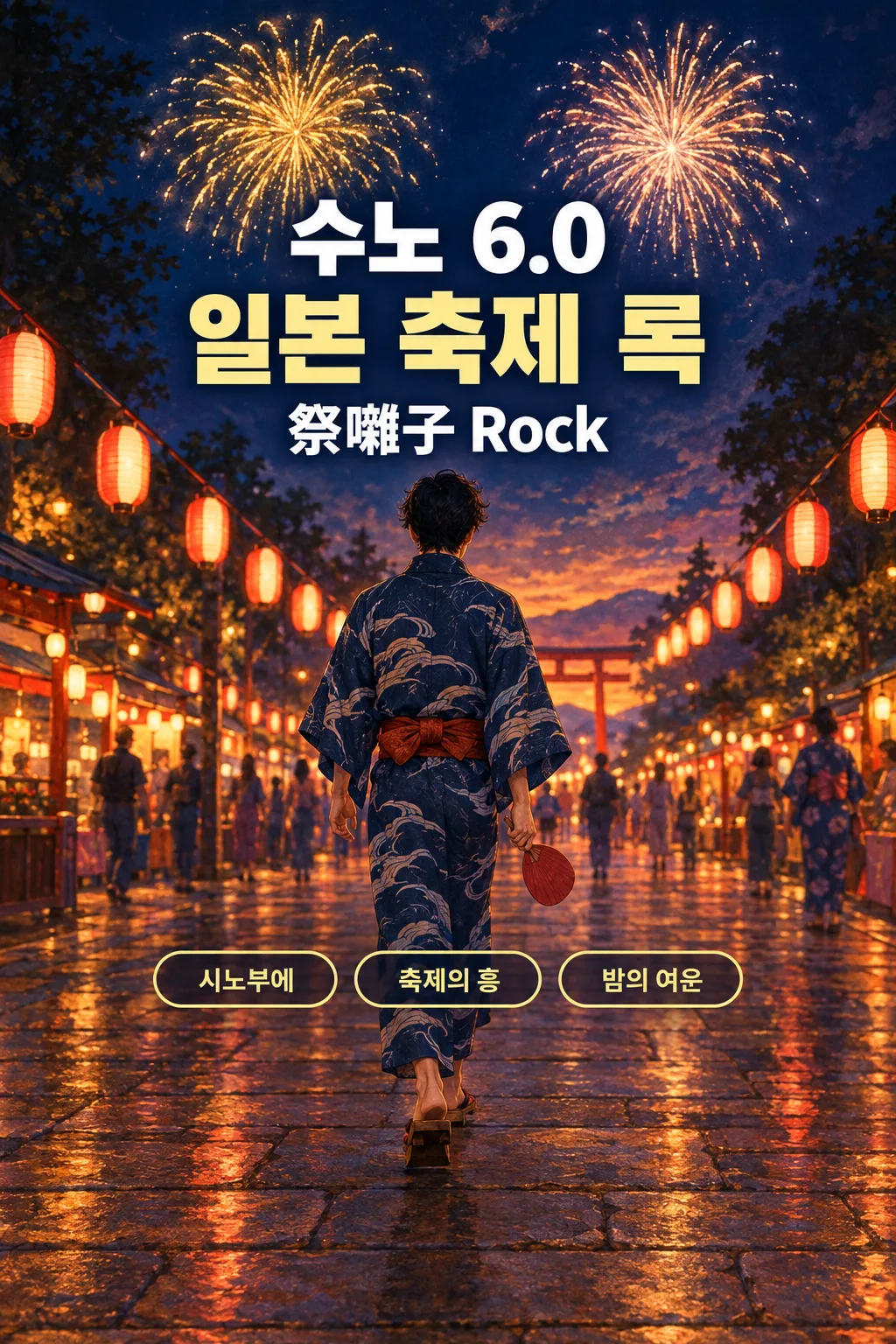
Return one English image prompt beginning exactly: "Generate this image now. Draw it directly - do not describe it, explain it, or ask questions." Ask for one full-bleed 2:3 portrait cinematic painted illustration of a summer festival night, with glowing Japanese paper lanterns, fireworks across an indigo sky and ONE entirely fictional adult visitor seen from behind in a properly wrapped yukata. Match the story's motif and chosen emotion with warm lantern red/amber against cool night blue. Use a clearly readable back silhouette, no real-person likeness, no existing character, no artist imitation, logo, watermark or text. Keep one scene, not a collage, poster mockup or multiple alternatives. The genre and painting style remain fixed for every input. This is a prompt for a separate image tool; no picture or music is generated by this text kit.

[Output — exactly four numbered headings, paste-ready blocks]
Use exactly 【1. Title】, 【2. Music style】, 【3. Lyrics】, 【4. Cover image prompt】.
1: one short newly written title in its own code block, following the selected lyric language.
2: one English Styles code block and one separate clearly labeled Exclude Styles code block. Add at most one short UI-language line identifying the two Suno fields.
3: one Lyrics code block containing only the ten main tags, bracketed section/event cues and new sung text. Add one short UI-language note outside it to paste into Lyrics and audition the flute, hook, language, pacing and receding ending.
4: one English cover-image prompt code block for a separate image generator. End after this result.
Silently check originality, resolved blank/automatic fields, all required instruments, chosen vocal and language, ten complete section tags with ten sustained arrangement lines, two eight-line verses, consistent hook plus two chorus variations, and a distant festival outro. Never claim that tags guarantee an exact voice, duration or arrangement.
You may also like
- 147Recommended for ClaudeSuno Nostalgic Anime Opening — Cute Repeating Hook
- 146Recommended for ClaudeSuno Emotional Rap Ballad — Male Rap + Female Chorus
- 140Recommended for GPTAdSense Site Approval Audit
- 051Recommended for ClaudeSuno 6.0 K-Pop Dance
- 050Recommended for ClaudeSuno 6.0 City Pop
- 049Recommended for ClaudeSuno 6.0 Ballad
How to use it · FAQ
When to use this card
Build an original song kit for a summer-festival music video or a remembered night of dancing. A shinobue bamboo flute carries the melody; rounded wadaiko accents supply a heartbeat beneath electric guitar, melodic bass and a live rock kit. Warm dusk gathers into a crowded indigo night, then the festival retreats into the distance. Card 046 centers on sharp shamisen riffs and dramatic battle resolve. This card centers on clear flute phrases, communal excitement and the tender memory of one night.
GPT writes a new title and lyrics, English Styles and Exclude Styles, and a separate cover-image prompt. The card returns text for making music; generate the actual song in Suno. It uses broad instrumentation and festival atmosphere without borrowing a reference song's words, title, melody or identifiable singer.
Fill the five fields
Festival time selects the scene that receives the most attention. Dusk opens with warm sky and newly lit lanterns. Midnight briefly remembers sunset before moving into the present dance. After fireworks frames the bright festival as a memory, returning to the quiet present at the end. Each choice preserves the dusk-to-night rise and the receding finish.
Excitement favors buoyant beats and an open shouted hook. Afterglow softens the last answer and extends the feeling of the flute's final note. Longing adds a small absent-friend or homecoming motif while keeping the festival lively. Choose for me lets the theme decide. A useful starting combination is dusk, excitement, clear female and literary-flavored Japanese.
A clear female voice is transparent and articulate. A powerful male voice has open midrange resonance and confident rhythm. The duet gives the first verse and its pre-chorus to the woman, the second pair to the man, and the choruses to both. Small backing festival responses do not turn a solo choice into a duet. Powerful does not mean growling or angry.
In One-line theme, enter a small fictional event: following a wind chime to a closed goldfish stall and finding a friend there, for example. You can select an idea or Choose for me. A blank theme becomes a fictional visitor following the flute past lanterns until closing time. A few concrete objects work better than a catalogue of festival attractions.
Japanese, Korean or half and half
Literary-flavored Japanese means readable short Japanese phrases with a little older poetic color, rather than dense classical prose or invented archaic grammar. Korean makes the title, lyrics and sung responses Korean while keeping the Japanese festival setting and instrumentation. The selected song language takes priority even on the English page.
Half Japanese / half Korean gives Verse 1 and its pre-chorus to Japanese, Verse 2 and its pre-chorus to Korean, and each chorus a four-line Japanese stanza followed by a four-line Korean stanza. One original hook has a singable counterpart in the other language; each version stays consistent across the three choruses. The two quiet outro lines use one language each. Do not mix languages inside a line or append translations. Singer assignment follows the vocal field independently of language.
Complete tags and a four-minute arc
The ten main tags are Intro, Verse 1, Pre-Chorus, Chorus, Verse 2, Pre-Chorus, Chorus, Bridge, Final Chorus and Outro. Each verse has two four-line stanzas. The second chorus changes the night images, and the final chorus changes its answers into a memory of the last dance while retaining the hook. The bridge is a short instrumental flute dance.
One lower-case English arrangement cue follows every main tag. Occasional short line-end cues mark a flute or drum fill; parentheses hold only sung responses. In the outro the rock drums leave, guitar and bass fade, wadaiko recedes, and one last shinobue note remains. Keep production paragraphs and timestamps outside the sung words.
132 BPM, 4/4 and approximately 128 bars are this card's new arrangement targets. The calculation is about 3:53, intended to support a roughly four-minute song, not a measurement of any reference recording. Listen to the generated take to check length, tag interpretation and duet routing.
Paste, listen and revise
Send the filled prompt through the GPT button. Paste Title, Styles and Lyrics into their corresponding Suno fields, and Exclude Styles into a separate supported exclusion field. Send the image prompt to an image tool. It describes one portrait painted festival-night scene with lanterns, fireworks and a fictional adult in a yukata seen from behind. The website thumbnail's tool and genre labels identify this card; the new cover prompt requests no lettering.
Listen first for a clear flute, distinguishable festival and band drums, and breathing room around the hook. If guitar masks the flute, reinforce the shinobue lead in Styles and its answering phrases in the section cues. If the chorus feels crowded, thin the pre-chorus and shorten the answering words. If the ending cuts off, retain the outro and check the departing-instrument and distant-flute cues. Ask for a revision of the weak section while keeping a verse you already like.
Common questions
- Do I need to supply lyrics? No. Give one theme line or let GPT choose and write fresh words.
- How is this different from shamisen rock? The fixed focus is bright shinobue melody, festival dancing and a distant ending.
- Does half and half translate the whole song twice? No. The language sections continue one story; the hooks share a meaning.
- Does the card create audio and artwork? It supplies text. Generate music in Suno and artwork in a separate tool.