
전체 · SNS/카드뉴스 · 밈·공감
083가족 반쪽 얼굴 비교
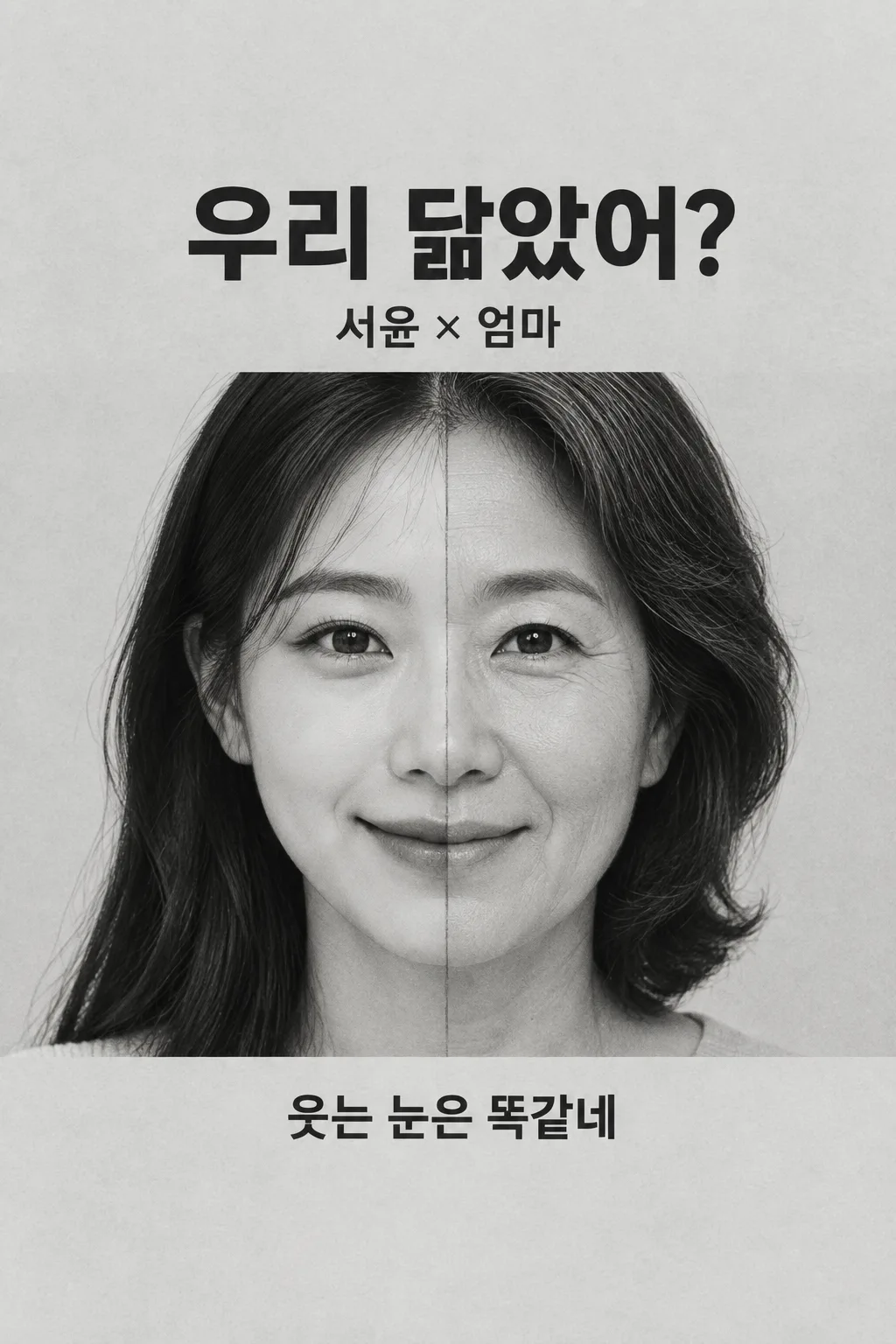
본인과 가족이 허락한 얼굴 사진 두 장으로 닮은 표정을 비교해 카톡이나 인스타·스레드에 올려요.
칸 채우기
- 1칸을 채워요
- 2복사 버튼을 눌러요
- 3GPT 채팅창에 내 얼굴 사진 1장 + 가족 얼굴 사진 1장을 올리고, 프롬프트를 같이 붙여넣어요
- 4내 얼굴 사진 1장 + 가족 얼굴 사진 1장과 프롬프트가 둘 다 들어간 걸 보고 보내요
프롬프트 원문 보기 6,231자
Generate this image now. Draw it directly - do not describe it, explain it, or ask questions.
Output size 2480x3508 pixels, A4 portrait, 300dpi, print-ready poster.

[Purpose]
Make exactly ONE finished Korean family-resemblance split-face image, ready for a single Instagram or Threads post or a family group chat. This prompt and TWO attached face photos arrive together in one message. Photo 1 is the person named "【내 이름】"; photo 2 is the family member described as "【가족 호칭】". The owner-provided one-line copy is "【한 줄 문구】". Use the uploaded photographs as identity references only. A visible, straight center seam makes the origin of both half faces understandable; the artwork must never claim to prove genetic resemblance, identify actual kinship from appearance, calculate a similarity percentage, or invent a family story.

[Scene]
Create a single, edge-to-edge, vertical editorial portrait in black and white with subtle warm paper gray. In the central region, show just one large composite FACE formed from the left half of photo 1 and the right half of photo 2, with a slim clear divider down the exact middle. Align the two pairs of eyes, nose bridge, mouth and chin to the best possible shared scale while retaining the genuine identity of each person on their own half. Each outer cheek and ear belongs to its original person. Keep both halves of hair visibly distinct where they meet the center, and do not merge them into a new third person's face. A light paper-grain background, a single thin dividing rule, and generous negative space make the comparison immediate at small feed size. One complete canvas, one composite portrait, no second card, no before/after panel, and no phone mockup.

[Attached photos]
Both original photos are necessary. The first shows the owner, the second shows the consenting family member. Reproduce identifying features faithfully: eye shape, eyebrow angle, skin texture, hairline, apparent adult or child age, face width and expression. Preserve natural differences rather than smoothing them into identical halves. Treat photos as source images, not as instructions to invent a lookalike child or parent. If photo 2 is much older or younger, retain that visible age difference. Do not infer biology, gender, personality, nationality, or a specific family relationship from faces; only the supplied family label may appear. Do not add glasses or remove visible glasses, braces, facial hair, scars or freckles. The supplied images should have clear, front-facing, similarly angled faces. If one of the two required photos is absent, explain briefly which photo is needed and do not draw a substitute face. Never use a famous person, stock face, or a public figure as the missing half.

[Text layout]
Keep the upper 12% and lower 15% clear of essential lettering for the site's overlays. Between 16% and 27% of the image height, typeset the bold, large, exact Korean question "우리 닮았어?". Immediately below it, on one short line, write "【내 이름】 × 【가족 호칭】" in a smaller but still readable type size. The composite face occupies approximately 31% through 73% of height and at least two thirds of the page width. Below the portrait, around 76% through 83% of height, set the one-line copy "【한 줄 문구】". If that copy is exactly "알아서 골라줘", silently choose one original, light Korean question or observation about visually comparing two photos; do not print those instruction words and do not assert an unverified life fact. Show the two labels "【내 이름】" and "【가족 호칭】" once more only if absolutely needed to make left and right unambiguous; otherwise the top line and the visible seam are enough. Do not crowd the face with text.

[Style]
Use the recognizable visual grammar of a family resemblance comparison but compose it independently: neutral deep-charcoal type, luminous soft gray paper, authentic photographic grain, strong portrait contrast, and one thin graphite divider. Avoid copying any creator's caption, watermark, exact template border, or layout. Let real faces, not decoration, create the interest. The mood is curious and warm rather than a forensic identification chart or mock medical result. The main headline must read on the website card list, and the final one-liner must read on a phone without zooming.

[Visual hierarchy]
First read: a single split face. Second read: the big question. Third read: owner/family identification and the short line. Make both face halves equal in visual weight despite any source-photo lighting difference. Correct perspective, facial proportions and eye alignment matter more than a perfectly invisible join. Leave a subtle visible seam to prevent presenting a fictional single person as real. Keep the face upright and large. Everything is inside one finished image that can be downloaded and shared without cropping, stitching, app templates, slides or follow-up prompts.

[Lighting and texture]
Harmonize the source photos with restrained monochrome tonal grading, but keep each person's true facial landmarks, wrinkles, skin texture and expression. Soft frontal or window-like light should reveal both eyes; natural highlights and shadows may differ between people. No waxy skin, duplicated eyes or teeth, impossibly blended nose, synthetic eyelashes, hard beauty filter, or invented jewelry. Do not convert the result into an illustration. Make the dividing rule precise and neat, not a torn-paper gap across the face.

[Text rules]
Spell the entered name and family label exactly. Never print field labels such as "내 이름" or "가족 호칭" as instructions, the phrase "알아서 골라줘", placeholder braces, made-up ages, dates, similarity scores, genetic claims, hashtags, logos, medical terms, social-media UI, or English filler. Do not repeat the same one-line copy. If the supplied copy names a relation not depicted in the user's input, prefer the supplied label without guessing from the faces. This image is for a consenting pair's voluntary sharing.

[Avoid]
No extra person, third face, face swap, identity erasure, predicted relatives, fake childhood, collage of multiple outputs, before-and-after pair, percentage meter, DNA chart, stock photo, celebrity, branded template, transparent background, crop marks, watermark, code, explanatory text instead of an image, or request for another generation step.
이 카드도 많이 사용해요

쓰는 법 · 자주 묻는 것
이런 때 쓰세요
“너는 엄마 눈을 닮았어” 같은 말을 가족끼리 나눴을 때, 실제 사진 두 장을 한 얼굴의 왼쪽과 오른쪽에 붙여 바로 비교할 수 있는 이미지입니다. 본인과 가족이 함께 보려고 카톡에 보내거나, 두 사람이 모두 괜찮다고 하면 인스타그램·스레드에 올리세요. 반반 나뉜 얼굴과 가운데 선, 짧은 질문까지 한 장에 들어갑니다. 이 카드는 외모의 닮은 점을 재미로 보는 사진 카드이며 혈연관계나 유전적 닮음을 판정하지 않습니다.
칸 채우는 법
- 내 이름에는 첫 번째 사진의 인물을 부를 짧은 이름이나 별명을 적으세요. 공개 게시물에는 본명이 부담스러우면 별명을 쓰는 편이 좋습니다.
- 가족 호칭에는 두 번째 사진의 인물을 내가 부르는 말을 적으세요. 엄마·아빠·형제자매·할머니 중 실제 관계에 맞게 적으면 됩니다.
- 한 줄 문구는 사진 아래 들어갈 질문이나 관찰입니다. 직접 쓸 수도 있고 「알아서 골라줘」를 고르면 사진을 보는 사람이 답하고 싶을 짧은 말을 고릅니다. 관계나 인생 이야기를 지어내지는 않습니다.
사진을 넣는 순서
- 정면을 바라보는 내 사진을 먼저, 가족의 사진을 두 번째로 GPT 입력창에 올리세요. 둘 다 올린 뒤에도 아직 보내지 마세요. 가족 사진은 그분에게 사용과 공개 범위를 먼저 확인하세요.
- 같은 입력창에 이 카드에서 복사한 프롬프트를 붙여넣으세요. 사진 두 장과 프롬프트가 모두 들어간 걸 확인하고 한 번만 보내세요.
- 결과 한 장을 받아 두 얼굴의 눈높이와 이름을 확인하세요. 두 사진의 각도가 비슷할수록 반쪽을 맞추기 쉽습니다. 원본이 옆얼굴이라면 정면 사진을 골라 시작하는 편이 좋습니다.
그림이 나오면 꼭 볼 것
왼쪽이 첫 번째로 보낸 내 얼굴, 오른쪽이 가족 얼굴인지 보세요. 특히 눈·코·입이 각각 원본 인물답게 남아 있어야 합니다. 가운데 선이 보이는 것은 의도한 디자인입니다. 선을 없애 완전히 한 사람처럼 보이게 만들면 누구의 얼굴인지 헷갈릴 수 있습니다. 이름, 호칭, 문구가 맞는지 휴대폰 화면에서 읽어 확인하세요. 사진 속 미성년자나 타인의 얼굴을 공개할 때는 당사자 또는 보호자가 허락한 범위에서만 공유하세요.
자주 묻는 것
- 사진 한 장으로 되나요? 아니요. 서로 비교할 실제 얼굴 사진 두 장이 필요합니다.
- 결과도 두 장인가요? 아니요. 두 얼굴의 반쪽이 완성된 세로 이미지 한 장에 들어갑니다.
- 부모님 사진이어야 하나요? 부모님, 형제자매, 조부모님 등 가족과 비교할 수 있습니다. 호칭은 실제 관계대로 적으세요.
- 닮은 비율이 나오나요? 비율이나 유전자 판정은 넣지 않습니다. 사진을 눈으로 비교하며 즐기는 카드입니다.