
All · Comics & illustration · Scenery
177My Room as Anime Scenery
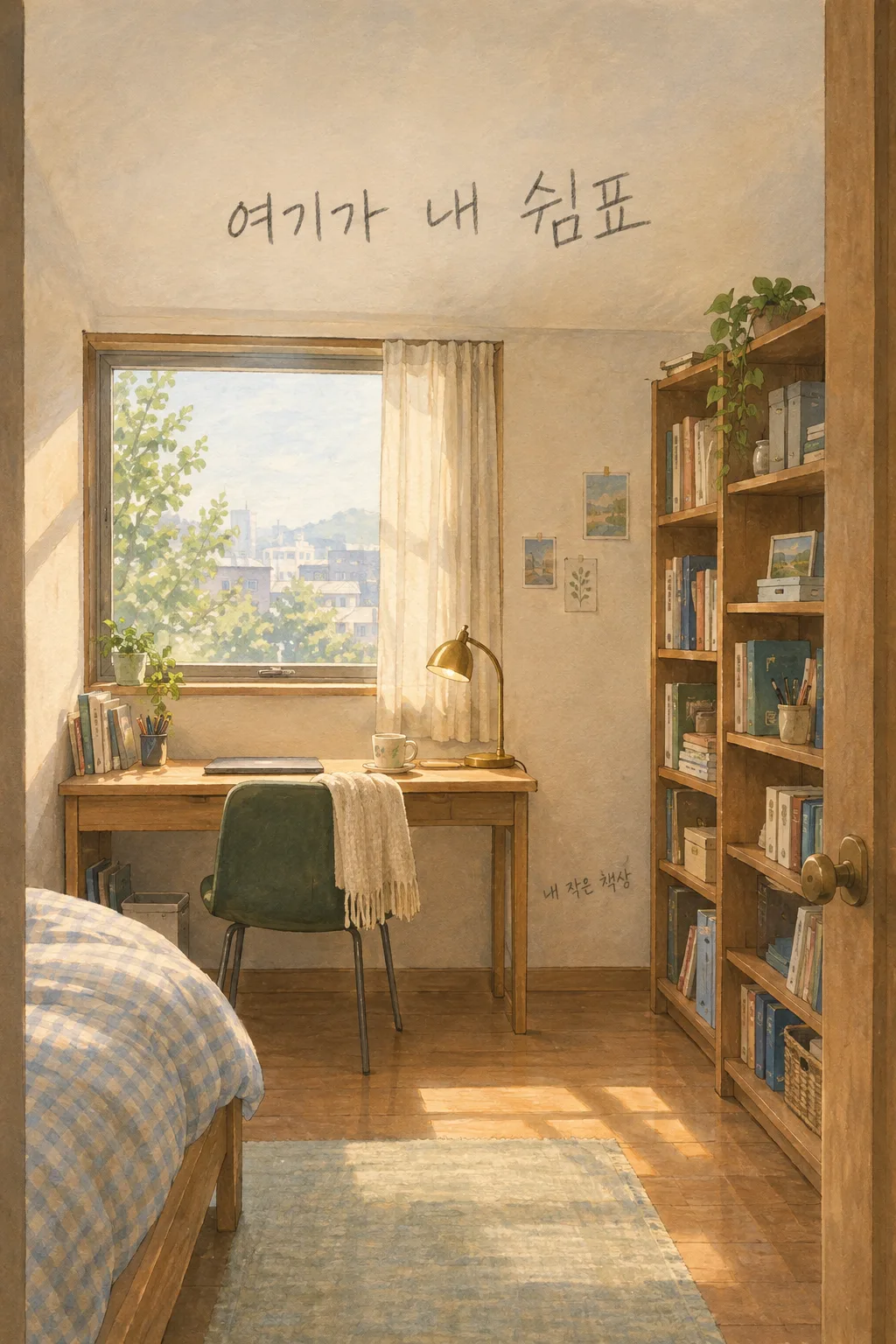
Turn a photo of your room into one hand-painted interior illustration to share a personal memory.
Fill in the fields
- 1Fill in the fields
- 2Copy the prompt
- 3Upload One actual room photograph and paste the prompt into your GPT chat
- 4Check that both the photo and prompt are attached, then send
Full prompt 5,619 characters
Generate this image now. Draw it directly - do not describe it, explain it, or ask questions.
Output one landscape A3 poster, 420 x 297 mm, aspect ratio 1.414:1. Use the largest supported resolution. Final print target: 4961x3508 pixels at 300dpi. Keep all text at least 10 mm inside the edges.

[Purpose]
Turn the user's actual room photograph into ONE finished hand-painted daily-life anime interior illustration for social sharing. Preserve the recognizable personal space as a quiet visual record, with one large pencil-written memory line. The output is a single inhabited-feeling room scene without a human figure, original photo inset, collage or comic panels. It is not an interior redesign or a shopping plan.

[Scene]
Use the room visible in the photograph as the whole scene. Maintain its major wall, window, desk, bed, shelving and door relationships, and keep the same one-point or gentle two-point perspective. Only show the photographed room, not a new apartment or additional room. The remembered event is "【Memory to keep】"; use it to inform the short line, not to add celebration props, food, furniture or a fabricated date. Keep the feeling warm and lived-in through painterly edges and soft light on the existing objects. Do not introduce a person, pet, magical portal or a location label suggesting the room is in a specific city.

[Attached photo]
One actual room photograph is REQUIRED. Preserve the user's visible furniture, personal object clusters and distinctive window shape. Simplify tiny lettering on book spines or packaging into unobtrusive marks rather than inventing readable titles, addresses, logos or labels. Do not move the door, replace the bed with a different furnishing, add a television, change the floor plan or invent a view outside the window. Retain visible outside scenery softly without making up a famous landmark. Reinterpret colors and texture in the fixed illustration medium while keeping the user's place identifiable.

[Text layout]
All visible text is in English. The memory line is "【Pencil line】". If it is "Choose for me", invent one gentle original sentence of at most twelve Korean/Japanese characters or five English words, based on the remembered event. Never print the automatic control or invent a date. Place the line in large readable soft graphite handwriting between13-20% height on a quiet wall or sky patch already present in the composition. Maintain at least7% side margins and a contrast gap around the letters. The room scene extends beneath it, with the main window and furnishings between25-100% height. Do not frame the art as a physical postcard or add a decorative text plaque. The entire top12% and bottom15% are free of essential text.
If provided, write "【Room nickname】" once as a small pencil memory signature at64-68% height, on an unbusy surface. When this instruction is absent, do not invent a room name or add an empty label.

[Style]
One fixed nostalgic Japanese daily-life animation-background style: hand-painted gouache washes, gentle original contour drawing, muted ochre, moss, cream and gray-blue accents, modest brush grain and calm window light. No named artist, franchise or recognizable film scene is referenced. Objects have believable proportions and coherent perspective. This is full-scene environment art rather than a sketchbook containing an original photo above a drawing, a floor-plan diagram or a tiny3D dollhouse.

[Visual hierarchy]
The room's familiar window and furniture arrangement lead the eye into the image, and the large pencil line gives it a personal reason to share. Keep the text readable at list size without covering the room's distinctive details. Use painterly atmosphere rather than adding stock nostalgic props. Preserve one continuous composition from edge to edge, with no blank margin frame, split-screen comparison, decorative stamps, stickers, arrows or fabricated social metrics. A different canvas ratio fits this same room scene and text order; it never introduces another view or output type.

[Lighting and texture]
Use soft warm window illumination consistent with the photograph's visible window, with gentle grounded shadows and restrained highlights. Painted curtains, wood and cloth should retain their material character. Avoid orange fog covering every surface, glowing outlines, mirrored duplicate furniture, floating lamps, lattice-like repeated objects and implausibly stretched chair legs. Artwork fills the canvas directly; the room is depicted as art, not as a photo of an illustration hanging inside another room.

[Text rules]
All quoted visible copy belongs to the artwork, while input labels and instruction headings do not. Resolve any automatic wording control into a short original sentence before drawing; never print that control literally. Preserve provided spelling and numbers, and use the target language consistently. Keep readable letters separate from highlights, folds, shadows and decorative marks. Do not invent a price, discount, date, availability, award, endorsement, biography or purchasing condition. The fixed composition and medium stay the same for every user; personal inputs change its content only.

[Avoid and final delivery]
Deliver exactly ONE finished raster image in this response. Draw it directly with image generation. Do not execute code, give drawing instructions instead of an image, offer multiple versions, create separate pages, ask for a next message, or require cropping and assembly. No phone mockup, browser frame, watermark, publisher logo, branded packaging, existing character or celebrity likeness. Finish all artwork within the selected aspect ratio, preserving the composition and large readable lettering. Leave the upper 12% and lower 15% free of essential lettering and maintain generous side margins.
You may also like
How to use it · FAQ
When to use it
Keep a personal visual record of your room or workspace. One real photograph becomes a hand-painted daily-life anime background, with familiar furniture and window relationships preserved and one large pencil memory line. A first day after moving, a freshly tidied desk or a quiet evening can give the image a reason to share. Unlike a photo-and-drawing diary, the entire output is one finished room illustration.
Fill in the fields
Write an actual memory you want to keep, such as the first day in a new home or finishing a desk tidy-up. It informs the wording; it does not add party props, furniture or invented dates. Provide a short line or choose “Choose for me.” The optional room nickname can be a name you use for the space. Clear it to omit the signature. GPT does not infer an address or city from your photo.
Use one room photo
Choose a photograph showing a coherent room perspective, ideally including both window and furnishings. A close-up desk photo cannot reveal unseen architecture, so only the visible area should be illustrated. Attach the photo to GPT without sending yet, paste the copied prompt into the same message, check both, and send once. If the photo was sent earlier, append “Use the photo above.” No code, multiple views or cut-and-assemble workflow is required.
Inspect the illustration
You should recognize your own room first. Check window shape, the desk and bed relationship, and familiar object clusters. Duplicate chairs, disconnected table legs, an added television or a new room outside the door do not fit the purpose. Soft gouache texture and contour drawing change the medium, not the space's basic structure. Tiny book lettering is simplified into quiet marks rather than invented readable titles.
Read the pencil line
The line sits on an unbusy wall or window area and should remain large enough for a phone. It does not appear on a separate plaque or within a photographed postcard mockup. Shorten long wording to protect both text and recognizable room details. Clearing the nickname removes only its independent signature; the line and scenery remain. The thumbnail's room is fictional demonstration art. Your actual result uses the room photograph you supply.
Correct a detail
Identify one or two structural features that must stay, such as one window on the left with the desk beneath it. Ask to remove a newly invented object and preserve the original arrangement. Give the exact line for a spelling correction. These optional refinements follow a completed first image; the card does not require several images for you to cut up or combine.
Questions
- Will it redesign my interior? No. It records your existing space in one fixed illustration style, without a shopping plan or floor-plan changes.
- Can it add a person? This format is a room scene without people. A person-and-room transformation belongs in a different card.
- Was free GPT tested directly? The preview was generated with the image API and checked for text and room structure. No direct free-GPT interface generation test was performed. Availability depends on your image feature and remaining allowance.