All · Social posts · Business stories
245Two-Person Table Flat Lay
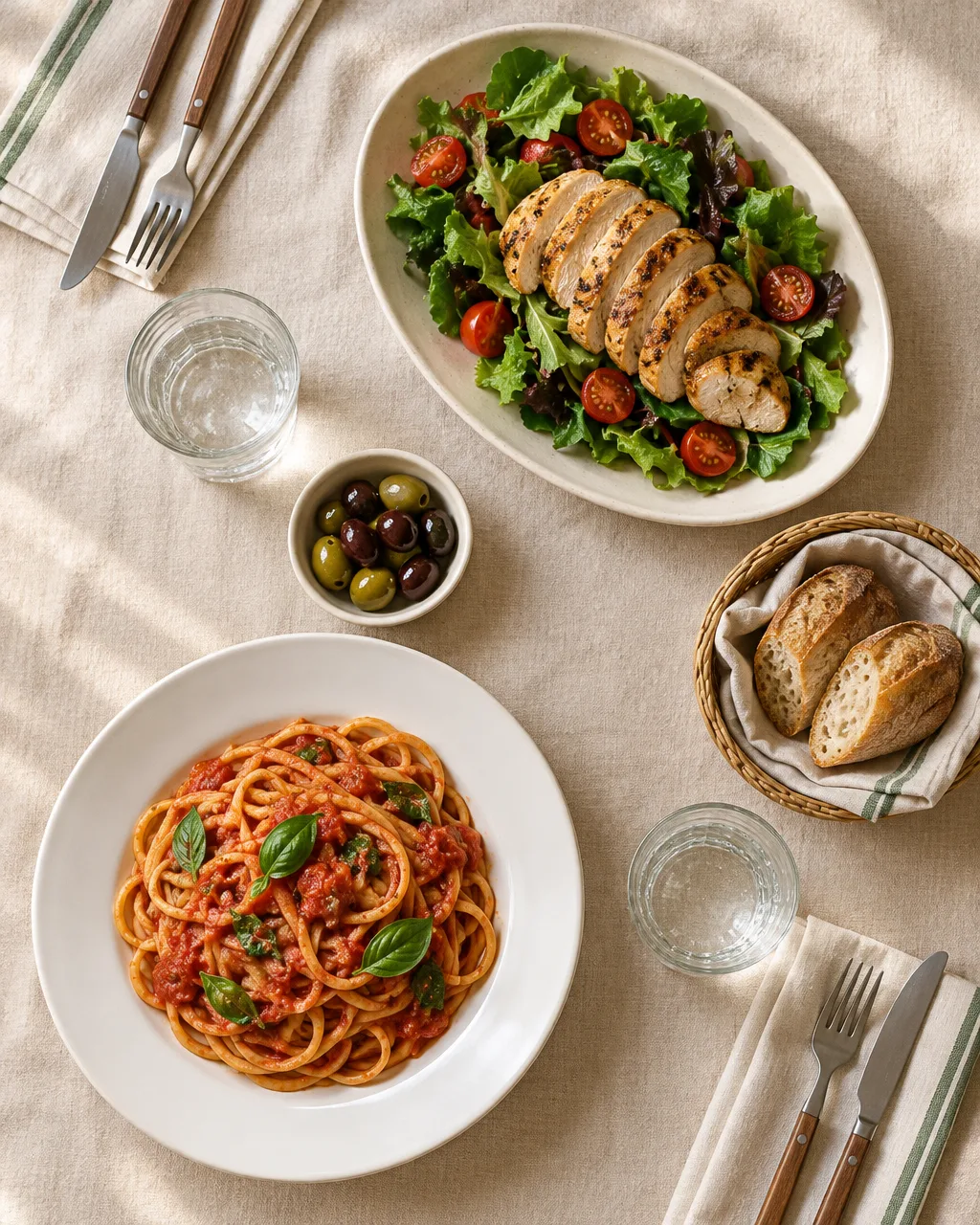
Shoot two plates, side dishes, water glasses, and napkins all at once from above. This is a food photo showing the mood of a table shared by two people.
What you get
- Two-Person Table Flat Lay
Fill in the fields
- 1Fill in the fields
- 2Copy the prompt
- 3Paste it into a GPT chat
- 4Send it as is and you get an image like the thumbnail example
- 5Attach a real photo that fits the card and it is used in the result: a background photo for background cards, a person or food photo for those cards Optional
Full prompt 4,795 characters
Generate this image now. Return exactly ONE complete image directly. Do not ask questions, browse for photos, return a plan or give a prompt instead of the image.

Output size 1080x1350 pixels, 4:5 portrait, Instagram standard.

[Input: values are the only facts and wording]
MAINS: "【Main Dishes】"
SIDES: "【Side Dishes】"
TABLE: "【Table Mood】"
ACCENT: "【Accent Color】"
DETAIL_1: "【First Dish Composition】"
DETAIL_2: "【Second Dish Composition】"
DISHES: "【Two Bowl Shapes】"
UTENSILS: "【Two Sets of Tableware】"
LIGHT: "【Light】"

[Fixed card design]
Photograph a two-person table from a truly vertical 90-degree overhead camera. MAINS gives exactly TWO main foods in order; place each on a separate large dish, diagonally balanced, following DISHES if supplied. DETAIL_1 and DETAIL_2 specify the first and second dish respectively; never merge them. SIDES gives the only side foods and drinks and their counts. Count each stated item once, distributed naturally in small dishes, basket or glasses as appropriate. One continuous table space, no grid lines, collage or multiple photos. Main foods together take at least 60% of the area.
Use believable nonrepeating food surfaces and a thin food-appropriate sauce. TABLE controls the real table and cloth. Add exactly two folded napkins and two complete UTENSILS sets, one per diner, at the edges with mild natural asymmetry. ACCENT appears in small napkin or food-related details without dyeing food unnaturally. LIGHT is soft window light from the side with short, directionally consistent contact shadows. Every dish has the same overhead projection: no three-quarter food side views, stretched edge plate or colliding glass. Keep vessels realistic in scale and separate.
Only explicitly supplied foods and SIDES may be shown; do not invent salad toppings, fruit, drink or an extra meal. A supplied DETAIL_1 or DETAIL_2 is an exhaustive ingredient whitelist for its plate, not a suggestion: no grated cheese, parmesan dust, parsley, new seasoning garnish or croutons unless explicitly listed. Do not place a plant, herb sprig or loose ingredient outside the declared dishes. If a detail input is absent choose the ordinary main food with a simple plausible composition. Keep exactly two mains and two place settings even when optional lines are absent. No text, headings, price, labels, person, hands, receipts, brand, watermark or mockup. Richness is a natural shared meal with connected ceramics, cloth and table, not a flat catalogue arrangement. This is a newly imagined meal photograph, not proof of any real restaurant's set contents.

[Button meanings, internal instructions only]
ACCENT: "Green" means green; "Brick red" means brick red; "Dark navy" means deep navy; "Mustard yellow" means mustard yellow.
UTENSILS: "Fork and knife" means fork and knife; "Spoon and chopsticks" means spoon and chopsticks.
LIGHT: "Soft afternoon light" means soft afternoon window light; "Clear morning light" means clear morning window light; "Cloudy day window light" means overcast window light.

[Missing inputs and finish]
An optional input line removed from this prompt is absent. Do not print its key, invent a substitute caption, ask for it or reserve an empty panel. Choose a fitting simple visual only where the fixed design explicitly permits an automatic default. Selected values alter content only; retain this card's single style and one composition. Every supplied visible string stays verbatim in its original script and currency, without translation. Ordinary automatic lettering, if explicitly allowed above, is English; internal English keys and button names are never captions.
Use the stated aspect ratio, adapting one coherent layout rather than stretching food or letters. Text-bearing posters keep important lettering within the central 16–83% of image height and 5–95% of width; extend food-related ornament, background, shadows or texture to the trim so these insets do not create empty bands. Keep all price digits and ingredient labels unobstructed. Text-free photographs fill the canvas naturally with their scene. No frame, phone, wall mockup, watermark or extra results.
No uploaded photo is needed: create a fictional food scene from these inputs. If a reference photo is attached, use it only for the stated food's visible shape and materials within this same drawing or photographic medium, without adding absent products or claiming exact portion preservation. Finish one image even when no photo is attached.

[Final output format]
Output size 1080x1350 pixels, 4:5 portrait, Instagram standard.
This selected output format takes priority over any fixed canvas size or aspect ratio elsewhere in this template. Adapt the composition, text zones and margins to the selected canvas without stretching or cropping essential content. Device safe areas apply only when a device is selected. Never print these format instructions on the image.
How did it turn out?
You may also like
How to use it · FAQ
A Two-Person Table in a Single Shot from Above
This is a dining table photo with two large plates placed diagonally, connected by small side dishes and water glasses in between. It looks straight down at the moment two people are about to start their meal. Unlike close-up photos of a single menu item, it shows the arrangement and mood of an entire spread, making it ideal for brunch feeds or shared meal posts. Letters and prices are not included.
Two Main Dishes and Side Dish Quantities
For the main dishes, write two different foods, such as "Tomato pasta and grilled chicken salad." The food written first goes on the first plate, and the food written second goes on the second plate. For side dishes, write down the quantities as well, such as "One small plate of olives, two slices of baguette, two glasses of water." For the table mood, it is comfortable to use the colors of tables and fabrics like wood or stone. The green on the cover is an accent that extends only to the napkins and small parts of the food.
Divide the Ingredients for Each Plate
The composition of the first dish is written separately, like pasta ingredients, and the composition of the second dish is written separately, like salad ingredients. The shapes of the two bowls are also written in order, such as "Round white plate and oval ivory plate." Even if left blank, it determines appropriate dishes and compositions matching the entered food. The two sets of tableware are fork and knife, or spoon and chopsticks. Choose the light from afternoon, morning, or a cloudy window, and maintain the same vertical shooting composition for any value.
Count Quantities and Viewpoints
Send the text to GPT once and request a single table spread photo. In the result, count the two large food items, the number of side dishes, the two napkins, and the two sets of tableware. If only one plate looks like it was viewed from the side, correct it by saying, "Align all bowls to an exact vertical viewpoint." If the baguette pieces have multiplied, you can request to leave only the two slices actually written down. It should look like a single space for the entire table rather than a grid of multiple menu photos. Since this is a virtual meal photo, please check the sales composition separately for posts announcing actual set menus and quantities.