
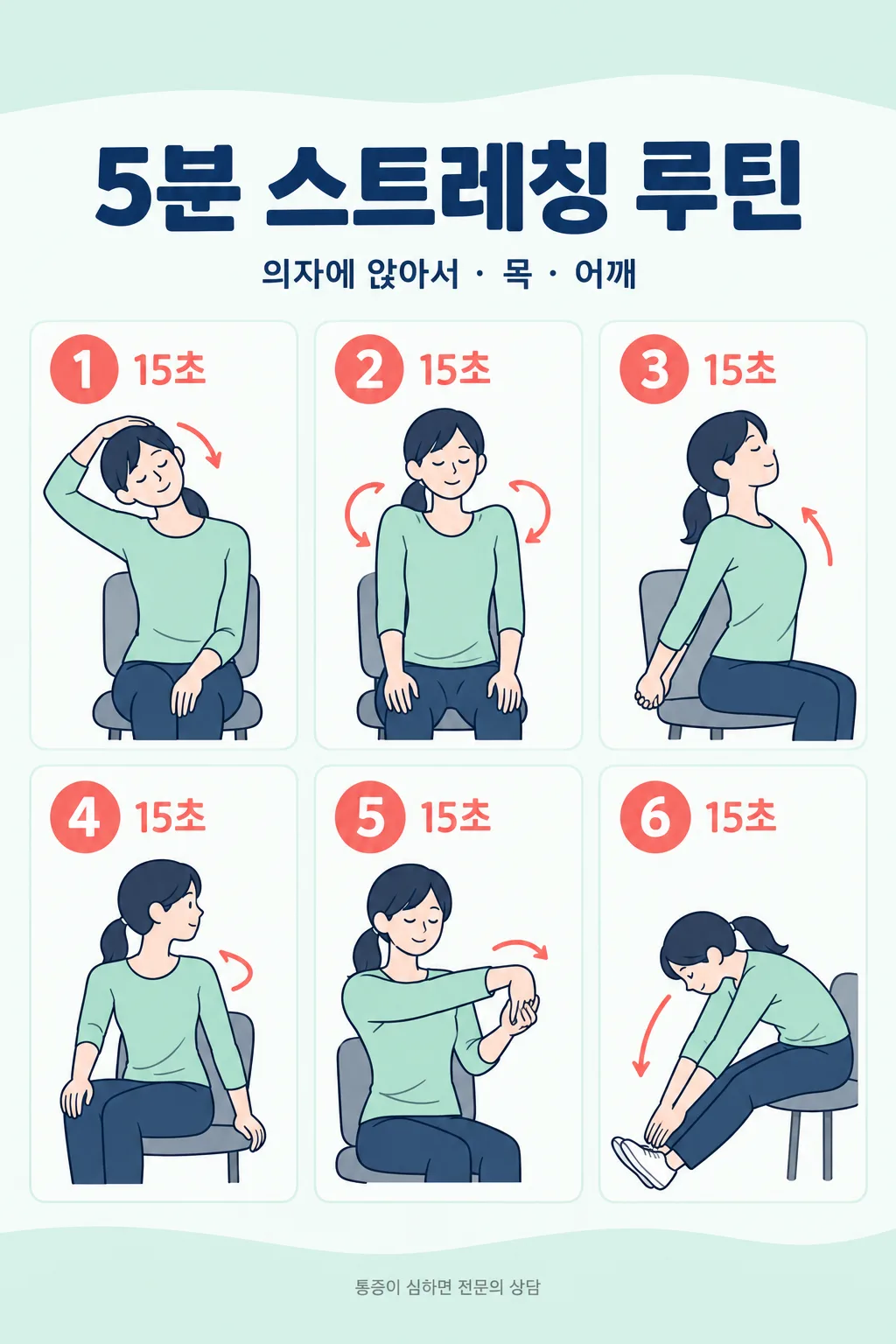
전체 · 인포그래픽/안내 · 순서·절차
062스트레칭 루틴표
오래 앉아 있는 날, 신경 쓰이는 곳과 시간을 고르면 동작 그림·초·횟수가 한눈에 보이는 스트레칭 순서표
칸 채우기
- 1칸을 채워요
- 2복사 버튼을 눌러요
- 3GPT 채팅창에 붙여넣어요
- 4제품·인물 사진을 쓰려면 사진과 프롬프트를 둘 다 넣은 뒤에 보내요 선택
프롬프트 원문 보기 8,854자
Generate this image now. Draw it directly - do not describe it, explain it, or ask questions.
Create one 2:3 portrait image, with all content inside generous print-safe margins. This card has a fixed output ratio; there is no size question to ask.

[Purpose]
Make a complete, practical Korean desk-break stretching routine chart that a student or office worker can save on a phone or print beside a monitor. Tailor the movement choices to the selected focus "【아픈 곳】", available duration "【시간】", and permitted position "【자세】". Treat the focus as the person's own description, never as a diagnosis. Present one gentle, equipment-free routine in exactly six numbered steps. The chart must let someone understand the order, the illustrated position, the seconds, and the number of repetitions or sides at a glance. This is general movement guidance, not treatment, rehabilitation, a claim to remove pain or swelling, or a substitute for individual clinical advice.

[Scene]
Build a single portrait instructional sheet, not six unrelated posters. Place exactly six equal movement panels in a two-column by three-row grid, read left to right and then top to bottom. Each panel shows one movement with one or two phases if needed, its short Korean movement name, its seconds, and its repetitions or left-right count. Use the same fictional adult in every panel: identical face and hairstyle, body proportions, skin tone, modest clothing, shoe style, and color placement. Draw every pose with the same clean line thickness, flat fill, simplified joints, and figure scale. A small arrow within a panel may connect two phases; it must not turn them into two exercises. Keep all hands, feet, hair, and arrows inside the panel. No equipment beyond a plain stable chair for the seated choice and the floor for the floor choice.

Use "【자세】" as a strict whole-chart constraint. For "의자에 앉아서", every panel keeps the figure seated on the same sturdy chair, with feet supported; no standing, kneeling, floor poses, chair balancing, or hand weight-bearing. For "서서", every panel is standing without leaning on a desk, chair, or wall; maintain balance-friendly, small-range movements. For "바닥에서", every panel remains on the floor in a comfortable seated, side-lying, or supine pose; avoid prone positions and poses that load the wrists. Do not mix positions within one chart. If the focus and position are hard to combine, choose a gentle nearby mobility movement that respects the position instead of forcing an awkward stretch.

Choose a coherent sequence: an easy settling movement, four focus-relevant movements, and a calm finishing movement. For "목 · 어깨", favor shoulder rolls, gentle side neck tilts, shoulder-blade movements, and relaxed arm reaches, with no full neck circles or forced neck extension. For "허리", favor small comfortable trunk and pelvic movements without deep forward folding or forceful twisting. For "손목", favor gentle fingers, forearms, and wrist range of motion without pushing on the hand or forcing the wrist back. For "다리 붓기", use modest ankle, calf, and leg movements only as a movement break; do not claim to treat swelling. For "전신", distribute the six steps across upper body, trunk, hands, and legs. Keep the selected position throughout, move slowly without bouncing, use normal breathing, and never depict a painful end range.

Avoided movement: "【피할 동작】"

If the optional avoided-movement line is present, remove that motion and close visual variations of it from all six panels. Replace it with a different gentle movement that still fits the chosen focus and position. Do not print the avoided motion or a warning label about it. If the line is absent, proceed with the normal position-safe routine.

Plan the timing before drawing. For "3분", use six roughly 25-second steps, leaving about 30 seconds total for transitions; for "5분", use six roughly 40-second steps and brief transitions; for "10분", use the 5-minute six-step circuit twice, visibly marking "2바퀴" in the footer. These are approximate routine lengths, not second-perfect guarantees. Each panel must show one compact seconds value and one compatible count, such as "25초 · 좌우 각 1회", "40초 · 6회", or "40초 · 좌우 각 2회". Count both sides inside the displayed time; do not imply 40 seconds on each side when the panel says 40 seconds total. Set the counts to a slow, plausible pace for the motion, and avoid long static neck or wrist holds. If a movement needs a slightly different duration, adjust the six panel times so the whole chart still fits the selected duration, including transitions.

[Attached photo]
No photo is needed. Invent one original, anonymous instructional figure. Do not model the person on a real individual, brand mascot, copyrighted character, celebrity, or identifiable trainer. Keep the same person and drawing style through all six poses.

[Text layout]
Render the exact Korean strings below without the quotation marks. Percentages are approximate vertical zones measured from the top of the 2:3 canvas.
- 5-11%: Main title "스트레칭 루틴표" in the largest text.
- 12-19%: One clear subheading line "【아픈 곳】 · 【시간】 · 【자세】". Preserve each selected value exactly, including its Korean spelling and spacing.
- 22-85%: Six equal panels numbered "01", "02", "03", "04", "05", "06" in reading order. In each panel, show one simple figure, one generated Korean movement name, and directly below it one generated instruction containing both seconds and repetitions or sides. Make the seconds and count prominent enough to read on a phone and on a small printout.
- 88-92%: A slim footer strip with "총 【시간】". If the duration is "10분", add "2바퀴" once in this strip; for "3분" and "5분", do not add a round count.
- 94-97%: Fixed safety line "통증이 심하면 전문의 상담". Keep this one line legible and completely separate from the movement panels.
Only the six movement names and their six seconds-and-count instructions may be composed freely. Do not add benefits, promises, diagnoses, explanations, captions, body-part labels, or extra safety text to the artwork.

[Style]
Use a polished adult Korean instructional infographic style. Fill the entire background with warm off-white. Use deep navy text, thin but high-contrast navy outlines, pale blue-gray panel fills, and one muted coral accent for step numbers and motion arrows. Use simple flat vector figures and a strong Korean Gothic sans-serif. Repeat the exact character design, line weight, palette, caption hierarchy, panel padding, and figure size. Give each panel enough white space that the pose, name, seconds, and count never collide. Use an understated printed-sheet appearance rather than a fitness-app screenshot.

[Visual hierarchy]
First read the short title, then the selected focus and time, then the path 01 through 06. Within each panel, the pose is the quickest cue; the movement name and "seconds · count" line follow directly beneath. Make all six panels equally important and give the bottom safety line its own quiet area. Keep a generous safe margin on all four edges, visible gutters between panels, and enough contrast for a monitor-side print. Avoid tiny text and avoid decorative elements that compete with the instruction.

[Lighting and texture]
Use even, opaque, matte color without photographic lighting. Draw crisp Korean strokes, digits, punctuation, movement lines, and hands. Separate panels by subtle solid fills and outlines; do not use glow, gradients, heavy shadows, distressed paper texture, or glossy effects. Keep the whole canvas painted edge to edge with no transparent or unfinished strips.

[Text rules]
Preserve "스트레칭 루틴표", "【아픈 곳】", "【시간】", "【자세】", "총 【시간】", and "통증이 심하면 전문의 상담" exactly. Use only familiar, short Korean movement names. In every panel, put the seconds and count on one line and include both a "초" unit and a "회" or "좌우 각 ...회" count. Keep the selected duration consistent between heading and footer; never convert 3, 5, or 10 minutes to a different number. Do not print the optional avoided-movement value, field names, prompt syntax, braces, English text, medical claims, or invented qualifications. Check all six sequence numbers and all Korean consonants, vowels, spacing, units, and digits before finishing.

[Avoid]
No extra or missing panels, duplicated numbers, cropped limbs, mixed characters, inconsistent line styles, hard-to-read captions, a seventh exercise in a two-phase drawing, or mismatched illustration and text. No forceful neck rotation, extreme back bends, deep knee bends, ballistic stretches, forced joint angles, wrist weight-bearing, breath-holding, or poses that contradict the chosen position or avoided motion. No pain symbols, anatomy callouts, medical crosses, cure claims, swelling-reduction claims, before-and-after images, devices, gym equipment, logos, QR codes, watermarks, app frames, contact details, or advertisements.
이 카드도 많이 사용해요
쓰는 법 · 자주 묻는 것
이런 때 쓰세요
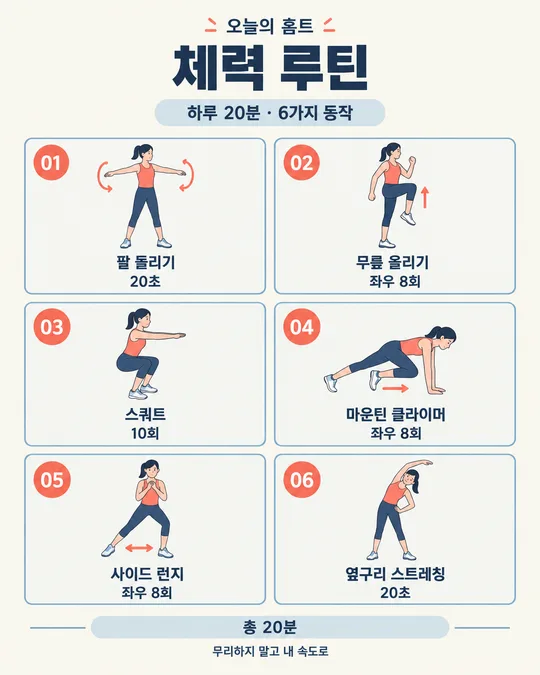
책상 앞에 오래 앉아 있다가 잠깐 움직이고 싶을 때 쓰는 한 장짜리 순서표예요. 직장에서는 모니터 옆에 붙여 두고, 학교나 독서실에서는 휴대폰에 저장해 볼 수 있어요. 여섯 칸에 01부터 06까지의 순서, 같은 사람이 보여 주는 자세, 동작 이름, 몇 초 동안 몇 번 하는지가 함께 들어가도록 만들었어요. 영상을 찾아 재생하거나 동작 순서를 외우지 않아도 바로 다음 칸을 찾기 쉽게 구성했어요.
이 카드는 가볍게 움직일 순서를 정리합니다. 아픈 부위를 진단하거나 통증·붓기가 나아진다고 약속하는 자료가 아니에요. 특히 불편함이 심하다면 그림을 끝까지 따라 하는 대신 전문의와 상담하세요. 그림 아래에도 「통증이 심하면 전문의 상담」 문구가 한 줄로 들어갑니다.
칸 채우는 법
- 아픈 곳: 목 · 어깨, 허리, 손목, 다리 붓기, 전신 중 지금 신경 쓰이는 한 가지를 고르세요. 여기서 말하는 부위는 루틴의 초점을 정하는 값이에요. 병명이나 치료 목표를 적는 칸은 아니에요.
- 시간: 3분, 5분, 10분 중 지금 낼 수 있는 시간을 고르세요. 3분은 짧은 여섯 동작, 5분은 조금 여유 있는 여섯 동작, 10분은 5분짜리 순서를 두 바퀴 도는 방식이에요. 동작 사이 자리를 고쳐 앉거나 숨을 고를 시간을 포함한 대략적인 길이로 보세요.
- 자세: 의자에 앉아서, 서서, 바닥에서 중 실제로 움직일 수 있는 자세를 고르세요. 그림 여섯 칸 모두 같은 자세를 유지하도록 지시합니다. 의자를 고르면 바닥으로 내려가는 동작은 나오지 않아야 해요.
- 피할 동작: 지금 하지 않으려는 동작이 있다면 짧게 적으세요. 예를 들어 「목을 뒤로 젖히기」처럼 움직임을 구체적으로 쓰면 비슷한 동작도 빼도록 지시하기 쉬워요. 비워 두어도 됩니다. 적은 내용은 그림에 인쇄되지 않아요.
네 칸을 채운 뒤 프롬프트를 복사해 이미지를 만들 수 있는 GPT나 Claude 대화에 붙여 넣으세요. 사진은 올릴 필요가 없어요. 추천하는 세로 비율은 2:3이에요. 그림이 완성되면 휴대폰에 저장하거나, 글자가 읽히는 크기로 인쇄해 책상 가까이에 두세요.
그림이 나오면 꼭 볼 것
먼저 번호가 01부터 06까지 빠짐없이 순서대로 있는지 보세요. 여섯 동작이 모두 고른 자세에서 가능한지, 같은 인물과 같은 선 굵기로 그려졌는지 확인하세요. 각 칸에는 동작 이름 바로 아래에 초와 횟수가 함께 있어야 해요. 10분을 골랐다면 아래 띠에 「총 10분 · 2바퀴」가 보여야 하고, 다른 시간을 골랐다면 두 바퀴 표시가 없어야 해요. 맨 아래 「통증이 심하면 전문의 상담」이 한 글자도 빠지지 않았는지도 확인하세요.
틀린 곳 고치는 법
그림 한 칸에서 숫자나 자세가 틀렸다면 같은 대화에 번호와 바꿀 내용을 한 문장으로 적으세요. 예를 들어 「03번 손목에 체중을 싣는 자세를 빼고, 의자에 앉은 채 하는 부드러운 손가락 펴기로 바꿔 줘. 초와 횟수도 같이 고쳐 줘」처럼 말하면 됩니다. 글자가 작다면 「여섯 칸은 유지하고 동작 이름과 초·횟수 글자를 키워 줘」라고 요청하세요. 수정한 뒤에는 해당 칸뿐 아니라 여섯 칸 전체의 순서와 시간을 다시 보세요.
자주 묻는 것
- 의자에서 하는 스트레칭만 만들 수 있나요? 아니요. 의자에 앉아서, 서서, 바닥에서 중 하나를 고르면 여섯 동작을 그 자세에 맞춥니다.
- 3분을 고르면 여섯 동작이 너무 많지 않나요? 짧은 동작 여섯 개를 약 25초씩 배치하고, 동작 사이 전환 시간을 남기도록 지시했어요. 실제 속도에 따라 끝나는 시각은 달라질 수 있어요.
- 피할 동작을 적으면 그림에도 나오나요? 아니요. 그 동작을 순서에서 제외하는 데만 쓰고, 글자로 인쇄하지 않도록 지시했어요.
- 통증이나 붓기를 치료하는 루틴인가요? 아니요. 책상 앞에서 가볍게 움직일 순서를 보여 주는 자료예요. 통증이 심하면 전문의와 상담하세요.