
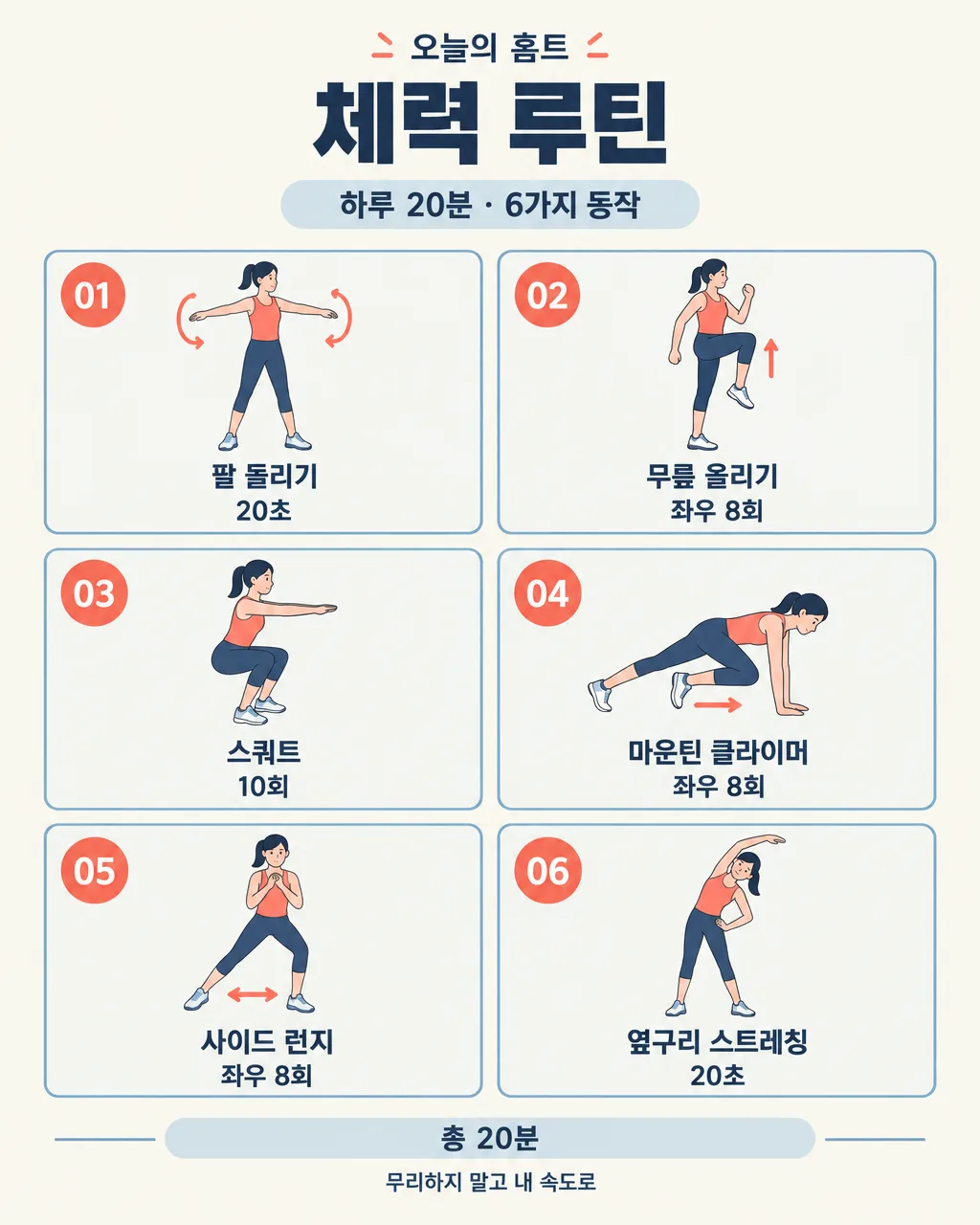
전체 · 인포그래픽/안내 · 순서·절차
028홈트 루틴표 — 목표와 시간에 맞춘 6가지 동작
목표와 하루 운동 시간을 고르면 번호 · 동작 그림 · 횟수가 한눈에 보이는 벽걸이용 홈트 루틴표 한 장
칸 채우기
- 1칸을 채워요
- 2복사 버튼을 눌러요
- 3GPT 채팅창에 붙여넣어요
- 4제품·인물 사진을 쓰려면 사진과 프롬프트를 둘 다 넣은 뒤에 보내요 선택
프롬프트 원문 보기 8,569자
Generate this image now. Draw it directly - do not describe it, explain it, or ask questions.
Output size 2480x3508 pixels, A4 portrait, 300dpi, print-ready poster.

[Purpose]
Create one complete Korean home-workout routine infographic for one individual to save, print, and keep on a wall while exercising. Build a practical routine for the selected goal "【목표】" and total daily duration "【하루 몇 분】분". Show exactly six movements in a clear numbered order, each with one immediately understandable exercise illustration and one concise repetition or time instruction. The finished page must be usable at a glance from a short distance, without needing another page or explanation. Treat the duration as a planning guide rather than a guaranteed exact completion time. This is a general fitness routine, not medical advice, diagnosis, treatment, rehabilitation, or a promise of weight loss or pain relief.

[Scene]
Design a single portrait flat-vector infographic with a calm, fully painted background. Place a compact header at the top, then arrange exactly six equal movement panels in a clean two-column by three-row grid. Number the panels 01 through 06 in normal reading order: left to right, then top to bottom. Each panel must contain one simplified full-body human figure demonstrating only that panel's movement, the Korean movement name, and a repetition count or time directly beneath it. Use arrows or motion lines only when they clarify direction; never use lettering inside the illustration. At the bottom, add one slim progress strip containing the total daily time and one short safety reminder. Do not create extra exercise panels, before-and-after bodies, equipment advertisements, anatomy diagrams, calorie counters, scales, or progress charts.

Choose six familiar, equipment-free movements that form a balanced sequence: a gentle preparation movement, four goal-relevant main movements, and a calm finishing stretch. Adjust the selections and workload to "【목표】" and "【하루 몇 분】분" while keeping every movement easy to identify from a single pose or a simple start-and-finish pair. For 근력, emphasize controlled body-weight strength movements; for 체력, use rhythmic low-complexity whole-body movements; for 스트레칭, use gentle mobility and held stretches; for 다이어트, use a varied full-body circuit but make no claim that weight will be lost. Scale repetitions, work intervals, and number of rounds so the full routine is reasonable for the chosen duration. Prefer counts such as repetitions, seconds, or rounds that a person can follow without extra calculation.

【피할 동작】

If the optional line above contains a movement to avoid, do not include that movement or a visually equivalent variation anywhere. Replace it with a different low-impact, equipment-free movement that trains a similar broad movement pattern when practical. In particular, if jumping is excluded, keep both feet controlled and use marching or step-based alternatives; if deep knee bending is excluded, avoid deep squats and lunges; if weight-bearing on the hands is excluded, avoid planks, push-ups, and quadruped positions; if prone positions are excluded, keep every exercise standing, seated, side-lying, or supine. Do not print the avoided-movement text on the artwork. If the optional line is absent, simply build the balanced six-movement routine without mentioning exclusions.

[Attached photo]
No uploaded photo is required. Draw neutral, original instructional figures rather than resembling any real person, celebrity, branded trainer, copyrighted character, or fitness-app mascot. The figures should have consistent proportions and simple modest sportswear with no logos, letters, numbers, or recognizable brand details.

[Text layout]
Render these exact Korean strings, without the surrounding quotation marks, in the indicated locations. The percentages describe the top-to-bottom structure of the canvas.
- 5-10%: Small eyebrow text "오늘의 홈트".
- 11-19%: Main title "【목표】 루틴" in the largest type.
- 20-24%: Supporting line "하루 【하루 몇 분】분 · 6가지 동작".
- 27-82%: Exactly six equal panels in a two-column by three-row grid. Label them with the fixed numbers "01", "02", "03", "04", "05", and "06". In each panel, render the chosen Korean movement name and its exact repetition, duration, or round instruction. Keep movement names short and familiar. Do not add benefits, body-part promises, calorie estimates, difficulty ratings, or motivational claims.
- 86-90%: Render "총 【하루 몇 분】분" inside a slim progress strip. This is the only total-time label.
- 93-96%: Render the fixed reminder "무리하지 말고 내 속도로" in small but clearly legible type.
The six movement names and their count or time instructions are the only text that may be generated from the selected routine. Keep each movement name on one line when possible and its instruction on a separate line. Never show the optional avoided-movement value.

[Style]
Use a polished Korean instructional-poster style: flat vector drawing, strong Korean Gothic sans-serif lettering, generous white space, rounded panels, restrained line icons, and a friendly but adult visual tone. Use a warm off-white background across the ENTIRE canvas edge to edge, deep charcoal text, muted navy panel outlines, and one coral accent for sequence numbers and motion arrows. Give each exercise figure a simple navy-and-coral outfit and enough contrast to read from a wall. Keep all six panels visually consistent in size, padding, figure scale, number placement, and caption placement. Use solid opaque colors only. Do not imitate an existing fitness brand, app interface, gym poster, or character style.

[Visual hierarchy]
The first read is the selected goal in the main title. The second read is the six-step path from 01 to 06. Within each panel, the figure is the quickest cue, the movement name is the next read, and the count or duration is immediately below it. Make the fixed sequence numbers prominent without overpowering the movement names. Preserve wide safe margins and visible gutters between all panels. Keep every body fully inside its own panel, including hands and feet. When a movement needs two phases, show two small silhouettes within the same panel and connect them with one arrow; do not let either phase resemble a seventh exercise. Ensure that the bottom strip and reminder are separate from the six exercise panels.

[Lighting and texture]
Use even flat color and a clean matte printed finish. There is no photographic lighting. Keep Korean strokes, small numbers, and body silhouettes crisp. Separate panels with pale fills and thin outlines rather than shadows. Avoid gradients, grain, glossy highlights, reflections, neon, glow, dramatic depth, or textures that interfere with instructional clarity.

[Text rules]
Preserve the supplied strings "【목표】" and "【하루 몇 분】" exactly wherever they appear. Render all movement names in natural Korean and use only standard Korean fitness terms that a general adult can understand. For each panel, provide exactly one instruction in a compact form such as "10회", "20초", "좌우 8회", or "2바퀴". Keep units consistent and do not invent a second competing count. The six instructions together must plausibly fit the selected daily duration, including brief transitions, but never promise second-by-second precision. Do not print field names, braces, prompt instructions, English words, medical language, diagnosis, treatment advice, weight-loss promises, pain-relief promises, calorie-burn figures, or claims about changing a body part. Do not print the selected avoided movement, even indirectly as a warning label. Check every Korean consonant, vowel, final consonant, digit, and unit for complete and legible strokes.

[Avoid]
No transparent or unpainted canvas, black letterbox bars, cropped bodies, tiny unreadable captions, extra panels, duplicated sequence numbers, missing sequence numbers, mismatched captions, or arrows crossing into another panel. No gym machines, dumbbells, resistance bands, branded clothing, logos, trademarks, QR codes, watermarks, celebrity faces, copyrighted characters, app screenshots, phone mockups, before-and-after comparisons, body measurements, weighing scales, food imagery, anatomy callouts, pain symbols, red injury marks, medical crosses, rehabilitation claims, treatment claims, disease claims, guaranteed weight-change results, guaranteed pain-improvement results, or equivalent wording. Do not portray dangerous momentum, extreme joint angles, advanced acrobatics, breath-holding, or competitive intensity. Do not add a shop name, contact information, social handle, song lyric, slogan, or invented certification.
이 카드도 많이 사용해요
쓰는 법 · 자주 묻는 것
이런 때 쓰세요
집에서 운동할 때 매번 영상을 찾거나 순서를 기억하기 번거롭다면 이 카드를 써 보세요. 목표와 하루에 낼 수 있는 시간만 고르면 준비 동작부터 마무리 스트레칭까지 여섯 칸으로 정리된 한 장짜리 루틴표를 만들 수 있어요. 휴대폰에 저장해 두고 보거나, 4:5 비율로 만든 이미지를 인쇄해 매트 옆이나 책상 앞 벽에 붙여 두기 좋아요.
이 카드는 일반적인 개인 운동 순서를 보기 쉽게 정리하는 용도예요. 의료 조언이나 재활 계획을 대신하지 않으며, 체중 변화나 신체 상태의 개선을 약속하지 않아요. 다이어트를 골라도 결과를 단정하는 문구 대신 여러 동작을 이어 하는 전신 루틴으로 구성돼요. 몸 상태가 걱정되거나 운동 중 불편함이 계속되면 루틴을 억지로 마치지 말고 적절한 전문가의 안내를 받아 주세요.
칸 채우는 법
- 목표: 근력, 체력, 스트레칭, 다이어트 중 지금 가장 중요하게 두고 싶은 한 가지를 고르세요. 한 장에는 목표 하나만 담아야 순서와 동작 구성이 선명해져요.
- 하루 몇 분: 10분, 20분, 30분 중 실제로 꾸준히 낼 수 있는 시간을 고르세요. 그림에 적힌 시간은 쉬는 시간과 동작 사이 이동을 포함한 대략적인 기준이에요.
- 피할 동작: 하고 싶지 않거나 지금 제외해야 할 동작 유형이 있다면 적으세요. 「점프 동작」, 「손목을 바닥에 짚는 동작」처럼 구체적으로 쓰면 비슷한 형태까지 피하고 다른 동작으로 바꾸기 쉬워요. 이 칸은 비워도 돼요.
칸을 채운 뒤 프롬프트를 이미지 만들기가 가능한 GPT 대화에 붙여 넣으세요. 사진이나 운동 영상을 올릴 필요는 없어요. 결과에는 01부터 06까지 여섯 동작이 그림과 함께 나오며, 각 칸 아래에는 횟수나 시간이 한 줄로 표시돼요.
우리 제품·인물 사진을 넣고 싶을 때
이 카드는 특정 인물이나 제품 사진 없이도 완성되는 안내 그림이에요. 실제 사람 사진을 넣으면 자세보다 얼굴이나 옷이 강조될 수 있으므로 기본 프롬프트에서는 중립적인 벡터 인물을 사용해요. 꼭 본인의 운동복 색을 반영하고 싶다면 먼저 사진 없이 결과를 만든 다음, 같은 대화에서 「인물의 옷 색만 남색 상의와 회색 하의로 바꾸고 자세와 글자는 유지해 주세요」처럼 색만 지정해 보세요. 로고가 있는 옷, 유명인 사진, 다른 운동 앱의 캐릭터나 화면은 넣지 마세요.
그림이 나오면 꼭 볼 것
번호가 01, 02, 03, 04, 05, 06 순서인지 먼저 확인하세요. 각 동작 이름과 그림의 자세가 맞는지, 횟수나 초가 바로 아래 동작에 붙어 있는지도 살펴보세요. 「피할 동작」에 적은 형태가 이름만 바뀐 채 그림에 남아 있지 않은지 확인하는 것이 중요해요. 손과 발이 잘리지 않았는지, 두 단계 그림이 별개의 운동처럼 보이지 않는지도 보세요.
제목의 목표와 「하루 몇 분」 숫자는 입력값과 한 글자씩 맞춰 읽어 주세요. 작은 화면에서도 동작 이름과 횟수가 보이는지 확인하고, 인쇄할 때는 먼저 한 장만 시험 출력해 글자와 선이 선명한지 살펴보세요. 그림의 자세가 모호하거나 따라 하기 어렵다면 그 동작은 사용하지 말고 더 단순한 동작으로 바꿔 다시 만들어 주세요.
틀린 곳 고치는 법
그림을 만든 같은 대화에서 번호, 위치, 바꿀 문장을 함께 말하면 고치기 쉬워요. 예를 들어 「04번 그림이 런지처럼 보입니다. 04번만 제자리 걷기로 바꾸고, 아래 글자는 '제자리 걷기'와 '40초'로 써 주세요. 나머지 다섯 칸은 유지해 주세요」처럼 요청하세요. 피할 동작이 들어갔다면 「손목을 바닥에 짚는 03번을 서서 하는 동작으로 교체해 주세요」라고 정확히 짚어 주세요.
숫자가 틀렸을 때는 「상단과 하단의 20분을 모두 10분으로 고쳐 주세요」처럼 같은 값이 들어간 위치를 함께 알려 주세요. 수정된 그림도 여섯 칸 전체를 다시 확인하세요. 한 부분을 고치면서 다른 번호나 횟수가 달라질 수 있어요.
자주 묻는 것
- 동작은 왜 여섯 개인가요? 한 장을 벽에 붙여 보고 따라가기 쉽도록 준비, 본운동, 마무리를 여섯 칸 안에 정리했어요. 동작을 더 넣기보다 한 동작의 횟수나 순환 수를 조절하는 편이 읽기 쉬워요.
- 10분을 고르면 정확히 10분에 끝나나요? 사람마다 움직이는 속도와 쉬는 시간이 달라요. 그림의 시간은 루틴을 계획하기 위한 기준이며 정확한 종료 시각을 보장하지 않아요.
- 다이어트를 고르면 살이 빠지나요? 이 카드는 운동 순서를 정리할 뿐 체중 변화를 보장하지 않아요. 결과 그림에도 「살이 빠진다」 같은 표현이나 칼로리 수치를 넣지 않도록 지시되어 있어요.
- 아픈 부위를 적어도 되나요? 진단명이나 치료 목적 대신 피하고 싶은 동작 형태만 적어 주세요. 통증이나 부상에 맞춘 운동 처방이 필요하면 이 카드에 맡기지 말고 자격을 갖춘 전문가에게 확인하세요.
- 준비물이 필요한가요? 기본 구성은 기구 없이 할 수 있는 동작만 사용해요. 미끄럽지 않고 주변에 부딪힐 물건이 없는 공간을 확보한 뒤 이용하세요.
- 매일 같은 표를 써도 되나요? 같은 루틴을 반복할 수 있지만 몸 상태와 일정에 맞춰 강도를 조절하세요. 다른 목표나 시간이 필요해지면 해당 칸을 바꿔 새 표를 만들면 돼요.