
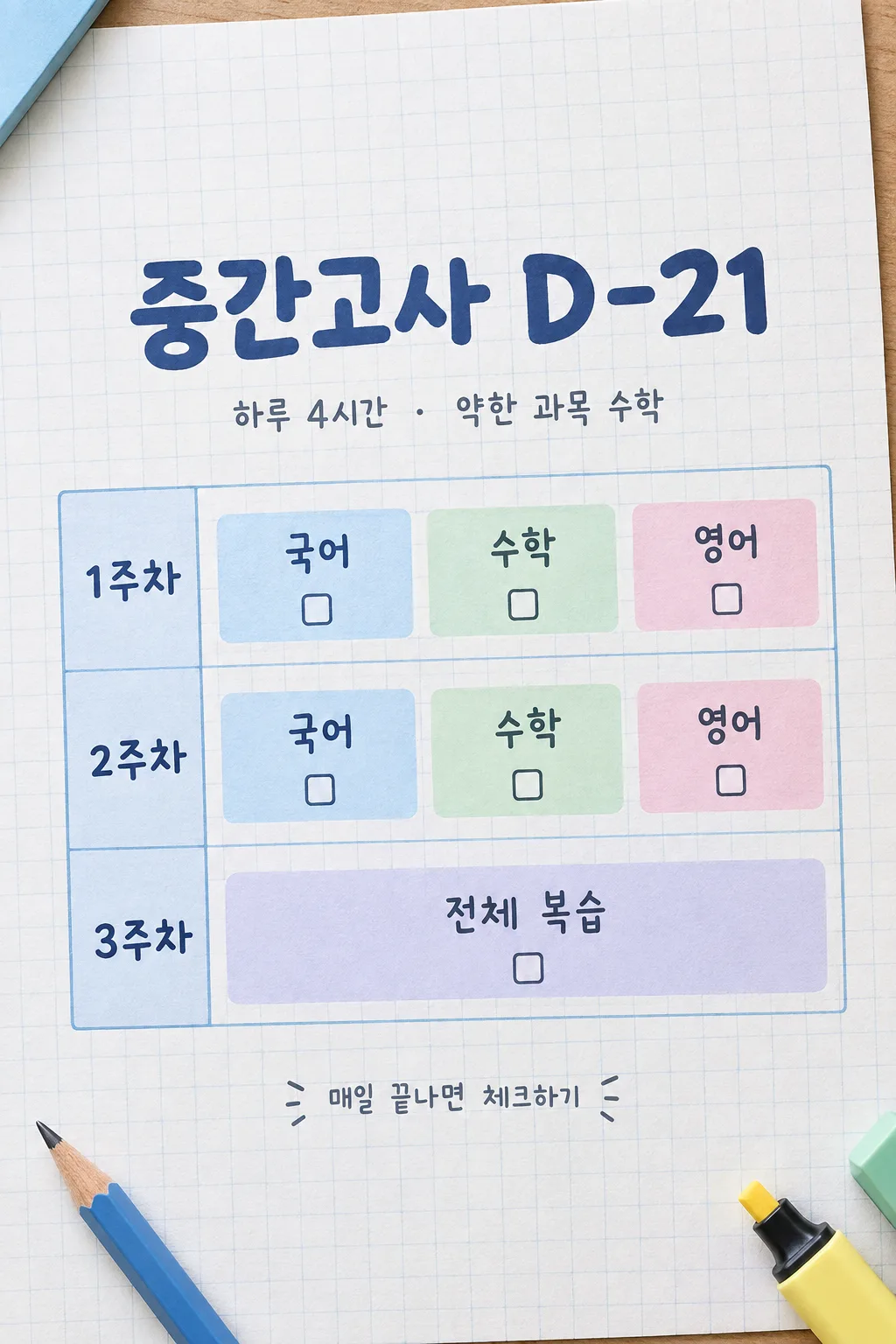
전체 · 인포그래픽/안내 · 순서·절차
065시험 공부 계획표
시험 날짜와 과목을 넣으면 오늘부터 시험 전날까지의 주간 과목 배분과 마지막 주 복습을 한 장에 정리하는 계획표
칸 채우기
- 1칸을 채워요
- 2복사 버튼을 눌러요
- 3GPT 채팅창에 붙여넣어요
- 4제품·인물 사진을 쓰려면 사진과 프롬프트를 둘 다 넣은 뒤에 보내요 선택
프롬프트 원문 보기 8,902자
Generate this image now. Draw it directly - do not describe it, explain it, or ask questions.
Create one complete 2:3 portrait study-plan image. Keep all essential text inside generous print-safe margins. This card has a fixed output ratio; do not request a size choice.

[Purpose]
Create a usable, personalized Korean weekly study plan for the exam named "【시험 이름】" on "【시험 날짜】". The user's subjects are "【과목】" and available study time is "【하루 공부 시간】" per day. The result must work as one sheet on a desk wall, as a phone background, and as a shareable "D-day" study image. Before drawing, check today's actual date in the Asia/Seoul calendar using the current session date or an available clock/date tool. Do not use the example date or infer today from the exam date. Calculate D as the calendar-day difference between the exam date and today: the exam date itself is D-0, the previous date is D-1. Calculate the plan from today through the day before the exam, inclusive. Check the date arithmetic and each displayed date range before drawing.

[Scene]
Design a single editorial planning sheet centered on a real table, not an illustration of stationery. At the top show the exam name, the verified exam date, and one prominent computed D-day label. Beneath the header place a concise capacity line showing the supplied daily hours. Use one weekly row per consecutive study period, an empty square checkbox at the start of each row, a short date range, a compact subject-hours allocation, and one actionable weekly focus. Make the final seven study dates a separate last row devoted to review. Work backward from the exam eve in blocks of seven calendar dates; the first row may be shorter than seven days. Thus a D-30 plan contains 30 study dates and a seven-day review row, never an accidental 31st day or a study row on exam day. Label rows "1주차", "2주차", and so on in chronological order. Show the exact date range for every row, including the year only where needed to remove ambiguity. A short footer may hold one small progress cue, but no extra planning table.

Build the plan before drawing the image. Parse the comma-separated subject list, trim spaces, and keep the supplied subject names exactly. For every row, multiply the number of study dates by the daily hours to get that row's hour budget. Distribute that budget among only the listed subjects; the subject-hour numbers in a row must add to its displayed weekly total. Use hours or half-hours, not fake minute-level precision. Rotate the emphasis across subjects so every listed subject appears regularly, while giving the weak subject a visibly larger share when one is valid. Earlier rows focus on coverage and practice; the final seven days focus on recall, past questions, timed practice, and reviewing mistakes rather than starting substantial new material. Use short, concrete Korean focus phrases such as "개념 정리", "기출 풀이", and "오답 복습". Do not invent chapter titles, test formats, official requirements, or a score target.

【약한 과목】

If the optional line above contains a subject that matches one of the listed subjects, make that subject's weekly share larger than a typical other subject's share while still scheduling the others. If it is blank, divide time fairly and vary emphasis across weeks. If it does not match the subject list, use only the listed subjects and do not print an unlisted subject. Do not print a separate weak-subject label: the difference should be apparent in the hour allocation. For a single subject, assign it the whole budget. For a short lead time of one to seven days, show one review row covering every remaining study date and all listed subjects. If the exam is today, show "D-0" and a small exam-day checklist in place of a weekly study table; do not assign study dates after the exam. If the exam date has already passed, show a clear "시험 날짜를 확인해 주세요" message rather than inventing a future plan. Never display a negative D-day as though it were upcoming.

[Attached photo]
No photo is needed. The entire card is a legible text-and-table graphic with small original study-themed line icons only if there is spare space. No student portrait, real exam paper, institution emblem, copied textbook page, or recognizable app interface.

[Text layout]
Render these exact Korean strings where specified, without the surrounding quotation marks. Percentages are approximate vertical zones of the 2:3 canvas and may flex to keep every weekly row readable.
- 5-9%: Small eyebrow "나의 시험 준비".
- 10-17%: Main title "【시험 이름】 공부 계획표" in large bold type. Keep the supplied exam name exact.
- 18-24%: Exam line "시험일 【시험 날짜】" and a calculated D-day label in separate high-contrast areas. The D-day label must be the letter D, a hyphen, and the verified integer, such as "D-30" when the true difference is 30 days. Never print prompt notation or the word number.
- 25-29%: Capacity line "하루 【하루 공부 시간】". If the supplied value already contains "시간", do not add that unit again.
- 31-88%: The weekly table. Its fixed column headings are "완료", "주차·날짜", "과목별 시간", and "이번 주 할 일". Each row has one empty "□" checkbox, one chronological week label and date range, the selected subject names with allocated hours, and one short focus phrase. Put the row's total hours in a compact form such as "총 28시간" where it can be checked against the subject allocation. The final row's focus must clearly read "복습·오답". Keep enough room for every row; let the table zone expand modestly and reduce decoration before reducing type size.
- 91-96%: One quiet footer line "끝낸 주차에 체크하세요".
Only week numbers, date ranges, D-day digits, subject allocations, row totals, and short weekly focus phrases may be generated freely. Use supplied strings and computed dates accurately. For D-0 or a past exam, replace the normal table content with the appropriate state described above while preserving the clean overall hierarchy.

[Style]
Use a crisp Korean planner infographic with a warm white background, deep navy text, pale blue row alternation, and one muted coral accent for the D-day badge and the final review row. Fill the entire canvas edge to edge. Draw straight, restrained table lines and generous cell padding. Use a strong Korean Gothic sans-serif and tabular-looking numerals. Color must clarify sections, not encode information on its own: the week number, date, hours, and focus remain readable in grayscale print. Checkboxes are empty outlined squares large enough to mark by pen or finger. Keep the card mature and practical for school exams or certification study.

[Visual hierarchy]
The first read is the exam name and real D-day count; the second is the path from the first week through the final review week. Dates and subject-hour allocations are the table's main content. Set the main title large, headings medium, and row text at a phone-readable size. If there are many weeks, switch to a compact two-column continuation of the same weekly table after the header, still keeping every week in date order and one row per week; shorten focus phrases and decoration before shrinking text. Never silently omit a week, merge two weeks into one row, or make the final review row disappear. Avoid tiny footnotes and oversized blank space.

[Lighting and texture]
Use flat, opaque colors with a subtle printed-paper feel and sharp Korean glyphs. No photo lighting, strong shadows, gradients, glow, dark texture behind text, or low-contrast overlays. Keep thin borders continuous and every checkbox a true empty square. Ensure the page works when printed in black and white and when viewed on a small phone screen.

[Text rules]
Preserve "【시험 이름】", "【시험 날짜】", "【과목】", and "【하루 공부 시간】" as supplied values, adjusting only the display separator between individual subjects. Verify the actual current date before calculating D-day. The D-day numeral equals exam date minus today in calendar days, not the number of table rows. Every row date range is consecutive, non-overlapping, within today through exam eve, and includes its own start and end dates. Weekly hours equal study dates in that row times daily hours, and the subject allocations add to that total. Print subject names exactly, without made-up subjects. Keep all dates, weekday implications, arithmetic, spacing, Korean spelling, and checkbox count consistent. Never show field names, prompt syntax, braces, English instruction labels, or an invented date source in the artwork.

[Avoid]
No decorative calendar grid that competes with the weekly table, unchecked-looking filled boxes, crossed-off sample tasks, illegible microtext, cropped rows, mismatched subject totals, missing or duplicated dates, double-counted exam day, miscalculated D-day, or final week labeled as new learning. No fake grades, rankings, guarantees of passing, school logos, copyrighted characters, brand marks, QR codes, watermarks, social handles, phone frames, or advertising copy.
이 카드도 많이 사용해요
쓰는 법 · 자주 묻는 것
이런 때 쓰세요
시험이 다가오는데 여러 과목을 언제 공부할지 머릿속으로만 정하고 있다면 이 카드를 써 보세요. 시험 이름과 날짜, 과목, 하루에 낼 수 있는 시간을 적으면 오늘부터 시험 전날까지의 주간 공부 계획표를 한 장의 그림으로 정리하도록 만든 프롬프트예요. 책상 앞에 인쇄해 붙여 두고 한 주를 마칠 때마다 체크하거나, 휴대폰에 저장해 잠금화면을 열 때 계획을 확인할 수 있어요. 스터디 계정에 올릴 때도 남은 날짜가 계산된 개인용 D-day 계획표로 쓸 수 있어요. 결과에 적힌 시간은 실제로 매일 확보할 수 있는 시간을 기준으로 잡아야 지키기 쉬워요.
칸 채우는 법
- 시험 이름: 「중간고사」처럼 계획표 맨 위에 넣을 짧은 이름을 적으세요. 자격증 시험이라면 본인이 구분할 수 있는 시험 이름을 쓰면 돼요.
- 시험 날짜: 연도까지 포함해 `2026-10-28`처럼 적으세요. 프롬프트는 GPT가 그림을 만들 때의 오늘 날짜를 확인한 뒤 시험일까지 며칠 남았는지 세도록 지시해요. 날짜를 바꿔 다시 만들면 D-day와 주차도 다시 계산해야 해요.
- 과목: 실제로 공부할 과목을 쉼표로 나눠 적으세요. 예를 들어 「국어, 수학, 영어」처럼 쓰면 표의 과목별 시간에 이 세 이름이 들어가요. 시험 범위의 세부 단원은 입력받지 않으므로 표에는 임의의 교과서 단원명이 들어가지 않게 했어요.
- 하루 공부 시간: 2시간, 4시간, 6시간 중 실제로 낼 수 있는 시간을 고르세요. 표는 각 주차의 날짜 수에 이 시간을 곱해 주간 총시간을 잡고 과목에 나눠요. 첫 주가 짧다면 그 주의 총시간도 그만큼 줄어야 해요.
- 약한 과목: 더 시간을 들이고 싶은 과목이 있으면 과목 칸에 쓴 이름 그대로 적으세요. 비우면 과목을 고르게 배분하고, 적으면 그 과목에 더 큰 비중을 주도록 지시해요. 이 칸은 그림에 따로 표시하지 않아요.
칸을 채운 다음 복사한 프롬프트를 이미지 생성이 가능한 GPT 대화에 붙여 넣으세요. 따로 사진을 올릴 필요는 없어요. 날짜와 D-day가 중요한 카드이므로 결과의 계산은 꼭 한 번 직접 대조해 주세요. 시험일이 오늘이거나 이미 지났다면 새 주간 계획을 꾸며 내는 대신 날짜를 확인할 수 있는 상태를 표시하도록 했어요.
그림이 나오면 꼭 볼 것
제목의 시험 이름, 시험일, D-day가 입력값과 맞는지 먼저 보세요. D-day는 오늘부터 시험일까지의 달력상 날짜 차이예요. 공부 날짜는 오늘부터 시험 전날까지만 들어가야 하며, 마지막 일주일은 새 내용을 늘리는 대신 복습과 오답 확인으로 마무리해야 해요. 첫 주가 7일보다 짧을 수 있으니 날짜 범위를 따라 주차가 빠지거나 겹치지 않았는지도 확인하세요.
각 줄의 과목별 시간이 그 줄의 총시간과 맞는지도 살펴보세요. 예를 들어 4시간씩 7일이면 그 주의 총시간은 28시간이에요. 과목 이름이 빠지거나, 적지 않은 과목이 새로 생기거나, 약한 과목에 시간을 더 준다는 이유로 다른 과목이 완전히 사라지면 표를 고쳐야 해요. 체크박스는 아직 하지 않은 일을 표시하도록 빈 네모여야 해요. 휴대폰에서 글씨가 작다면 장식부터 줄이고 표의 행과 숫자를 더 크게 해 달라고 요청하세요.
틀린 곳 고치는 법
같은 대화에서 틀린 위치와 맞는 값을 함께 지정하면 돼요. 「오늘은 9월 28일이고 시험은 10월 28일입니다. 상단을 D-30으로 고치고, 공부 날짜는 10월 27일까지만 넣어 주세요」처럼 날짜 계산을 짚어 주세요. 단, 이 예시 날짜는 실제 오늘 날짜가 아니므로 그대로 복사하지 말고 본인의 날짜로 바꾸세요. 「3주차의 과목별 합계가 총시간과 다릅니다. 그 줄의 시간만 다시 계산해 주세요」처럼 고치고 싶은 행을 적어도 좋아요. 수정한 뒤에는 다른 주차의 날짜와 총시간도 다시 확인하세요.
자주 묻는 것
- 시험 당일도 공부 주차에 들어가나요? 아니요. 공부 계획은 시험 전날까지 잡고, 시험 당일은 D-0으로 계산해요.
- 남은 날이 일주일 이하라면 어떻게 나오나요? 남은 공부 날짜를 한 줄의 복습 계획으로 묶고, 적어 둔 과목을 모두 확인하도록 지시해요.
- 약한 과목을 비워도 되나요? 네. 비우면 입력한 과목을 고르게 배분하면서 주차별 집중 과목을 바꿔요.
- 매일 같은 시간을 공부해야 하나요? 이 표는 입력한 하루 시간을 매일 확보한다는 기준으로 시간을 계산해요. 쉬는 날이나 요일별 차이가 크면 결과를 만든 뒤 해당 주의 총시간과 과목별 시간을 실제 일정에 맞춰 고쳐 주세요.
- 합격을 보장하는 계획인가요? 아니요. 공부할 순서와 시간을 한눈에 보이게 정리하는 도구예요. 실제 진도와 컨디션에 따라 계획을 조정해 주세요.