

All · Infographics & guides · Steps & processes
019Cook with Leftovers — Daily Meal Plan
Turn leftover ingredients into one practical dish per day, with seasonings and three cooking steps.
ChatGPT Free OK
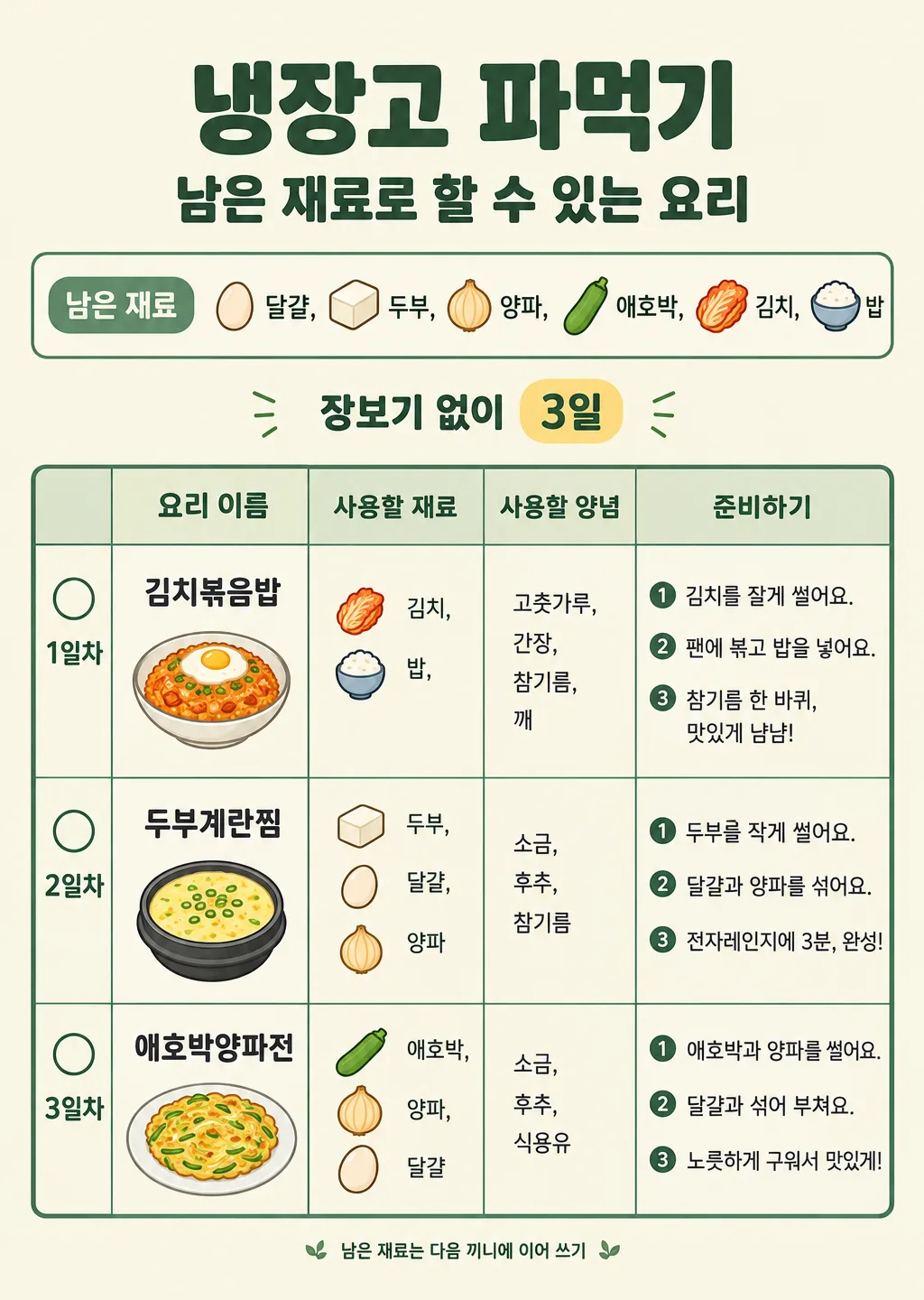
Fill in the fields
- 1Fill in the fields
- 2Copy the prompt
- 3Paste it into a GPT chat
- 4Send it as is and you get an image like the thumbnail example
- 5Attach a real photo that fits the card and it is used in the result: a background photo for background cards, a person or food photo for those cards Optional
Full prompt 7,307 characters
Before drawing, if web search is available, look up real Korean home dishes that can be made from the ingredients in "【Leftover ingredients】", and choose each day's dish from what you found. Then generate the image directly - do not describe the search, explain it, or ask questions.
Output size 2480x3508 pixels, A4 portrait, 300dpi, print-ready poster.

[Printable table rules]
Use text only: no food pictures, ingredient pictures, decorative icons, or photographs. Reserve at least 45% of the table width for the cooking steps. Each numbered step occupies exactly one line; use at most 20 characters including spaces in Korean or Japanese, or 36 characters in English. Use one action per step, compact wording, and a brief cheerful ending on step three. Never wrap a step onto a second line. Keep the title inside its specified vertical zone.

[Purpose]
Create one complete Korean refrigerator clean-out cooking plan for the supplied number of people (one person if absent), practical enough to print and tape to a refrigerator door. It recommends one dish per day for the period "【Number of days】", using up the leftover ingredients "【Leftover ingredients】". For each day it shows the dish name, the ingredients it uses, the seasonings it uses, and three short friendly cooking steps. Do not create a shopping list and do not tell the user to buy anything.

[Ingredients and seasonings]
- Main ingredients come only from "【Leftover ingredients】". Never add a main ingredient that is not in that list (no extra meat, vegetables, eggs, noodles, cheese, and so on). If the list is short, repeat a valid combination or make a simpler dish instead of inventing food.
- Seasonings may come from ordinary Korean home pantry basics: salt, pepper, soy sauce, sugar, cooking oil, sesame oil, perilla oil, Korean chili flakes, gochujang, doenjang, minced garlic, vinegar, sesame seeds. Use only the few that the dish really needs.
- Use ingredients that spoil sooner on earlier days. Each day uses only the two to four ingredients that dish really needs — never the whole list — and different days use different combinations.

[Scene]
A clean flat printable sheet only — no refrigerator mockup, room, hands, magnets, food photography, or brand marks. A title area, a compact strip showing the leftover ingredients, and a large table below with exactly one row per day of the period (for example, 3 days means three rows and 5 days means five rows). A small check circle at the left of each row so the printed sheet can be marked with a pen. Use text labels only in the ingredient strip and table.

[Text layout]
Render these English strings. The percentages describe the top-to-bottom structure; adapt spacing to the canvas size while keeping the reading order and the full table.
- 4-9%: the fixed title "Use Up Your Fridge" as the largest text, with the fixed subtitle "Meals you can make with leftovers" beneath it in a smaller bold style.
- 11-17%: a bordered strip with the fixed label "Leftover ingredients" followed by the exact string "【Leftover ingredients】".
- 19-22%: the exact period "【Number of days】" in a small badge beside the fixed text "No grocery trip".
- 24-92%: the table. A header row with exactly these four column titles: "Dish name", "Ingredients to use", "Seasonings to use", "Preparation". Then one row per day labeled "Day 1", "Day 2", and onward in order.
  - Dish name: a real, specific Korean dish name in bold.
  - Ingredients to use: only the ingredients from the list that this dish uses.
  - Seasonings to use: only the pantry seasonings this dish uses; write "None" if none.
  - Preparation: exactly three numbered short steps "①", "②", "③", in warm, friendly spoken English like a friend explaining — each step one short line with a simple time or amount where useful. Example of the tone: "① Sauté the meat first" / "② Add vegetables after 2 minutes" / "③ Add two small swirls of sesame oil and enjoy". The last step should end on a cheerful note, varied from day to day.
- 95-98%: the fixed footer "Use remaining ingredients in the next meal" in small text.

[Style]
A calm, highly legible Korean household-planner style: warm off-white paper, deep charcoal English bold sans-serif lettering, muted leaf-green table lines, and one pale-yellow accent for the period badge. Thin grid lines, rounded corners, generous padding, and check circles suitable for marking with a pen. Fill the canvas edge to edge with an opaque warm neutral background. When many rows are needed, reduce padding and icons before reducing text size; the Preparation steps must stay readable on a printed page.

[Lighting and texture]
Flat even color with a subtle matte paper feel. No realistic lighting, reflections, gradients behind text, or depth effects. It must print cleanly on an ordinary home printer.

[Text rules]
Write all displayed content in English, except numerals. Preserve "【Leftover ingredients】" and "【Number of days】" exactly. Do not print field names, braces, instructions, or text outside English. Before drawing, check every dish and every "Ingredients to use" cell against the list: a main ingredient that is not in "【Leftover ingredients】" must be removed. Check every letter and glyph, comma, circled number, and day number for accuracy.

[Avoid]
No shopping list, recommended purchase, substitution, optional topping, nutrition score, calorie number, health or diet claim, price, delivery-app logo, food brand, trademark, character, watermark, QR code, or social-media handle. No dish that needs a main ingredient absent from the list. No whole ingredient list repeated in every row. No long paragraphs in Preparation — three short steps only. No photorealistic food, collage, stickers over text, empty placeholder boxes, illegible handwriting, neon, lens flare, heavy shadow, or clipped rows.

[MORE OWNER INPUT — each line exists only when supplied; treat "Not selected" as absent]
PEOPLE: "【People】". Show this number beside the period badge. In every ingredients cell, give a practical amount for each ingredient, scaled to this number. Use household counts and cups only, such as pieces, blocks, bowls and cups; do not use gram weights, Latin unit symbols, or parenthesized conversions. Use equivalent words in the output language.
TIME: "【Cooking time】". Every dish fits this time. Put its total preparation-and-cooking minutes directly below each dish name, in the output language; calculate the total before drawing as all sequential step times plus five minutes for preparation. Choose dishes whose calculated total fits the supplied limit; print that calculated total without rounding down. A sequence of 3, 5, and 3 minutes therefore requires 16 minutes including preparation, never 5 minutes.
AVOID: "【Can't eat】". Never use these ingredients; mark the plan as free of them.
TOOLS: "【Tools】". Use only these tools.
Keep every added line smaller than the main message; never let added text crowd the hero or shrink the main title. Supplied texts stay exact.

[Final output format]
Output size 2480x3508 pixels, A4 portrait, 300dpi, print-ready poster.
This selected output format takes priority over any fixed canvas size or aspect ratio elsewhere in this template. Adapt the composition, text zones and margins to the selected canvas without stretching or cropping essential content. Device safe areas apply only when a device is selected. Never print these format instructions on the image.
How did it turn out?
More cards in this category

How to use it · FAQ
Use this card when you have leftover eggs, half-used tofu, or wilting vegetables and need a quick meal plan. Enter your leftover ingredients separated by commas and the number of days you want to cover. The AI searches for realistic dishes you can make without buying extra groceries, organizing each day with a dish name, main ingredients, seasonings, and three short cooking steps. It prioritizes perishable foods first.
Type your exact ingredients in the Leftover ingredients field, such as "eggs, tofu, onion, zucchini, kimchi, rice." Avoid vague terms like "some vegetables." Choose your target days in the Number of days field. Set the size to A4 if you plan to print it for your refrigerator door.
Verify that every suggested dish uses only the ingredients you provided, without adding unlisted meats or produce. Check that the cooking steps are concise and readable, that each day uses a different share of the ingredients, and that the number of rows matches the days you chose.
If an unexpected ingredient appears, reply in the same chat: "Remove the ham from Day 2 and suggest another dish using only my listed ingredients."
Fit it to your household
All of these are optional. Leave a field empty or tap "Not selected" and the plan uses only the basic fields.
- People: Scales portions and quantities to the number you choose. With only a few ingredients, a larger household makes repeated dishes more likely.
- Cooking time: Every dish fits within that time, and each row shows its minutes. "Under 20 min" suits a weeknight after work.
- Can't eat: Those ingredients are never used, and the plan is marked as free of them. For allergies, double-check every ingredient and seasoning yourself; sauces and pastes can contain hidden allergens.
- Tools: Only the listed tools are used. If you have just one pot, write "One pot."
Last checked · Published